
In this guide
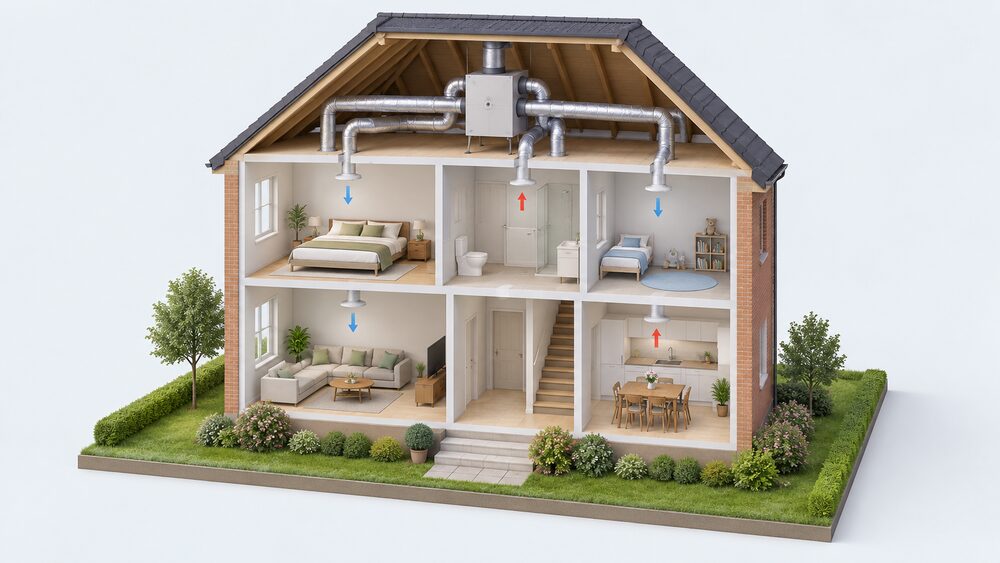
Zehnder is a German ventilation and radiator group whose UK arm, Zehnder Group UK Ltd, sells mechanical ventilation with heat recovery (MVHR) units into British homes1. Its domestic range is built around the ComfoAir family, with the newer EVO units sitting alongside it. The maker states that MVHR recovers up to 96% of the heat from extracted air, and that the majority of its units are Passive House accredited and comply with current UK Building Regulations for mechanical ventilation with heat recovery1.
For a household, the appeal is straightforward: an airtight home needs deliberate ventilation, and MVHR supplies it while keeping most of the heat that would otherwise leave through extract fans and trickle vents. What it does not do is remove the home from the electricity grid. Every unit runs on mains power, and the filters, fans and controls are consumables and service items tied to the manufacturer's parts chain.
Costs are installer-quoted rather than published. Independent guidance puts whole-house MVHR at around £3,000 and upwards, with well over £10,000 possible, and decentralised single-room systems from £600 per fan3. Zehnder does not publish a UK list price for its units in the material available here.
The ComfoAir range: MVHR units for whole-house ventilation
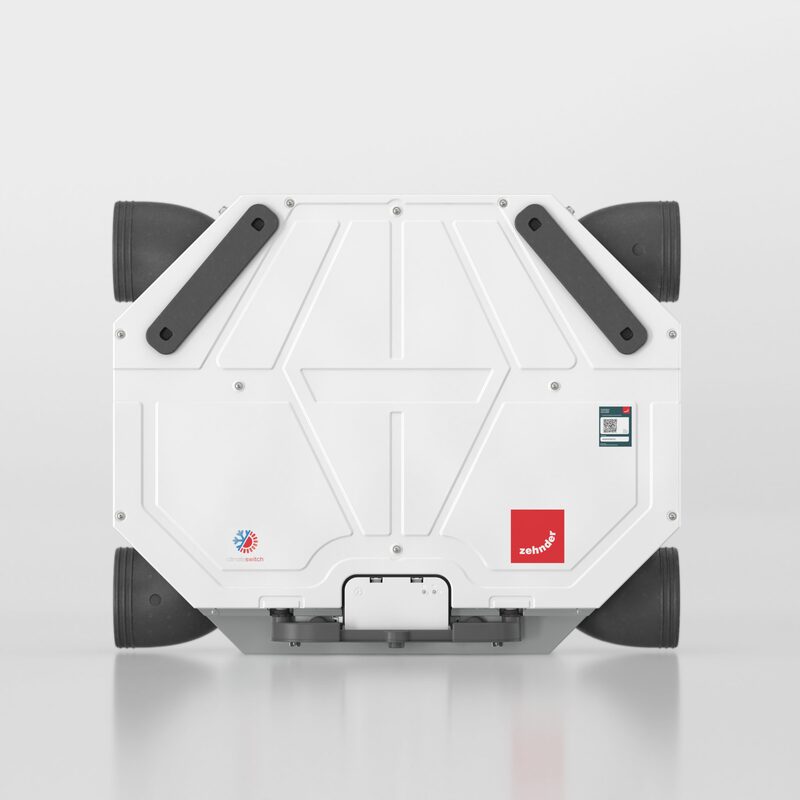
The ComfoAir name covers several distinct products rather than one appliance. The ComfoAir Q is the main whole-house range, described by Zehnder as its Mechanical Ventilation with Heat Recovery systems6. The ComfoAir Flex is a state-of-the-art MVHR unit specially developed for apartments and smaller houses7. Below those sit the wall-mounted units: the ComfoAir 180, 185WM, 155WM and 155 WMe, each described as a heat recovery unit designed to make specification of ventilation in new and refurbished buildings easier8.
The Q range's headline engineering claim is a diamond shaped heat exchanger that maximises heat transfer with 25% more surface area6. The Flex adds a built-in humidity sensor and can be integrated into smart homes through KNX and, as required, a CO2 sensor; both versions meet current and future EPB requirements7. The wall units are simpler: the 185WM carries an integrated humidity sensor and BMS capability, the 155WM and 155 WMe have tool free filter access and independently tested sound data, and the 180 has an internal pre-heater8.
Zehnder also sells ancillaries that attach to the ventilation system rather than replacing it. The ComfoClime is designed to connect seamlessly with the MVHR range to enhance temperature regulation, with compatibility across 220mm x 90mm ductwork and all ranges of ComfoAir Q12. The ComfoFond-L Q ST is a brine-earth heat exchanger developed for use with the ComfoAir Q350, Q450 and Q600 comfort ventilation units13.
| Unit | Type | Notable features |
|---|---|---|
| ComfoAir Q | Whole-house MVHR | Diamond shaped heat exchanger, 25% more surface area6 |
| ComfoAir Flex | MVHR for apartments and smaller houses | Built-in humidity sensor, KNX and CO2 sensor integration7 |
| ComfoAir 180 | Wall-mounted heat recovery unit | Internal pre-heater, tool free filter access8 |
| ComfoAir 185WM | Wall-mounted heat recovery unit | Integrated humidity sensor, BMS capability9 |
| ComfoAir 155WM | Wall-mounted heat recovery unit | Tool free filter access, independently tested sound data10 |
| ComfoAir 155 WMe | Wall-mounted heat recovery unit | Tool free filter access, BMS capability11 |
| ComfoClime | Air temperation device | Couples to ComfoAir Q, 220mm x 90mm ductwork12 |
| ComfoFond-L Q ST | Brine-earth heat exchanger | For ComfoAir Q350, Q450 and Q60013 |
ComfoAir Q and ComfoAir Flex: what each unit does
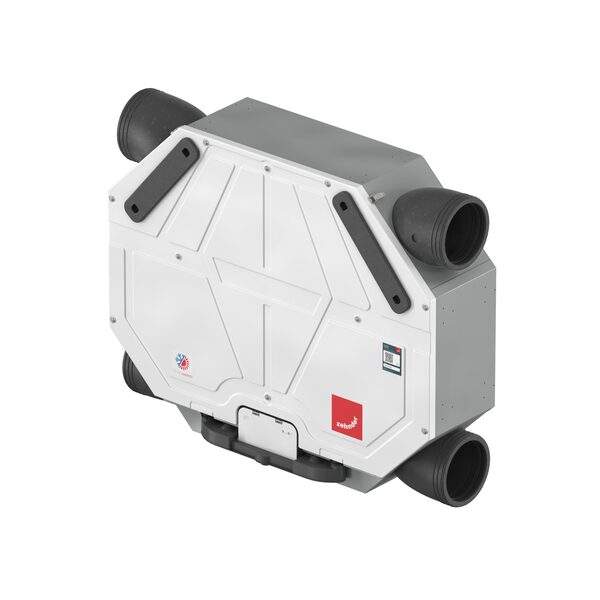
The two ranges answer different briefs. The ComfoAir Q is the larger, whole-house product, and Zehnder claims it will significantly improve indoor air quality and energy efficiency across a variety of property sizes, helping maintain a healthy indoor climate year-round6. Its diamond shaped exchanger is the core of that claim, and the Q range is the one the ComfoClime and ComfoFond-L accessories are built around12.
The ComfoAir Flex is aimed at apartments and smaller houses, where a full plant-room installation is not available7. It carries a built-in humidity sensor, so boost ventilation responds to moisture rather than to a manual switch, and it can be integrated into smart homes through KNX and, as required, a CO2 sensor7. Zehnder states that both versions meet current and future EPB requirements, which matters for specifiers working to energy performance rules7.
The Flex 350 variant adds a time and flow based filter alert, so replacement is triggered by how the unit is actually running rather than by a fixed calendar, and it accepts an optional ePM 1 (F7) filter14. That is a finer grade than the ISO Coarse >65% / ISO ePM1 >55% (G4 / F7) combination fitted as standard to the ComfoAir 1808. Filtration is not only about dust: independent guidance notes that MVHR units can include filtration of pollutants such as NOx and particulate matter to improve indoor air quality15.
For a household, the practical difference between the ranges is where the unit goes and how it is controlled. The Q needs space and duct runs to every wet room and living area. The Flex and the wall-mounted units suit flats and smaller houses where a compact unit or a single room heat recovery approach is the realistic option4.
Zehnder EVO: Passivhaus certified performance
The EVO is Zehnder's newer platform, and it is the unit most clearly aimed at certified low-energy construction. It is available in three different sizes, as HRV or ERV with or without a preheater, and Zehnder describes its straightforward installation as a defining feature1. The three sizes are EVO 2, EVO 3 and EVO 41.
Certification is the point of the range. Zehnder states the EVO is backed by recognised industry certifications such as Passivhaus, and it offers connectivity through KNX or Modbus16. That combination, a certified heat recovery core plus a building management protocol, is what a Passivhaus or EnerPHit project needs: the ventilation unit has to be modelled as part of the airtightness and energy balance, and it has to report into whatever control system the house runs.
The wider ComfoAir range carries similar credentials. Zehnder states that the majority of its units are Passive House accredited and comply with the current UK Building Regulations for mechanical ventilation with heat recovery1. Named certified units include the ComfoAir Q350 ST for properties up to 250m², the Q450 ST up to 300m² and the Q600 ST up to 350m², plus the wall-mounted ComfoSpot 50 and ComfoAir 701. Filters for the ComfoAir Q range are G4 and F7, with F7 specified for Passivhaus6.
"The majority our units are Passive House accredited and comply with the current UK Building Regulations for Mechanical Ventilation with Heat Recovery"
Certification is not the same as performance in a given house. A certified core recovers heat well when the building is airtight enough for balanced ventilation to work, and independent guidance is explicit that MVHR works best in buildings that are relatively airtight, such as new-build homes or older properties that are being fully refurbished3. In a leaky house, the same unit competes with uncontrolled draughts it cannot manage.
What MVHR means for household energy independence
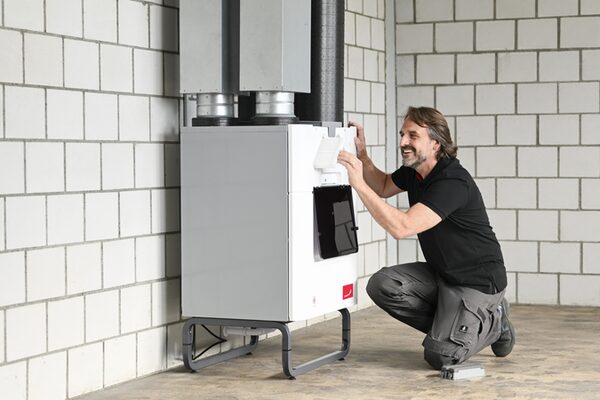
MVHR changes where a home's ventilation heat goes, not where its energy comes from. Independent guidance states that the units simultaneously recover valuable heat energy for maximum efficiency, and that whether in a home or a commercial building an MVHR system can significantly cut down on energy use15. Zehnder's own figure is that MVHR recovers up to 96% of the heat from extracted air1.
That recovery is a genuine reduction in demand: heat that would have left through extract fans is returned to the incoming air, so the heating system has less to replace. It is also a reduction that compounds with fabric work. A very deep retrofit, stripping the house back to the basic structure before improving it, is exactly the situation in which independent guidance suggests considering MVHR18. The same logic runs through the airtightness advice: modern homes are sometimes fitted with MVHR because they have to follow specifications for air-tightness set out in the Building Regulations3.
What remains is dependence. The unit runs on electricity, so the household stays on the grid and with an electricity supplier. The filters are proprietary consumables, and the fans and controls are the manufacturer's parts. Servicing is not optional: independent guidance states that MVHR systems do require servicing, as all equipment such as filters and fans must be kept clean to ensure effective operation4. A household that wants the heat recovery benefit is committing to a maintenance routine and a parts supply chain for the life of the unit.
The wider context is that homegrown energy means greater energy independence19, and MVHR sits on the demand side of that equation rather than the supply side. It reduces the heat a home needs; it does not generate any. Households weighing it alongside fabric measures can read more on insulation and energy independence and on MVHR as a system.
Zehnder MVHR in real UK homes: Taylor House and Wilmcote House
The evidence base for MVHR in British housing is mostly new-build and deep retrofit, and the documented UK examples reflect that. Taylor House is a block of 65 extra care homes with triple glazing, built to the AECB CarbonLite new-build standard20. That standard is a fabric-first specification, and a block of that type is where balanced ventilation with heat recovery is designed in from the start rather than added later.
The retrofit case is harder and more instructive. A Victorian mid-terrace in Warrington was renovated as a deep retrofit21. Victorian terraced homes built between 1850 and 1918 constitute over 10% of the UK's current housing stock22, so what works on that housing type matters nationally. A deep retrofit of that kind is the scenario in which independent guidance suggests MVHR may be worth considering, because the fabric is stripped back and made airtight before the ventilation is specified18.
The case for ventilation in British homes is not only about energy. A Zehnder study surveyed social housing landlords and tenants in London and found mould in the living rooms of 25% of properties surveyed23. Independent work on landlord experience reports widespread mould problems24. Ventilation that runs continuously and recovers heat addresses moisture at source, which is why MVHR appears in retrofit programmes alongside insulation rather than instead of it.
Choosing and sizing a Zehnder unit for your home
Sizing starts with the building, not the badge. Zehnder's own selection tool exists to match a unit to a property4, and the published property bands give a rough map: the ComfoAir Q350 ST is certified for properties up to 250m², the Q450 ST up to 300m² and the Q600 ST up to 350m²1. The ComfoAir 155CM is a compact ceiling-mounted unit for properties up to 125m²1.
The EVO range is sized differently, in three steps, EVO 2, EVO 3 and EVO 4, each available as HRV or ERV with or without a preheater1. The choice between HRV and ERV matters in a cold climate: an ERV transfers moisture as well as heat, which changes how a home behaves in winter. The preheater option protects the unit against very cold incoming air, and the ComfoAir 180 carries an internal pre-heater as standard8.
Retrofit suitability is better than the reputation suggests. Zehnder states that heat recovery systems can be installed in existing homes as part of a retrofit, although installation may be more complex than in new buildings, and that compact units or single room heat recovery options are often ideal for renovations4. Independent guidance agrees that mechanical ventilation systems can be more easily retrofitted to existing buildings15, and that many energy-efficient ventilation systems can be easily integrated into existing structures without major renovations17.
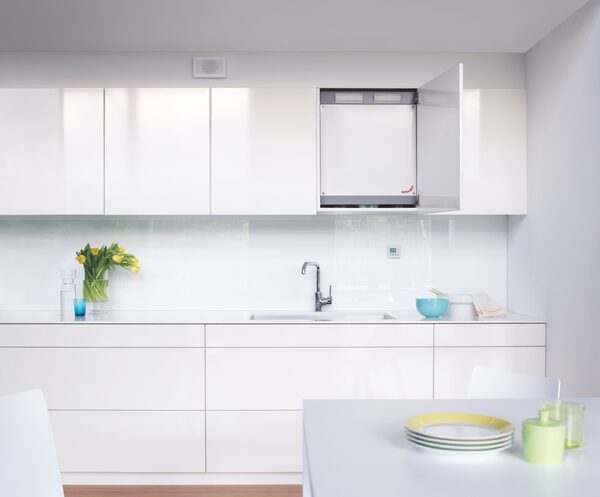
What drives the choice in practice is duct routing and where the unit can live. The ComfoAir 180 installs to a wall, a cupboard or a kitchen cupboard8, which is the difference between a straightforward retrofit and a disruptive one. A household planning fabric work first should read planning a whole-house retrofit and airtightness and air leakage before fixing a ventilation specification.
Installation, maintenance and filter changes
Maintenance is the part of MVHR ownership that decides whether the system keeps performing. Zehnder's guidance is that users can clean or replace filters every 3 to 6 months4. Independent guidance is looser, suggesting filters are checked every few months and cleaned or replaced as necessary5. The Flex 350 removes the guesswork with a time and flow based filter alert14.
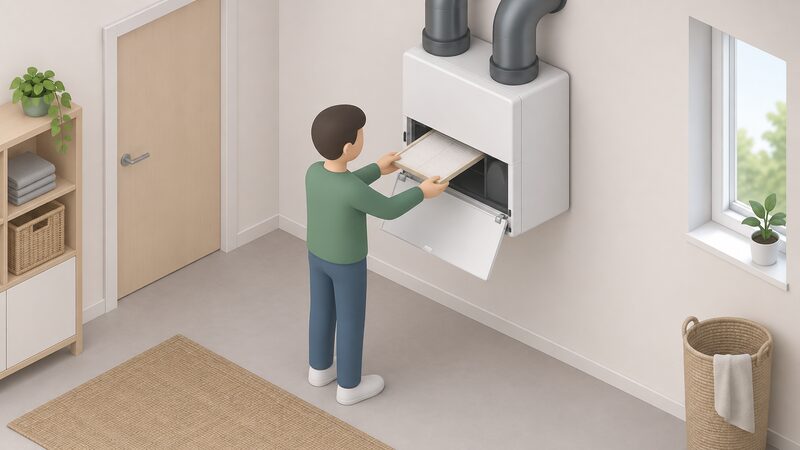
Filter access is designed to be a household task rather than an engineer visit. The ComfoAir 180, 185WM, 155WM and 155 WMe all have tool free filter access8. Replacement paper filters cost £10 to £155. Beyond filters, independent guidance suggests budgeting for a filter change every year and maintenance on a five-year basis25, and states plainly that MVHR systems do require servicing because filters and fans must be kept clean for effective operation3.
The units are built to run continuously. Zehnder states that MVHR systems work by maintaining a balanced air exchange throughout the day while recovering heat from outgoing air17, and that features such as summer bypass and cold recovery enhance efficiency and comfort year-round4. That is why the system is not switched off seasonally: it is the ventilation, not a supplement to it.
Costs, warranties and where to buy in the UK
There is no published Zehnder list price for a UK MVHR installation in the material available here, so figures are installer-quoted. Independent guidance puts decentralised MVHR systems from £600 per fan, and whole-house MVHR from around £3,000, though it could cost well over £10,0003. A separate study of retrofit costs used a £5,000 capital cost band of £5,000 to £10,000 for MVHR installation, with a lower-rate figure of £3,337.5026. A decent Passivhaus-certified system is described as costing a few thousand pounds5.
Zehnder states that the cost of an MVHR system depends on the home's size, the system type and installation complexity4. Those three factors explain most of the spread between the published figures: a compact unit in a flat is a different job from a whole-house system with duct runs to every wet room, and a retrofit through finished rooms is different again from a new build where ducts go in before plasterboard.
On warranties, the material available here does not state a Zehnder MVHR guarantee term or a registration procedure. Households should treat the guarantee as a question for the supplier and get the term, the conditions and the registration route in writing. The general principle that applies across ventilation and heating products is that registration after installation is what activates extended cover, as with other manufacturers' equipment27.
Zehnder Group UK Ltd sells the company's products in the UK2. The UK website carries the product ranges, technical documents and contact routes, and it is the starting point for both households and installers. For the wider picture on system choice, see home ventilation and MVHR.
Sources27 cited
- Mechanical ventilation with heat recovery, Zehnder, 2026
- Zehnder Terraline, Zehnder, 2026
- Mechanical ventilation with heat recovery, Centre for Sustainable Energy, 2026
- MVHR selection tool, Zehnder, 2026
- Airtightness and ventilation, CAT, 2025
- Zehnder ComfoAir Q, Zehnder, 2026
- Zehnder ComfoAir Flex, Zehnder, 2026
- Zehnder ComfoAir 180, Zehnder, 2026
- Zehnder ComfoAir 185WM, Zehnder, 2026
- Zehnder ComfoAir 155WM, Zehnder, 2026
- Zehnder ComfoAir 155 WMe, Zehnder, 2026
- Cooling and heating units, Zehnder, 2026
- Zehnder ComfoFond-L Q ST, Zehnder, 2026
- Zehnder ComfoAir Flex 350, Zehnder, 2026
- Ventilation, BESA, 2026
- Zehnder EVO, Zehnder, 2026
- How heat recovery can reduce heating costs and emissions, Brookvent, 2026
- Home energy efficiency, Centre for Sustainable Energy, 2025
- Solar Energy Scotland manifesto, Solar Energy UK, 2026
- AECB CarbonLite new build standard, AECB, 2026
- Victorian mid-terrace transformed in Warrington, AECB, 2026
- How to make your home more energy efficient, Which?, 2026
- 99% of landlords report mould problems, BESA, 2025
- Specifying MVHR, AECB, 2024
- Future Homes Standard Phase 1: network to emitter impact report, BEAMA, 2023
- Catalysing net zero retrofit: salary sacrifice scheme feasibility, CREDS, 2023
- Immersion heater platform, Zehnder, 2026