

In this guide
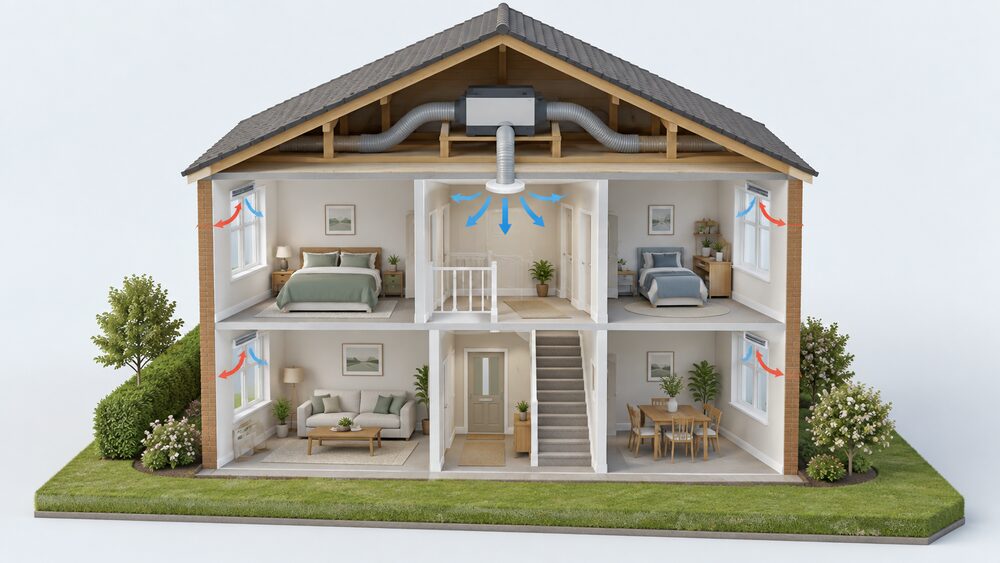
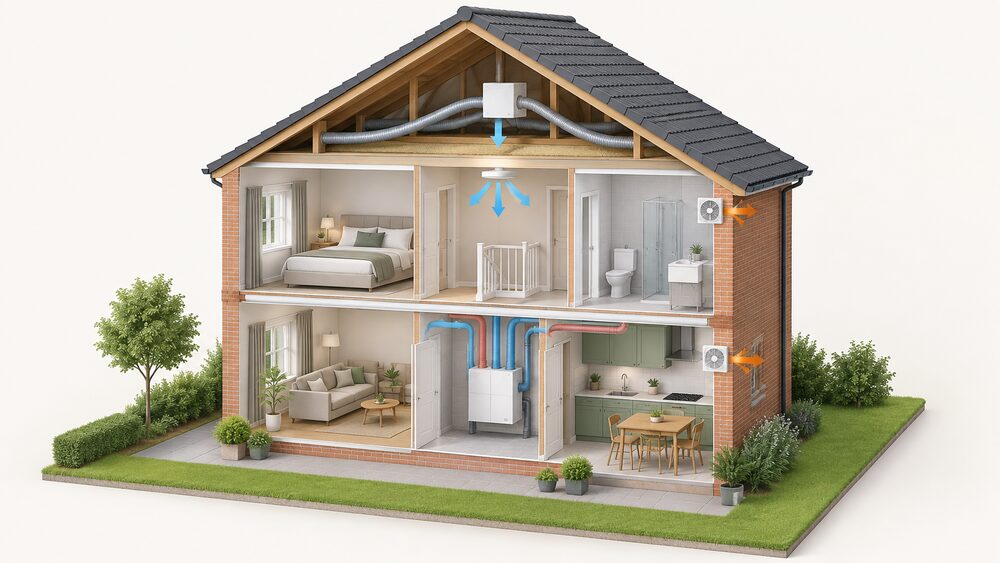
A Nuaire Drimaster is a positive input ventilation (PIV) unit: a fan that draws fresh air from outside a building and distributes it into all rooms through a centralised system, usually mounted in the loft1. It is a whole-house ventilation product rather than a heater, and it works by pushing air in and forcing stale, moist air out through the background ventilation and the building fabric2.
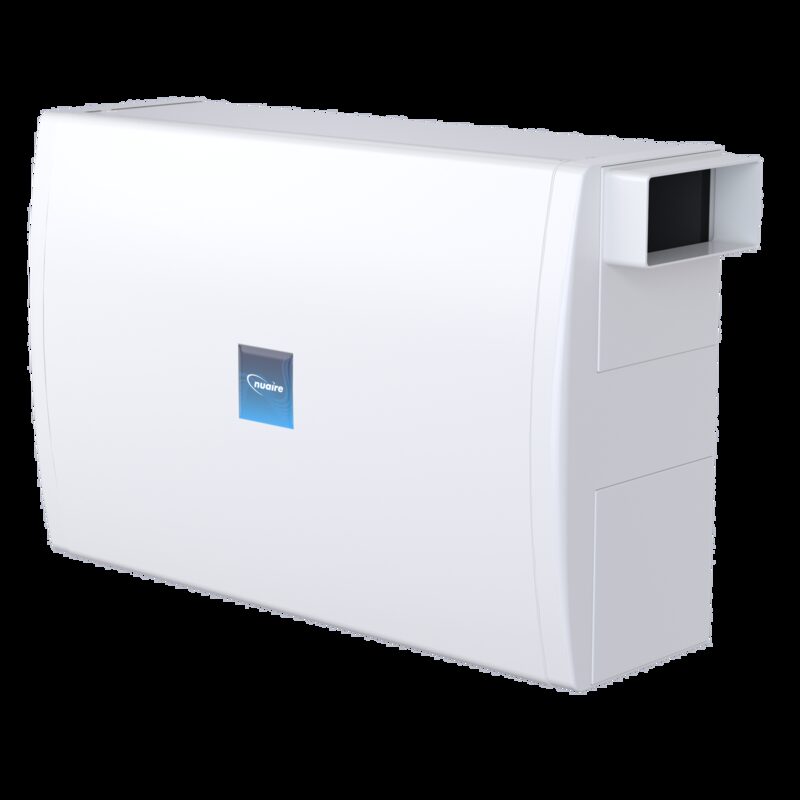
The range is built around the Drimaster Eco, with loft and wall variants and a 3S version for three-storey properties. Nuaire also makes the Flatmaster for homes without loft space, and an MVHR range for apartments where ducted heat recovery is the design intent3. Filters need changing every 5 years at a minimum, with a visual check every 2 years5.
The availability position matters for anyone buying now: the Drimaster Eco 3S Loft Control unit is recorded as sold out6. That is a stock position rather than a discontinued product, but it means the three-storey variant may not be obtainable on demand.
What a Drimaster is: positive input ventilation for the whole house
Ventilation is the planned exchange of air between the external and internal environment, to provide fresh air, remove pollutants and regulate humidity2. Whole dwelling ventilation provides outdoor air to the home, diluting and dispersing indoor pollutants and water vapour that has not been extracted by other means7. A Drimaster does that job from a single central unit rather than from vents in each room.
The distinction from other ventilation methods is worth holding on to. Trickle vents provide effective background ventilation, contributing to a healthy living environment by enabling unobtrusive and controllable whole-room ventilation, and replacement windows will usually have them4. Passive stack ventilation removes steamy air from bathrooms and kitchens through a ceiling outlet and a vertical duct, usually via the roof, and such systems are usually part of a building's original design and difficult to retrofit2. PIV sits alongside mechanical extract ventilation, decentralised mechanical extract and MVHR as one of the recognised methods in the standard assessment procedure for dwellings9.
The independent view of PIV is not uniformly positive. One guidance source describes it as usually located in the loft, blowing fresh air into the home and forcing stale moist air out through background ventilation and the building fabric, and notes three specific concerns: it can be cold directly under the fan, it may not provide fresh air to the rooms that need it, and forcing warm moist air into the building fabric can lead to condensation and structural damage2. Those are the limits to weigh against the maker's claims, and they are the reason a whole-building approach matters: thinking about the whole building rather than one bit at a time reduces the risk of problems like damp or poor ventilation10.
How PIV works: air is drawn in, filtered and pushed through the home
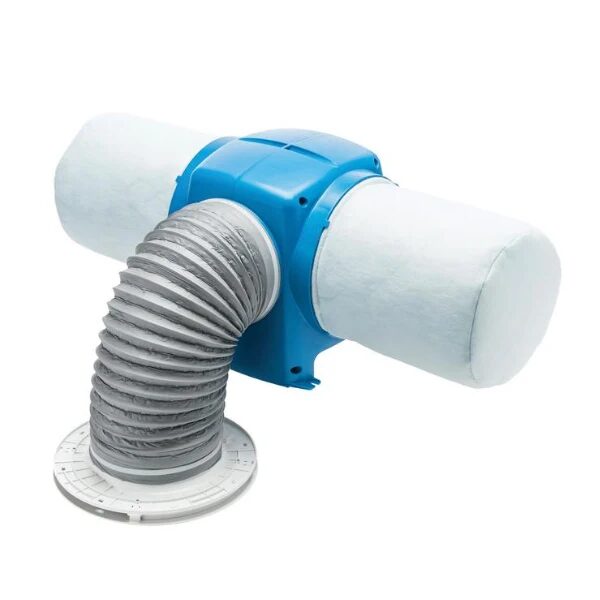
The mechanism is straightforward. Air is drawn from outside the building, passed through a filter, and delivered into the home under slight positive pressure. That pressure is what drives the stale air out, through trickle vents, extract fans and the fabric of the building, rather than through a dedicated extract duct1.
Because the unit runs continuously, the home has a permanent air change even when windows and doors are closed. That is the same principle a trickle vent serves, allowing fresh air to circulate naturally through a room and polluted air out, providing permanent ventilation even when windows or doors are closed8. PIV simply does it mechanically and at a higher rate, which is why it is used where background ventilation alone has not controlled condensation.
Filtration is the part that varies most between models. The Drimaster-Eco NOx uses two carbon cartridges hidden inside the ePM10 filters, and Nuaire states that the Drimaster-Eco NOx reduces hazardous NOx pollution levels within the home by up to 80%3. That is a maker's figure for a specific model, not a property of PIV generally, and it depends on the filters being fitted and changed as specified.
The dependence to note is electrical. A PIV unit is a continuously running fan, so it needs a permanent mains supply, and it does not work in a power cut. It also depends on the building having a route for the displaced air: in a very airtight home with no background ventilation, the pressure has nowhere to push against, which is why PIV is normally specified alongside trickle vents or an extract strategy rather than instead of one.
Drimaster Eco range: loft, wall and 3S variants
The Drimaster Eco family covers the standard loft installation, wall-mounted versions for properties where a loft route is not available, and the 3S variant for three-storey properties, where a single loft unit cannot serve the whole house evenly. The 3S Loft Control unit is the one currently recorded as sold out6.
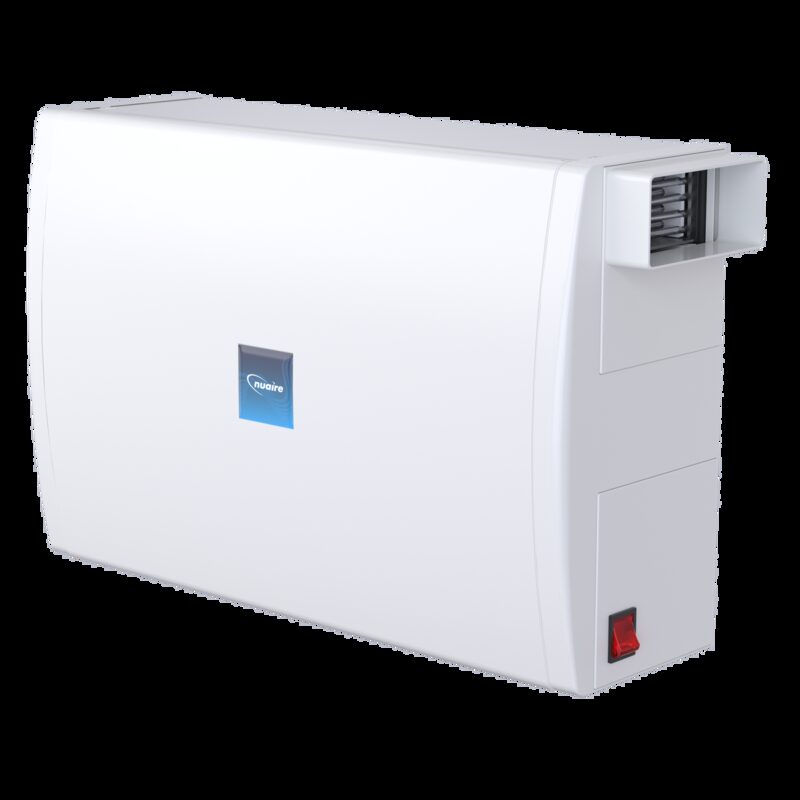
For homes without loft space at all, Nuaire's answer is the Flatmaster. The company states that the Flatmaster solution has been specifically designed to ventilate homes without loft space, and describes the heated version as designed to ventilate homes without lofts, compact, and able to be concealed away in a convenient location3. The Flatmaster Heated PIV System is stated to reduce humidity in the air, reducing condensation dampness and mould growth, and to reduce the presence of indoor and outdoor pollutants from the home, helping improve overall indoor air quality3.
For apartments in new-build blocks, the appropriate product is often not PIV at all. Nuaire's MVHR range includes options that are suitable for wall and ceiling-void installation11. MVHR is a different system type, recovering heat from extracted air rather than supplying tempered air under pressure, and it needs ducting to each wet room. The choice between the two is a design decision about the building, not a like-for-like product swap.
| Product | Intended property | Key stated feature |
|---|---|---|
| Drimaster Eco Heat | Homes with loft space | Casing in 100% recycled ABS plastic5 |
| Drimaster-Eco NOx | Homes with loft space | Two carbon cartridges inside ePM10 filters, NOx reduction up to 80%3 |
| Drimaster Eco 3S Loft Control | Three-storey properties | Recorded as sold out6 |
| Flatmaster Standard | Homes without loft space | Designed specifically for homes without loft space3 |
| Flatmaster Heated | Homes without loft space | Compact, concealable, reduces humidity and pollutants3 |
| MRXBOX MVHR | New-build apartments | Suitable for wall and ceiling-void installation11 |
Running cost and energy use
Nuaire publishes no annual running cost for the Drimaster, and no figure for its power draw appears in the material available here. That absence is itself the honest answer: the running cost is a function of the unit's continuous electrical load and the household's unit rate, and it cannot be stated as a single number without both.
What can be said is the scale. A PIV unit is a fan, not a heater, so its consumption sits in the same class as other small continuous loads rather than in the class of appliances that dominate a bill. For comparison, a 500W dehumidifier run for 24 hours uses 12kWh and costs £3.12 at 26p per unit12, and a dehumidifier costs around 17p per hour to run at 27p per kWh13. A Drimaster draws a fraction of a dehumidifier's load, but it runs every hour of the year, so the annual figure is the daily figure multiplied out rather than a one-off.
The wider context is that ventilation is not where household energy goes. The five most energy-hungry appliances in a home, the oven, dishwasher, fridge, washing machine and tumble dryer, cost £1,327 a year to run combined14. A washer-dryer alone averages £216 a year, with the most expensive model tested at £31515. Washer-dryers are the priciest appliances to run, costing over £200 per year on average according to Which? testing16. Against those figures, a continuously running ventilation fan is a minor line, and the case for it rests on moisture control rather than on energy saving.
The heated variants change that calculation slightly, because tempering the incoming air uses energy. Nuaire does not publish a consumption figure for the heated Flatmaster or the Drimaster Eco Heat, so the additional load is not quantifiable from the published material. A household comparing a heated and unheated variant is comparing a small continuous fan load against a small continuous fan load plus a heating element, and the difference depends on how the heater is controlled.
Installation: where the unit sits and what it needs
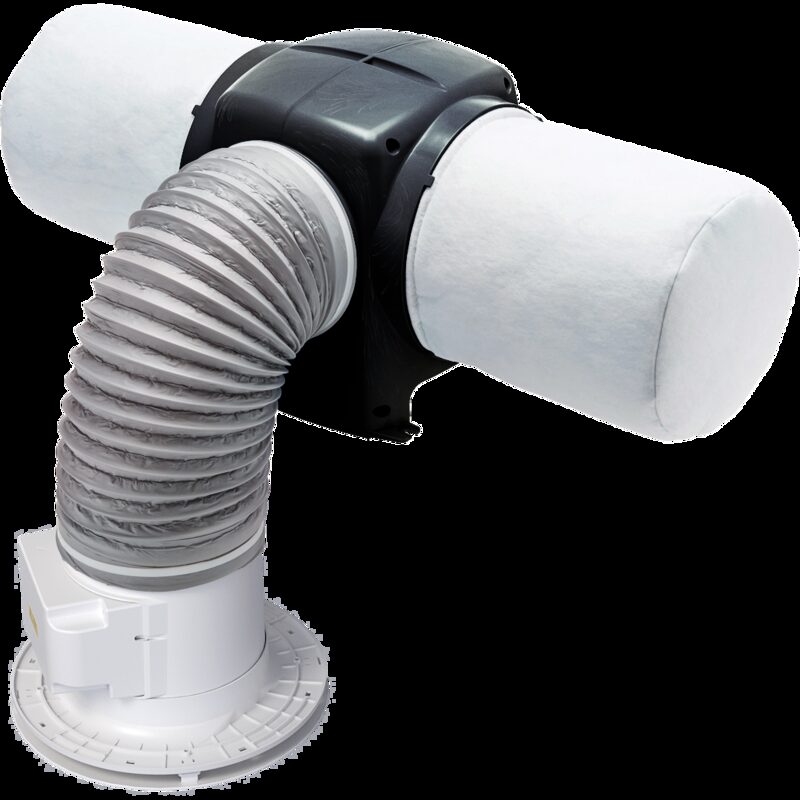
A loft-mounted Drimaster sits on the loft floor or on a mounting frame, with a short duct to an external air intake and a diffuser through the ceiling below, normally in a landing or hallway where the air can spread to the rooms. The unit needs a permanent mains supply, and the diffuser position determines how evenly the air reaches the rest of the house.
The installation route for household equipment of this kind generally runs through a competent tradesperson rather than the householder. Hive recommends finding a local tradesperson to install its smart thermostat, as it can be a bit of a task17. Smart meter installers are required to show a photo ID card before they start18. Neither is a PIV rule, but both illustrate the pattern: work on fixed electrical and ventilation equipment is installer work, and the commissioning record is what the warranty depends on.
Where the unit is wired into the installation, the electrical protection matters. Surge protective devices are usually installed within the consumer unit to protect the electrical installation19. A continuously running fan on a permanent supply is exactly the kind of load that a surge event can end, and the consumer unit is where that protection sits.
For flats and apartments, the installation question is different. A loft unit is not an option, so the choice is a wall-mounted PIV unit or a ducted MVHR system suitable for wall and ceiling-void installation11. In a block of flats, external alterations are also constrained: the permitted development rules for domestic premises state that in the case of the installation of a wind turbine, a stand-alone wind turbine is installed within the curtilage of the dwellinghouse or the block of flats is not permitted20. That is a wind turbine rule rather than a ventilation rule, but it shows the pattern of curtilage restrictions that apply to external equipment on flats, and any new external intake or terminal on a flat should be checked against the lease and the building's consent route.
Maintenance: filters and annual checks
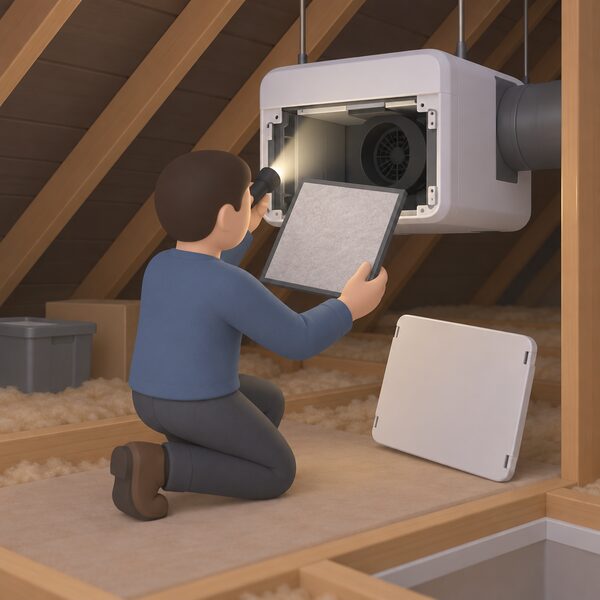
The published maintenance schedule is light. Nuaire states that filters only need to be changed every 5 years at a minimum, and that for best results filters should be visually checked every 2 years5. That is a longer interval than most household filters, and it reflects the fact that a PIV filter is protecting the air supply rather than the machine.
The comparison with other equipment is instructive. System filters on heating systems are designed to be easily cleaned out by service engineers21. Biomass heating systems should have a maintenance check once a year22. A washing machine filter should be cleaned every month to ensure continued good performance23. A PIV unit sits at the low-maintenance end of that spectrum, but the two-year visual check is the point at which a blocked or dirty filter would be spotted before it affects the air supply.
Replacement filters are ordered through Nuaire. For its MVHR systems, the company states that replacement filters can be obtained either by scanning the QR code located on the front panel of the unit or by contacting Nuaire and quoting the filter part number, or by purchasing via the Xpress website11. The same front-panel route is the practical way to identify the unit and its filter specification.
What PIV does for damp, condensation and indoor air quality
The case for PIV rests on moisture. Nuaire states that the Flatmaster Heated PIV System helps reduce humidity in the air, reducing condensation dampness and mould growth, and reduces the presence of indoor and outdoor pollutants from the home, helping improve overall indoor air quality3. The Drimaster-Eco NOx goes further on one specific pollutant, reducing hazardous NOx pollution levels within the home by up to 80% through its carbon cartridges3.
Those are maker claims for specific models. The independent position is more measured. PIV forces stale moist air out through background ventilation and the building fabric, and forcing warm moist air into the building fabric can lead to condensation and structural damage2. The same source notes that a PIV unit can be cold directly under the fan and may not provide fresh air to the rooms that need it2. Those are the failure modes to design around: diffuser position, background ventilation and the building's airtightness all determine whether the system performs as intended.
Where PIV is not the right answer, a dehumidifier is the alternative for moisture, drawing moisture out of the air and being particularly useful where clothes are often dried inside the house1. The two approaches are not equivalent: a dehumidifier treats the air in the room it sits in, while PIV changes the air across the whole dwelling. A household dealing with condensation in one room and a household dealing with it throughout the house are facing different problems.
For a household's energy independence, the position is limited but real. A PIV unit does not generate anything, does not reduce gas or electricity consumption in any way the published figures support, and adds a small permanent electrical load. What it does is address a building fabric problem without adding a heat source, and it does so without depending on a fuel supplier beyond the electricity that runs the fan. The dependence it creates is on mains power, on a filter supply from the manufacturer, and on the unit continuing to be supported with spares. That is a lighter dependence than a boiler creates, but it is not independence.
Availability: the Drimaster Eco 3S is currently sold out
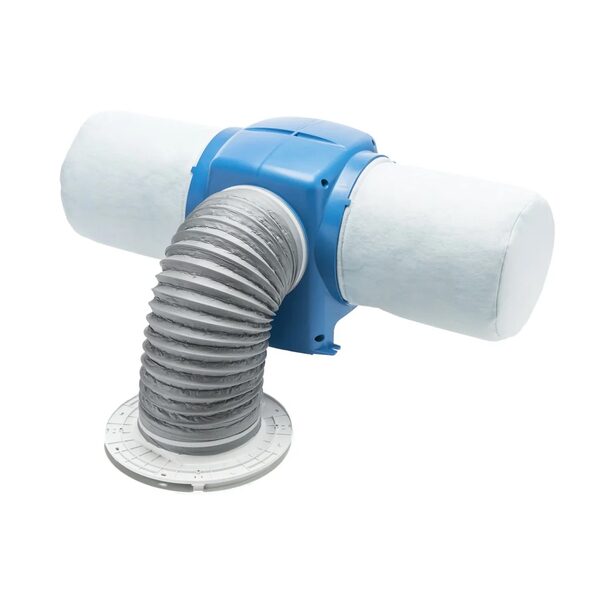
The Drimaster Eco 3S Loft Control unit, the variant intended for three-storey properties, is recorded as sold out6. That is a stock position at the point of record rather than a statement that the product has been withdrawn, and availability of a specific variant can change.
The practical consequence is that a three-storey property needing PIV may have to wait for stock, take a different variant, or use a different approach. Nuaire's MVHR range includes options suitable for wall and ceiling-void installation11, and the Flatmaster range covers homes without loft space3, so the product family has alternatives even where the 3S is unavailable.
For a household, the availability question is worth checking before an installer visit rather than after. A sold-out variant can change the specification, the diffuser positions and the cost of a job, and the lead time is not published. The wider point about manufacturer dependence applies here too: a ventilation system that depends on one maker's filter and one maker's spares is a system whose long-term service depends on that maker continuing to supply them. That is the same position as any branded household equipment, and it is worth weighing alongside the product's performance.
Sources23 cited
- How to stop condensation, Which?, 2026-05-26
- Ventilation advice, Centre for Sustainable Energy, 2025-07
- Flatmaster Heated PIV System, Nuaire, 2026-09-20
- Ventilation and trickle vents, Glass and Glazing Federation, 2026-09-20
- Drimaster-Eco Heat PIV System, Nuaire, 2026-09-20
- Drimaster Eco 3S Loft Control, Air Con Centre, 2026-09-17
- BESA focus areas: ventilation, Building Engineering Services Association, 2026-09-20
- Building regulations for homeowners, FENSA, 2026-09-20
- RdSAP 10 specification, BRE, 2024-02-12
- Retrofit explained, Energy Saving Trust, 2026-02-06
- Mechanical ventilation with heat recovery, Nuaire, 2026-09-20
- How much electricity am I using?, Centre for Sustainable Energy, 2026-07
- Condensation, damp and mould, Centre for Sustainable Energy, 2023-11
- How to save energy at home, IVIE, 2026-09-20
- How much your appliances cost to run, Which?, 2026-10-01
- Five top tips to cut your energy bills, Welsh Government Climate Action, 2026-03-18
- tado vs Hive, Energy Helpline, 2026-09-20
- Getting a smart meter installed, Smart Energy GB, 2026-03-16
- Surge protective devices, Institution of Engineering and Technology, 2026-09-17
- Class H: installation of a wind turbine on domestic premises, legislation.gov.uk, 2026-09-17
- HHIC guidance, Heating and Hotwater Industry Council, 2026-09-17
- Biomass, Energy Saving Trust, 2026-05-22
- How to save energy when using your washing machine, Energy Saving Trust, 2025-08-27
 Nuaire MVHR, PIV and extract ventilationWhich Nuaire system suits your home: MVHR, PIV or an extract fan?