
In this comparison
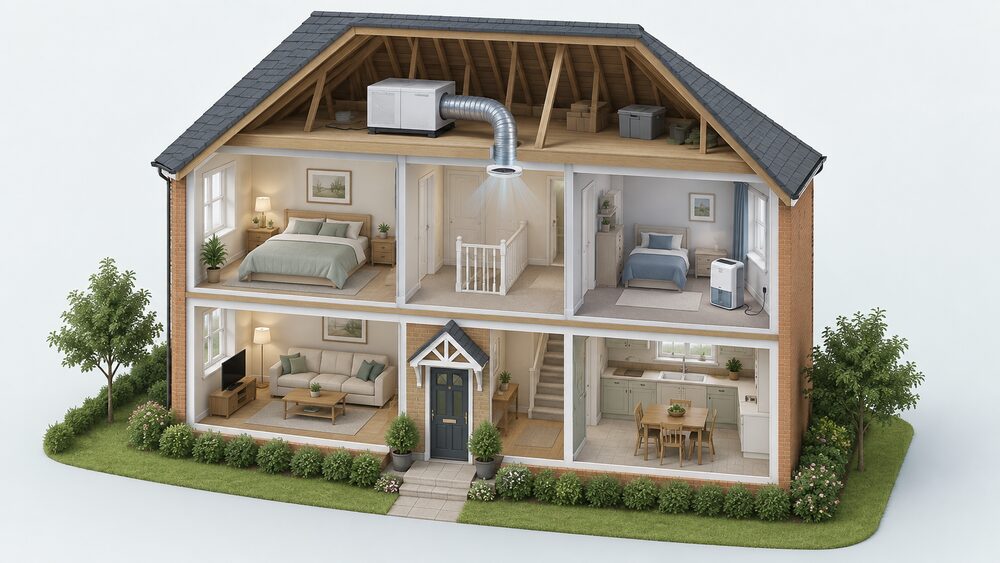
Condensation is the most common damp problem in UK homes, and the two devices most often put up against it work on completely different principles. A positive input ventilation (PIV) unit draws fresh air from outside and distributes it into all rooms through a centralised system usually mounted in the loft, diluting the moist air already in the house1. A dehumidifier does the opposite job in miniature: it takes water vapour out of the air in the room where it stands2.
The choice matters because the two carry very different running costs and very different coverage. Non-heated PIV units can operate for less than 1p a day according to maker guidance3, while most dehumidifiers use less than 200W and an average unit draws 185W, which works out at around 5p an hour at July 2026 prices4. One treats a whole house continuously; the other treats one room while it is switched on.
Neither is a cure for the fabric of a building. A dehumidifier does not fix the underlying causes of damp, such as condensation, rising damp or structural leaks2, and ventilation is a different thing from air infiltration, the unplanned draughts that move through gaps in the building fabric6. What follows sets out how each approach works, where each suits, what it costs to run, what installation involves, and whether the two can be used together.
PIV and dehumidifiers attack condensation in different ways
Condensation forms when moist air meets a cold surface. The two devices interrupt that process at different points. A PIV unit works on the supply side, bringing in drier air from outside and pushing it through the dwelling so that the moisture produced by cooking, washing and breathing is diluted before it can settle. A dehumidifier works on the air already inside, pulling water out of it so that the same rooms hold less vapour to condense in the first place.
The distinction between ventilation and air infiltration matters here. Ventilation is planned air movement, whether delivered by a fan system or by opening a window; air infiltration is the unplanned movement through gaps in the building fabric6. A PIV unit is a whole-dwelling ventilation strategy, providing outdoor air to the home and diluting and dispersing indoor pollutants and water vapour that has not been extracted by other means9. A dehumidifier is not a ventilation strategy at all: it conditions the air in a single enclosed space.
That difference shapes everything else. Whole-house dilution depends on air being able to move through the dwelling, which is why maker guidance recommends keeping all internal doors closed in order to obtain the maximum benefits of the system, so that the pressure regime works as designed10. A dehumidifier depends instead on containment: it performs best in a closed room where it is not fighting a constant supply of fresh moist air.
The scale of the problem is not small. Two thirds of households report struggling with damp and mould, and a third have turned down their heating because of high energy bills, which itself makes condensation more likely as surfaces stay colder4. Both devices are responses to that, but they respond to different parts of it.
What a PIV unit does: dilute moist air with fresh, drier air from the loft
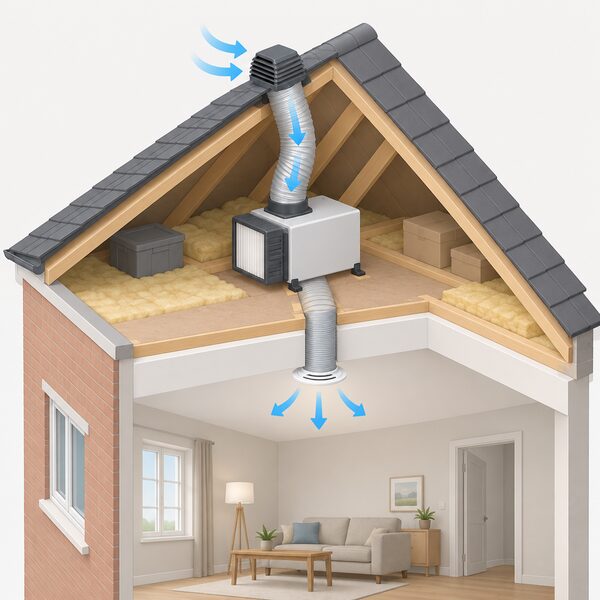
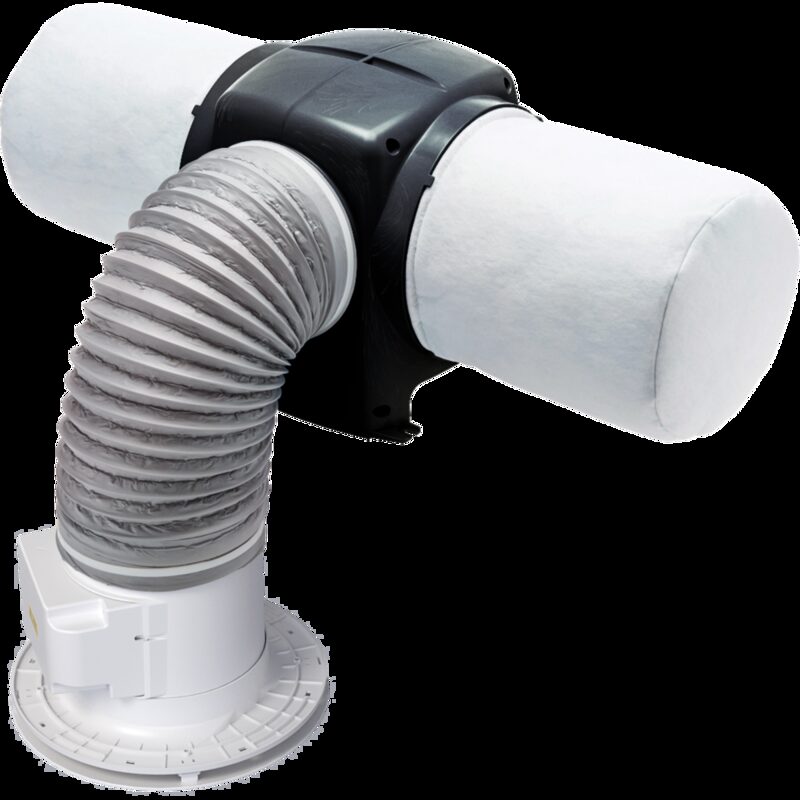
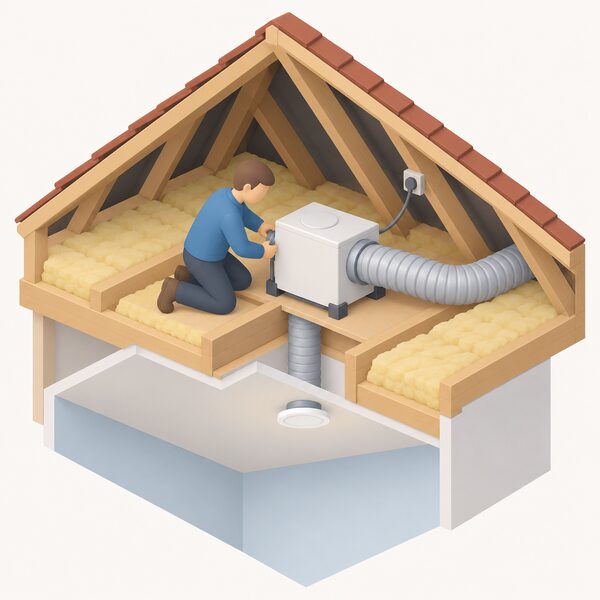
A PIV unit draws fresh air from outside a building in and then distributes it into all rooms through a centralised system that is usually mounted in the loft1. The fan is designed to run continuously at a controlled low rate, and its speed increases with a rise in relative humidity levels above 65% or when manually controlled10. That continuous low-rate operation is what keeps the whole dwelling under slight positive pressure, so that moist air is displaced rather than allowed to sit.
The air itself is often warmer than the outdoor temperature, because it is drawn through the loft space, and many units come with optional heaters to temper incoming air during colder months3. Some units go into sleep or summer bypass mode when loft temperatures are above 25°C, to ensure the system does not continue to introduce hot air in warm weather10. Maker guidance states the system can help improve indoor air quality and potentially help reduce heating demand10.
Filtration is part of the package. The filters on each system remove particles as small as pollen as standard, although higher grade filters are available3. Results are reported as quick: maker guidance describes noticeable results in air quality and humidity control within days of installation, with minimal structural changes required3.
For a household's energy independence, the picture is mixed. A PIV unit reduces reliance on opening windows and on the heating needed to dry a damp house, and it runs on a very small electrical load. But it remains a mains-powered fan with a manufacturer behind it, and it depends on a loft or a wall position and on the building being able to distribute air as designed. It is a low-draw device, not an off-grid one.
What a dehumidifier does: extract water vapour from the air in one room
A dehumidifier draws moisture out of the air, and is particularly useful if clothes are often dried inside the house1. Using one is a way to dry clothes indoors much more cheaply than a tumble dryer11. It does not lower the air temperature, but it can take out existing moisture in the air12.
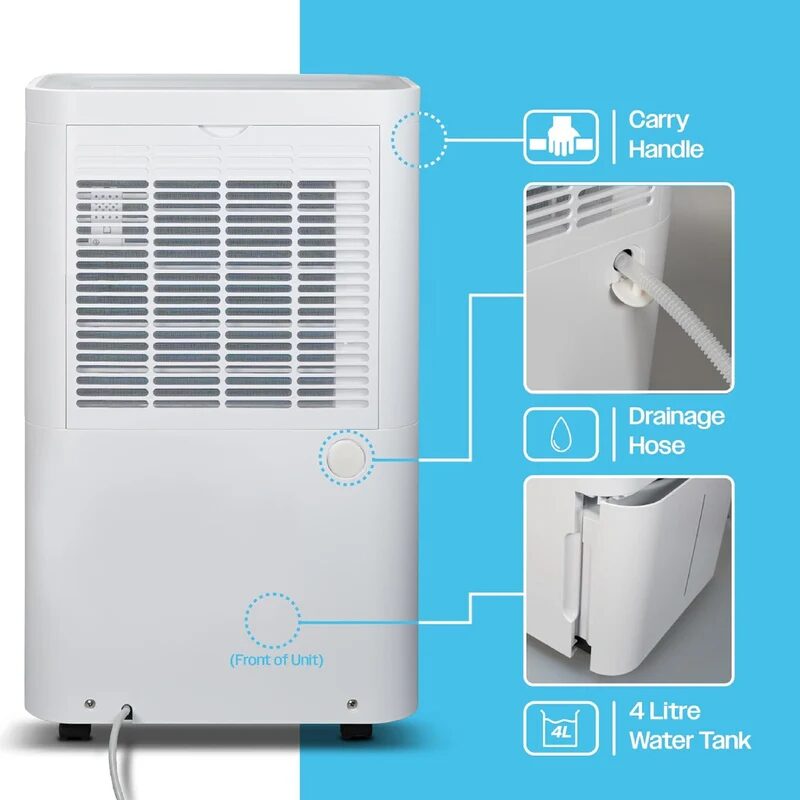
There are two main technologies. Refrigerant, or compressor, models draw in moist air and pass it over cold coils, where moisture condenses and collects in a water tank or drains away2. Desiccant dehumidifiers use an absorbent material to capture moisture from the air, which is then gently heated to release the moisture2. The compressor approach is the most common and cost-effective for home use according to one maker8.
Capacity varies widely, and the extraction rate is the figure that matters most. Independent guidance suggests buying a dehumidifier that will remove at least 5 litres of water every 24 hours7. Compressor models commonly run from smaller versions at 5 litres a day drawing around 150W to larger versions at 20 litres a day drawing around 350W; desiccant types run from small desktop units of up to 1 litre a day at around 20W to larger 10 litre a day versions up to 680W13. One maker's range illustrates the spread: 10 litre, 14 litre and 20 litre models, with the 10 litre version described as suiting smaller rooms8.
For independence, a dehumidifier is a plug-in appliance that treats one room and stops when it is switched off or its tank fills. It reduces reliance on a tumble dryer and on heating a whole house to dry it, but it adds a mains load and, in most homes, a manual routine of emptying.
Where each one works best in a house
The two devices suit different parts of the same house, and different households.
A PIV unit suits a whole dwelling with a moisture problem spread across it: condensation on windows and cold walls in several rooms, a musty smell on a landing, or a house that is closed up for much of the day. It is suitable for homeowners, landlords and housing providers3. Because it works by diluting air across the property, it addresses the general background humidity that produces condensation in the coldest spots.
A dehumidifier suits a defined space. It is the practical answer for a single bedroom with black mould on an external wall, a bathroom with no effective extract, or a room used for drying laundry. Compressor models work best in warmer temperatures and are generally more energy-efficient in such conditions, while desiccant types perform better in cooler or unheated environments but may use more energy overall2. That split matters in the UK: an unheated spare bedroom in winter is a desiccant job, a warm kitchen is a compressor one.
There is a cheaper option for small, enclosed spaces. Disposable dehumidifiers come in 500ml versions available from high street discounters and online retailers, for households where an electric unit is out of price range14.
Where the moisture is structural rather than behavioural, neither device is the answer. A dehumidifier does not fix the underlying causes of damp, such as condensation, rising damp or structural leaks2. The same limit applies to ventilation: it manages airborne moisture, not a failed damp course or a leaking roof.
Running costs and noise compared
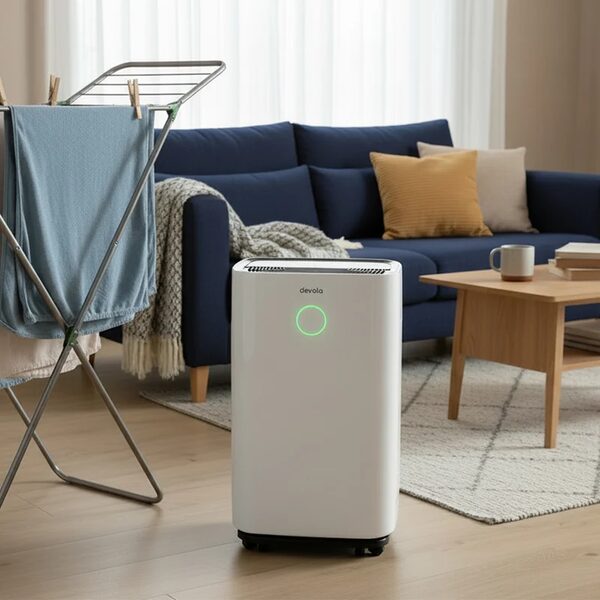
This is where the two diverge most sharply, and where the figures need care because they come from different dates and price assumptions.
| Device | Load | Running cost | Basis |
|---|---|---|---|
| PIV, non-heated | Low continuous fan | Less than 1p a day3 | Maker guidance |
| Average dehumidifier | 185W | Around 5p an hour5 | July 2026 price cap unit rate |
| Dehumidifier, 500W example | 500W | 13p an hour15 | July 2026 |
| Dehumidifier, 500W for 24 hours | 12kWh | £3.1215 | 26p per unit, July 2026 |
| Dehumidifier, 0.35kW, 5 hours a week | 0.35kW | Around 48p a week4 | 27.69p per kWh |
| Dehumidifier | Typical | Around 17p an hour7 | 27p per kWh, November 2023 |
The spread in the dehumidifier figures is not a contradiction: it reflects different power ratings, different electricity prices and different dates. The 17p an hour figure is based on a November 2023 price of 27p per kWh7, while the 5p an hour figure is an average unit at the July 2026 price cap unit rate5. A 500W unit is at the heavy end of the range and costs 13p an hour, or £3.12 if run for a full 24 hours15. Most dehumidifiers use less than 200W, which is what makes them a relatively cheap way to keep a home dry4.
For context on other household loads, an LCD television draws 120W and a desktop computer 140W16. A pedestal fan at 50W costs 1.3p an hour, while a typical portable air conditioner at 1,000 to 1,500W costs around 26 to 39p an hour, roughly 14 to 20 times more than a fan12. A dehumidifier sits between those extremes.
Noise is the other practical difference. A PIV unit runs continuously at a controlled low rate10, so its sound is a constant background hum from a loft or wall unit rather than a cycling appliance in the room. A portable dehumidifier sits in the living space it serves, which is why placement and timing matter as much as the decibel figure.
Installation: what fitting each involves
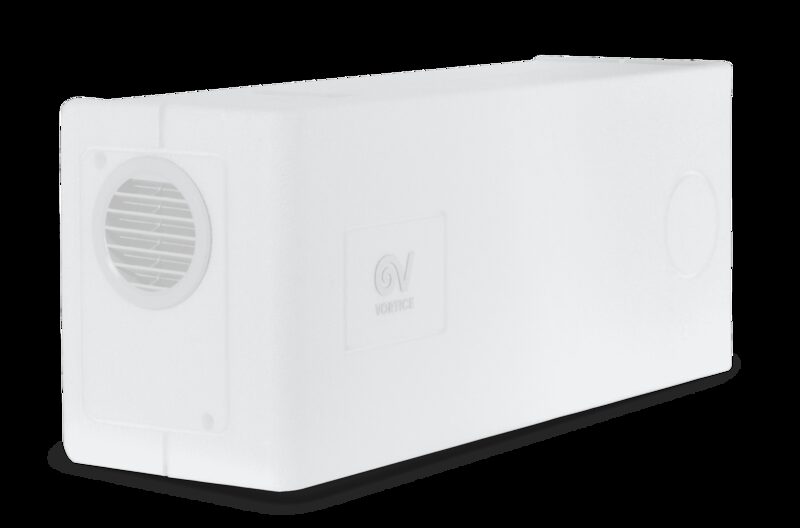
A PIV system must be installed by qualified professionals, which ensures the system is tailored to the property's needs, and it complies with Building Regulations3. A typical installation includes site surveys, installation and a warranty3. The best way to check suitability is a survey from a local specialist who will check whether installing PIV will be suitable, looking at the size and layout of the dwelling, the suitability of the loft space if any, and adequate door undercuts10.
That last point is easy to overlook. A PIV system relies on air being able to move from the diffuser through the dwelling, and door undercuts are part of the path. Where a loft is not available, PIV units can be wall-mounted in flats or basements, providing the same airflow benefits as loft installations in houses3.
A dehumidifier needs no installation at all: it is unpacked, placed and plugged in. The maintenance routine is the trade-off. Owners should empty the water tank after each use and before moving the unit2, and buyers should avoid second-hand dehumidifiers which may not comply with current regulations2.
Where a home is being altered at the same time, other rules can bear on the work. Roof insulation placement, for instance, is governed by building regulations, with insulation placed between the joists or rafters, or between ceiling joists in the case of a pitch roof, and vents placed along the ridge where insulation sits between the rafters18. Retrofit work more generally is subject to verification rules: under PAS 2030:2023, the retrofit installer shall verify that the pre-installation building inspection has been independently checked by an appropriately qualified person prior to commencement of installation20.
Can you use both together?
Yes, and in some homes that is the sensible division of labour, though neither device is a substitute for the other. A PIV unit handles the background humidity across the whole dwelling; a dehumidifier handles a specific room or a specific task, such as drying laundry or dealing with a cold bedroom that condensation reaches first.
The two do interact, and the interaction is worth understanding before running both. A PIV system is recommended to have all internal doors closed in order to obtain the maximum benefits of the system10. A dehumidifier also works best in a contained space. Running both at once in the same closed room means the dehumidifier is working on air that the PIV unit is steadily replacing, so the dehumidifier's tank will fill more slowly and its contribution is smaller than it would be in a sealed room. In practice the two are often used in different parts of the house, or at different times.
There is a wider principle here about how ventilation and moisture control fit together. Whole dwelling ventilation provides outdoor air to the home, diluting and dispersing indoor pollutants and water vapour that has not been extracted by other means, while purge ventilation removes high concentrations of pollutants and water vapour intermittently, for example to clear fumes from painting, and can be delivered simply by opening windows or doors9. A dehumidifier is neither of those: it is a local moisture extractor that sits alongside them.
For a household weighing energy independence, the combination reduces reliance on heating a whole house to dry it and on tumble drying, but it does not remove reliance on the grid, on a manufacturer for parts and filters, or on the building's own air paths working as intended.
PIV's origins: the 1972 Norma anti-condensation unit
Positive input ventilation is not a new idea. Nuaire designed the Norma anti-condensation ventilation system with the Northern Gas Board in January 1972, and it was installed in several hundred homes. The principle has not changed: bring in outside air, distribute it through the dwelling, and keep the internal air moving enough that moisture does not settle on cold surfaces.
What has changed is the control gear. Modern units vary fan speed with humidity, with the speed increasing above 65% relative humidity or under manual control10, and they add summer bypass so that hot loft air is not pushed into the house when loft temperatures exceed 25°C10. Optional heaters address the cold-weather objection, and filtration has moved from a basic dust barrier to filters that remove particles as small as pollen as standard3.
The system sits within a family of mechanical ventilation options. The main types are PIV, MEV, d-MEV and MVHR, and the differences between them, and how to choose, are set out in industry guidance21. PIV is the simplest of the four: it supplies air rather than extracting it, and it does not recover heat. That is why it is cheap to run and why it is not a substitute for a heat recovery system in a very airtight home.
For a household, the history is a reassurance about the principle rather than the product. Half a century of use in UK housing stock means the mechanism is well understood, and the maintenance burden is light compared with heat recovery systems, whose filters need checking every few months17.
Sources21 cited
- How to stop condensation, Which?, 2026-05-26
- Dehumidifiers, Electrical Safety First, 2026-09-19
- The ultimate guide to positive input ventilation, Vortice, 2026-01-14
- Condensation nation, Uswitch, 2026-02-23
- Heated clothes airers and energy efficiency, Uswitch, 2026-07
- Ventilation, Centre for Sustainable Energy, 2025-07
- Condensation, damp and mould, Centre for Sustainable Energy, 2025-12
- Dehumidifier buying guide, Dimplex, 2026-09-20
- Ventilation, BESA, 2026-09-20
- Troubleshooting, Envirovent, 2026-09-20
- Easy ways to save energy, Home Energy Scotland, 2026-09-20
- Summer energy tips, National Energy Action, 2026-08-13
- Ratings of electrical appliances, Electrical Safety First, 2026-09-19
- Preparing for winter, National Energy Action, 2025-10-14
- How much electricity am I using?, Centre for Sustainable Energy, 2026-07
- Plug in solar, Centre for Sustainable Energy, 2026-09
- Airtightness and ventilation, CAT, 2025-06-27
- Building regulations: new roofs, Planning Portal, 2026
- Building regulations: roof thermal resistance, Welsh Government, 2026-09-17
- A guide to PAS 2035, 2030 and 2023 standards, IAA, 2025-03-25
- Ventilation and air quality guide, IAA, 2026-09-20
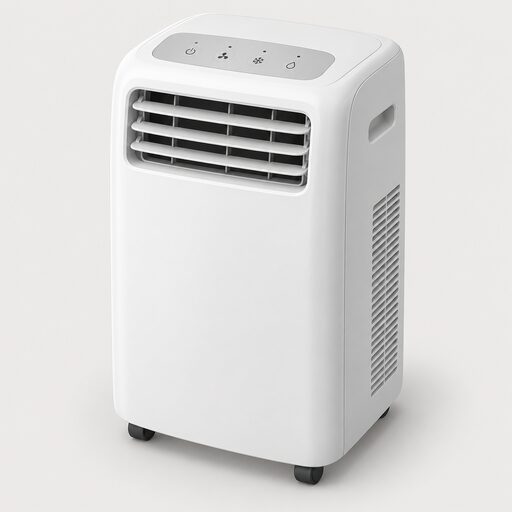 Air Conditioning and HumidityExplains how air conditioners remove moisture as they cool, what dry or dehumidify mode does and how extraction rates are stated.
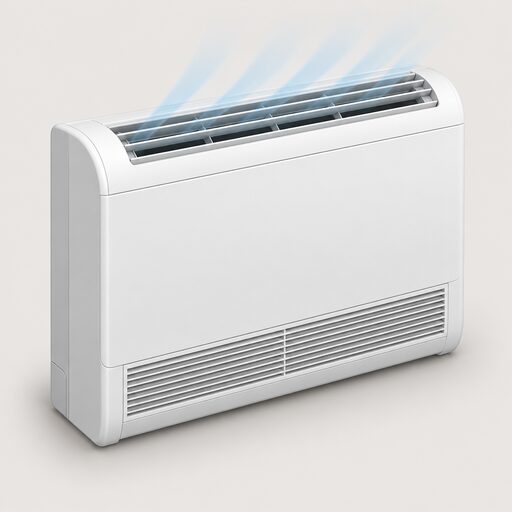 Split Air ConditioningA split air conditioning system cools or heats one room using an indoor unit and an outdoor unit linked by pipes.
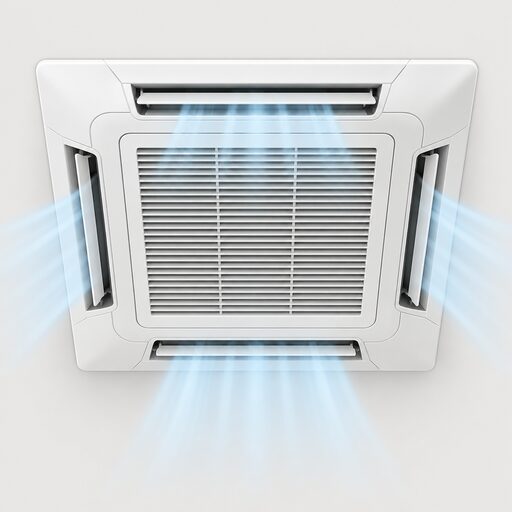 Ducted and Cassette ACDucted air conditioning hides the unit in a loft or ceiling, while a ceiling cassette sits in the ceiling with only vents on show.
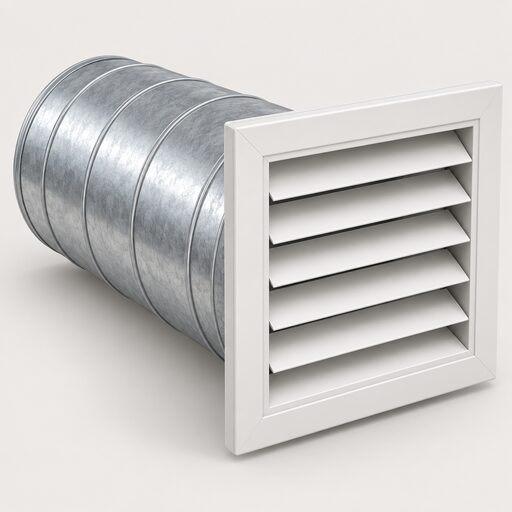 Types of Air ConditioningPortable, wall-mounted, multi-room or ducted: which air conditioning suits your home?
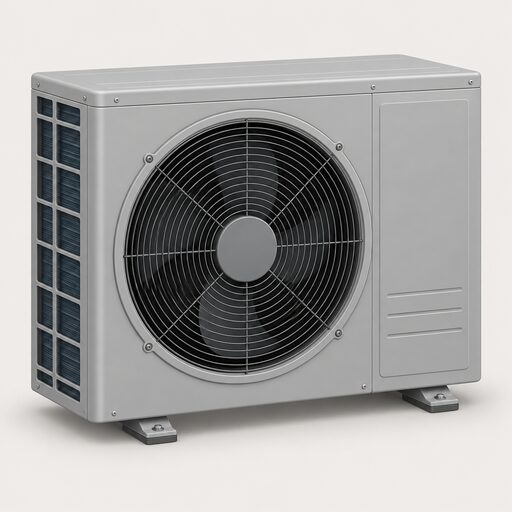 Cooling and Heat PumpsCan an air conditioner heat your home as well as cool it?
 Using a Heat Pump for CoolingCan a heat pump cool your home in summer as well as heat it in winter?