In this guide
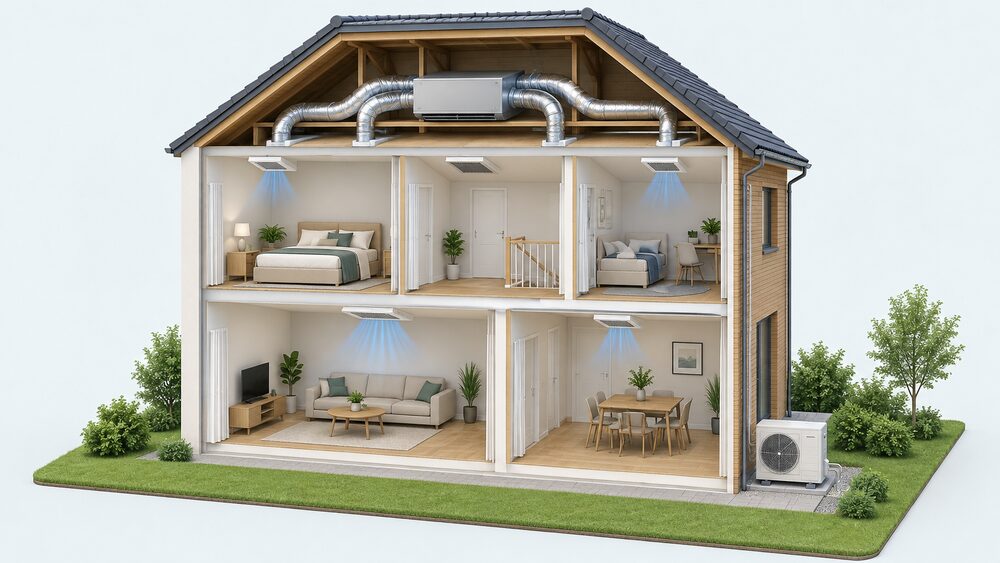
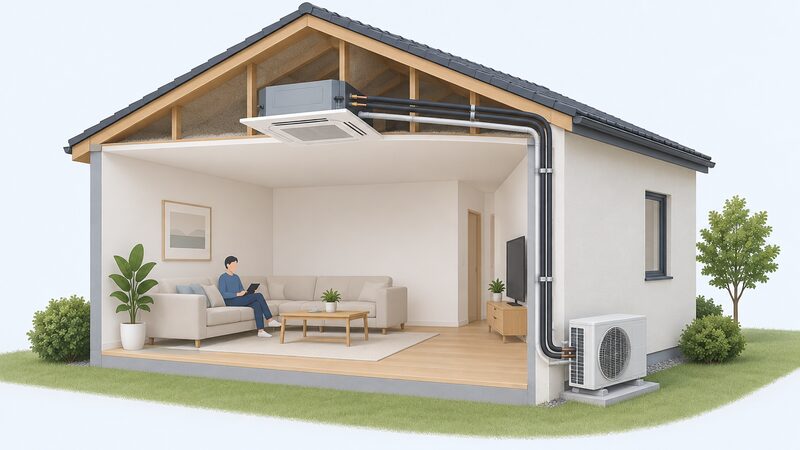
Ducted air conditioning hides the indoor unit out of sight, in a loft, ceiling void or false ceiling, and delivers cooled or warmed air to each room through ducts ending in grilles. Independent guidance describes ducts that move air through slim pipes hidden in ceiling voids, with the air treated in an air handling unit roughly the size of a boiler, normally placed in a loft or utility room1. A ceiling cassette is different: it is a split air conditioner whose indoor unit sits in the ceiling itself, with just the vents visible, connected to an outdoor unit by slim piping and with no ductwork required2.
The concealed indoor units sold in the UK start small. Fujitsu's slim duct unit in the 2.0 kW class is 198 mm tall and the maker gives a sound pressure of 23 dB(A) on its quiet fan setting in cooling3. Its medium static pressure ducted range has an indoor unit height of 240 mm and a static pressure that can be set between 30 and 150 Pa, which lets it push air along longer duct runs4. One published sizing table puts a 2.0 kW unit against rooms up to 16 m² and a 10.0 kW unit against spaces up to 80 m²5.
A concealed system gives a household cooling, and on reverse-cycle models heating, from electricity alone, with no gas. It does not remove dependence: it runs on the grid or on the home's own generation, needs a certified engineer for refrigerant work and relies on the maker for parts. Independent guidance also warns that a ducted air-to-air system can be disruptive to install unless the home already has ducted warm air heating, which is uncommon in the UK6.
A ducted unit hides in a void; a cassette sits in the ceiling
Both types are forms of split air conditioning: an outdoor unit containing the compressor, linked by refrigerant pipes to an indoor unit that blows air across a cold (or, in heating, hot) coil. The difference is where the indoor unit goes and how the air reaches the room.
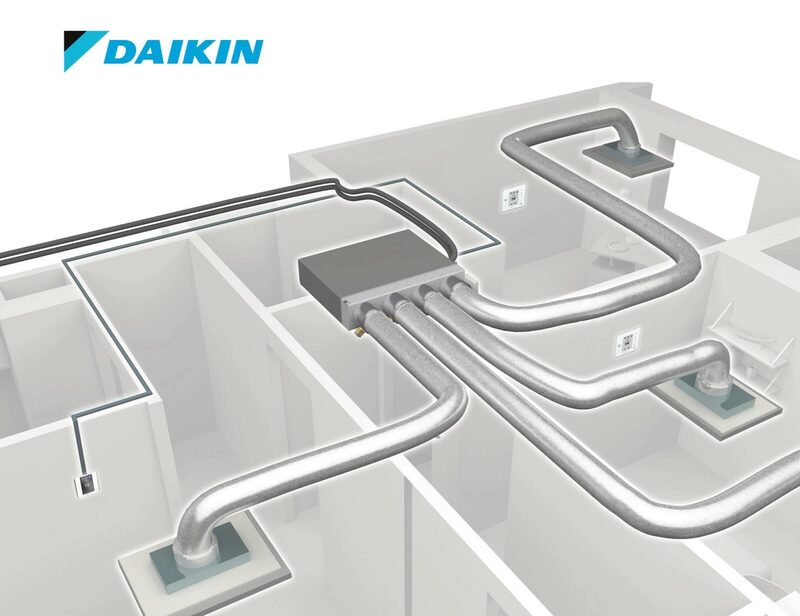
A cassette's indoor unit is not fixed to a wall but embedded in the ceiling, more specifically the false ceiling9. It discharges air directly into the room below through a grille, so it serves the room it is installed in. A ducted unit sits further back, in a void, and air travels from it along ducts to one or more grilles. Fujitsu states that on its slim duct units, locally purchased branch ducts can be attached to distribute the airflow3, which is how one concealed unit can serve more than one outlet. Makers of multi-room systems describe ducted indoor units built for recessed installation or in a false ceiling10, and residential ranges typically list ducted units and cassettes alongside multi-split, window and floor-mounted types11.
The ducting is a large part of the job. A UK case study of a high-velocity system describes fully insulated and sound-attenuated ducting routed above ceilings and inside cavity walls, delivering air through multiple branches to room outlets12. Independent guidance notes that some ducted systems are also known as exhaust air heat pumps and can supply hot water as well1. Those are a separate category from the cooling-led units on this page.
A third concealed type, the under-ceiling unit, is fixed to the surface of the ceiling rather than recessed into it, so it needs no void above. It is visible, but it keeps floor and wall space clear.
Ducted, cassette or wall-mounted: which suits which home
Air conditioners can be fixed or mobile, wall-mounted, or ceiling-mounted as a cassette13. The choice between them is set mostly by the building.
Maker guidance describes ducted air conditioning as ideal where a home already has ducts fitted, in new builds, or where the whole house is to be climate controlled, and as not appropriate for small apartments, registered buildings or smaller budgets2. Independent guidance adds that ducted systems are typically seen in energy efficient houses such as Passivhauses and may not suit older or larger houses with high heating needs1. Hitachi states that its ducted unit fits into attics or false ceilings, whether in houses or apartments14, so a flat with a deep enough false ceiling is not ruled out on space alone; lease and consent questions are covered in air conditioning in flats.
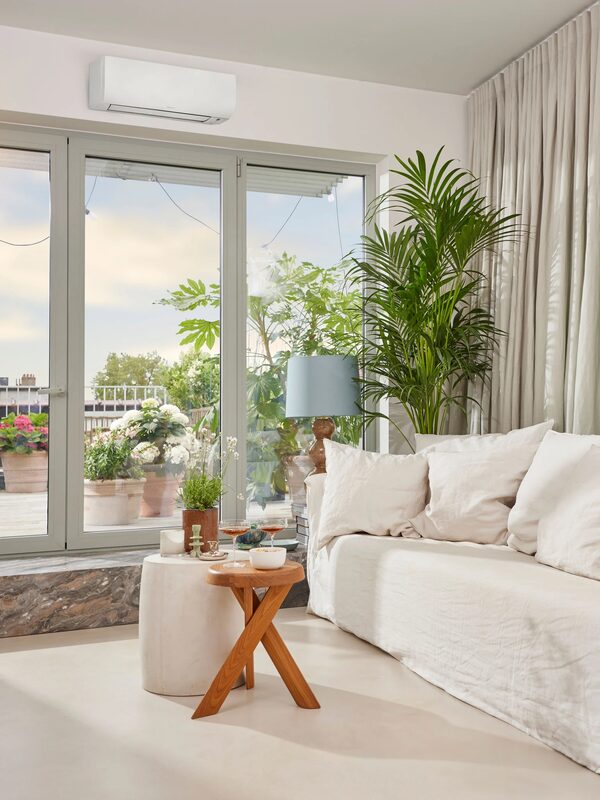
A wall-mounted unit is a fixed unit, most of the time installed high up on the wall of the room it cools9. Guidance from a UK retailer describes fixed wall-mounted air conditioning as usually better for regular use, especially in bedrooms, living rooms, offices and garden rooms5. Where ducting is not practical but several rooms need cooling, a multi-split system is the usual alternative, and maker guidance describes multi-split as suitable where ducted systems are not2.
These types can also be mixed on one outdoor unit. Fujitsu lists wall-mounted, floor, compact cassette, mini duct, slim duct and medium static pressure duct indoor units from the 1.5 kW to 3.5 kW class as connectable to one of its multi outdoor units15, and another UK supplier's multi system accepts wall-mounted, cassette, ducted, ceiling/floor and console indoor units10.
| Type | Where the indoor unit goes | What shows in the room | Typical fit |
|---|---|---|---|
| Ducted | Loft, ceiling void or false ceiling1 | Supply and return grilles | New builds, homes with existing ducts, whole-house control2 |
| Ceiling cassette | Recessed into a false ceiling9 | Grille panel only | Single room with a ceiling void |
| Under-ceiling | Fixed to the ceiling surface | Whole unit on the ceiling | Rooms with no void |
| Wall-mounted | High on the wall9 | Whole unit on the wall | Regular use in bedrooms and living rooms5 |
A direct comparison of the two whole-home options is on ducted vs multi-split.
Capacity: from 2.0 kW compact units to 10.0 kW
Capacity is stated in kW of cooling (and heating, on reverse-cycle models), sometimes with the BTU equivalent. The table below is one published sizing guide; it is a rule of thumb by floor area, not a heat-gain calculation5.
| Unit output | BTU | Room size up to |
|---|---|---|
| 2.0 kW | 7,000 | 16 m² |
| 2.5 kW | 9,000 | 20 m² |
| 3.5 kW | 12,000 | 30 m² |
| 6.2 kW | 21,000 | 50 m² |
| 10.0 kW | 34,000 | 80 m² |
| 14.0 kW | 48,000 | 110 m² |
A ducted unit serving several rooms is sized on their combined load, which is why ducted outputs run higher than single-room units. A UK comparison site gives a power rating of 1 to 5 kW for multi-split or ducted systems16, while a Daikin multi outdoor unit certified by Quiet Mark covers 5.2 to 9.0 kW in cooling and 6.8 to 10.0 kW in heating17. The gap between those figures reflects what is being measured: electrical rating in one case, delivered capacity across several indoor units in the other. More on sizing is in what size air conditioner.
Inverter units also vary their output. Fujitsu gives its 2.5 kW compact cassette a cooling capacity of 2.5 kW with a range of 0.9 to 3.2 kW18, so the same unit can run well below its nameplate on a mild day. The concealed units with published specifications are set out below.
| Model (maker's name) | Type | Class or capacity | Airflow | Size (H × W × D) |
|---|---|---|---|---|
| Fujitsu ARXG07KSLAP | Slim duct | 2.0 kW class3 | 550 / 440 / 390 / 360 m³/h3 | 198 × 700 × 450 mm3 |
| Fujitsu ARXG12KSLAP | Slim duct | 3.5 kW class19 | 650 / 490 / 430 / 360 m³/h19 | 198 × 700 × 450 mm19 |
| Fujitsu ARXG09KLLAP | Slim duct | 2.5 kW model, 0.600 kW input in cooling20 | not stated | not stated |
| Fujitsu medium static pressure duct | Ducted | not stated | 30 to 150 Pa static pressure4 | 240 mm tall4 |
| Fujitsu AUXG09KVLA | Compact cassette | 2.5 kW (0.9 to 3.2 kW)18 | not stated | not stated |
Both slim duct units weigh 15.5 kg and run on a single phase 230 V supply, and their external static pressure is given as 0 to 303. That low figure is what separates a slim duct from a medium static pressure unit: a slim duct suits short runs close to the grilles, while a medium static pressure unit can drive air along longer ducting. Where one outdoor unit feeds several indoor units, each can be adjusted independently21.
Efficiency: SEER minimums of 4.0 and 4.6
The legal floor matters more than any marketing claim. Approved Document L for England sets a minimum seasonal energy efficiency ratio (SEER) for an air conditioner in cooling mode of 4.6 in new dwellings and 4.0 in existing dwellings7. The Welsh Government's consultation version of its Approved Document L uses the same two figures22. Equivalent figures for Scotland and Northern Ireland are set in their own building standards.
Certified products sit well above that floor. Eurovent certifies a Carrier ducted combination at a SEER of 6.2023, and consumer guidance from Uswitch advises looking for ratings of 7 and above to keep running costs down16. Fujitsu states only that its medium static pressure duct has achieved a high energy efficiency rank with a compact design4. Ducted systems carry an efficiency cost that wall units do not: the fan has to move air through the ducts, and duct losses depend on the installation rather than on the unit's laboratory rating.
Maker data can be inconsistent. For the Fujitsu ARXG09KLLAP slim duct, the maker's published figures give annual energy consumption as both 141 kWh/a and 845 kWh/a on its own pages20; the two figures disagree and no ruling between them is available, so neither can be relied on without the current datasheet. Seasonal heating figures (SCOP) are published per model and pairing and are covered in efficiency ratings explained.
Two thresholds set by regulation are worth knowing. The Ecodesign regulation for air conditioners applies to units below 12 kW rated capacity24, which covers domestic ducted and cassette units. The UK's energy performance of buildings rules on air conditioning inspections apply to systems with an effective rated output of more than 12 kW25, and CIBSE reports that the threshold for regular inspections was changed from over 12 kW to over 70 kW26. Few if any domestic systems reach either inspection threshold.
Noise: 22 to 46 dB(A) indoors, 45 to 51 dB(A) outdoors
Indoor sound depends mainly on fan speed. The makers' figures below are sound pressure, measured at a distance, for cooling unless stated. Sound power (the total noise the unit emits) is higher; Fujitsu gives 52 dB(A) and 53 dB(A) on different pages for the 2.0 kW slim duct, and 55 dB(A) and 57 dB(A) for the 3.5 kW one, and the pairs disagree3.
| Model (maker's name) | Type | Sound pressure, cooling (High / Middle / Low / Quiet) |
|---|---|---|
| Fujitsu ARXG07KSLAP | Slim duct | 29 / 26 / 24 / 23 dB(A)3 |
| Fujitsu ARXG12KSLAP | Slim duct | 31 / 27 / 25 / 23 dB(A)19 |
| Fujitsu ARXH45KMTAP | Medium static pressure duct | Quiet: 29 dB(A); other settings not stated27 |
| Fujitsu AUXG09KVLA | Compact cassette | Middle: 31 dB(A); other settings not stated18 |
| Fujitsu AUXG45KRLB | Cassette | 46 / 42 / 39 / 35 dB(A)28 |
| Fujitsu ABEG22KRTA | Under-ceiling | Quiet: 31 dB(A); other settings not stated29 |
A ducted unit has an advantage here: the fan is in the void, and the room hears the grille rather than the machine. A cassette's fan is directly above the room, and its higher figures reflect larger airflow at larger capacity. For comparison, Fujitsu's floor console units are rated at 22 dB(A) quiet and 40 dB(A) high in cooling for the AGEG12KVCA30, and 43, 37 and 29 dB(A) in heating for the AGEG14KVCA31. For the ARXG09KLLAP slim duct, the maker gives both 28 dB(A) and 27 dB(A) on different pages20.
Quiet modes trade airflow for sound. Quiet Mark describes Daikin's indoor 'quiet operation' mode as one that reduces the sound pressure by reducing the airflow rate, and the outdoor unit's 'night quiet' mode as reducing the sound pressure during the night32.
The outdoor unit is where neighbours notice. Fujitsu gives 51 dB(A) outdoors in cooling for the under-ceiling ABEG22KRTA29 and for the pairing with the AGEG14KVCA31, and 45 dB(A) cooling and 51 dB(A) heating for the AGEG12KVCA outdoor unit30. Outdoor noise also governs whether an installation is permitted development; see air conditioning noise and the planning pages for England, Scotland, Wales and Northern Ireland.
Refrigerant, pipe runs and installation limits
Concealed systems are practical partly because the connection to the outdoor unit is small. Air-to-air systems need only small refrigerant pipes, typically 6 to 12 mm in diameter, between the outdoor and indoor units33. Fujitsu's slim duct units use 6.35 mm and 9.52 mm pipe connections3. Those pipes can be run through a ceiling void, a boxed-in corner or a wall cavity, which is one reason a cassette needs no ductwork at all.
The refrigerant itself is a design constraint. Daikin's Altherma 3 H HT heat pump, for example, uses R3234. A UK government consultation on the F-gas regime in Great Britain proposed limiting the size of air-to-air systems using flammable refrigerant to around 6.5 to 7 kW8. The Heat Pump Association notes that all refrigeration, air conditioning and heat pump products fall under Ecodesign requirements and other rules, including the Low Voltage, Machinery, Pressure Equipment and Electromagnetic Compatibility Directives35. Handling refrigerant is regulated work; the rules are covered in F-gas rules for home air conditioning.
Pipe insulation affects both efficiency and condensation. Industry guidance on building services states that heat gain to uninsulated chilled pipes should only be permitted where the distribution pipework accounts for less than 5% of the total cooling load36. In practice, refrigerant pipes in a warm loft are insulated throughout.
Every indoor unit also produces condensate when cooling, and in a ceiling void that water must be pumped or drained away. The heating industry's guidance for boiler condensate, written after the freezing weather of March 2018, calls for external condensate pipe runs to be increased to at least a 30 mm inside diameter and insulated37; the same freezing risk applies to any condensate pipe run outside. Where ducting is used, the SAP methodology allows only small sections of flexible ducting in otherwise rigid ventilation ducting, with a maximum length of 200 mm per section, for vibration isolation38; a similar approach, rigid runs with short flexible connections, keeps ducted air conditioning efficient and quiet.
The maximum pipe length and height difference between indoor and outdoor units are set per model in each maker's installation data. For wall-mounted units, maker guidance says the indoor unit should generally be at least 2 metres above the ground21. The survey and commissioning steps are covered in air conditioning installation, and the reason for a minimum run in why there is a minimum pipe length.
Controls and running features: timers, auto changeover, fresh air ducts
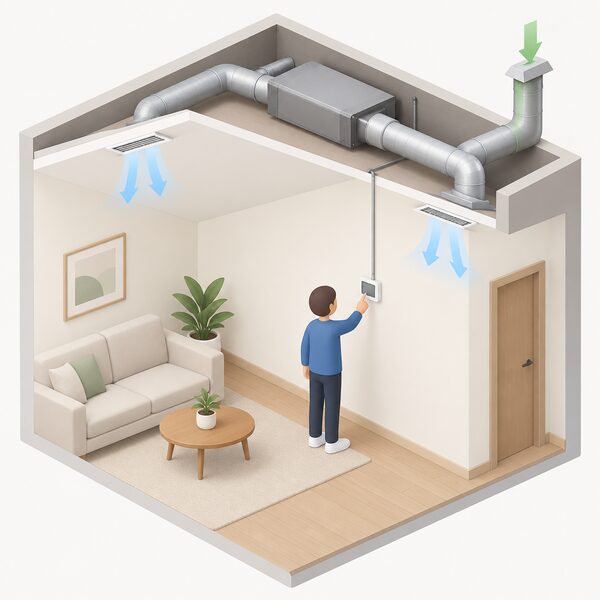
Concealed units are controlled by a wired wall controller, a remote or an app, since the unit itself is out of reach. Independent guidance notes that air-to-air systems are programmable like other heating systems and often come with a remote and/or smart wi-fi option, and many offer dehumidification and air purification functions6. Fujitsu lists wired, simple and central remote controllers, wireless LAN adapters and KNX and Modbus interfaces as optional parts for its slim duct units3.
The maker lists these features on its 2.0 kW and 3.5 kW slim duct units3:
- Weekly timer: "Different ON-OFF times can be set for each day."
- Weekly and temperature setback timer: sets the temperature for two time spans on each day of the week.
- Auto changeover: switches between heating and cooling based on the set temperature and the room temperature.
- Economy operation: adjusts the thermostat setting to the room temperature to avoid unnecessary cooling or heating.
- Set temperature auto return: returns the setting to the previously set temperature.
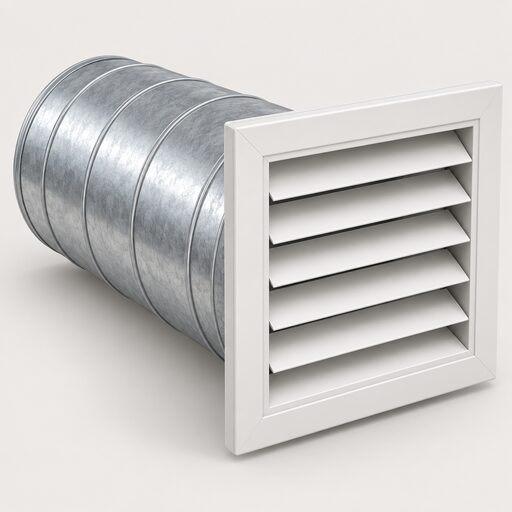
- Connectable fresh air duct and distributing duct: outside air through a fresh air knockout; branch ducts to spread the airflow.
- Filter sign: indicates the filter cleaning period by blinking.
- External ON/OFF input: lets another system switch the unit.
The medium static pressure duct adds low noise mode, automatic fan speed, automatic airflow adjustment, a fresh air intake and a drain pump as standard27.
Power cuts are handled by auto restart. Fujitsu uses the same wording for its slim duct, cassette and floor units28:
"In the event of a temporary power failure, the air conditioner will automatically restart in the same operating mode as before, once the power supply is restored"
The fresh air option brings in outside air but is not whole-house ventilation with heat recovery, which is a separate system. The app and wi-fi features add a dependence on the maker's cloud service; the unit's own timers and wired controller work without it. Detail on wired, remote and wi-fi control is in air conditioning controls.
Maintenance access, drain pumps and filter care
A concealed unit is only as serviceable as the access to it. Fujitsu states that its medium static pressure duct offers easy inspection of the drain hose, easy cleaning of the heat exchanger and easy filter change, with large panels on both sides for maintenance in narrow spaces, and a drain hose supplied as a standard accessory to make drainage easier to design in narrow spaces under the ceiling4. Hitachi's ducted unit has an integrated lift pump for drainage and easy access to the drain pump for faster servicing14. Both Fujitsu slim duct units list the drain pump as standard3.
A drain pump matters because a unit in a ceiling void usually sits below the level at which condensate can fall away by gravity. If the pump fails, water collects in the tray; access to the pump is therefore part of the design, not an afterthought. Ceiling hatches or removable grille panels need to be planned before the ceiling is closed.
Householders can do the routine tasks. Maker guidance lists them plainly:
"These include washing the filter, removing dust, and checking for mould and other build-ups"
On a slim duct unit the filter sign prompts the cleaning3. Other work is for an engineer. General guidance lists changing the filter, checking the motor and topping up the refrigerant9, and the Energy Saving Trust lists the tasks in a heat pump service as cleaning coils and fan blades, inspecting filters, checking refrigerant level and pressure and checking that electrical connections are safe39. Air-to-air units are heat pumps in all but name, so the same list applies. More on schedules is in air conditioning maintenance.
What a concealed system does for energy independence
A ducted or cassette system replaces nothing in the home's gas supply for cooling, because there was none; where it is a reverse-cycle unit it can also take some heating off gas. Everything it does runs on electricity, so its value to a self-sustaining home depends on where that electricity comes from. The main load comes on hot, sunny afternoons, when rooftop solar output is also high, which is covered in running air conditioning on solar panels.
The dependencies are specific. The system needs a certified engineer for any refrigerant work, and its refrigerant choice is subject to F-gas rules that may change8. Parts such as drain pumps, fan motors and controllers come from the maker. App control depends on the maker's online service, though the wired controller and built-in timers do not. The fixed ductwork is the least portable investment in cooling: independent guidance is clear that it suits efficient homes and new builds, and can be disruptive to retrofit where no ducted warm air heating exists1.
Concealed systems also sit at the top of the cooling hierarchy's last step. Reducing heat gain first, with external shading and passive cooling, lowers the capacity needed and so the electricity drawn. The full picture is on the home cooling guide and home cooling and energy independence.
Sources39 cited
- Air to air heat pumps, Energy Saving Trust, 2026-09-11
- Air conditioner buying guide, Hitachi Cooling & Heating, 2026-09-17
- ARXG07KSLAP slim duct indoor unit, Fujitsu General, 2026-09-23
- Medium static pressure duct range, Fujitsu General, 2026-09-23
- Air conditioning size guide, CoolEasy, 2026-09-23
- How a heat pump can cool your home, Which?, 2026-07-17
- Approved Document L, Volume 1: Dwellings, UK Government, 2026
- HFC phasedown reform de minimis assessment, Defra, 2025-09-02
- How does air conditioning work, Netatmo, 2026-09-20
- UE Multi air to air heat pump, Alpha Innovation, 2026-08-17
- How does air conditioning work, Hitachi Cooling & Heating, 2026-09-17
- Unico 3-in-1 system, CIPHE, 2025-03-19
- Cooling down a room: what is the best way, Netatmo, 2026-09-20
- airHome Ducted, Hitachi Cooling & Heating, 2026-09-17
- AOEG14KBCA2 multi outdoor unit, Fujitsu General, 2026-09-23
- Is air conditioning worth it in the UK, Uswitch, 2026-07-14
- Daikin 4 port multi air conditioner, Quiet Mark, 2026-09-17
- AUXG09KVLA compact cassette, Fujitsu General, 2026-09-23
- ARXG12KSLAP slim duct indoor unit, Fujitsu General, 2026-09-23
- ARXG09KLLAP slim duct, Fujitsu General, 2026-09-23
- Home air conditioning, Netatmo, 2026-09-20
- Approved Document L, Volume 1, consultation version, Welsh Government, 2026-09-17
- Carrier ducted unit certificate, Eurovent Certification, 2026-09-17
- ASHP noise and permitted development rights in Wales, phase 1, Welsh Government, 2023-12-13
- Energy Performance of Buildings Regulations 2012, Part 4, legislation.gov.uk
- Changes to the energy performance of buildings regulations, CIBSE, 2026-09-17
- ARXH45KMTAP medium static pressure duct, Fujitsu General, 2026-09-23
- AUXG45KRLB cassette, Fujitsu General, 2026-09-17
- ABEG22KRTA under-ceiling unit, Fujitsu General, 2026-09-23
- AGEG12KVCA floor unit, Fujitsu General, 2026-09-17
- AGEG14KVCA floor unit, Fujitsu General, 2026-09-23
- Daikin 5 port Class 90 multi air conditioner, Quiet Mark, 2026-09-17
- Air-to-air heat pumps: a low carbon solution for UK homes, Nesta, 2026-02-17
- Daikin Altherma 3 H HT heat pump, Quiet Mark, 2026-09-17
- Statement on R290 safety zone, Heat Pump Association, 2025-10-06
- HVAC legislation, MIMA, 2026-09-20
- Heating industry statement on condensate pipes, HHIC, 2018-03-29
- SAP 10.2, BRE, 2021-12-17
- Is now a good time to get a heat pump, Energy Saving Trust, 2025-12-12
 Types of Air ConditioningPortable, wall-mounted, multi-room or ducted: which air conditioning suits your home?
 Air Conditioning SizingHow big an air conditioner does a room need?
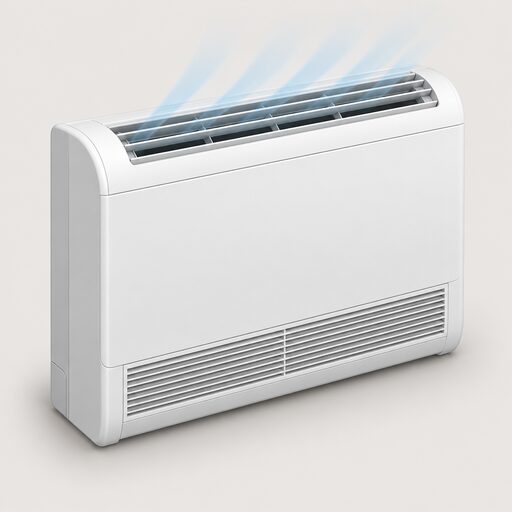 Split Air ConditioningA split air conditioning system cools or heats one room using an indoor unit and an outdoor unit linked by pipes.
 Room-in-Roof InsulationTurning a loft into a room changes how the roof keeps heat in, so the insulation has to work with the ventilation rather than being squeezed in afterwards.
 Home Ventilation SystemsWhy do modern insulated homes need extra ventilation, and what happens if they do not get it?
 Draught-Proofing a HomeCovers sealing around windows, doors, floorboards, loft hatches, letterboxes and chimneys, and the products used for each.