On this page
Dry mode on an air conditioner removes moisture from the air rather than heat. In cooling mode a system does both jobs at once: as it brings the room temperature down, it also takes water out of the air, so it acts as a dehumidifier and a cooler together1. Dry mode strips out the cooling part and concentrates on the moisture. Makers are candid about its limits: the dry setting "is not designed to be a standalone dehumidifier", and dehumidification does not happen at all when the system runs in heating mode1.
That distinction matters in a British summer, because much of what makes a warm room unbearable is water in the air rather than temperature alone. A typical portable air conditioner of 1,000 to 1,500W costs around 26 to 39p per hour to run in cooling, roughly 14 to 20 times more than a fan2, so knowing when dry mode, a fan or a standalone dehumidifier will do the job more cheaply is worth a household's attention. This page explains what dry mode does, how it differs between split systems and portables, what it costs, and where a dedicated dehumidifier is the better answer.
Dry mode explained: lowering humidity rather than cooling the air
An air conditioner in cooling mode actively removes heat and reduces the room temperature2. Dry mode uses the same hardware to a different end. The unit draws moist room air over its cold coils, the moisture condenses on those coils, and the water collects in a tank or drains away. That is exactly how a refrigerant dehumidifier works too: "Refrigerant (compressor) models draw in moist air and pass it over cold coils", where the moisture condenses and is collected3. The difference is that a dehumidifier then returns the heat it extracts to the room, while an air conditioner in dry mode lets a little cooling happen as a by-product.
The other main type of dehumidifier, the desiccant type, works differently: it "use[s] an absorbent material to capture moisture from the air", which is then gently heated to release it into a tank3. Air conditioners do not work this way; dry mode is always a refrigerant process.
Because dry mode is not aiming at the thermostat, the compressor cycles gently and the fan runs at low speed. The room may feel a degree or two cooler simply because drier air lets sweat evaporate from skin more readily, but the mode is not a substitute for cooling on a genuinely hot day. Makers state the point plainly: dry mode "is not designed to be a standalone dehumidifier"1, and it is certainly not designed as a standalone cooler either.
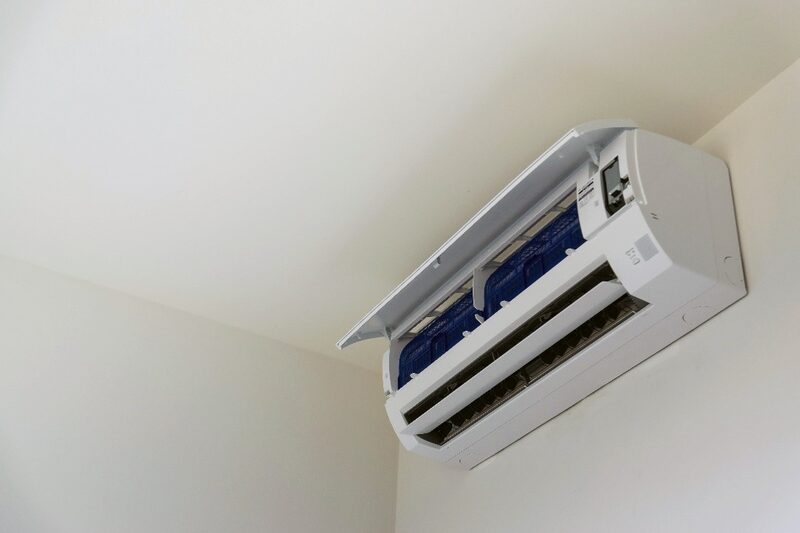
Dry mode versus cooling mode: choosing between them
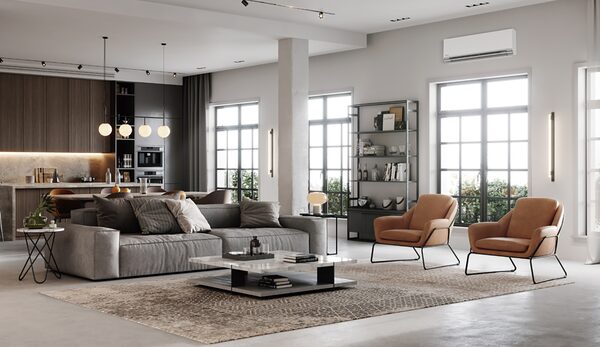
The rule of thumb is simple. If the room is hot and humid, cooling mode does both jobs at once and is the mode that will actually bring the temperature down1. If the room is only mildly warm but feels heavy, sticky or clammy, dry mode targets the moisture without spending the electricity that full cooling demands.
Efficiency standards give a sense of how much cooling performance has improved. Building regulations guidance across England, Wales and Scotland sets the seasonal energy efficiency ratio of an air conditioner working in cooling mode at a minimum of 4.06, and the 2025 consultation version of the Welsh approved document raises that to a minimum of 4.6 for new dwellings9. A modern fixed system therefore delivers a lot of cooling per unit of electricity, which narrows the gap between the modes on cost, though dry mode still runs the compressor less hard.
It is worth being clear about what dry mode is not. It is not the same as an evaporative air cooler, which uses water to slightly cool the air and is more effective than a fan in dry conditions2. Nor is it a heating setting: dehumidification does not happen in heating mode at all1. The choice in hot weather is between cooling mode, which cools and dries together, and dry mode, which dries alone at lower power.
Humidity, not temperature, is what makes heat uncomfortable
Human comfort in heat depends heavily on how well sweat can evaporate, and that depends on the moisture content of the air. A humid heatwave feels worse than a dry one at the same temperature, because the air is already close to saturated and evaporation slows. It is also why the health guidance on humidity is consistent: a general guide is that humidity "should be between 30% and 60% in all rooms of your house"4. Staying inside that band matters for the fabric of the home as well as for comfort, because prolonged high humidity is the condition under which condensation and mould take hold.
One subtlety is worth understanding. When cold damp air from outdoors is brought into the house and heated, "the 'relative humidity' goes down, and the 'absolute humidity' stays the same"10. Warming a room dries the air only in the relative sense; the actual quantity of water in it is unchanged. This is why ventilating a home on a humid day, or drying clothes indoors, adds real moisture that has to go somewhere.
Traditional fixed air conditioning has a known weakness on this point. The system cools until it hits the thermostat setting, then "the system shuts off and the humidity level slowly increases, making the living space uncomfortable"11. A system that cycles on temperature alone can leave a room cool but clammy between cycles, which is precisely the situation dry mode exists to handle. Ducted small-duct high-velocity systems claim an edge here: a Unico SDHV system "can remove 30% more humidity than a traditional air conditioning system"11, a figure also stated as 30% more than conventional HVAC systems12.
Moisture removal by dry mode: manufacturer ratings versus everyday performance
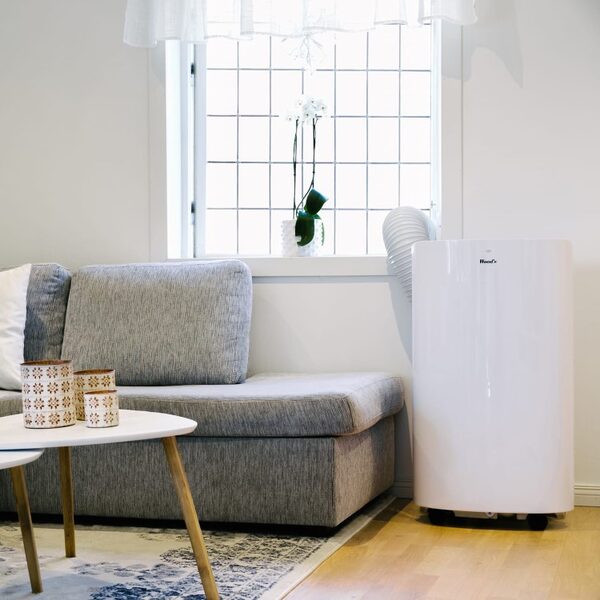
Extraction capacity is where marketing and reality diverge most. Makers quote dehumidification figures for their units, typically stated as litres per day, but those figures are measured at set temperature and humidity conditions that a British living room rarely matches. A cooler room, or a less humid one, yields less water. No independent UK body publishes a standardised extraction test for air conditioner dry mode, so a household comparing models is comparing maker-quoted numbers on maker-chosen conditions.
What the product range shows is that moisture removal is now a standard selling point rather than an afterthought. A 2.6kW (9,000 Btu) portable unit, the Honeywell HG09CESLKG, is listed with three functions in one: cooling, dehumidification and fan13. At the other end of the market, whole-house ducted systems compete explicitly on humidity removal, with the 30% claim over traditional systems noted above11.
In practice, what a household should expect from dry mode is steady, modest extraction rather than dramatic drying. The mode runs the compressor intermittently and the fan slowly, so it will pull water out of the air over several hours, not minutes. For a room that is damp from drying laundry or a humid night with the windows open, that is usually enough. For a persistently damp problem, such as condensation on windows each morning, a dedicated dehumidifier with a stated extraction rate and a humidistat is the tool designed for the job, and makers themselves say dry mode is not a standalone dehumidifier1.
Dry mode on split systems versus portable air conditioners
The same mode behaves differently depending on the hardware. On a fixed split system, dry mode benefits from the same efficient refrigerant circuit that cooling uses, and condensate is piped permanently to a drain, so the moisture side of the operation is invisible to the household. On a portable unit, dry mode works through a single chassis with an exhaust hose: "Portable air conditioners remove warm air from the room and vent it outside via an exhaust hose, while circulating cooled air indoors"13, and the water it extracts usually ends up in a tank that has to be emptied by hand.
The efficiency penalty of portables is well documented. Independent guidance states that "portable units use 30-50% more electricity than fixed systems"5, so a household running dry mode on a portable is paying a premium for the moisture removal compared with the same job on a split system. Fixed air-to-air heat pumps, which cool in summer and heat in winter, compound the case: they have "lower running costs than with other types of electric heating and plug-in air conditioning"14.
Installation is the portables' counter-argument. "No permanent installation is required. Simply position the unit near a window, connect the exhaust hose, and start cooling"13, and neither standard air conditioners nor portable units require a water connection1. A split system needs an outdoor unit, pipework and a certified installer. Neither type needs plumbing: the water a portable extracts goes into its tank, and a split system's condensate drains by gravity or a small pump.
Noise behaviour also differs. On split systems, some makers offer a night setting on the outdoor unit: the Daikin Multi+ Class 90's "outdoor unit has a 'night quiet' mode setting to reduce the sound pressure during the night"15. Portable units have no outdoor unit, but their whole compressor sits in the room with the household.
Choosing a dehumidifier over dry mode: the 30L/day alternative
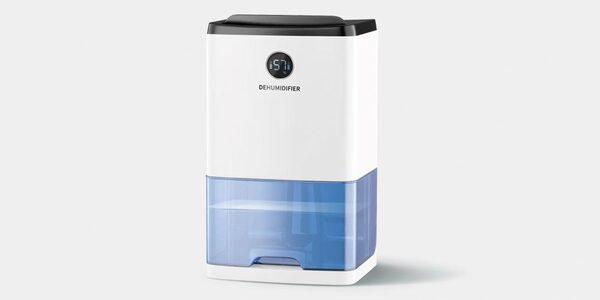
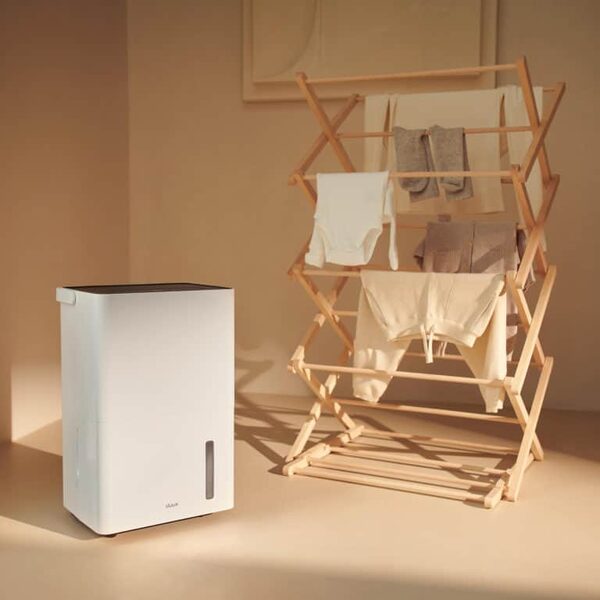
For real damp problems, a dedicated dehumidifier outperforms dry mode on every measure that matters: extraction, control and running cost. A large domestic unit such as the Bora Smart 30L is rated to remove up to 30 litres of water a day, several times what an air conditioner's dry mode will manage, and the 2024 version of that unit adds a dedicated laundry drying mode on a 4-hour timer. It also has a humidistat, so it can be set to hold a room at a chosen humidity and then switch off, something dry mode on most air conditioners cannot do precisely.
The choice of dehumidifier type matters in summer. Refrigerant (compressor) dehumidifiers "work best in warmer temperatures and are generally more energy-efficient in such conditions"3, which makes them the natural summer choice. Desiccant types "perform better in cooler or unheated environments but may use more energy overall"3, which suits a cold garage or an unheated conservatory in winter rather than a warm living room in July.
The laundry case deserves its own mention. A dehumidifier "will draw moisture out of the air" and is "particularly useful if" a household often dries clothes inside16, and using one is "a great way to dry clothes indoors much more cheaply than a tumble dryer"17. Energy advice consistently lists "a dehumidifier or heated clothes horse" among the cheaper alternatives to a tumble drier18. Since indoor drying is one of the main sources of summer moisture in UK homes, a dehumidifier often solves the problem at its source, before the air ever feels clammy enough to reach for the air conditioner.
Comparing what dry mode and dehumidifier settings cost to run
No source publishes a per-hour cost for dry mode specifically, but the surrounding figures bracket it well. At the top end, a typical portable air conditioner of 1,000 to 1,500W "can cost around 26-39p per hour, roughly 14-20 times more than a fan"2. At the bottom, dehumidifiers cost "approximately 4p and 15p per hour, depending on their size and settings"3, with an average dehumidifier working out at "around 5p an hour in electricity" at the July 2026 price cap unit rate19. A 500W dehumidifier is listed at 13p per hour in one independent cost table20.
| Appliance | Running cost | Basis |
|---|---|---|
| Portable air conditioner, cooling | 26 to 39p per hour | Typical 1,000 to 1,500W unit2 |
| Electric fan | around 3p per hour | Average fan5 |
| Dehumidifier | 4p to 15p per hour | Depending on size and settings3 |
| Dehumidifier, average | around 5p per hour | July 2026 price cap unit rate19 |
| Dehumidifier, 500W | 13p per hour | Independent appliance cost table20 |
Over a full day the sums add up visibly. Running a 500W dehumidifier for 24 hours uses 12kWh, which at 26p per unit gives "a grand total of 312p, or £3.12"20; the same calculation at 27p per unit gives "351p, or £3.51"21. Those two examples also show how sensitive the total is to the unit rate on the household's tariff.
The pattern across independent advice is consistent: fans are "far cheaper to run than air conditioning", and air conditioning "can add significantly to summer energy bills"22. Dry mode sits between the two, because it runs the compressor at a fraction of full cooling output. A household using dry mode instead of cooling mode on a day that is humid rather than hot is making the cheaper choice; a household using dry mode instead of a dehumidifier for a persistent damp problem is usually making the more expensive one.
Noise, tank emptying and drainage: the practical side
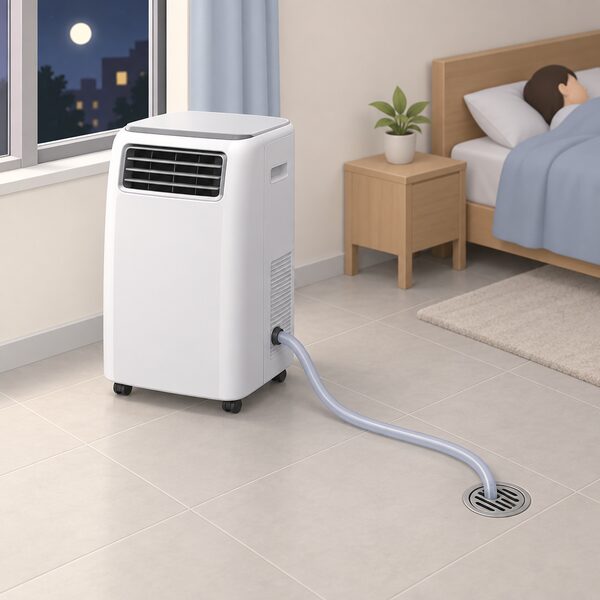
The practical frictions of dry mode are noise and water. On noise, the maker figures for portable units should be read carefully, because the published specifications differ. Honeywell lists its HG09CESLKG portable at a minimum of 51 dBA and a maximum of 52 dBA on one specification, and elsewhere states between 65 dB(A) depending on the BTU and fan speed23; both figures come from the maker's own pages and cannot be reconciled from the published information. The Bora Smart 30L dehumidifier is listed at 36 to 42dB, with a separate claim of 36dB in night mode24. As a rough orientation, a quiet room at night is the condition that matters most, and a unit running dry mode at low fan speed is quieter than the same unit in full cooling.
On water, the behaviour depends on the unit. Many portable air conditioners are self-evaporating in cooling mode, disposing of condensate through the exhaust, and need a drain hose only when the internal tank fills, shown as an error code, or when the unit is run in dehumidifier mode. Where a hose is needed, one retailer specifies a hose with an internal diameter of about 13mm for the condensate drain port of its AirFlex 15 unit. In dry mode the extraction is the point of the exercise, so the tank fills faster and a hose to a drain or out of a window saves the daily walk with a full tank. On a refrigerant dehumidifier the same physics applies: moisture "condenses on the coils and collects in a water tank or drains away"3.
Availability is a seasonal practicality worth noting: the Meaco Cirro 12,000 BTU portable air conditioner, sold out at the time of writing, was listed to return to stock in October 202625, which is a reminder that portable cooling stock in the UK sells out during hot spells rather than before them.
How VAT and fitting rules shape domestic air conditioning choices
The tax and regulatory position affects what a household actually pays, and it changed recently. Energy-saving materials permanently installed in dwellings, including air source heat pumps, are subject to VAT relief at 0% until 31 March 202726, after which they will be reduced rated, at 5%27. The relief comes with conditions: the 5% reduced rate applies "where the total cost of them (not including VAT) is not over 60% of the cost of the installation of the products (not including VAT)"28, and "you cannot buy or install the products yourself" to qualify29. The changes were introduced by affirmative Statutory Instrument8.
Not everything qualifies. Heating equipment that is not funded through an energy efficiency grant, energy efficient boilers, secondary or double glazing, low emission glass and energy efficient fridge freezers attract 20% VAT, with wind and water turbines excluded in Northern Ireland only30. Where a product sits in these lists determines whether an installation quote carries 0%, 5% or 20% on top.
On the regulatory side, a household that "put[s] in a fixed air-conditioning system" needs building regulations approval31. Portable units, needing no permanent installation13, sit outside this. Planning rules have also moved in the direction of easier installation: the laws on installing air source heat pumps in England and Scotland were relaxed from 1 December 2011 to make installation more appealing1, and permitted development changes in England in 2025 brought air-to-air cooling systems within scope, so many homes no longer need a full planning application. The position differs between the nations, and the pages on planning permission in England, Scotland, Wales and Northern Ireland cover each in detail.
The current state of household self-reliance
Dry mode is one of the cheaper tools in a home's cooling kit, but every tool on this page runs on mains electricity. Air conditioning "increases electricity use and can add significantly to summer energy bills"22, and portable units carry a 30 to 50% penalty over fixed systems5, so a household that cools with electricity is trading summer comfort for dependence on the grid and on the unit rate of its tariff. A dehumidifier at 4p to 15p an hour3 is a far lighter load, and a fan at around 3p5 lighter still.
The independence calculation is therefore about matching the tool to the day. Dry mode and dehumidifiers manage moisture, which is often the real discomfort in a UK heatwave, at a fraction of the cost of full cooling. Fixed air-to-air heat pumps, with their lower running costs14, and pairing cooling with solar panels shift the balance further, as does passive cooling that needs no electricity at all. What no appliance on this page removes is the underlying dependence: on the grid for power, on the maker for spare parts and refrigerant, and on the installer for a fixed system's upkeep. The full picture is set out in home cooling and energy independence, and the wider options in the home cooling guide.
Sources31 sources
- Air conditioning FAQs, CoolEasy, 2026-09-23
- Summer energy tips, National Energy Action, 2026-08-13
- Dehumidifiers safety advice, Electrical Safety First, 2026-09-19
- Condensation, damp and mould, Plymouth Energy Community, 2026-09-20
- How to keep your home cool in hot weather, Centre for Sustainable Energy, 2026-07
- Building regulations Part L and F review, stage 2a, Welsh Government, 2020-12
- Domestic Building Services Compliance Guide, draft, Scottish Government, 2010
- Approved Document L, Volume 1: Dwellings, 2021 edition with 2023 amendments, HM Government, 2026-09-17
- Approved Document L Volume 1, consultation version, Welsh Government, 2025-08
- The secret to a healthy home, Carbon Co-op, 2019-03
- HVAC choices for the home, CIPHE, 2024-03-12
- The Unico system enhances well-being, CIPHE, 2024-02-08
- Domestic portable air conditioners, CoolEasy, 2026-09-23
- How a heat pump can cool your home, Which?, 2026-07-17
- Daikin 5-port Class 90 multi air conditioner, Quiet Mark, 2026-09-17
- How to stop condensation, Which?, 2026-05-26
- Easy ways to save energy, Home Energy Scotland, 2026-09-20
- Energy efficient laundry, uSwitch, 2026-01-06
- Heated clothes airers and energy efficiency, uSwitch, 2026-07
- How much electricity am I using?, Centre for Sustainable Energy, 2026-07
- What uses watt, Plymouth Energy Community, 2026-09-20
- Make your home more comfortable in warmer weather, Plymouth Energy Community, 2026-09-20
- Honeywell HG09CESLKG local air conditioner, Honeywell Air Comfort
- Bora Smart 30L dehumidifier with ThreeSixty smart heater bundle, Duux
- Meaco Cirro 12,000 BTU super quiet smart portable air conditioner, Meaco
- VAT rates on different goods and services, HMRC / GOV.UK, 2026-07-10
- VAT Energy Saving Materials and Grant Funded Heating Supplies: VENSAV3062, HMRC, 2026-09-17
- VAT forms and rates, goods and services, HMRC, 2026-07-10
- Tax on shopping: energy saving products, GOV.UK, 2026-09-17
- VAT for consumers: energy saving, HMRC, 2026-09-20
- Building regulations approval, GOV.UK, 2026-09-17