
In this comparison
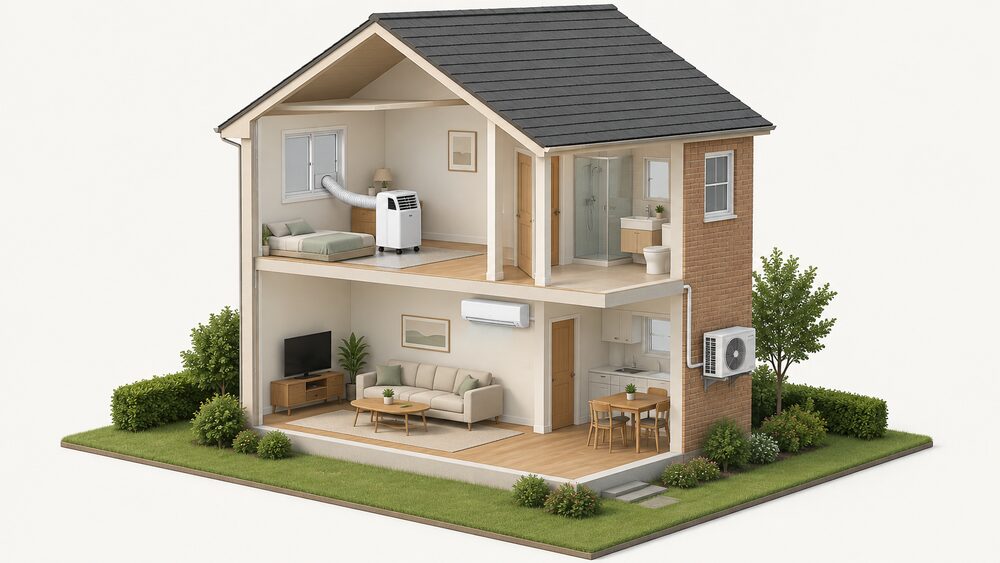
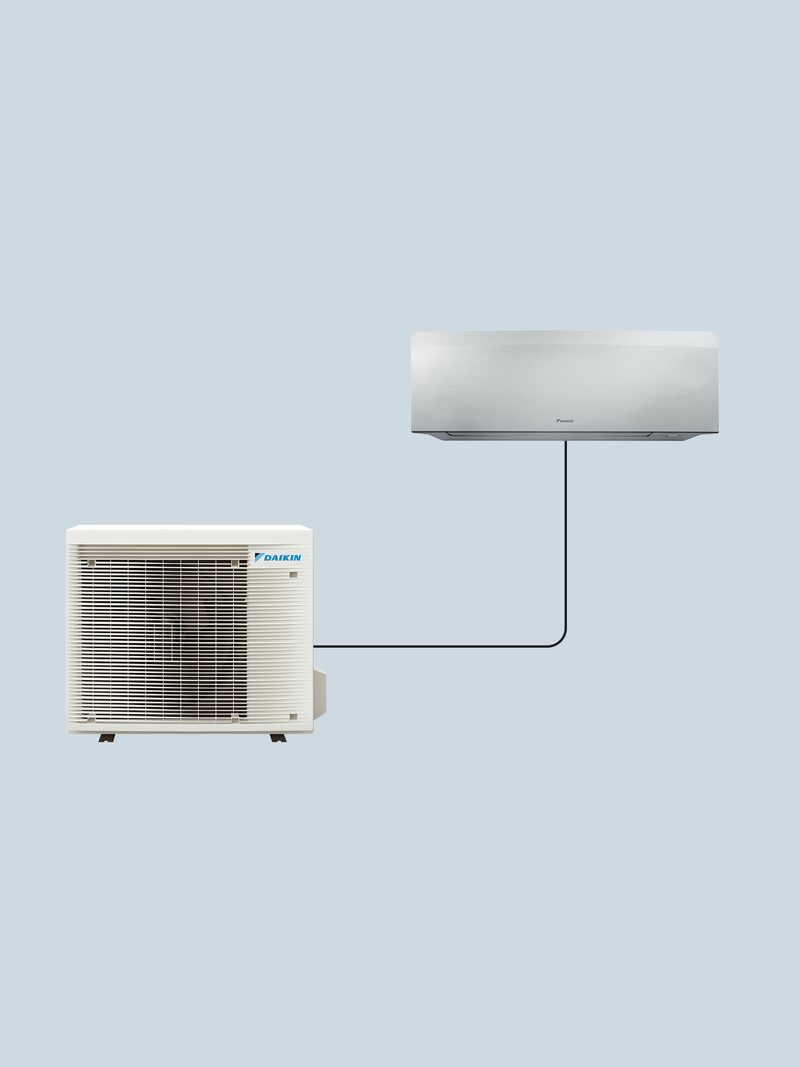
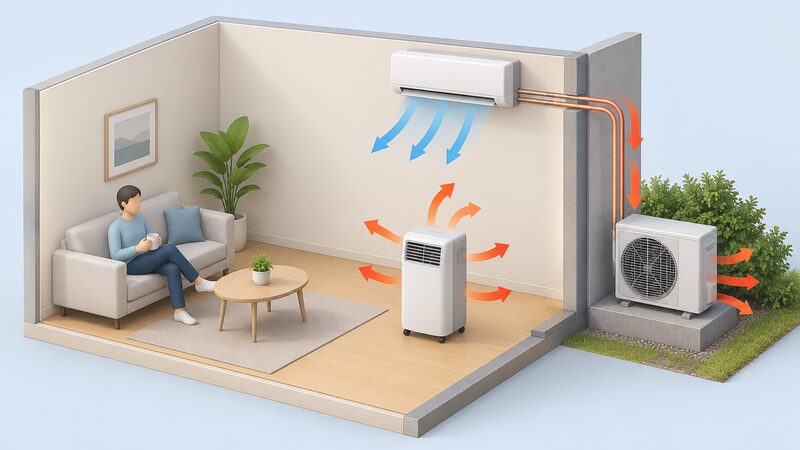
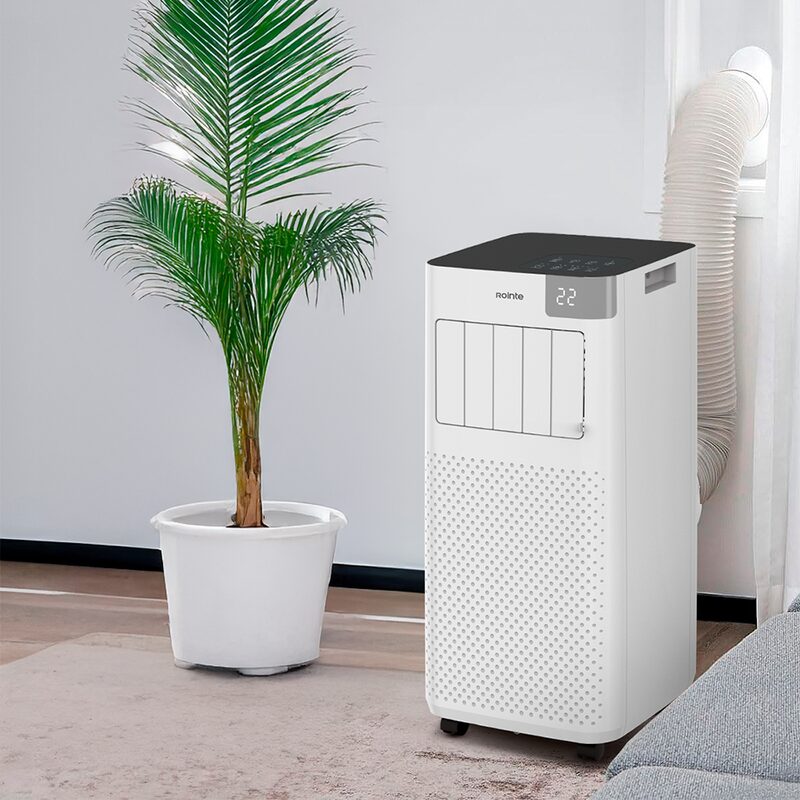
The choice between a split system and a portable air conditioner is the most common product-type decision a UK household faces, and the two are not variations on the same thing. A split system is built in two halves, an indoor unit and an outdoor unit, connected by a pipe1. A portable unit is a single box on castors that sits in the room and vents warm air out of a window2.
That structural difference drives everything else. Because a split puts part of the heat transfer outside the building, it cools more per unit of electricity: independent guidance puts portable units at 30 to 50% more electricity than fixed systems3. Portable units are cheaper to buy and need no installation, but they are less efficient, noisier and limited to small spaces4.
The practical split is therefore between a low upfront cost with no work and a higher upfront cost with professional installation. A portable unit is a plug and play set up with a hose vented out of a window or door2. A fixed system requires professional intervention, and by law a split type system needs an F-Gas registered engineer to install or at minimum commission it2.
Split vs portable at a glance
The two product types differ in configuration, installation, efficiency and where the hardware physically sits. A single-split air conditioner consists of one outdoor unit connected to one indoor unit8. A multi-split is a more advanced version of the same idea, where one outdoor unit is connected to multiple indoor units9. A portable packaged unit has no outdoor half at all: the entire system is installed indoors6.
| Split system | Portable unit | |
|---|---|---|
| Configuration | Indoor unit plus outdoor unit connected by a pipe1 | Single indoor box, no outdoor unit6 |
| Installation | Professional, F-Gas registered engineer required2 | Plug and play, hose vented out of a window or door2 |
| Efficiency | More efficient at cooling10 | 30 to 50% more electricity than fixed systems3 |
| Rooms served | One room for a single split; several for a multi-split9 | Small spaces only6 |
| Upfront cost | Higher; professional installation adds to it10 | £170 to £700 depending on capacity and features6 |
| Noise | Quiet, better performance than portable units4 | Noisier than a fixed unit4 |
The outdoor half of a split can be mounted on an outside wall, the roof or even a balcony10. A multi-split outdoor unit is compact enough to fit small spaces such as roofs or terraces and can even be installed on a wall8. That flexibility matters in flats and terraced housing where ground space is limited.
Portable units are described by makers as an auxiliary device with limited cooling capacity, and noisier than a fixed unit4. They are on castors so they can be wheeled from one room to another, but they can only cool small spaces6. Packaged air conditioners generally have less cooling capacity than split systems and are not powerful enough to cool a large room6.
For a household weighing energy independence, the split reduces the electricity drawn from the grid for a given amount of cooling, but it adds a permanent appliance with an outdoor unit and a refrigerant circuit that needs a certified engineer. The portable keeps the household free of installation and certification, at the cost of drawing more power and depending on a window that must stay closed around the vent.
Efficiency: why splits cool more per unit of electricity
The efficiency case for a split rests on where the heat goes. Split systems can be more efficient because some of the heat transfer takes place inside the building where it is warmer11. In a portable unit, the whole machine sits in the room it is cooling, so the compressor and the condenser both reject heat into that room, and the unit has to work harder to overcome its own output.
Independent guidance quantifies the gap: portable units use 30 to 50% more electricity than fixed systems3. Maker guidance agrees in direction, describing portable units as not as efficient as split units and noting that they tend to use more energy, especially when left running all day10. Split units are described as quieter, sleeker and more efficient at cooling10.
The gap widens further when a household needs more than one room cooled. A multi-split system is more energy-efficient than using several separate units, because it uses one outdoor unit for multiple indoor units, reducing overall energy consumption and maintenance costs compared to multiple single-split systems9. Running three portable units in three rooms means three compressors drawing power; running a multi-split means one outdoor unit serving three indoor units.
There is a wider context here that bears on how much a cooling appliance costs to run. Heat pumps are much more efficient than boilers, using three to four times less energy per unit of heat12, and direct electric heating such as infrared panels, storage heaters and electric boilers uses three to four times more electricity than a heat pump13. The same principle applies to cooling: moving heat with a compressor beats generating an effect with resistance or with a unit that fights its own waste heat.
Sizing matters as much for cooling as for heating. Heat pumps work most efficiently when they are precisely sized for the home; too big is expensive to run, too small feels the chill on the coldest days14. The equivalent rule for cooling is that an oversized unit cycles on and off and an undersized one runs continuously without reaching the set temperature.
Installation: what each type needs in a UK home
The installation rules are the sharpest dividing line between the two types, and they are legal rather than merely practical. By law, all split type air conditioning systems require an F-Gas registered engineer to carry out the installation or at a minimum a commissioning of the system, except DIY category monobloc products2. Splits have higher installation costs due to refrigerant charging, which requires an F-Gas Certified installer12.
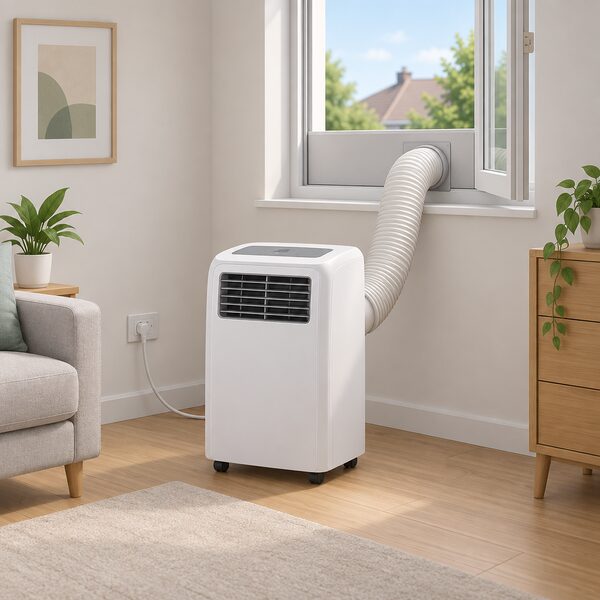
Portable units sit outside that regime entirely. They need no proper or professional installation and are more of a plug and play set up, with a hose vented out of a window or door2. If a portable air conditioner is bought, no work is required; fixed models must be fitted by a professional4. Several companies should be contacted for quotes4.
There is one middle path. Easy-Fit single split systems are designed for quick, simple installation without the need for a professional engineer, because pre-charged pipework means no refrigerant handling is required15. A single split system consists of one indoor unit connected to one outdoor unit, offering targeted climate control15. These are recommended for bedrooms, living rooms, garden offices and small commercial spaces15. The guide to DIY air conditioning installation sets out how pre-charged systems differ from a standard split, and the F-Gas rules for home air conditioning explain the certification requirement in full.
On planning, most AC units fall under permitted development rights, meaning no planning application is required to install them7. The position changes in protected areas: if a home is in a Conservation Area then permission will be required, and a listed building needs listed building consent16. For air source heat pumps on listed buildings, both planning permission and listed building consent are needed17. Scotland has its own permitted development legislation for domestic air source equipment, and development which does not meet the criteria or thresholds within the legislation will not be considered permitted18. The England, Scotland, Wales and Northern Ireland pages cover the national variations.
Noise, looks and where the unit sits
Noise is where the portable unit's single-box design costs the household most. A packaged air conditioner can be noisier than a split system because the entire system is installed indoors, so more of the mechanical noise is heard in the room6. Portable air conditioning is described as an auxiliary device with limited cooling capacity and noisier than a fixed unit4. Fixed air conditioning, by contrast, is described as quiet with better performance than portable units4.
The trade-off is that a split moves some of its noise outside, and that outdoor unit can become a neighbour issue. Multi-split systems carry the disadvantage that the outdoor units can be noisy, alongside complex and potentially expensive fitting work and a high purchase price4. The page on air conditioning noise deals with indoor and outdoor levels and the neighbour question.
Placement is constrained in different ways for each type. A portable unit has to sit near a window or door for its vent, and the room must be kept closed while it runs, because air conditioning works best in a completely sealed environment and all windows and doors should be kept closed to achieve optimum results2. That is an awkward combination: the vent occupies the window opening while the rest of the window must stay shut.
A split's indoor unit is wall-mounted and out of the way, and its outdoor unit can go on an outside wall, the roof or a balcony10. A multi-split outdoor unit fits small spaces such as roofs or terraces and can even be installed on a wall8. For flats and homes without ground access, that mounting flexibility is often what makes a split possible at all. The guide to air conditioning in flats covers lease and consent issues, and air conditioning without an outdoor unit covers the through-wall alternatives.
Servicing differs too. Portable air conditioning units are not usually equipped with service valves, so they do not require full services, but their mesh filters require regular cleaning2. Standard air conditioners and portable units do not require a water connection2. The maintenance page sets out filter cleaning and servicing schedules.
Cost: purchase price and running costs
Portable models tend to be less expensive upfront compared to split systems10. Portable packaged air conditioners can cost between £170 and £700, depending on their capacity and features6. Split systems carry a higher purchase price, and the professional installation adds to it10. A split air conditioning system is described as a cost-effective solution with lower upfront costs and simpler installations compared to the alternatives, which in that comparison means other fixed system types rather than portables9.
Running costs are where the efficiency gap shows up in pounds. Independent guidance gives a typical portable air conditioner of 1,000 to 1,500W a cost of around 26 to 39p per hour, roughly 14 to 20 times more than a fan5. A standard fan is put at 20 times less than portable air conditioners19. The 2.2 million homes with portable air conditioning units use 1kW of power20.
The pattern is that a portable unit is cheap to buy and expensive to run, while a split is expensive to buy and cheaper to run for the same cooling. Over a long, hot summer the running cost difference narrows the upfront gap, and over several summers it can close it. The running costs page works through the arithmetic, and the cost to run a portable air conditioner per hour covers the portable case in detail.
For a household thinking about energy independence, the split draws less electricity from the grid for the same comfort, which matters more as cooling demand grows. But it also introduces a permanent dependency: a certified engineer for installation and any refrigerant work, and an outdoor unit that needs a suitable mounting position. The portable keeps the household independent of installers and certification, and dependent instead on a window, a vent and a higher electricity draw. Neither removes the grid connection, and neither stores energy. The cooling and energy independence page sets both against the wider question of how a home supplies its own power.
Sources20 cited
- How does air conditioning work, Hitachi Air Conditioning, 2026-09-17
- FAQs, Cooleasy, 2026-09-23
- How to keep your home cool in hot weather, Centre for Sustainable Energy, 2026-07
- Home air conditioning, Netatmo, 2026-09-20
- Summer energy tips, National Energy Action, 2026-08-13
- Packaged air conditioning, Netatmo, 2026-09-20
- Eight facts about air conditioning, Carbon Brief, 2026-07-10
- How to choose your air conditioner location, Daikin UK, 2026-09-20
- How to choose the right home air conditioning, Mitsubishi Electric, 2025-04-07
- Guide to air conditioning units, EDF Energy, 2024-05-22
- Air source heat pumps, Energy Saving Trust, 2026-07-16
- Reduce the cost of heat pumps, Nesta, 2022-03-02
- Seven reasons we still need heat pump subsidies, Nesta, 2025-11-20
- Is your home heat pump ready, CIBSE, 2026-05-07
- Easy-Fit single split air conditioning systems, Cooleasy, 2026-09-23
- Is permission needed for installing new roof tiles, Planning Portal, 2026
- Heat pumps, New Forest District Council, 2026-09-17
- Permitted development rights for domestic air source heat pumps, Scottish Government, 2015-11
- Do fans work in hot weather, Ecotricity, 2025-07-15
- The cost of keeping cool, Uswitch, 2026-04-30
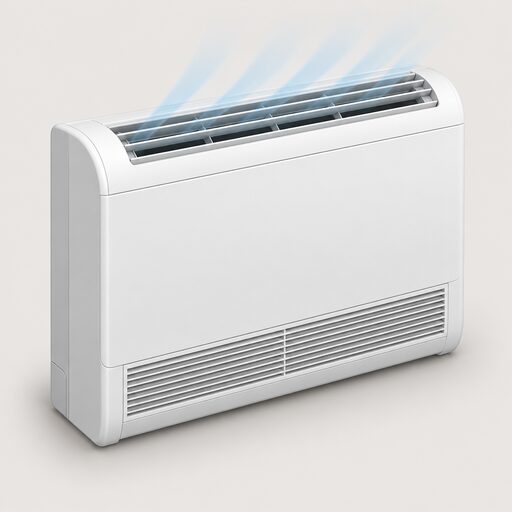 Split Air ConditioningA split air conditioning system cools or heats one room using an indoor unit and an outdoor unit linked by pipes.
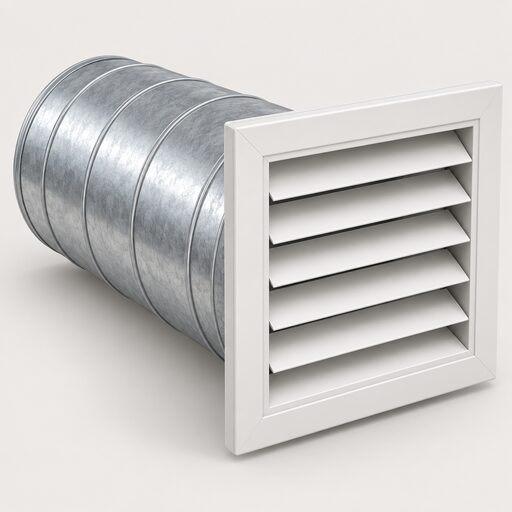 Types of Air ConditioningPortable, wall-mounted, multi-room or ducted: which air conditioning suits your home?
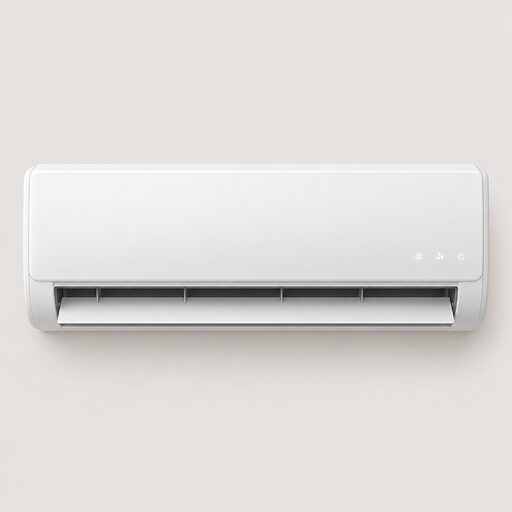 Air Conditioning CostPublished UK equipment prices and the parts of an installed price for portable, single split, multi-split and whole-house air conditioning.
 Cooling and Heat PumpsCan an air conditioner heat your home as well as cool it?
 Running CostsA portable air conditioner costs roughly twenty to forty pence for every hour it runs, while a fixed unit uses far less electricity for the same cooling.
 The Full Cooling and Air Conditioning GuideDo you really need air conditioning in a British summer, or would a fan and better shading do the job?