
In this comparison
A split air conditioner is more efficient than a portable one. Independent guidance puts portable units at 30 to 50% more electricity than fixed systems for the same cooling, and one maker states that a portable A+ class model can consume 2.4 times more electricity than a wall-mounted unit of the same class1. The reason is structural: a split system keeps its compressor and condenser outdoors, while a portable unit carries the whole refrigeration cycle inside the room it is trying to cool.
The trade-off is upfront cost and installation. Portable packaged units cost between £170 and £700 depending on capacity and features, while a fixed wall-mounted unit costs more than a portable model but is generally more efficient at cooling the home3. A split system also needs a permanent outdoor position and a qualified installer, which a portable unit does not.
For a household weighing energy independence, the split unit reduces the electricity drawn from the grid for each hour of cooling, but it adds a fixed installation and a manufacturer's service network to the equation. A portable unit keeps the purchase simple and the installation free, at the cost of higher running consumption and more noise in the room.
Split vs portable: the short answer
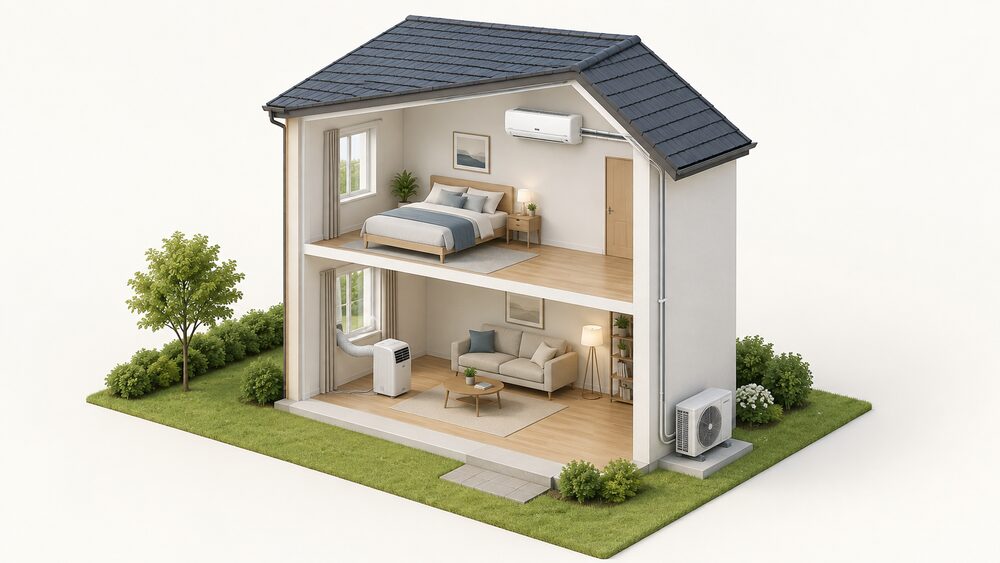
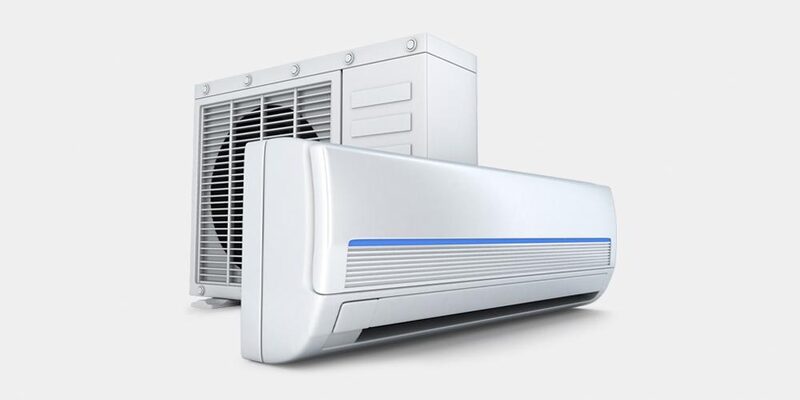
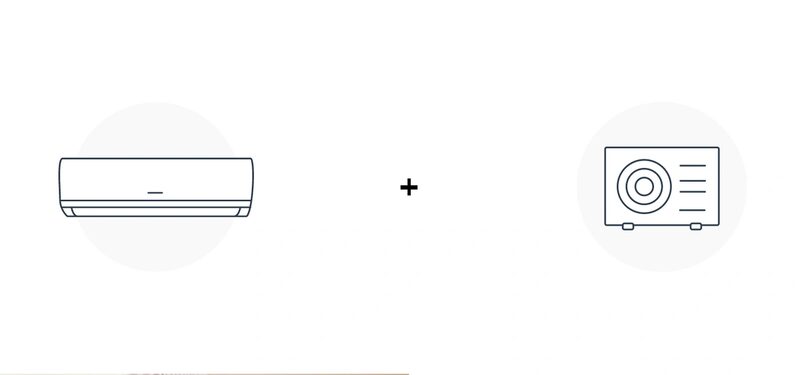
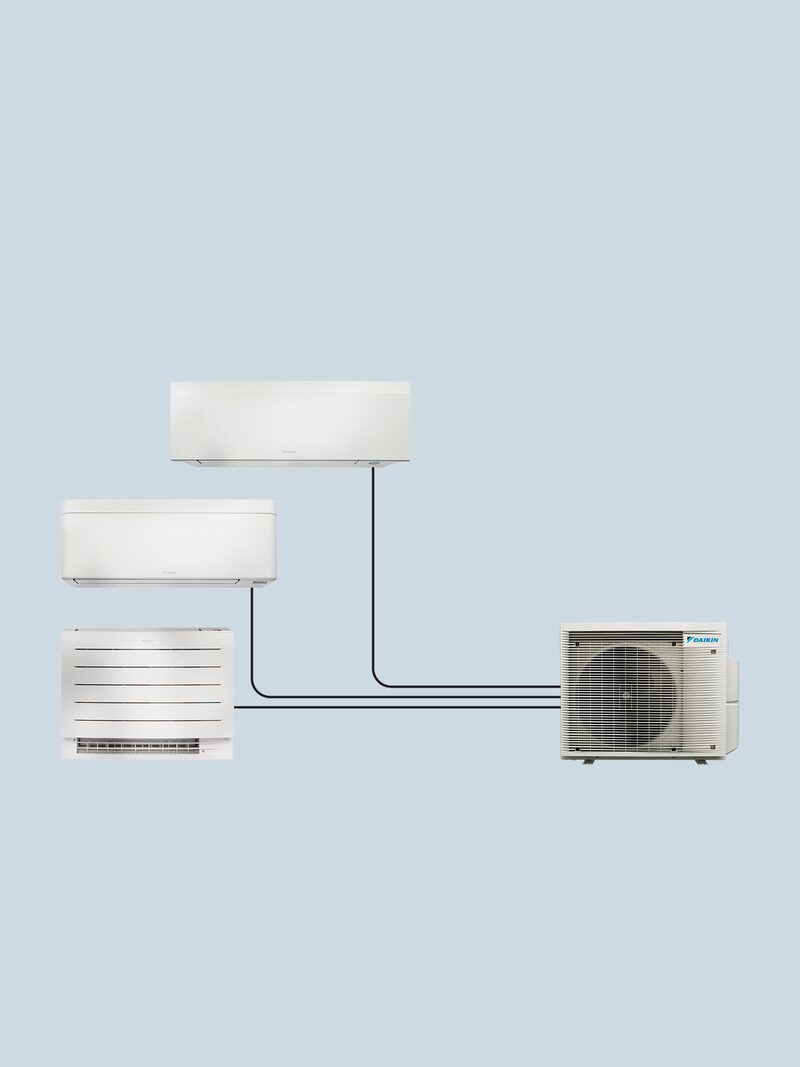
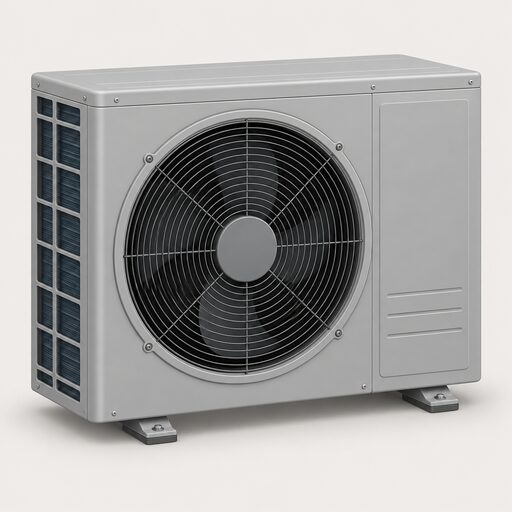
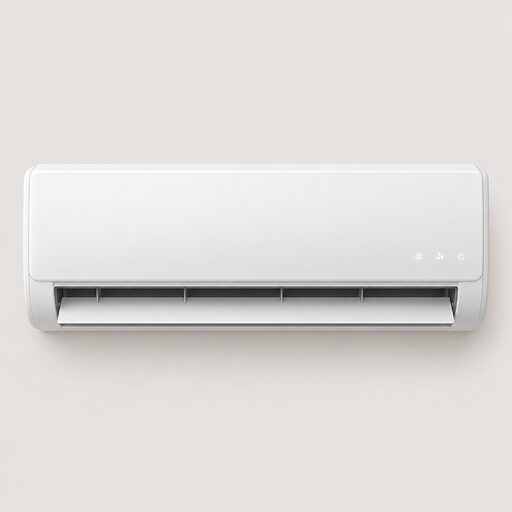
A split system is two halves, an indoor unit and an outdoor unit, connected by refrigerant pipework6. A portable air conditioner is a single box that sits on the floor, usually with an exhaust duct to a window. That physical difference drives everything else: efficiency, noise, purchase price and where each type can be used.
Maker guidance is direct on the efficiency question. Split-unit air conditioners are known to be very energy efficient, while portable units, though less expensive upfront, are not as efficient as split units and tend to use more energy, especially when left running all day1. Independent guidance agrees, putting portable units at 30 to 50% more electricity than fixed systems1.
The gap is not marginal. A portable A+ class model, which looks efficient on its energy label, could still consume 2.4 times more electricity than a wall-mounted unit of the same class2. That figure comes from a maker's own comparison, so it describes that maker's product line, but it matches the direction and rough scale of the independent range.
Portable units still have a place. Maker guidance notes they suit temporary set-ups or rooms under 10 m², but for longer-term or larger-room cooling a fixed system is the better fit5. Packaged air conditioners generally have less cooling capacity than split systems and are not powerful enough to cool a large room3.
Efficiency compared: how much more a split unit delivers
The headline comparison is the 30 to 50% electricity penalty carried by portable units against fixed systems1. That is independent guidance, and it is the figure to hold on to when comparing two products on a shop floor.
A maker's product page for the Midea PortaSplit claims 4x more efficiency and 6x more cooling power than conventional portable AC units7. Those are maker claims for one product, not a general rule, and they compare a specific portable split design against conventional portable units rather than against a fixed wall-mounted split. They are worth reading as an illustration of how far a well-designed portable can close the gap, not as a substitute for the independent range.
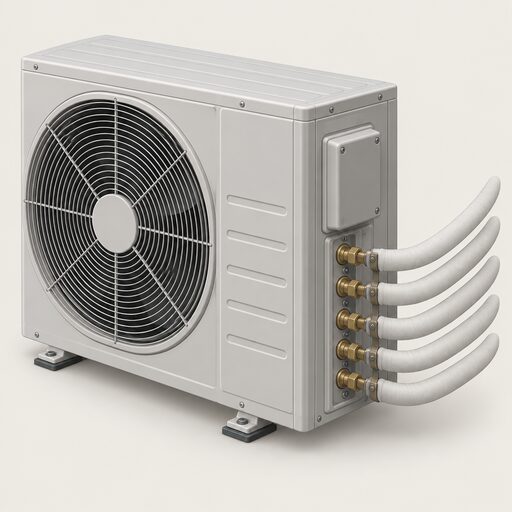
Where a household needs more than one room cooled, a multi-split system using one outdoor unit for several indoor units is described as more energy-efficient than using several separate units, reducing overall energy consumption and maintenance costs compared to multiple single-split systems9. That is a different comparison from split versus portable, but it matters for anyone cooling more than one room.
For context on how efficient cooling can get, an air-source heat pump typically uses three to four times less energy than a gas boiler to produce the same amount of heat, and the same equipment can run in reverse for cooling10. Natural and powered ventilation can be much more efficient than traditional air conditioning11. A split air conditioner sits between a portable unit and a full heat pump system on the efficiency scale.
| System | Efficiency position | Source type |
|---|---|---|
| Portable air conditioner | 30 to 50% more electricity than fixed systems | Independent guidance1 |
| Portable A+ class model | 2.4 times the electricity of a wall-mounted unit of the same class | Maker guidance2 |
| Fixed wall-mounted split | More efficient at cooling than a portable model | Maker guidance3 |
| Multi-split (one outdoor, several indoor) | More energy-efficient than several separate single-split units | Maker guidance9 |
Why split units are more efficient at cooling
The efficiency advantage of a split system comes from where the heat goes. Split systems can be more efficient because some of the heat transfer takes place inside the building where it is warmer12. In a portable unit, the condenser sits in the room being cooled, so the heat it rejects has to be ducted out through a window, and some of it leaks back into the room. The compressor also adds its own motor heat to the same space.
A split system moves that entire process outdoors. The indoor unit absorbs heat from the room air and the outdoor unit rejects it to the outside air, with no duct to leak and no compressor noise in the room. That is why the same nominal cooling output can be delivered with less electricity.
The configuration also affects how many rooms one system can serve. A split system consists of just one indoor unit connected to one outdoor unit, and is described as a cost-effective solution with lower upfront costs and simpler installations compared to the alternatives9. A multi-split modulates air conditioning in several rooms independently and is more powerful than a monobloc unit, so it can cool larger areas13. Ferroli describes its split heat pumps as offering greater installation flexibility from the split configuration, with an outdoor unit connected to an indoor unit14.
Portable units cannot match that. A packaged air conditioner can be slightly less energy efficient than other types, using more energy and leading to higher electric bills, because the entire system is installed indoors3. The design constraint is physical, not a matter of build quality.
Running costs: what the efficiency gap means on your bill
Running cost follows electricity use. A typical portable air conditioner rated at 1,000 to 1,500W can cost around 26 to 39p per hour, roughly 14 to 20 times more than a fan4. That figure is for a portable unit; a split system delivering the same cooling would draw less power for the same output, so the hourly cost would be lower.
The scale of air conditioning consumption is easy to underestimate. Some air conditioners can use the same amount of energy in one hour that a fridge uses in a day15. A portable unit drawing 1kW of power is the figure used in a press release noting that 2.2 million homes have portable air conditioning units16. Air conditioners generally tend to use a lot of electricity, leading to higher bills17.
For a household thinking about independence, the running cost is the recurring dependence: every hour of cooling is electricity bought from a supplier. A split unit reduces the number of units drawn per hour of cooling, which lowers both the bill and the load on the grid. It does not remove the dependence, because the system still runs on mains electricity.
Where a household has a heat pump already installed, the same equipment can provide cooling. An air-to-air heat pump has lower running costs than other types of electric heating and plug-in air conditioning7. That is the closest thing to a whole-home cooling solution that also serves heating, and it changes the calculation for anyone already considering a heat pump for winter.
Noise and comfort: the other practical differences
Noise is the difference a household notices first. Split units are described as quieter, sleeker and more efficient at cooling1. Fixed air conditioning is listed with quiet operation and better performance than portable units as its advantages13. A portable unit is described as an auxiliary device with limited cooling capacity and noisier than a fixed unit13.
The reason is the same as the efficiency reason. With a package system, the entire system is installed indoors, so more noise is audible than with a split system3. The compressor, the fan and the refrigerant flow all sit in the room being cooled. A split system moves the noisiest components outside.
Some split indoor units go further. The Daikin Multi+ Class 90 indoor unit has a quiet operation mode which reduces the sound pressure by reducing the airflow rate18. That is a maker specification for one product, but it illustrates the control a fixed system gives over noise in a bedroom or living room.
Comfort follows noise. A portable unit's limited cooling capacity means it works harder and longer to hold a temperature, and the duct to the window is a permanent opening for warm air unless it is sealed properly. A split system holds a set temperature with less cycling, and a multi-split can modulate several rooms independently13. For a bedroom used overnight, the difference between a compressor running beside the bed and one running outside the wall is the difference between sleeping and not.
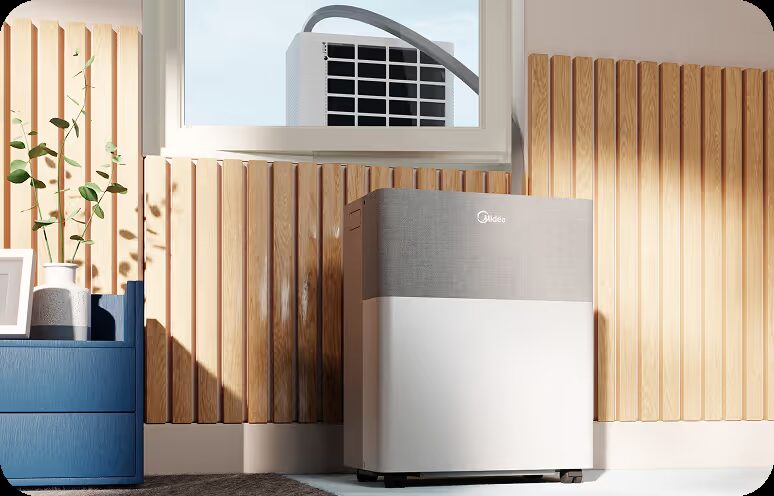
Cost to buy: where split and portable units sit
Portable packaged air conditioners cost between £170 and £700, depending on their capacity and features3. That is the maker guidance figure, and it covers the range from a small single-room unit to a larger model. A fixed wall-mounted air conditioner costs more than a portable model, but is generally more efficient at cooling the home3.
The purchase price is only part of the split system's cost. A split installation needs an outdoor unit position, refrigerant pipework through a wall, and a qualified installer. None of that is included in the unit price, and prices for installation are quoted by installers rather than published as a standard rate. A portable unit needs no installation at all.
A single-packaged air conditioner costs less than installing a system with multiple units19. That is the comparison for anyone considering a multi-split: the upfront cost rises with each additional indoor unit, even though the running efficiency improves.
| Portable packaged unit | Fixed wall-mounted split | |
|---|---|---|
| Purchase price | £170 to £700 depending on capacity and features3 | More than a portable model3 |
| Installation | None required | Professional installation needed |
| Cooling capacity | Less than split systems; not enough for a large room3 | Generally more efficient at cooling the home3 |
| Running cost | Around 26 to 39p per hour for 1,000 to 1,500W4 | Lower per hour of cooling, from lower electricity use1 |
Which type fits which home
The choice turns on room size, how long the unit will be used, and whether a permanent outdoor position is available.
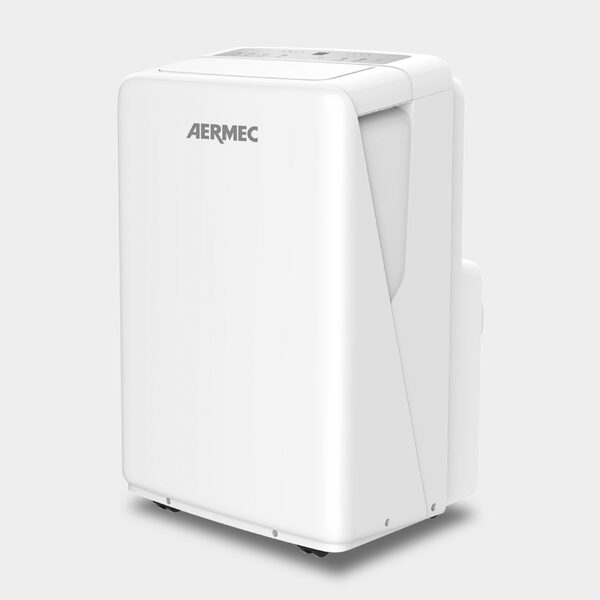
Portable units suit temporary set-ups or rooms under 10 m²5. They also suit rented homes where fixed installation is not possible, and households that need cooling for a few weeks a year rather than a full season. The Aermec PST is described as a portable air conditioner ideal for heating, cooling, dehumidification or ventilation both at home and at the office20.
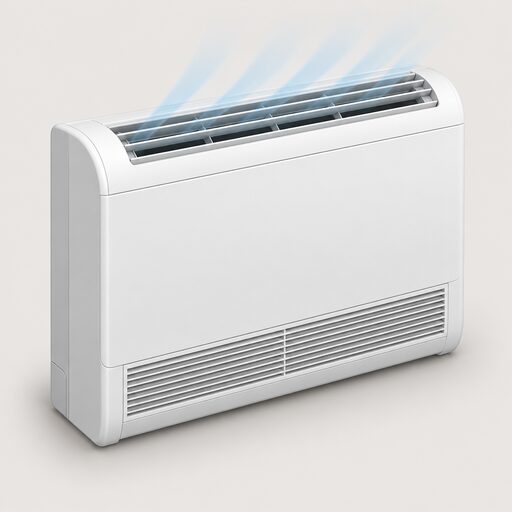
Split systems suit regular use and larger rooms. The residential range includes multi-split, ducted systems, cassette type, window type and floor mounted consoles, so the indoor unit can be matched to the room6. Split systems are available for living rooms, bedrooms and children's rooms, including models with self-cleaning filters and models capable of cleaning the room air11.
For a household already considering a heat pump, the calculation changes. An air-source heat pump can cool as well as heat, and the same unit can serve both seasons10. That is a larger investment than either a portable or a split air conditioner, but it addresses heating and cooling together rather than adding a separate cooling appliance.
Sources20 cited
- Guide to air conditioning units, EDF Energy, 2024-05-22
- How to keep your home cool in hot weather, Centre for Sustainable Energy, 2026-07
- Packaged air conditioning, Netatmo, 2026-09-20
- Heat the whole house or one room, Uswitch, 2026-08-13
- Air-to-air heat pumps for small rooms, Daikin UK, 2026-09-17
- How does air conditioning work, Hitachi Air Conditioning, 2026-09-17
- Midea PortaSplit, tado, 2026
- Midea PortaSplit, tado, 2026
- How to choose the right home air conditioning, Mitsubishi Electric, 2025-04-07
- How a heat pump can cool your home, Which?, 2026-07-17
- Home cooling, CAT, 2025-06-27
- Air source heat pumps, Energy Saving Trust, 2026-07-16
- Home air conditioning, Netatmo, 2026-09-20
- Split heat pumps, Ferroli, 2026-09-17
- How to save on your energy bill, Which?, 2026-08-27
- The cost of keeping cool, Uswitch, 2026-04-30
- Summer energy tips, National Energy Action, 2026-08-13
- Daikin Multi+ Class 90, Quiet Mark, 2026-09-17
- How does air conditioning work, Netatmo, 2026-09-20
- PST portable air conditioner, Aermec, 2026-09-17
 Split Air ConditioningA split air conditioning system cools or heats one room using an indoor unit and an outdoor unit linked by pipes.
 Running CostsA portable air conditioner costs roughly twenty to forty pence for every hour it runs, while a fixed unit uses far less electricity for the same cooling.
 Cooling and Heat PumpsCan an air conditioner heat your home as well as cool it?
 Air Conditioning CostPublished UK equipment prices and the parts of an installed price for portable, single split, multi-split and whole-house air conditioning.
 Passive Cooling at HomeKeeping a home cool without air conditioning comes down to blocking heat before it gets in, then letting trapped heat out.
 Multi-Split ACHow multi-split air conditioning works when one outdoor unit serves several indoor units: how many rooms one system can serve, independent room control, efficiency, outdoor unit size and sound, planning rules in England and Scotland, servicing and lifespan, the 0% VAT position and how it compares with separate single splits.