
In this comparison
A dual fuel tariff provides both gas and electricity from the same supplier, on one contract and one bill1. It is the default shape of the domestic market: pretty much all energy suppliers offer dual fuel tariffs, because they are cheaper and easier to manage for both the supplier and the household2. Whether it is cheaper than buying the two fuels separately is a different question, and the honest answer is that it depends on the discount and on the unit rates behind it.
There is no guarantee that a dual energy deal is cheaper than separate gas and electricity tariffs, though suppliers tend to pass on some savings3. Most suppliers offer a discount for dual fuel, which makes the combined deal cheaper than separate gas-only and electricity-only tariffs in many cases, but in some cases separate suppliers could be cheaper4. The discount is the mechanism that usually decides it, and it is worth less than most households assume.
The cap for 1 October to 31 December 2026 is £1,723 a year for a typical dual fuel household paying by Direct Debit, a rise of about £60 on the previous quarter6. That figure describes a dual fuel standard variable account, not a saving.
What dual fuel offers a UK household
A dual fuel tariff offers one contract for both gas and electricity9. The same tariff covers both fuels with the same supplier, so a household does not have to switch each fuel separately, and there is one point of contact when something goes wrong4. Billing follows the same logic: one monthly or quarterly invoice covering both gas and electricity3.
The arrangement is not universal by rule. Whether an energy supplier offers a dual fuel tariff is completely up to them, and it can differ from supplier to supplier, though most suppliers offer one1. Where a supplier does offer it, the discount is common but not automatic: a lot of energy suppliers offer a discount on energy if a household takes out a dual fuel tariff, and some suppliers offer a discount for having both fuels with them, so it can work out cheaper to be on a dual fuel tariff1.
The alternative is two single fuel contracts, one for gas and one for electricity, potentially with two different companies. That route keeps the fuels separable, which matters if one supplier is strong on electricity rates and another on gas. It also means two bills, two sets of terms and two points of contact.
Business energy works differently and is worth separating out: there is no dual fuel option, so a business needs separate contracts for gas and electricity4. Domestic households have the choice; small commercial premises generally do not.
For a household already on two separate single fuel tariffs, moving to dual fuel is straightforward. Yes, if you are on two separate single fuel tariffs for both your gas and electricity, you can switch to a dual fuel one with no problem1. The eligibility condition is simply that the household uses both fuels: to use this tariff you must use both gas and electricity10.
What the specifications actually are
The specification of a dual fuel tariff is not a piece of hardware, so the useful comparison is structural: how many contracts, how many bills, how the rate is set, and what happens at the end of a fixed term.
| Feature | Dual fuel | Two separate tariffs |
|---|---|---|
| Contracts | One contract for both fuels9 | One per fuel, possibly two suppliers |
| Billing | One monthly or quarterly invoice3 | Two invoices |
| Discount | Commonly offered for taking both fuels1 | Discount lost |
| Exit fee on a fixed term | Payable for both types of energy3 | Payable per contract |
| Rate basis | Fixed or variable, depending on tariff3 | Set per fuel |
| Business equivalent | Not available4 | Separate contracts required4 |
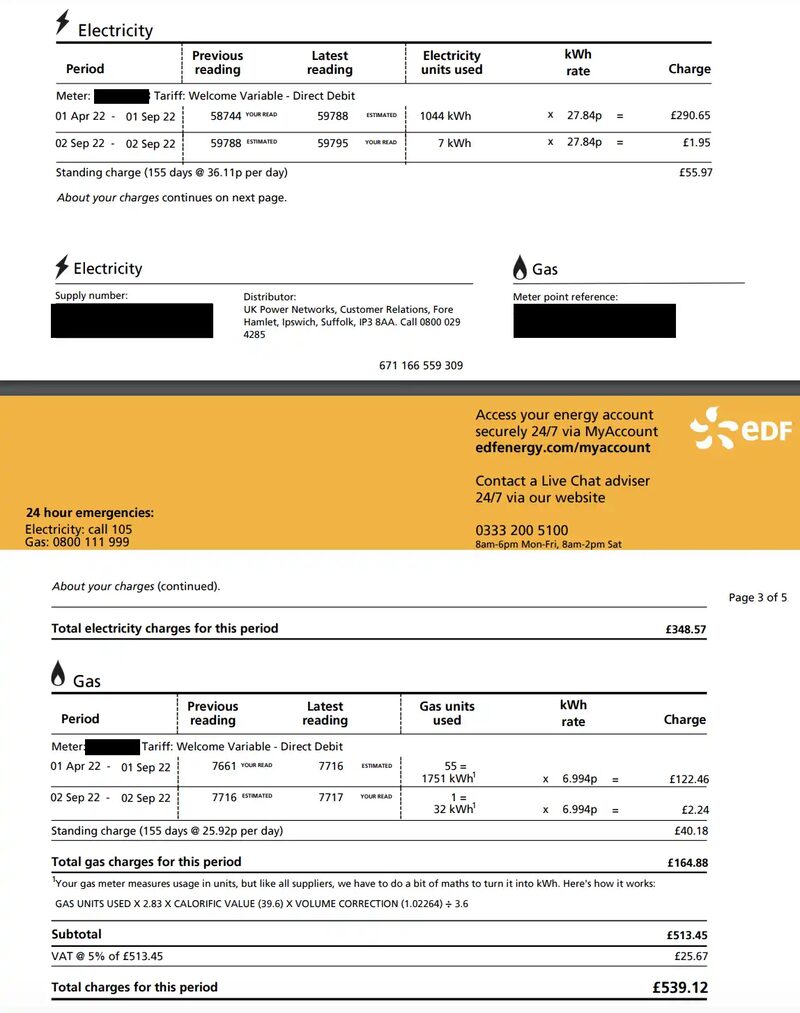
The rate basis matters as much as the structure. On a variable rate dual fuel tariff, the rate paid changes depending on the wholesale, or industry, price of energy3. A standard variable dual fuel tariff will cost more than a fixed dual fuel tariff most of the time1. That is a statement about tariff type, not about dual fuel against separate supply, and the two questions are often confused.
There is a regulatory layer underneath the pricing. Ofgem's retail market review set out that dual fuel discounts and online discounts have to be presented in pounds per year, and they have to have the same terms11. Dual fuel and online account management discounts remain, and are treated not as core tariffs but as a discount12. Closed fixed term tariffs were exempted from the requirement for features such as surcharges, bundles, reward points, payment method differentials, dual fuel discount and online discount to be the same across all tariffs13.
The cap itself is built on three separate caps for gas, single-rate electricity and multi-rate electricity, rather than one combined number14. A dual fuel bill is therefore the sum of two regulated components, and the headline £1,723 is a typical consumption figure rather than a ceiling on any individual household's bill.
What the discount and the exit terms cover
The dual fuel discount is the whole financial case for combining supply, and its recorded value is modest. Ofgem's 2012 review found the average dual fuel discount for a typical direct debit and QCC customer on a standard tariff with one of the major suppliers was 0.7%, or £97. A much earlier consultation recorded a yearly discount of £14.50 for dual fuel customers15. The figures are from different periods and different market structures, and they are not directly comparable, but both point the same way: the discount is a small percentage of the bill, not a structural saving.
Exit terms are where dual fuel can cost more than expected. On a fixed term dual fuel tariff, an exit fee is payable for both types of energy if the household wants to get out of the contract early3. Fees are sometimes quoted per fuel, so £25 per gas or per electricity, which doubles to £50 for a dual fuel account8. The free window is the same as for single fuel: a tariff can be changed for free if there are less than 50 days left on the contract3.
The discount is not the only thing that can disappear. Where a household holds two single fuel contracts, leaving one early affects only that fuel. On dual fuel, one decision ends both supplies, and the household has to arrange replacements for gas and electricity together.
What dual fuel costs, and how it compares
The current reference point is the cap. From 1 October to 31 December 2026, the typical dual fuel standard variable bill is £1,723 a year, a rise of about £60 on the previous quarter6. The cap protects existing and future domestic customers on standard variable and default tariffs16.
Historic figures show how the components have moved. Ofgem's 2016 breakdown of a dual fuel bill attributed 38% to wholesale costs, 26% to network costs, 8% to policy costs, 1% to other direct costs, 17% to operating costs, 5% to profit and 5% to VAT14. On a dual fuel bill, an average consumer paid £475 in 2011, rising to £515 in 2012, in other costs including VAT17. The Committee on Climate Change concluded in 2011 that household energy bill increases were caused primarily by the rising cost of gas, not environmental policies18.
Supplier cost data gives a sense of scale. Ofgem calculated a weighted average of £230 per dual fuel customer for 2019 core operating costs, in 2023 prices19. In cap period eight, a 1% additional risk allowance was worth around £9 per dual fuel customer annualised, and a Contracts for Difference benefit was calculated at £7 per dual fuel customer annualised20. Shaping and imbalance costs were put at £17 per customer for non-PPM dual fuel and £22 for PPM dual fuel during the same period; the documents give a second, higher non-PPM figure of £66 and the two are not reconciled21.
For context on how these numbers have moved, a medium usage dual fuel standard variable customer paying by direct debit was estimated at around £1,142 a year using revised Typical Domestic Consumption Values in 201920, and an alternative TDCV calculation using 2019 and 2021 data produced around £2,379, described as £121 lower than using the then current TDCVs19. The comparison basis for the six larger suppliers' standard variable tariffs is an annual average on a dual fuel basis22.
Where dual fuel is not the cheaper option
The case against dual fuel rests on three things: the discount is small, the comparison is not like for like, and the market does not always let a household price the alternative easily.
First, the discount. At 0.7%, or £9, on a 2012 standard tariff, the saving is a rounding error against a bill of over a thousand pounds7. A supplier that prices its electricity keenly and its gas poorly can be beaten on one fuel by a competitor even after the dual fuel discount is applied. Some suppliers offer a discount for having both fuels with them, so it can work out cheaper to be on a dual fuel tariff, but in some cases separate suppliers could be cheaper4.
Second, comparison friction. Some comparison services can currently only show dual fuel deals, which limits a household's ability to price two separate suppliers side by side5. That is a constraint of the tools rather than of the market, but it shapes what households actually see.
Third, gas-only supply is a real option. Several suppliers offer green gas tariffs without requiring a household to sign up for electricity or dual fuel5. A household with a heat pump, or one generating its own electricity, may have little reason to buy electricity and gas from the same company.
The counterweight is administrative. It is less admin to deal with one energy company23. For a household that values a single point of contact and a single direct debit, that has value even where the discount is small.
The companies behind the comparison

The comparison services a household uses to weigh dual fuel against separate tariffs are companies in their own right, and their status matters when something goes wrong. Energy Swap is listed as active, Go Compare Energy Ltd is listed as active, MyBillsCompare is listed as active, and Your Energy Matters is listed as active, all as of 19 September 202624. None of these entries records a failure or an administration.
Suppliers themselves are covered by conduct rules rather than by a single status register. Ofgem's standards of conduct for suppliers apply to domestic consumers12. Separately, the fuel mix disclosure Standard Licence Condition requires suppliers to include data relating to a tariff's fuel mix and its environmental impact on at least one bill for each financial year and on all promotional materials28. That is the mechanism by which a household can see what it is buying, whether on dual fuel or on two single fuel contracts.
Scale is worth noting. A 2000 consultation estimated there were up to 6.8 million dual fuel customers nationally at October 2000, a revised estimate15. The market has grown far beyond that since, and dual fuel is now the ordinary way domestic supply is sold.
What dual fuel means for energy independence
Dual fuel is an administrative simplification, not an independence measure. It reduces the number of companies a household deals with, and it does nothing about the physical dependence underneath: the gas grid, the electricity network, and the wholesale market that sets the price of both.
The dependence it creates is specific. One supplier holds both fuels, so a supplier failure exposes both supplies at once rather than one. The exit fee structure reinforces that: leaving a fixed dual fuel contract early means paying for both fuels3. A household on two single fuel contracts has two separate relationships and can end one without disturbing the other.
The dependence it removes is also real but narrow. One contract, one bill and one point of contact reduce the administrative load23. For a household without generation or storage, that is the whole of the benefit.
Where a household does generate, the picture changes. The Smart Export Guarantee pays for exported electricity, and at least one export tariff requires energy supply plus two or more additional services29. A household exporting power and buying gas is not obviously served by bundling its import supply, and gas-only tariffs exist for exactly that situation5.
The wider point is that neither structure touches consumption. The 2016 bill breakdown put 38% of a dual fuel bill on wholesale costs and 26% on network costs14, and the 2011 conclusion that rising gas costs drove bill increases rather than environmental policy remains the clearest statement of what households are actually exposed to18. Choosing between dual fuel and separate tariffs changes who is paid and how many invoices arrive. It does not change how much energy the home uses, where it comes from, or what happens when wholesale prices move.
For households weighing the wider menu, the UK energy tariffs pillar sets out how fixed, tracker, time-of-use and export rates fit together, and dual fuel tariffs covers the single supplier arrangement in more detail. Where the decision is really about contract length rather than fuel bundling, fixed-rate energy tariffs and exit fees and tariff contract terms deal with the terms that apply either way.
Sources29 cited
- Dual fuel or single fuel tariffs, Energy Helpline, 2026-09-20
- Dual fuel, Confused.com, 2025-11-03
- How to compare dual fuel tariffs, Confused.com, 2025-11-03
- Types of energy tariff, Confused.com, 2025-11-03
- Gas, Energy Helpline, 2026
- Average gas and electricity bills in the UK, Uswitch, 2026-10-01
- Which? response to the retail market review, Ofgem, 2012-02-23
- What the Middle East conflict means for your energy bills, Which?, 2026-04-10
- Energy tariffs explained, Uswitch, 2026-02-17
- Choosing an energy tariff, Citizens Advice, 2023-08-24
- The retail market review: final domestic proposals, Ofgem, 2013-03-27
- New standards of conduct for suppliers, Ofgem, 2013-08-27
- The retail market review: statutory consultation on domestic proposals, Ofgem, 2013-04
- Default tariff cap: policy consultation overview, Ofgem, 2018-05-25
- Review of domestic gas and electricity competition and supply price regulation, Ofgem, 2001-11
- Energy price cap wholesale costs review, Ofgem, 2023-12-15
- Ofgem figures show energy bills continue to rise rapidly, Carbon Brief, 2012
- Household energy bill increases caused primarily by rising cost of gas, Committee on Climate Change, 2011-12-15
- TDCV 2023 call for input, Ofgem, 2023-02
- TDCVs 2019 open letter, Ofgem, 2019-10-01
- Price cap: decision on possible wholesale cost adjustment, Ofgem, 2022-08-04
- Standard variable tariff prices compared with the default tariff cap level, Ofgem, 2019-01-01
- Switching your energy supplier, Energy Saving Trust, 2026-06-26
- Energy Swap, Energy Ombudsman, 2026-09-19
- Go Compare Energy Ltd, Energy Ombudsman, 2026-09-19
- MyBillsCompare, Energy Ombudsman, 2026-09-19
- Your Energy Matters, Energy Ombudsman, 2026-09-19
- Fuel mix disclosure Standard Licence Condition, UK Parliament, 2022-05-17
- Smart Export Guarantee, Solar Energy UK, 2026-05-12
 Dual Fuel TariffsExplains what a dual fuel tariff is, how discounts and single billing work, and where separate gas and electricity contracts remain available.
 Unit Rates by RegionWhy do electricity and gas prices differ depending on where you live?
 Green Energy TariffsDoes a green tariff really mean greener electricity comes into your home, or just that your supplier buys renewable certificates to match what you use?
 Wholesale Energy MarketsGas and electricity prices are set by several markets, and gas often decides the electricity price even when wind is blowing.
 Energy Price CapThe price cap sets the most you pay for each unit of gas and electricity, plus the daily standing charge, but not your total bill.
 Heat Pump Electricity TariffsA heat pump tariff gives you cheaper electricity for part of the day, so running your heating costs less than on a standard rate.