

In this comparison
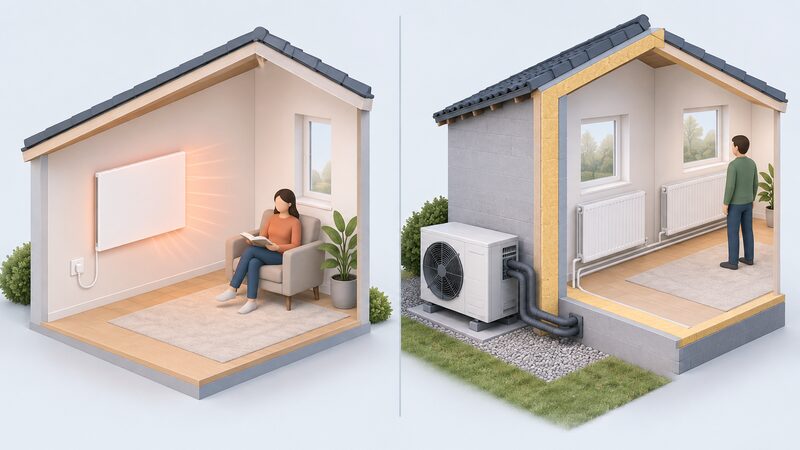
Infrared heating panels and heat pumps are both electric heating, but they are not the same proposition. A panel converts electricity to radiant heat at the point of use, and independent guidance puts the electricity it draws at two to four times that of a heat pump for the same amount of heat delivered1. A heat pump moves existing heat from the air or ground rather than creating it, which is why it needs less electricity for the same warmth.
The practical difference is the tariff. Infrared heating is a type of direct electric heating, and electricity costs about four times as much as gas for the same amount of energy1. A panel that is 100% efficient at the socket is still buying an expensive unit of energy, while a heat pump buys fewer units. Independent analysis of direct electric systems, including infrared panels, storage heaters and electric boilers, notes that they share a key flaw: they use three to four times more electricity than a heat pump2.
That does not make infrared panels useless. They are cheap to buy, quick to install, need no pipework and suit a single room, a well-insulated flat or a home where a wet system is impractical. What follows sets out how each works, what the running costs look like, where the evidence is thin, and which homes each option fits.
Infrared panels vs heat pump: the short answer
The short answer is that a heat pump delivers the same warmth for a fraction of the electricity, and infrared panels win on simplicity and upfront cost rather than on running cost. Independent guidance is direct on the comparison: heat pumps use less electricity than infrared heating to produce the same amount of heat, typically two to four times less1. The same figure appears in guidance on electric wallpaper, which states that heat pumps use two to four times less electricity than infrared heating for the same heat5.
Against that, infrared heating could be less expensive to install than a boiler or heat pump and radiators for a whole house system, though it will cost more than simply replacing an existing boiler1. That is the trade: lower capital, higher running cost per unit of heat.
Infrared heating is also a young market. One maker describes it as very much in its infancy in terms of where it is in the heating market6, which is a candid framing from a company that sells panels. Independent guidance is more measured, noting that a well-controlled infrared system will probably cost less to run than standard electric panel heaters, and might also be cheaper to run than storage heaters or electric underfloor heating depending on how they are controlled, but that there is little research available to confirm this1.
For a household thinking about energy independence, the distinction matters. Both options cut reliance on gas and on a gas supplier. A heat pump cuts the amount of electricity bought from the grid for each unit of heat, which is the larger lever on both bills and exposure to price swings. Infrared panels cut the installation barrier and the disruption, but leave the household buying more units of the most expensive common fuel.

How infrared heating works: radiant heat, not warm air
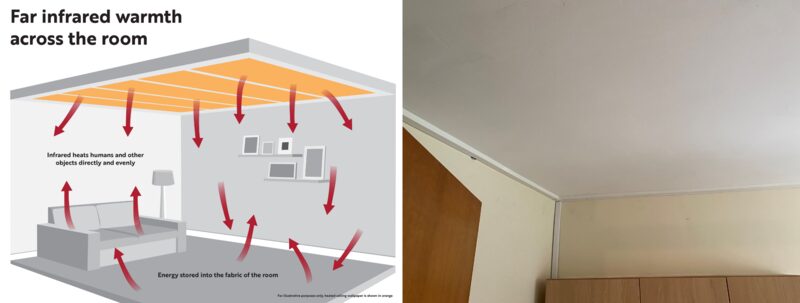
Infrared heating systems provide heat via radiation, with heat radiating outwards from the heater and warming any surfaces it comes into contact with1. That is a different mechanism from a radiator or a fan heater, which warm air and rely on that air circulating to carry warmth around the room. One maker describes the output as thermal radiation emitting infrared rays, the same kind of heat emitted by the sun6.
Because the heat lands on surfaces and people rather than on the air, the temperature profile of a room changes. Maker guidance claims that infrared panels ensure the gap in temperature between the top and bottom of a room is much smaller6. A related product page for far infrared underfloor heating makes the same point in different words: it directly heats humans and objects in the room rather than the entire space7.
The practical consequence is that a panel feels warm quickly to someone in its line of sight, and less so to someone behind a sofa or around a corner. Radiant heat travels in straight lines and is absorbed by whatever it strikes. That is why placement matters more than it does with a convection system, and why a panel on a ceiling aims its output downwards at the floor and the people on it.
There is no fan, no pump and no compressor in a panel. Independent guidance notes that infrared panels do not contain any moving parts and are practically silent8. That removes the noise and the draught that some people dislike about convection heating, and it removes the servicing that moving parts require.
Efficiency claims: 100% at the socket, but the tariff is the catch
A resistive electric heater converts essentially all the electricity it draws into heat, and one maker puts the energy conversion rate of infrared at around 98%9. That figure is accurate as far as it goes, and it is also where the marketing tends to stop. The number describes what happens inside the panel, not what the household pays for warmth.
The catch is the price of the input. Infrared heating runs on electricity, which costs about four times as much as gas for the same amount of energy1. A panel that wastes almost nothing still buys an expensive unit of energy, and a heat pump buys fewer units of the same energy to deliver the same heat. Independent guidance states plainly that heat pumps use less electricity than infrared heating to produce the same amount of heat, typically two to four times less1.
Where a heat pump is installed well and paired with a suitable tariff, the gap widens further. Independent analysis reports that a household could save more than 50% on running costs with a heat pump compared to a gas boiler, but that this requires high quality installation, high efficiency and a heat pump tariff10. A time-of-use tariff matters: independent research found that almost all homes, 98%, made additional bill savings by using their heat pumps in combination with a time-of-use tariff11. Guidance on renewable tariffs advises avoiding a heat pump tariff that includes a peak rate12.
The combination of a heat pump with solar panels and battery storage goes further still. In some cases, energy bills were reduced by more than 80% compared with a gas-heated home on a standard tariff when operated on an appropriate tariff13. A heat pump paired with a time-of-use tariff could save £280 versus a boiler, and adding solar panels and a battery could add to that14.
None of this is available to a resistive panel in the same way. A panel can be run off a cheap overnight rate or off solar generation, but it cannot turn one unit of electricity into two or three units of heat. The efficiency claim is true and the tariff is the catch.
Running costs: what an 800 W panel actually costs per hour
Infrared panels cost £100 to £200 per heater to install3. Wall panels designed for homes typically range from 350 to 900 Watts1, so an 800 W panel sits near the top of the domestic range. Running cost is then a straightforward multiplication of that wattage by the household's electricity unit rate. Published examples give a sense of the scale: a 600 W panel run for six hours at 25p/kWh works out at 90 pence per day2, and maker figures for individual panels run from about 8p per hour for a 300 W model to 29p per hour for a 1100 W model4. What can be said of the relationship is that the same heat delivered by a heat pump would draw two to four times less electricity1.
That ratio is the whole running-cost argument. A household heating a room with an 800 W panel for several hours a day is buying those kilowatt hours at the full electricity rate. The same room heated by a heat pump draws roughly a quarter to a half of that electricity, depending on the system and conditions, because the heat pump moves heat rather than generating it.
Control quality changes the picture at the margin. Independent guidance notes that a well-controlled infrared system will probably cost less to run than standard electric panel heaters, and might also be cheaper to run than storage heaters or electric underfloor heating depending on how they are controlled, but that there is little research available to confirm this1. The word "probably" is doing real work in that sentence.
For a household already on an off-gas tariff, the comparison that matters is often against storage heaters rather than against a heat pump. A North Devon case study found that installation of infrared heating panels can be a lower cost option to installing an air source heat pump and wet central heating system when replacing storage heaters15. The same study noted that savings from the cheaper infrared panel system could be put towards a solar PV and battery system, which can help reduce heating costs particularly in the spring and autumn15.
| System | Electricity for the same heat | Install cost signal | Source |
|---|---|---|---|
| Infrared panel | Baseline | £100 to £200 per heater | 1 |
| Heat pump | Two to four times less | Higher; may need emitters or insulation | 1 |
| Storage heater | Considered more expensive to operate and much less efficient than infrared panels | Existing stock | 8 |
Installation: a plug socket versus a heat pump and pipework
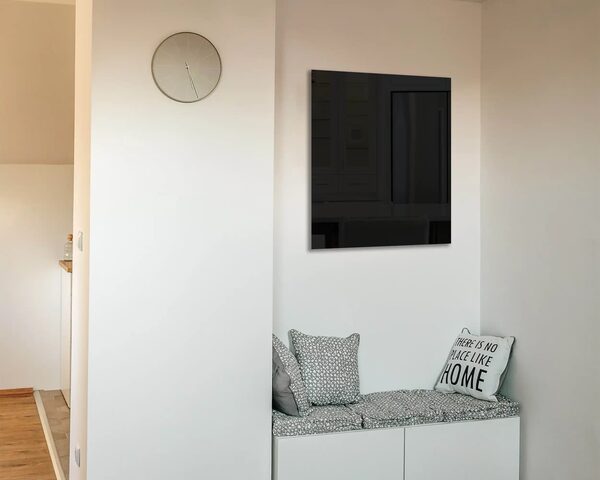
Infrared panels are highly cost-effective to install because they do not require pipework to function9. Portable panels are also available that can be plugged into the mains, while free-standing panels are usually wired into the electricity supply by an electrician1. Maker guidance states that panels can be fitted on walls, ceilings or simply used as a plug-in heater9. For a single room, that is close to a same-day job.
A heat pump is a different scale of work. Air source units are easier and cheaper to install than ground source because they do not use buried pipes17. Ground source installation involves groundworks or dredging a body of water to install pipework or other equipment necessary for the operation of the pump, and that work falls within the definition of installing energy-saving materials in the legislation18. Refrigerant pipework for heat pumps in dwellings should be fully insulated, and heat losses from hot water and heating pipework are limited under the building rules19.
The bigger constraint is often the heat distribution system rather than the pump itself. When installed as a replacement for gas or liquid fuel heating, heat pumps will usually need more or larger heat emitters, or substantially improved building insulation, adding to the already high installation cost21. More radiators are often needed, or improved insulation is required, when a heat pump replaces a liquid fuel or gas system22. Underfloor heating can work with a heat pump but needs larger pipes, pipes placed closer together, and good insulation beneath them to reduce heat loss23. Air-to-air units can connect one outdoor unit to more indoor units, but that needs more pipework installed24.
Heat pumps are best suited to buildings with good insulation levels, and insulation may need to be added internally or externally where homes do not already have it16. Ground or air source heat pumps can use existing heating pipework but are best suited to well-insulated buildings25.
Comfort, health and damp: what the evidence supports
Comfort is where infrared panels have a genuine claim, and where the evidence is mixed. Radiant heat warms people directly, so a panel can feel effective within seconds of switching on. Maker guidance states that warm-up times are a thing of the past and that you start to feel warm almost immediately after switching the panel on9. The same source claims infrared is far more efficient than convection heaters because heating the surface area of objects takes less energy than heating a large volume of air6.
On damp and mould, the claims diverge sharply and the independent view is the one to weigh. One maker states there is less risk of mould and dampness in walls, and that the lack of convection current eliminates stuffiness6. Independent guidance contradicts this directly: if a home has damp or mould issues, this type of heating is not recommended because it can make the problem worse3. Radiant heat warms surfaces without moving air, so it does not ventilate a room or remove moisture, which is what mould control depends on.
On health and safety, one maker notes that the panels do not emit UV light and are completely safe to use6. Independent guidance notes that a panel's surface temperature could be hotter than a standard radiator, though usually less than 100°C1. That is a surface a child or a pet could touch, and it is worth knowing before mounting a panel at low level.
On comfort with a heat pump, the evidence is more positive than the reputation suggests. In the Energy Systems Catapult Living Lab trial, two participants reported improved comfort when heating with a heat pump26. That is a small sample and should be read as such, but it runs against the common assumption that heat pumps feel less warm than a boiler.
Where infrared falls short: uneven warmth and a thin evidence base

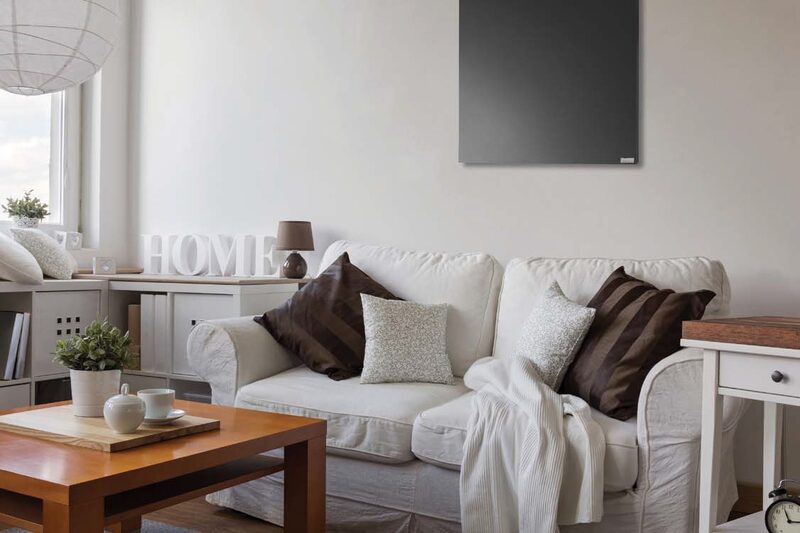
The first limit is uneven warmth. Radiant heat travels in straight lines, so a room with a single panel has warm spots and cool spots, and furniture or a doorway can cast a shadow. Independent guidance notes that some rooms will need more than one panel if they are the main heat source in the room1. That multiplies both the purchase cost and the electrical load.
The second limit is the evidence base. Independent guidance states that there is little research available to confirm running cost savings for infrared against storage heaters or electric underfloor heating1. A technology with a thin independent evidence base is harder to specify confidently, and harder to compare like for like with a heat pump that has been monitored at scale.
The third limit is the wider heat pump picture, which is not frictionless either. One sustainability writer described a heat-loss survey finding that heat demand in a three-bed semi-detached London home with underfloor heating but no wall insulation was too high for the installer's range of heat pumps, and that a big enough heat pump from another installer was very pricey27. Information on heat pumps is fragmented and contradictory, presented by a range of different bodies with little personalisation28. Among homeowners aware of and willing to consider a heat pump, 20% said the second most common barrier was not having enough information to make an informed decision29.
That is the honest framing of the choice. Infrared panels are simple and cheap to install and carry a weak independent evidence base on running costs. Heat pumps are more disruptive and more expensive upfront, carry a stronger evidence base on efficiency, and depend on the quality of the installation and the tariff.
"If your home has damp or mould issues, this type of heating is not recommended because it can make the problem worse."
Which suits which home: off-gas, retrofit and all-electric
The fit depends on the starting point. For a home already on mains gas with a working boiler, infrared panels are a poor whole-house substitute on running cost, because electricity costs about four times as much as gas for the same energy1. For a home off the gas grid, the comparison changes, because the alternative is often oil, LPG or storage heaters rather than cheap gas.
For a home replacing storage heaters, infrared panels can be the lower cost route. A case study found that installation of infrared heating panels can be a lower cost option to installing an air source heat pump and wet central heating system when replacing storage heaters15. The same study suggested putting the savings towards solar PV and battery storage to reduce heating costs, particularly in spring and autumn15.
For a well-insulated home with the budget and the space, a heat pump is the more efficient route, and the insulation condition is decisive. Official guidance warns that if a home is not well insulated, installing a heat pump may increase energy bills instead, because electricity is more expensive than gas30. Heat pumps are best suited to buildings with good insulation levels16.
Hybrid arrangements exist for homes on mains gas. Retrofit and packaged hybrids, where the heat pump and gas boiler components are in separate units, are eligible for support provided the home is currently heated by mains gas, and only the heat pump component can receive funding where a new gas boiler is fitted31. That is a route for a household that wants to cut gas use without removing the boiler.
On carbon, the picture favours heat pumps over their life. Electric-heated homes with heat pumps have on average 440 kgCO2e/m2 lower operational carbon impact over 60 years compared with gas boilers, and mechanical, electrical and plumbing systems account for approximately 3 to 4% of the whole building's embodied carbon over that lifespan32. For a household weighing independence, that is the longer-term argument: a heat pump reduces both the units of electricity bought and the carbon attached to them.
Sources32 cited
- Infrared heating explained, Energy Saving Trust, 2026-03-13
- Seven reasons we still need heat pump subsidies, Nesta, 2025-11-20
- Electric heating advice, Centre for Sustainable Energy, 2026-06
- Heat pump transition report, Department for Energy Security and Net Zero, 2026-05
- Electric wallpaper explained, Energy Saving Trust, 2026-03-26
- How does infrared heating work, Surya Heating, 2026-09-20
- Ezy-Warm underfloor heating, UK Green Building Council, 2024-04-25
- Infrared heating panels, HIES Scheme, 2018-07-24
- Advantages of infrared heat panels, Tansun, 2026-06-15
- Air source heat pump costs and savings, Which?, 2026-04-14
- Exploring the costs to consumers of Scottish clean heating requirements, Nesta, 2024-08-01
- Tariffs for renewable technology, Energy Saving Trust, 2026-08-12
- Supporting households with low carbon technology combinations, Energy Saving Trust, 2026-07-15
- Factcheck: what it really costs to heat a home in the UK with a heat pump, Carbon Brief, 2026-01-30
- Solar PV report, National Energy Action, 2025-02-19
- Heat pumps, New Forest District Council, 2026-09-17
- Air source heat pumps fact sheet, Pendle Borough Council, 2026-09-17
- Schedule 7A, Part 2, Chapter 2, legislation.gov.uk, 2026-09-17
- Approved Document L Volume 1 consultation version, Welsh Government, 2026-09-17
- Approved Document L Volume 1 Dwellings, HM Government, 2026
- Off gas grid heating guides: options available, OFTEC, 2026-09-17
- Future liquid fuels, UKIFDA, 2026-01-27
- Energy saving upgrades for home renovation, Energy Saving Trust, 2026-05-05
- Air-to-air heat pumps, Energy Saving Trust, 2026-09-11
- Clean energy boost, Low Carbon Hub, 2024-06-25
- How to increase consumer confidence in gas boiler alternatives, Energy Systems Catapult, 2020-05-03
- I'm a sustainability expert, here's why I'm not getting a heat pump, Which?, 2026-02-12
- How sector innovators can speed heat pump adoption, Nesta, 2022-02-02
- Homeowners and heat pumps, Which?, 2023-06
- Air and ground source heat pumps, Croydon Council, 2026-09-17
- WHSHF wave 3 scheme guidance addendum, Department for Energy Security and Net Zero, 2026-06
- A new era of carbon transparency, Future Homes Hub, 2025-11-25
 Infrared Heating and PanelsDo infrared heating panels cost less to run than normal electric heaters, and how much do they add to a bill?
 Energy IndependenceA heat pump runs your heating on electricity instead of gas or oil, so how much does that really cut what you pay and how exposed you are when fuel prices jump?
 Electric Heating CostsHow to work out what electric radiators, panel heaters, infrared and storage heaters cost to run per hour and per season.
 Heat Pump Electricity TariffsA heat pump tariff gives you cheaper electricity for part of the day, so running your heating costs less than on a standard rate.
 Solar Water Heating CollectorsSolar water heating uses panels on your roof to warm the water in your cylinder, working alongside your boiler rather than replacing it.
 Electric Radiator ControlsElectric heaters cost far more to run than gas, so the controls really matter.