
In this answer
Short answer
Damp and mould appearing after insulation or new glazing is a common post-retrofit fault, and in most cases the cause is not the insulation itself. Condensation is the most common cause of damp and mould, and it is caused by moisture inside the home1. Insulation and draught-proofing reduce the rate at which a dwelling leaks warm, moist air, so the same cooking, washing, showering and drying produces a higher indoor humidity that has fewer ways out.
The mechanism is well documented. Improving insulation and airtightness without adequate ventilation can lead to moisture build-up, which poses health risks due to damp and mould and, in some cases, structural damage2. The same pattern shows up in the official record of poor installations: substandard work has ranged from missing or incomplete paperwork to insufficient ventilation or missing and exposed insulation, which if left unchecked could lead to damp and mould3.
The practical answer is that the fabric work is usually sound and the ventilation is usually missing. Condensation primarily stems from ventilation issues, with insufficient air circulation the root cause and controlled ventilation the most effective remedy4. That reframes the problem as one a household can act on, rather than a defect to be ripped out.
Why insulation and double glazing can cause damp and mould
Insulation does not create water. It changes where water condenses and how long it stays. A wall or ceiling that was previously the warmest surface in a room becomes, in effect, the boundary of a smaller heated envelope, and the moisture generated inside that envelope has to go somewhere. Where it cannot leave, it settles on the coldest available surface.
The Scottish Government's own analysis of interactive EPCs sets out the risk plainly: improving insulation and airtightness without adequate ventilation can lead to moisture build-up, which poses health risks due to damp and mould, and in some cases, structural damage2. That is a statement about sequencing, not about insulation being a bad measure.
Double glazing has a similar effect for a different reason. Double glazing works by trapping air between two panes of glass, creating an insulating barrier that reduces heat loss, noise and condensation8. The inner pane stays warmer than a single pane would, which reduces condensation on the glass, but it also means the glazing no longer acts as the home's de facto dehumidifier. Moisture that used to run down the window now finds a colder bridge elsewhere, often a wall to floor junction, a window reveal or a ceiling corner.
The evidence from real installations shows what happens when the work is done badly rather than merely tightly. An independent case study of external wall insulation in Fishwick found that the choice of measures and quality of work was poor and properties developed severe damp and mould9. The Government's own press notice on poor quality insulation describes substandard installation ranging from missing or incomplete paperwork, insufficient ventilation, or missing or exposed insulation, which if left unchecked could lead to damp and mould3. In both cases the fault is in the installation, not in the principle of insulating.
For a household, the distinction matters. A home that is damp because a wall was left unventilated needs ventilation added. A home that is damp because insulation was installed over a leak needs the leak fixed. The two have different remedies and different routes to redress.
The mechanism: less ventilation, more condensation
Condensation damp generally happens when a property cannot deal with normal levels of water vapour because of a lack of insulation, ventilation or heating, or a combination of all of these things10. That definition is useful because it names three inputs rather than one. A home can be damp because it is underheated, because it is underventilated, or because it is underinsulated, and retrofit usually changes the second and third of those.
Citizens Advice lists the causes it sees: not having proper ventilation, not having good enough extraction fans in kitchens and bathrooms, broken heating systems such as a boiler not working properly, not having insulation on external walls or ceilings, and no suitable way to dry clothes10. Note that insulation appears on that list as a missing measure, not an added one. The list describes the conditions under which a dwelling cannot manage moisture, and retrofit can move a home from one failure mode to another if only part of the list is addressed.
The building regulations give a measurable target. The performance criterion for moisture is that there should be no visible mould on external walls in a properly heated dwelling with typical moisture generation5. That is the standard a dwelling is expected to meet, and visible mould is evidence it is not being met.
Two specific construction details carry elevated risk. Insulating a pitched roof at ceiling level results in a colder attic space above, meaning an increased risk of condensation and pipe freezing11. Inside the home, dot and dab approaches have the highest risk of interstitial condensation and should be avoided as they leave air gaps behind the insulation12. Both are cases where the position of the insulation, not its presence, creates the problem.
"Condensation primarily stems from ventilation issues"
Where the moisture shows up first
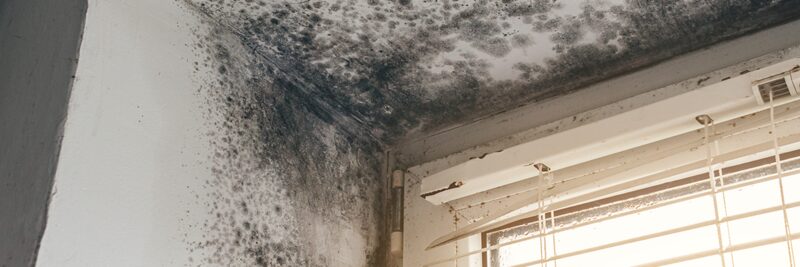
The first signs are usually the ones householders notice and dismiss: misted windows in the morning, a cold patch on an external wall, a musty smell in a bedroom, black spotting along a ceiling junction. Condensation damp can occur anywhere on a wall, may form at the base of a wall or from top to bottom, and can result in mould growth, damage to furniture and belongings and in some cases mite infestation10.
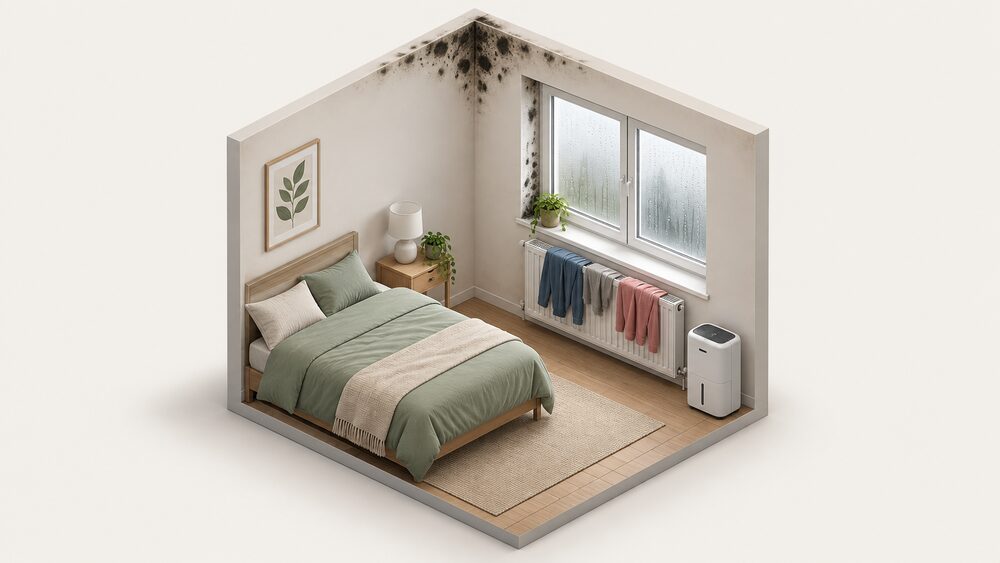
The pattern of where it appears tells you something about the cause. Mould concentrated in corners, behind furniture pushed against external walls, and around window reveals points to cold bridging and still air. Mould in a bathroom or kitchen points to extraction. Mould in a bedroom with clothes drying on a radiator points to moisture generation without a route out.
Some signs are specific to particular measures. Spray foam insulation is identifiable as a bumpy cream, yellow or blue foam between the rafters, most commonly in roofs13. Where spray foam is present and damp is appearing, the two are worth investigating together, because spray foam is removed where it is causing damp and condensation, damage to the property, or where a repair such as a roof repair is needed13.
For anyone viewing a home that has already been retrofitted, the Energy Saving Trust advises paying close attention for signs of damp and mould, condensation, draughts and poor ventilation14. Those four signs together describe a home whose fabric and ventilation are out of step.
What a householder can do about it
The first step is to establish whether the damp is condensation, penetrating water or a plumbing leak, because the remedies differ. Condensation damp generally happens when a property cannot deal with normal levels of water vapour because of a lack of insulation, ventilation or heating, or a combination of all of these things10. If the damp appears after rain, tracks down from a roof or rises from a floor, it is not condensation and the retrofit is not the cause.
Where it is condensation, the practical measures are the ones that reduce moisture at source and increase air change. A dehumidifier draws moisture out of the air and is particularly useful where clothes are dried inside the house15. It manages the symptom rather than the cause, and it works best alongside extraction and adequate heating rather than instead of them.
Low-cost fabric measures help the same problem from the other direction, by keeping surfaces warmer. These include an insulation jacket for a hot water tank, foam lagging on exposed pipes, foil or rigid radiator panels behind radiators, insulating window film where there is no double glazing, and DIY loft insulation16. Sealing up draughts around doors and windows, swapping old bulbs for LEDs, fitting thermostatic radiator valves, and insulating hot-water pipes and tanks are the quick wins a whole-house retrofit guide recommends as a starting point17.
Two conditions matter before any further work. Damp and mould problems in many cases need to be fixed before other energy saving measures like insulation can be installed14. And where cavity wall insulation is planned, damp issues and leaks should be resolved first, because trapping moisture inside can create problems19.
For rented homes, the route is different. If the damp and condensation is not going away after the household has tried the practical steps, the advice is to contact the landlord20. The landlord will probably be responsible for dealing with condensation damp if the tenancy agreement says so or says they will keep the home fit to live in, if the damp was caused by the landlord not making certain repairs such as heating or ventilation, or if the damp has caused damage the landlord has to repair such as rotting window frames or damaged plasterwork10.
Ventilation options: from trickle vents to MVHR
Ventilation is the part of the retrofit that is most often left out and most often the answer. The options run from passive openings to whole-house mechanical systems, and the right choice depends on how airtight the home has become.
Passive and background ventilation includes air bricks built into outside walls, air vents through internal walls or sealed chimneys, roof ventilation tiles and ventilated soffits, and window vents on window frames15. Draught-proofing guidance describes the same family of measures as extractor fans, airbricks, wall vents or trickle vents in modern windows21. These are low-cost and unobtrusive, and they work by guaranteeing a permanent, small air path rather than relying on a household to remember to open something.
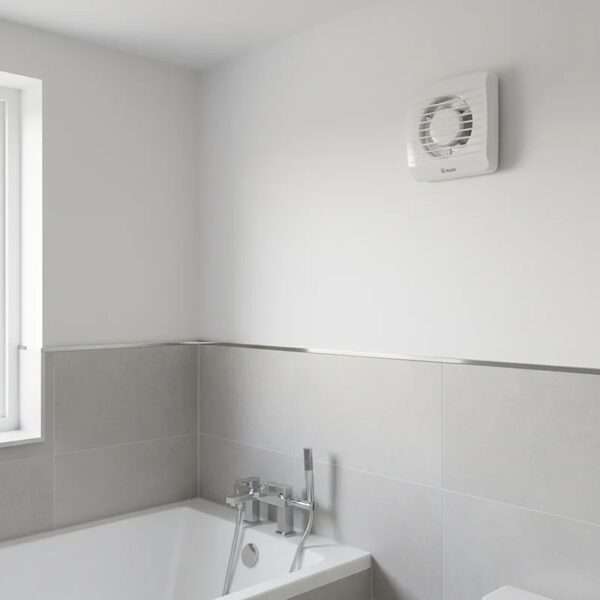
Extractor fans in kitchens and bathrooms are the next step, and their absence is one of the causes Citizens Advice lists for condensation damp10. BEAMA's guidance on mould and condensation sets out three key ventilation solutions: extractor fans, trickle vents and whole home ventilation systems22.
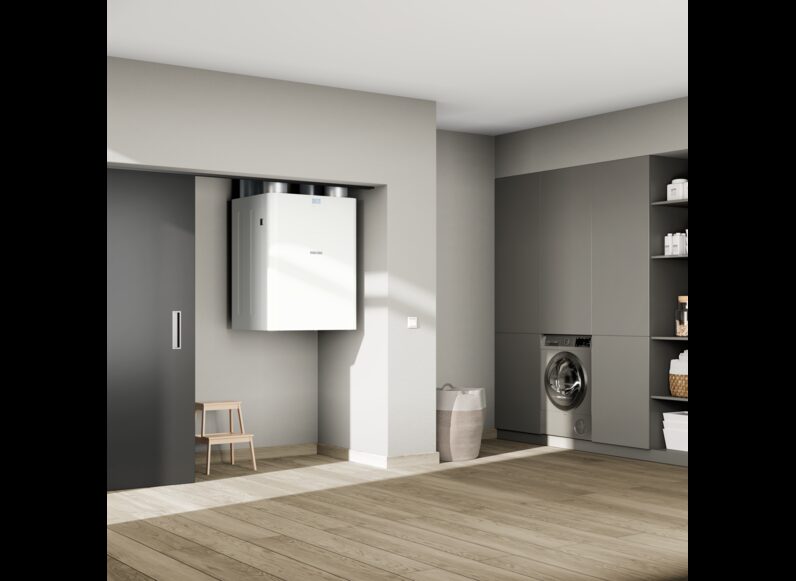
Whole-house systems are the most consistent option. Mechanical Extract Ventilation or Mechanical Ventilation with Heat Recovery offer more consistent results, especially in newer, more airtight homes23. Air filtration is commonly built into MVHR systems to prevent pollen and other particles from entering the home24.
The public sector has used the same approach at scale. Edinburgh's High Rise Retrofit and Upgrade Programme designed out damp and mould risk through the use of decentralised ventilation and mechanical ventilation with heat recovery systems25. The AECB's CarbonLite standard lists MVHR as its ventilation approach26.
What is MVHR and can it be retrofitted to an existing home?
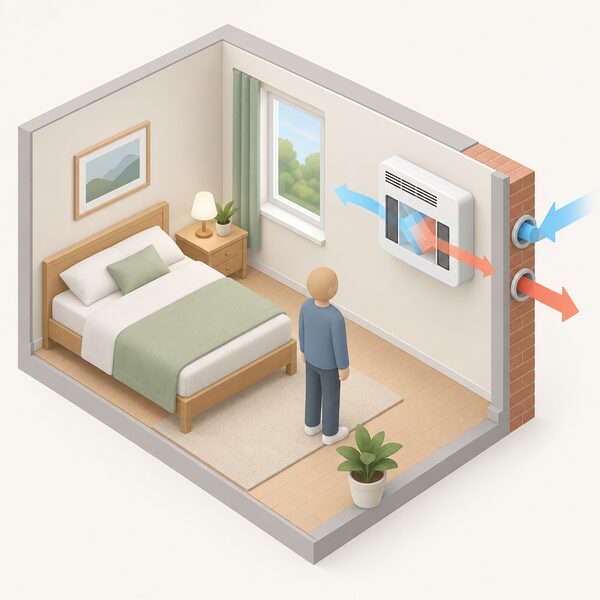
Mechanical ventilation with heat recovery extracts warm damp air and draws in fresh air. The warm air passes through a heat exchanger, which recovers heat and passes it on to the incoming air. MVHR systems are more commonly found in new-builds or whole-house retrofits, but small decentralised MVHR systems can be installed in individual rooms27. That last point is what makes MVHR relevant to an existing home rather than only to a new one.
The retrofit route is well established enough to have its own guidance. Titon's guidance on MVHR retrofitting in existing properties covers surveys, design, installation and maintenance28. The practical constraints are duct routes, ceiling voids and the cost of making good, which is why single-room decentralised units are often the entry point in a home that has already been decorated.
The trade-off is between consistency and disruption. Whole-house systems offer more consistent results, especially in newer, more airtight homes23, but they need ductwork and a plant location. Decentralised units avoid the duct runs but serve one room each. Natural ventilation, by contrast, is the simplest way of ventilating a home, but there is no guarantee that the fresh air gets to places that need it, and opening windows in winter can also lead to significant heat loss27.
For a household's energy independence, the distinction is about control. A passive vent or an extractor fan depends on the occupant operating it and on the outdoor conditions. An MVHR system runs continuously and recovers heat that would otherwise leave with the stale air, which reduces the ventilation penalty that otherwise offsets some of the saving from airtightness. It does, however, add a powered appliance with filters to maintain, so the home becomes dependent on electricity and on servicing rather than on the occupant opening a window.
Getting help: retrofit assessment and support schemes
Support for diagnosing and fixing post-retrofit damp varies by nation and by tenure, and the assessment route is usually the entry point rather than a direct grant for remedial work.
Under the Great British Insulation Scheme, eligible applicants have their energy supplier arrange an assessment of the property, and the household finds out after the assessment if anything needs to be paid towards the installation of the insulation29. That assessment is the point at which ventilation and damp should be raised, because the measures offered follow from it.
The Warm Homes Local Grant works in a similar sequence. If an application is successful, the council carries out a retrofit assessment and may offer one or more measures, subject to a full survey and the funds being available30. In social housing, the Warm Homes: Social Housing Fund Wave 3 expects grant recipients to use the technical support on offer from RISE, the Retrofit Information, Support and Expertise service31.
Remediation for failed installations is a separate track. The failure of external wall insulation installations under ECO4 and GBIS is to be resolved with an audit of all homes, while support will be made available for remediation if needed32. The scale of the problem is significant: the National Audit Office claims that 98% of homes that had external wall insulation installed under these schemes have problems7.
For owner occupiers outside the grant schemes, the assessment route is a retrofit assessment or a survey by a competent assessor, and the findings should cover ventilation as well as fabric. For rented homes, the landlord route described above applies, and the condition of the property at the point of letting is also relevant: damp and mould, condensation, draughts and poor ventilation are among the things a viewing should check14.
The wider point for energy independence is that a retrofit which ignores ventilation trades one dependency for another. A well-insulated, well-ventilated home needs less gas and less grid electricity for heating, and it manages its own moisture. A tightly sealed home with no controlled ventilation depends on the occupant remembering to open windows, and pays for that with heat loss and, in the worst cases, with the health effects of mould: respiratory issues, skin irritation and poor mental health6.
Sources34 cited
- Retrofit advice, Act on Energy, 2026
- Potential for interactive EPCs for Scotland, ClimateXChange, 2025-06-06
- Action taken to protect households with poor quality insulation, GOV.UK, 2025-01-23
- Condensation advice, FENSA, 2026-09-20
- Approved Document F review, stage 2a, Welsh Government, 2020-11
- What is fuel poverty, Cadent Gas, 2026-09-20
- Solid wall insulation costs and savings, Which?, 2026-05-05
- Glazing, Planning Portal, 2026
- External wall insulation project in Fishwick, National Energy Action, 2025-11-25
- Repairs: damp, Citizens Advice, 2026-09-20
- Guide to the conversion of traditional buildings, Scottish Government, 2026-08-10
- Updated guidance for internal wall insulation, Retrofit Academy, 2022-08-22
- Make sure your home is energy efficient, Citizens Advice, 2026-09-19
- Energy saving house viewing tips, Energy Saving Trust, 2026-05-20
- How to stop condensation, Which?, 2026-05-26
- Make your home more energy efficient in one weekend, Which?, 2026-08-28
- Your home retrofit guide, Low Carbon Hub, 2025-10-30
- Five things I wouldn't do as an insulation expert, Which?, 2025-10-28
- Installing blanket insulation, Which?, 2026-05-26
- Dealing with condensation and mould, National Energy Action, 2026-07-13
- Draught proofing your home, Smart Energy GB, 2026-03-16
- Mould and condensation infographic, BEAMA, 2026-09-19
- Home ventilation guide, IAAS, 2026-09-20
- Mechanical ventilation with heat recovery, Centre for Sustainable Energy, 2026-07
- High rise retrofit and upgrade programme, phase 1, City of Edinburgh Council, 2026-04-20
- AECB CarbonLite new build standard, AECB, 2026-09-04
- Ventilation advice, Centre for Sustainable Energy, 2025-07
- Breathing new life into old walls with MVHR retrofitting, Titon, 2025-06-19
- Apply for the Great British Insulation Scheme, GOV.UK, 2026-09-17
- Apply for a Warm Homes Local Grant, Liverpool City Council, 2026-09-17
- Warm Homes: Social Housing Fund Wave 3 scheme guidance addendum, Department for Energy Security and Net Zero, 2026-06
- Insulation grants, Which?, 2026-02-26
- Get help with faulty solid wall insulation, Citizens Advice, 2026-09-17
- Dealing with condensation and mould in Northern Ireland, National Energy Action, 2026-09-07
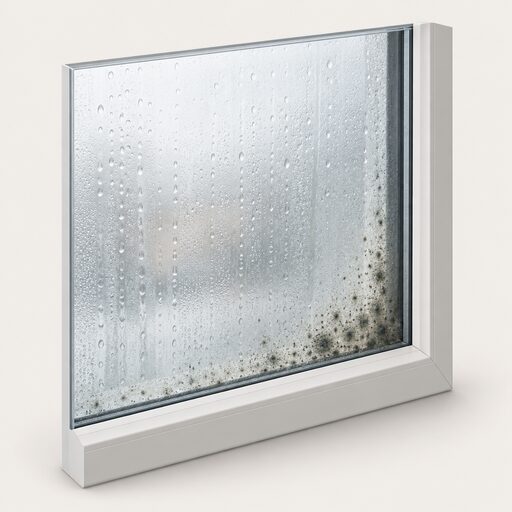 Condensation, Damp and MouldWhy does mould appear after insulation or new windows go in?
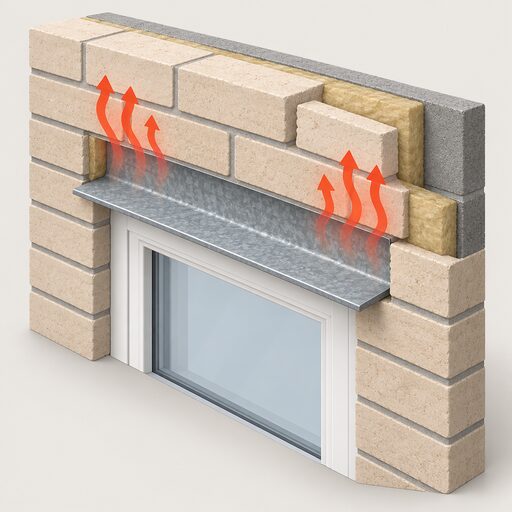 Thermal Bridging and Cold SpotsCold patches on walls and ceilings usually mean heat is escaping through a gap in your insulation, often around windows, doors or where an extension meets the old house.
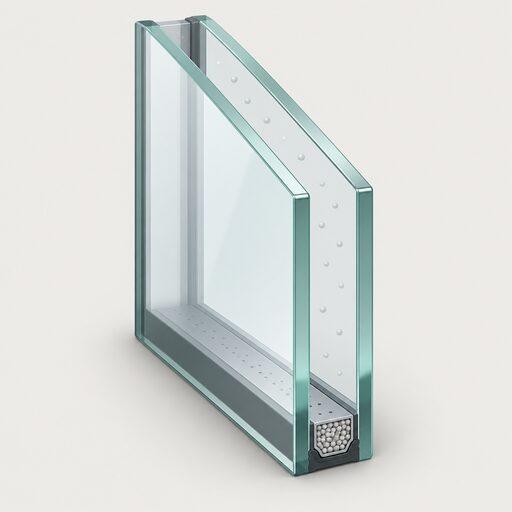 Double GlazingMisted up panes, noisy streets, rooms that never feel warm: is new double glazing worth the money, and how much could it cut your bills?
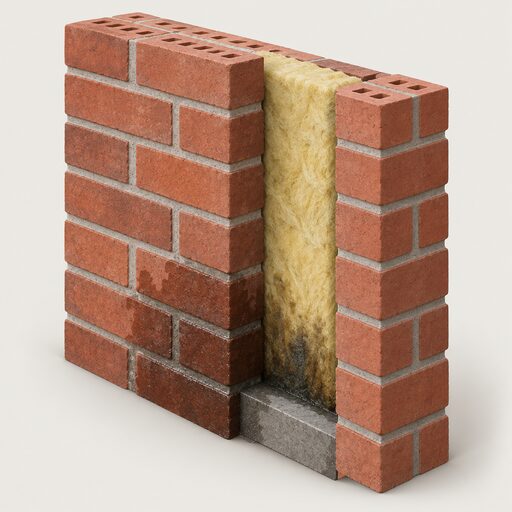 Cavity Wall Insulation ProblemsDamp patches after cavity wall insulation, and whether the guarantee actually pays out, are the two things people most want answered.
 The Full Insulation and Glazing GuideWhere is your home losing the most heat, and what can you do about it?
 Triple Glazing in UK HomesTriple glazing costs more than double, so is it worth it for your home?