

In this answer
Short answer
A PAS 2035 retrofit assessment is the survey stage of a whole-house retrofit. A qualified Retrofit Assessor visits the dwelling and records what is there: the construction, the condition, the occupancy and the energy performance. Those findings are handed to a Retrofit Coordinator, who commissions a design from them. The assessment is not a rating and not a quotation. It is the evidence base a designer works from, and it sits inside PAS 2035, described as the overarching UK retrofit standards framework1.
The standard is deliberately broad in scope. PAS 2035 introduces a whole-house, whole-lifecycle approach to retrofit and defines the roles, responsibilities and processes that must be followed at every stage, from assessment, coordination and design through to installation and evaluation2. PAS 2030:2023 is designed to complement it, focusing on the delivery phase of retrofits3. So the assessment is one half of a pair: PAS 2035 governs how the project is planned and managed, PAS 2030 governs how the work is installed.
For a household, the assessment is the point at which a plan stops being generic. It is also the point at which a project acquires a named person responsible for it, because PAS 2035 requires a retrofit coordinator role4. What follows sets out what the assessment covers, who the standard binds, the conditions and exceptions, and how the process runs in practice.
What the assessment covers, and what it is not
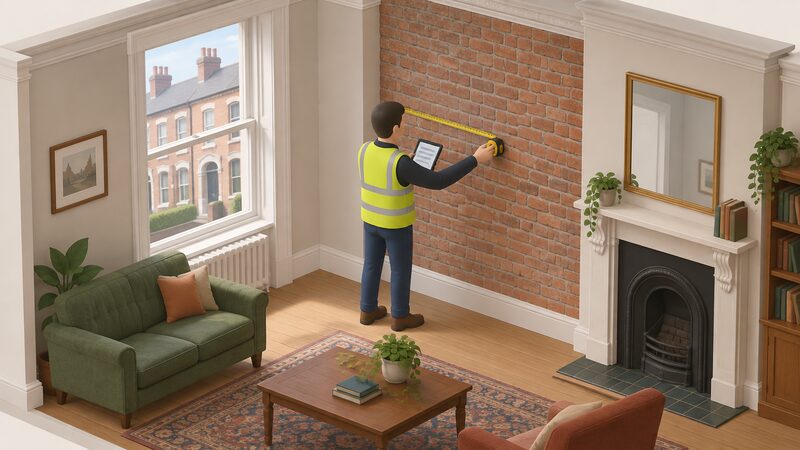
The assessment stage exists because retrofit decisions made without dwelling-level evidence tend to go wrong. PAS 2035 provides a robust framework for managing risk, balancing competing priorities and delivering better retrofit outcomes8, and the assessment is where that balancing starts. The assessor records the dwelling and its occupancy so that the designer can judge which measures suit this building rather than a typical one of its age and type.
It is not an EPC, and it is not a quote. An EPC rates performance and offers recommendations; the retrofit assessment feeds a design. It is also not the design itself. Under PAS 2035:2023 the Retrofit Assessment requirements are the same as the existing Path B requirements9, while the Retrofit Design requirements are the same as the existing Path A requirements but with additional clauses depending on the characteristics of the project9. Assessment and design are separate stages with separate requirements, and the assessment comes first.
The scope of the standard is the whole life cycle of a retrofit project, from the initial engagement with a client, through the assessment, design, installation and subsequent evaluation and monitoring stages10. That matters to a household because it means the assessment is not a one-off document. It is the first link in a chain that ends with evaluation, and the later stages depend on what the assessor recorded.
"It introduces a whole-house, whole-lifecycle approach to retrofit and defines the roles, responsibilities, and processes that must be followed at every stage of a retrofit journey, from assessment, coordination, design, and installation through to evaluation"
Who the standard applies to

PAS 2035 applies to domestic retrofit projects, and its reach is widest where public money is involved. It provides a specification that any publicly funded retrofit should comply with7, and the Welsh Government describes it as the overarching UK retrofit standards framework1. PAS 2035:2023 covers the whole life cycle of a retrofit project10, and PAS 2035:2019 covers the same ground, from the initial engagement with a client through assessment, design, installation and evaluation11.
The roles are defined rather than implied. PAS 2035/30:2019 sets out five: retrofit coordinator, assessor, designer, installer and evaluator6. Retrofit Coordinators are required for all domestic retrofit projects in order to comply with PAS 20355, and the standard has to be managed by a qualified Retrofit Coordinator12. The coordinator is certified by Trustmark13. PAS 2035 acts as the overarching document which helps to co-ordinate the activities of those in roles which are, for the most part, new14.
For non-domestic buildings the picture differs. PAS 2038:2021 ensures retrofit solutions are tailored to property types like offices, hospitals and multi-residential buildings3. A household in a flat or a house is therefore in PAS 2035 territory, while a landlord retrofitting a mixed-use block may be working to a different standard.
| Standard | What it governs | Applies to |
|---|---|---|
| PAS 2035:2023 | Planning and managing the project: design, risk, evaluation15 | Domestic retrofit |
| PAS 2030:2023 | The delivery phase, complementing PAS 20353 | Installation of measures |
| PAS 2038:2021 | Retrofit solutions for non-domestic property types3 | Offices, hospitals, multi-residential |
Conditions, exceptions and the version question
The most common practical question is which version of the standard a project falls under, and the answer has been moving. PAS 2035 was introduced in 2019 as a clear framework for best practice in the energy retrofit of domestic properties12, and PAS 2035:2023 was first introduced in 2019 as a structured framework for managing domestic retrofit projects3. The 2023 revision is the current reference point for funded work: all Retrofit Assessments in Wave 3 of the Warm Homes Social Housing Fund must be done or upgraded to PAS 2035:202316.
Older projects were given a deadline. For PAS 2035:2019 projects, the retrofit assessment and all measures must be handed over before 30 March 202517. That date has passed, so assessments now sit under the 2023 version.
Two exceptions are worth knowing. First, the 2023 revisions included clauses to facilitate scale retrofit by allowing Retrofit Design to commence based on assessments of archetypes18. That is a volume mechanism for programmes, not a route for a single household wanting its own home assessed. Second, PAS 2035:2019 retrofits used Medium Term Improvement Plans for certain levels of retrofit, such as those receiving three or more energy efficiency measures19. The standard also requires the production of longer-term retrofit plans20, which is why an assessment can lead to a staged programme rather than a single visit from a installer.
How the assessment is carried out, stage by stage
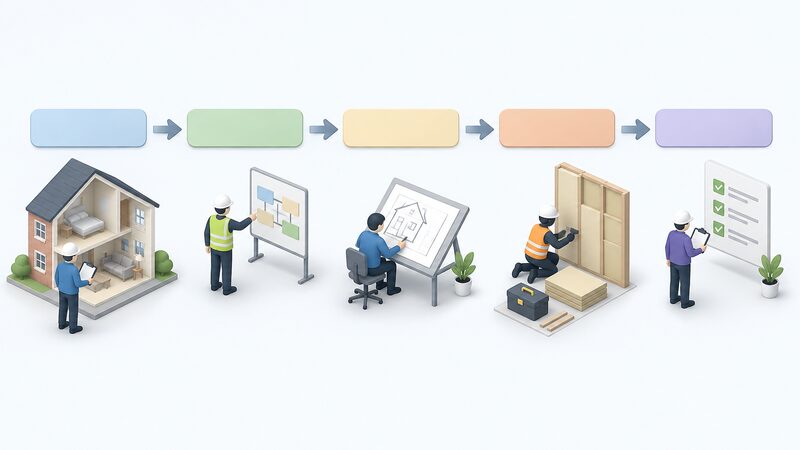
The process is sequential, and each stage has a defined owner. PAS 2035 pertains to retrofit standards and is designed to clarify the responsibilities of those in retrofit roles and the qualifications they must hold prior to the commencement of any physical retrofitting installation14. Nothing is installed until the assessment and design are complete.
- Assessment. A Retrofit Assessor surveys the dwelling and records its construction, condition, occupancy and performance. PAS 2035 calls for a Level 3 qualification in Retrofit Assessment2.
- Coordination. A qualified Retrofit Coordinator takes responsibility for the project12, a role required by PAS 20354.
- Design. The coordinator commissions a Retrofit Design, which under PAS 2035:2023 carries the Path A requirements plus additional clauses depending on the project9.
- Installation. The work is delivered to PAS 2030:2023, which focuses on the delivery phase3.
- Evaluation and monitoring. The project closes with evaluation, part of the whole life cycle the standard covers10.
The assessment stage is also where ventilation and heritage questions surface early. Ventilation work in retrofit is carried out using the guidance of PAS 203521, and PAS 2035 provides a robust framework for managing risk, balancing competing priorities and delivering better retrofit outcomes8, which is precisely the function it serves on older and harder-to-treat buildings.
What it means for a household's energy independence

A retrofit assessment does not generate energy and does not disconnect anything. What it does is establish, on paper, what a specific dwelling needs and in what order, which is the precondition for a plan that a household can act on over years rather than weeks. PAS 2035 creates a framework for deep retrofit projects that are high quality, safe and fit for the future22, and it requires the production of longer-term retrofit plans20. That is the independence dividend: a documented route rather than a series of disconnected purchases.
The dependence that remains is real. The assessment is carried out under an industry-led quality standard that provides best practice for retrofit, taking a whole house approach23, and it is delivered by certified businesses rather than by the household. The coordinator is certified by Trustmark13, and the standard has to be managed by a qualified Retrofit Coordinator12, so a household is buying into a professional chain it does not control. Where public funding is involved, the specification is set by the scheme: PAS 2035 provides a specification that any publicly funded retrofit should comply with7, and scheme rules decide what is funded.
The assessment also does not cover everything a household might want. It is a domestic standard, with PAS 2038:2021 handling non-domestic property types3. And it is a standard, not a guarantee: PAS 2035 provides a robust framework for managing risk8, but the quality of any individual project still rests on the people certified to carry it out. For a householder, the practical value is a written, versioned plan that names who is responsible at each stage, and a clear record of what was assessed and why.
Sources23 cited
- Retrofit, Act on Energy, 2026
- What is a PAS 2035 Retrofit Assessor?, The Retrofit Academy, 2025-11-24
- PAS 2030 Guide, The Retrofit Academy, 2026-04-06
- Green Homes Grant Voucher Scheme: where did it go wrong, The Retrofit Academy, 2021-05-07
- Energy Company Obligation Schemes, Elmhurst Energy, 2026-09-20
- Heat and Buildings Quality Assurance Statement, Scottish Government, 2022-06-07
- Homes of Today for Tomorrow, Welsh Government, 2024-02
- Why heritage retrofit design is essential, The Retrofit Academy, 2026-08-07
- A guide to PAS 2035, 2030 and 2023 standards, The IAA, 2025-03-25
- ECO4 delivery guidance version 4.0, Ofgem, 2026-03-26
- Great British Insulation Scheme Delivery Guidance, Ofgem, 2023-08-31
- Home energy efficiency key terms explained, Development Bank of Wales, 2024-10-17
- Options for accelerating retrofit rates in the domestic owner-occupier sector, CREDS, 2022-11-09
- PAS 2035 and the impact on the Each Home Counts review, The Retrofit Academy, 2019-10-22
- PAS 2030 Guide, The Retrofit Academy, 2026-04-06
- Warm Homes Social Housing Fund, Greater Manchester Combined Authority, 2026-09-17
- Consultation on Administration of Mid-scheme changes to ECO4 and GBIS, Ofgem, 2025-04-07
- PAS 2030 and 2035 draft for public comment, National Insulation Association, 2023-05-16
- Energy efficiency and net zero, House of Commons Environmental Audit Committee, 2021-04-30
- CIBSE response to 10 Point Plan on Green Industrial Revolution, CIBSE, 2020-11
- The Retrofit Academy talks ventilation, The Retrofit Academy, 2021-12-22
- The domestic retrofit challenge, CIBSE, 2022-10
- Heat Strategy for Wales, National Insulation Association, 2023-11-17
 Assessors and CoordinatorsYour home is having energy work done, so who decides what gets fitted and who checks it?
 Home Energy AssessmentsWhich home energy check do you actually need?
 Whole-House Retrofit CostsA whole-house retrofit can cost anywhere from a few thousand pounds to over fifty thousand, so what you actually pay depends on how much work your home needs.
 Planning a Whole-House RetrofitWhich jobs come first when you upgrade a whole house, and which can wait?
 Using Your EPC to Plan WorkAn EPC comes with a recommendations report, and that report is the part worth reading before you spend anything.
 Comparing Installation QuotesWhat should a solar or heat pump quote actually include before you pay a deposit?