

In this answer
Short answer
A home energy assessment usually takes between 30 minutes and 2 hours on site, depending on the size and complexity of the property1. A retrofit assessment, which gathers more information than a standard energy performance certificate, typically runs 1 to 2 hours2, and grant-funded retrofit assessments can take 1 to 3 hours3. The Northern Ireland Housing Executive's Affordable Warmth Scheme puts its technical assessment at up to 60 minutes4.
The visit itself is only part of the time commitment. Booking, the assessor's data entry and lodgement, and the return of the report all sit around it, and those periods are measured in days or weeks rather than hours. The type of assessment matters more than anything else: an EPC records the building, while a retrofit assessment also records how the household uses energy and what state the building is in.
This page sets out what drives the duration, how the main assessment types compare, what happens during the visit, and what a household can do beforehand so the appointment runs to time.
What affects the duration: property size and complexity
The published guidance is consistent that size and complexity are the two variables that move the clock. Elmhurst Energy states that a typical assessment can take between 30 minutes and 2 hours to complete, qualified by the size or complexity of the property1. Acton Energy gives the same qualifier for retrofit assessments, at 1 to 2 hours2.
Complexity is not only floor area. It covers the number of rooms and extensions, how many heating systems and controls there are, whether the loft and any cellars are accessible, and how much glazing has to be recorded. An assessor collecting room dimensions, insulation levels, heating systems and the amount of glazing is working through a fixed list, and every additional space adds to it1.
Property age and type also shape the picture, though indirectly. Around 95% of gas consuming properties built from 2000 onwards have EPC ratings A to C, compared with around a third of EPC rated bungalows and almost half for all other types of houses7. Older and harder-to-treat homes tend to need more investigation on site, and bungalows, with their large roof and exposed perimeter relative to floor area, are a recognised weak point in the stock.
There is a further pressure on time. Under RdSAP 10, assessors will need to spend more time at the property to collect the additional data the methodology requires8. That is a change to the assessment standard rather than to any individual home, and it points to visits at the upper end of the published ranges becoming more common.
For the household, the practical implication is that a small, simple flat and a large extended house with several heating zones should not be expected to take the same slot. When booking, the useful information to give is the number of bedrooms, the number of extensions, and whether the loft is boarded or full of stored items.
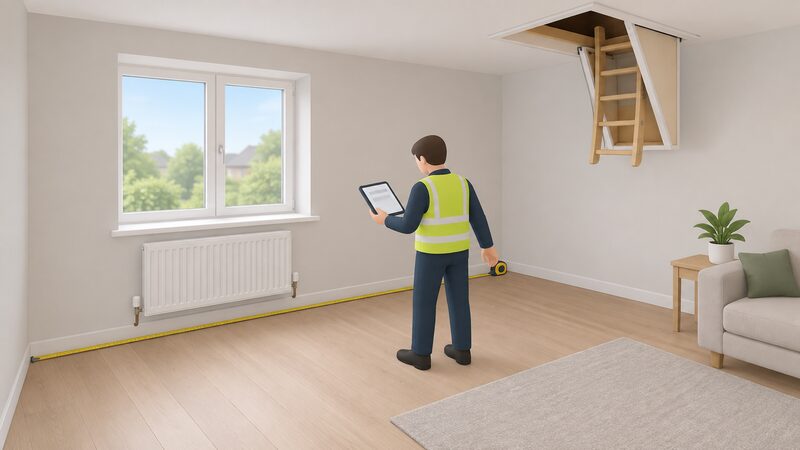
Assessment types compared: EPC, retrofit and full home assessments
The three common assessments differ in what they produce, and the time difference follows from that.
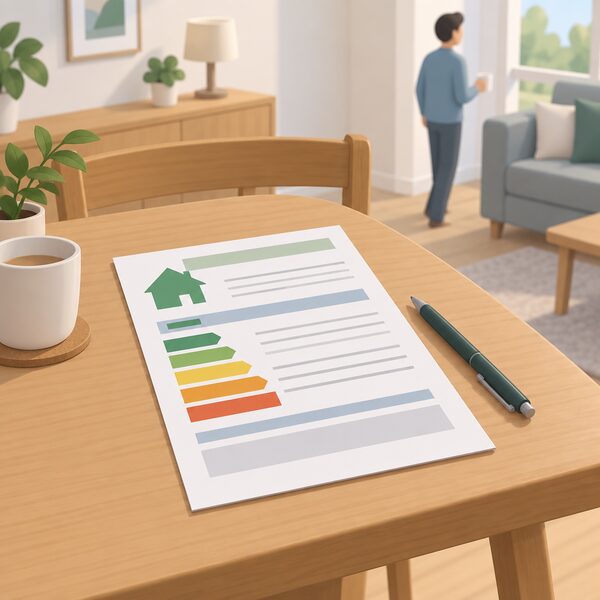
An EPC provides an assessment of your home's energy efficiency9. To determine the energy efficiency rating of a home, EPC assessors use the standard assessment procedure (SAP), and reduced SAP (RdSAP) for existing homes where information may not be available10. The EPC assessment reflects the energy performance of the building itself, not the way it is used by its occupants11. That is why a standard EPC visit can be short: the assessor is recording the fabric and services, not interviewing the household.
A retrofit assessment adds two further elements. A three-part retrofit report includes an EPC, an Occupancy Assessment detailing how energy is used in your home, and a Condition Report on the building's state of repair12. The PAS 2035 retrofit assessor's outputs are described in the same shape: an Energy Report such as an EPC, a Condition Survey to flag building defects or maintenance issues, and an Occupancy Assessment to understand how energy is used in the home13. The Occupancy Assessment is what makes the visit longer, because it depends on information only the household can supply.
| Assessment | Typical on-site time | What it produces |
|---|---|---|
| Domestic EPC | 30 minutes to 2 hours1 | Energy efficiency rating for the building11 |
| Retrofit assessment | 1 to 2 hours2 | EPC, Occupancy Assessment, Condition Report12 |
| Grant-funded retrofit assessment | 1 to 3 hours3 | Scheme-specific assessment for funded measures |
| Affordable Warmth technical assessment (NI) | Up to 60 minutes4 | Assessment for scheme eligibility and measures |
A caution belongs here. EPC ratings do not always capture the true efficiency of a retrofit; measures like PV panels or air-source heat pumps may improve an EPC score but fail to address fundamental building issues such as poor insulation or moisture risks14. The Scottish Government's own review makes that point, and it is the reason a retrofit assessment spends time on condition and occupancy rather than relying on the certificate alone.
There is also movement in what an EPC will contain. The Climate Change Committee has recommended that domestic EPCs should include four primary metrics, using real-world units, and clear simple names: total energy use intensity in kWh/m2/yr, space heating demand intensity in kWh/m2/yr, heating system type ranked from 1 to 6, and energy cost intensity in £/m2/yr15. If adopted, that widens the data an assessor must collect, with the same effect on visit length as RdSAP 10.
For a household, the choice is between a certificate that supports a sale or rental, and an assessment that supports a plan of work. The home energy assessment page sets out what each type tells you, and the retrofit assessor and coordinator page explains who does what.
What the assessor does during the visit
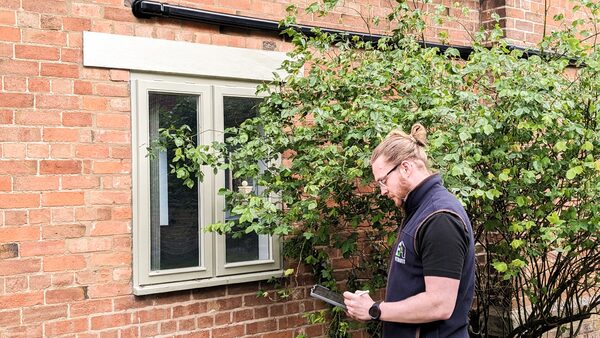
A Domestic Energy Assessor will visit the property to collect data such as room dimensions, insulation levels, heating systems and amount of glazing, and the process is non invasive, with no drilling or hammering into walls1. The assessor visits in person to perform an inspection, assessing insulation, heating systems, ventilation, window glazing and the building's materials, then enters the data into government-approved software to generate the EPC, which avoids bias5.
That software point matters for the household's expectations. The calculation is not done by hand at the kitchen table; it is produced from the recorded data, which is why accuracy at the point of collection is the whole game. An assessor who cannot see the loft insulation, or who is not told about a recently added heating control, records a default.
The visit is also a chance to ask what the home's weak points are. Cosy Homes Oxfordshire describes its process as beginning with a visit from a Retrofit Coordinator or an Energy Assessor who conducts an assessment of a home to identify appropriate energy efficiency measures16. Some routes are free: the Local Energy Advice Programme provides a free home visit from a qualified Home Energy Advisor17, and the Which? home energy planning service is free to use18.
"A Domestic Energy Assessor (DEA) will visit your property to collect property data/information such as room dimensions, insulation levels, heating systems and amount of glazing."
Not every assessment involves a visit at all. An On Construction Domestic Energy Assessor works from building plans and elevation drawings, before and after construction, with calculations and EPCs sent to Building Control for sign off1. For existing homes, some services now run remotely: all you need is a smartphone and one hour for an advisor to virtually assess your home19. A virtual survey is quicker to arrange but depends on the household photographing and describing the property accurately.
How to prepare so the assessment runs to time
Preparation is mostly about access and information. The assessor needs to reach the loft hatch, the boiler, the hot water cylinder, the meter and every room, so clearing stored items from the loft and around the boiler before the visit removes the most common cause of overrun.
Documents help in two ways. Recent energy bills let the assessor and any advisor check recorded consumption against the certificate, and paperwork for insulation, glazing, heating controls or renewable measures already installed prevents those being recorded at default values. For a retrofit assessment, the Occupancy Assessment depends on how the home is actually heated and used, so an adult who knows the household's patterns is more useful on the day than a keyholder.
The assessor's own credentials are worth checking before booking. The legislation requires an energy assessor who is accredited to produce energy performance certificates for the category of building in question20. Accreditation is specific to building categories, so a domestic assessor is the right person for a house.
Two timing points sit outside the visit. The Energy Performance Validation Scheme aims to provide an assessment of its findings within five working days6. Home Energy Scotland aims to process claims within 10 working days after submitting all required claim documentation, and to send an application referral email usually within two working days of an initial call21. Where a grant application depends on the assessment, those periods, not the visit, set the pace.
Cost, repeat intervals and what the assessment does for independence
A domestic energy assessment typically costs £50 to £120, varying by location and property size5. Prices are installer-quoted and vary by region, so that range is a guide rather than a tariff. Some routes carry no cost to the household: the Which? home energy planning service is free18, Local Energy Advice Programme home visits are free17, and grant-funded assessments such as those under the Warm Homes Local Grant are part of the scheme3. In Scotland, the Home Energy Scotland Grant and Loan covers assessment-linked claims through its own process21.
On repetition, the published rules are about buildings and systems rather than households. The Energy Performance of Buildings Directive requires the methodology to be used to set energy standards for buildings, reviewed every five years23, and air-conditioning systems must be inspected by an energy assessor at regular intervals not exceeding five years24. There is no equivalent published interval for a voluntary home assessment, so the sensible trigger is a change: a new heating system, a completed measure, or a plan to sell.
What the assessment does for a household's energy independence is diagnostic rather than transformative. It produces a record of the building and, in the retrofit form, of how the home is used, which is the basis for deciding what to do and in what order. It does not reduce dependence on the grid, a supplier or gas on its own. The whole house plan page covers how an assessment feeds a plan, and the order of energy improvements page covers sequencing. Households weighing whether to act at all may find the finding that decisions are strongly affected by the length of time they expect to stay in their current home a useful prompt25.
Sources25 cited
- EPCs explained, Elmhurst Energy, 2026-09-20
- Retrofit, Acton Energy, 2026
- Warm Homes Local Grant, Surrey County Council, 2026-09-17
- Affordable Warmth Scheme, Northern Ireland Housing Executive, 2026-09-17
- What is an EPC?, Retrofit Academy, 2025-08-18
- Consumer brochure, Energy Performance Validation Scheme, 2026-09-17
- National Energy Efficiency Data Framework: summary of analysis 2026, Department for Energy Security and Net Zero, 2026-06-11
- RdSAP 10: what it means for homeowners and tenants, Elmhurst Energy, 2025-05-21
- Solar photovoltaic (PV) panels, London Borough of Bromley, 2026-09-17
- Energy Performance Certificates, House of Commons Library, 2026-09-17
- Energy Performance Certificates guide, Scottish Government, 2026-08-24
- Five top tips from Which? to cut your energy bills, Welsh Government Climate Action, 2026-03-18
- What is a PAS 2035 retrofit assessor?, Retrofit Academy, 2025-11-24
- Review of retrofit assessment in Scotland, Scottish Government, 2025-06-06
- Letter on reform of domestic EPC rating metrics, Climate Change Committee, 2026-09-19
- Cosy Homes Oxfordshire, Low Carbon Hub, 2025-12-19
- Grants and funding, Tameside Council, 2026-09-17
- Use our home energy planning service, Which?, 2026-06-18
- Retrofit advice for homeowners, Centre for Sustainable Energy, 2026-06-16
- Energy Performance of Buildings Regulations 2012, regulation 7, legislation.gov.uk, 2026-09-17
- Grants and loans, Home Energy Scotland, 2026-09-17
- Final decision: smart meter guaranteed standards of performance, Ofgem, 2026-01-30
- Energy Performance of Buildings Directive 2002/91/EC, legislation.gov.uk, 2026-09-17
- Energy Performance of Buildings Regulations 2012, Part 4, legislation.gov.uk, 2026-09-17
- Consumer insight: understanding how to motivate whole-house retrofit, UK Green Building Council, 2024-03-25
 Home Energy AssessmentsWhich home energy check do you actually need?
 Home Energy ModelThe energy rating on your EPC is about to be worked out differently when you buy, sell or build a home.
 Payback Periods ComparedHow long does it take for a home energy upgrade to pay for itself?
 Assessors and CoordinatorsYour home is having energy work done, so who decides what gets fitted and who checks it?
 Energy Checks Before BuyingHow energy efficient is the house, and what will it cost to heat?
 Measuring Savings After the WorkHow to compare before-and-after energy use after a retrofit, why weather and comfort taking shrink measured savings, and how much data a fair comparison needs.