
In this answer
Short answer
The Home Energy Scotland Grant and Loan is an interest-free borrowing scheme for homeowners in Scotland, delivered by the Energy Saving Trust on behalf of the Scottish Government1. Repayment is not a single fixed term: the maximum period depends on how much is borrowed. Loans under £5,000 can be repaid over five years, loans of £5,000 to £9,999 over ten years, and loans of more than £10,000 over twelve years2.
The monthly figure is not set by a formula in the scheme rules. Repayment is made in affordable instalments following a financial assessment carried out as part of the loan application process3. That assessment, not a published table, decides what a household actually pays each month.
The loan is genuinely interest-free. The published terms state 0% APR Representative, with no interest or fees, so the total repayable equals the amount borrowed4. It sits alongside grant funding: up to £7,500 for energy efficiency measures such as insulation, and up to £7,500 for clean heating systems such as heat pumps5.
What the Home Energy Scotland loan is and who runs it
The scheme is run by the Energy Saving Trust on behalf of the Scottish Government1. The Trust delivers the Home Energy Scotland Grant and Loan through Home Energy Scotland, again on behalf of the Scottish Government6. Loans have been administered by the Energy Saving Trust since at least 20217.
It provides homeowners in Scotland with a grant, an interest-free loan or a combination of both8. The scheme launched in December 20229, and monthly data on it runs from April 2025 to January 20261. Funding comes principally from the Scottish Government, which is named as the funder of the loan products10, and the scheme is described as funded by the Scottish Government11.
For a household, the structure matters for independence. The money is public rather than commercial, so there is no lender margin and no interest to service. What remains is a repayment obligation to a Scottish Government scheme, and the work itself is tied to measures the scheme will fund. The advice arm is separate: Home Energy Scotland is a free and impartial advice service12, and the Scottish Government describes it as a free independent advice and referral scheme13.

Repayment: affordable instalments set by a financial assessment

The repayment rule is stated plainly in scheme rules: the loan can be repaid in affordable instalments following a financial assessment as part of the loan application process3. There is no published repayment calculator in the scheme material, and no fixed monthly figure attached to a given loan size.
What the rules do fix is the outer limit. Under £5,000 can be spread over five years, £5,000 to £9,999 over ten years, and more than £10,000 over twelve years2. A separate source gives the same structure but describes the lowest band as up to £4,999 rather than under £5,0007. The two documents disagree on that boundary wording, and the difference is one pound at the edge of the band.
The practical effect is that a smaller loan is repaid faster. A household borrowing a modest sum to top up a grant has five years to clear it; a household borrowing a five-figure sum for a whole-house retrofit has twelve. The financial assessment sits underneath both, and it is what converts the maximum term into an actual instalment.
Loans have also been available to cover additional costs beyond the headline measure14, which is where the assessment matters most: the more a household borrows, the more the affordability check shapes the outcome. Independent analysis of UK home upgrade lending argues that repayment terms must be flexible, favourable to the consumer, able to be spread over a longer period and substantial enough to enable meaningful retrofit15. That is a description of what good looks like, not a statement of what this scheme delivers in every case.
Interest-free borrowing: what you repay and what you don't
The loan is interest-free, and the terms are unusually explicit. The published conditions state 0% APR Representative, no interest or fees, and total repayable equals amount borrowed4. The scheme rules repeat the point: there is no interest to pay17.
That means a household repays the sum borrowed and nothing more in interest. Grant funding, by contrast, is not repaid at all: the amount received depends on the improvements made, and it does not have to be paid back18. The two are different instruments sitting in the same scheme.
The scheme is open to owner occupiers and private sector landlords, with interest-free, unsecured loans of up to ten thousand pounds available to both groups16. Unsecured matters: the borrowing is not secured against the property, so the loan does not put the home at risk in the way a secured loan would.
For energy independence, interest-free public lending removes the cost of capital from a retrofit decision. What it does not remove is the obligation itself, the administrative fee, or the fact that the money comes from a government budget that is finite. The scheme has not been funding new measures indefinitely: the Scottish Central Government Energy Efficiency Grant Scheme has not funded new measures since January 2024 and its funding is due to end in 202619. That is a different scheme from the Grant and Loan, but it shows how scheme budgets move.
Grant or loan: how the two combine, with up to £7,500 in grant support
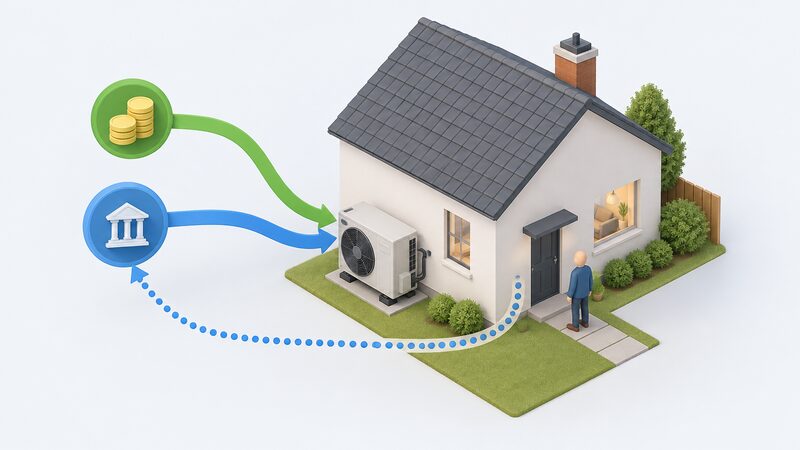
The scheme offers a grant, an interest-free loan or a combination of both8. For energy efficiency measures such as insulation, grant funding is available up to 75% of the combined cost of measures, to a maximum grant amount of £7,5005. For clean heating systems such as heat pumps, grant funding of up to £7,500 is available5.
The loan sits on top. An additional £7,500 of funding is available as an optional interest-free loan for clean heating systems such as heat pumps5, and the same optional interest-free loan is available for both clean heating and energy efficiency13. Independent guidance describes the heat pump package as £7,500 grant plus £7,500 optional loan for standard households in Scotland20.
| Support | Amount | Repaid? |
|---|---|---|
| Grant, energy efficiency measures | up to 75% of combined cost, maximum £7,5005 | No |
| Grant, clean heating such as heat pumps | up to £7,5005 | No |
| Optional loan, clean heating | £7,500 interest-free5 | Yes |
| Optional loan, energy efficiency | £7,500 interest-free5 | Yes |
The 75% cap is the detail that catches people out. Grant funding does not cover the whole bill even at the maximum: it covers up to 75% of the combined cost of measures, capped at £7,5005. The remaining share is where the loan, or household savings, comes in.
Historically the structure was different. Loans of up to £10,000 were available for renewable heating systems including heat pumps, of which up to £7,500 was available as non-repayable cashback grant21. That is an earlier design of the same support, and it shows the grant element has been the constant while the loan wrapper has changed.
For a household, the combination is what makes a whole measure affordable in one go rather than in stages. The dependence that remains is on the scheme continuing to fund the measure, and on the household's own ability to service the loan element through the assessment.
Loan amounts in practice: the £1,050 average and what it means for your repayments

The loan averages £1,050 over the last three years, according to scheme rules3. That is the single most useful figure for anyone trying to picture their own repayments, because it shows most borrowers are not taking the maximum.
The gap between the average and the ceiling is wide. The maximum interest-free loan is up to £7,500 for energy efficiency measures and clean heating5, and independent guidance puts the same figure at up to £7,500 to fund home improvements4. A £1,050 average against a £7,500 ceiling suggests most households use the loan as a top-up rather than as the main funding route.
Official statistics from the earlier Loan and Cashback Scheme show how volumes moved. Loans paid out ran at 31 in 2017-2018, 264 in 2019-2020 and 143 in 2020-202122. Agreed loan offers were worth £135,060 in 2017-2018 and £1,335,015 in 2020-202122. Those are counts and totals for a predecessor scheme, not the current Grant and Loan, but they show the scale of lending the scheme has handled.
For repayment, the average matters directly. A loan of around £1,050 falls in the lowest band, so the maximum repayment period is five years2. A household borrowing at the ceiling would be in the twelve-year band. The financial assessment then sets the actual instalment within that term3.
The independence point is that a small loan clears quickly and leaves the household owning the improvement outright. A large loan spreads the cost over more than a decade, which is a longer commitment but a lower monthly figure. Neither is a recommendation; the assessment decides what is offered.
Scheme deadlines: when the Grant and Loan scheme is scheduled to end
The scheme has a claim window that matters more day to day than any end date. After signing a funding agreement, a household has 9 months to complete all the installation of funded measures and submit a final funding claim2. The Scottish Government confirms the same period, describing a set period to complete work and submit a claim, currently 9 months for the Grant and Loan23.
That window is the practical deadline. A household that signs and then delays loses the funding, regardless of what the scheme's overall end date turns out to be.
On the wider picture, the Scottish Central Government Energy Efficiency Grant Scheme has not been funding new measures since January 2024 and its funding is due to end in 202619. That is a separate scheme, and it is the clearest dated signal in the material about grant funding winding down in Scotland.
The Warm Home Discount (Scotland) Scheme runs on a different track entirely: it has effect during the period beginning with the commencement day and ending with 31st March 2031, with certain duties continuing afterwards24. That is a discount on electricity bills, not a retrofit loan, and it is included here only to show that not every Scottish scheme shares the same horizon.
For a household weighing up borrowing, the deadline structure means the decision is time-bound at both ends: the claim must be completed within 9 months of signing2, and the grant funding landscape in Scotland is contracting19. The loan repayment itself, once agreed, runs for five, ten or twelve years depending on the amount borrowed2.
Sources24 cited
- Home Energy Scotland Grant and Loan Scheme: application and claim processing times, Scottish Government, 2026-03-12
- Home Energy Scotland grants and loans, Home Energy Scotland, 2026-09-17
- Energy Efficient Scotland Area Based Schemes, West Lothian Council, 2026-09-17
- Financial support for home energy, Energy Saving Trust, 2026-09-14
- Energy saving home improvements, Scottish Government, 2026-09-17
- Home Renewables Scotland, Energy Saving Trust, 2026-02-19
- MCS Renewing Britain Report, MCS Certified, 2021-09
- Local and small scale renewables, Scottish Government, 2026-09-17
- Research briefing CBP-9889, House of Commons Library, 2026-09-17
- Consumer duty, Home Energy Scotland, 2026-09-20
- Find funding, Home Energy Scotland, 2026-09-20
- Make winter feel like summer, Home Energy Scotland, 2026-09-20
- Heat in Buildings progress report 2025, Scottish Government, 2025-10-02
- Heat in Buildings progress report 2024, Scottish Government, 2024-10-10
- Investing in Great British homes, E3G, 2024-07-04
- Home Energy Scotland, Turn2us, 2026-09-20
- Home Energy Scotland Grant and Loan terms and conditions, Home Energy Scotland, 2026-09-17
- Government help with gas and electric bills, StepChange, 2026-09-20
- Heat in Buildings progress report 2025, Scottish Government, 2026
- Available funding, Energy Saving Trust, 2025-12-16
- Heat Pump Sector Deal Expert Advisory Group: Scottish Government response, Scottish Government, 2022-11-11
- FOI 202300383142, Scottish Government, 2024-01-16
- FOI 202400442664, Scottish Government, 2025-01-20
- The Warm Home Discount (Scotland) Regulations 2026, legislation.gov.uk, 2026-04-30
 Energy Debt Repayment PlansOwe money to your energy supplier?
 Payback Periods ComparedHow long does it take for a home energy upgrade to pay for itself?
 Payback and SavingsHow long until a home battery pays for itself, and why do quoted payback times vary so much?
 Housing Stock and EPCsHow energy efficient are Scottish homes, and how many reach a good rating?
 Cycle Life and DegradationHow long will a home battery actually last, and what decides that?
 Power Cuts in ScotlandWho do you call when the power goes out in Scotland, and how long should it take to come back on?