

In this answer
Short answer
A Scottish domestic Energy Performance Certificate is valid for 10 years from the date it is issued. That is the position today, and it is the figure that applies to any certificate already lodged for a Scottish home. The Scottish Government has legislated to change it: the validity period is being reduced from 10 years to five years, as part of a wider reform of Energy Performance Certificates in Scotland1.
The reduction is not yet in force for the certificates households hold now. The Energy Performance of Buildings (Scotland) Regulations 2025 were laid to deliver the reform, and the outstanding provisions, as amended, are scheduled to come fully into force on 30 April 2028, replacing the previous 31 October 2026 commencement date2. Until then, a certificate issued under the current rules runs for its stated 10 years.
The practical answer for a seller or landlord is therefore straightforward: check the date on the certificate, not the date on the reform announcement. A certificate lodged in 2024 remains current into 2034 unless the property is sold or let to a new tenant sooner, or unless a funding scheme requires an updated one.
How long a Scottish domestic EPC is valid: 10 years, falling to 5
The current rule is a 10-year life. Independent guidance states plainly that EPCs are valid for 10 years from the date issued, and the same period appears across consumer and scheme guidance for the UK as a whole3. The Scottish Government's own reform documents describe the change as a reduction in the validity of the EPC from 10 years to five6.
The five-year figure is repeated consistently across the Scottish Government's reform programme. The 2025 Regulations impact assessment describes the reduction in the validity of the EPC from 10 years to five6. The consultation response of January 2025 states that the decision has been taken to reduce the validity period of EPCs to five years, and lists it as a programme commitment: reduce the validity period of the EPC from 10 years to five7. The Heat in Buildings progress report of October 2025 repeats the same commitment5.
One qualification matters for anyone relying on a certificate for a specific purpose. The five-year period applies unless it is overridden by another existing requirement, such as a funding scheme or a Home Report7. In other words, the certificate's life is the general rule, but a scheme or a transaction can impose a shorter effective window.
For a household, the change shifts the rhythm of assessment. A 10-year certificate is close to a one-off document across a typical period of ownership. A five-year certificate is a recurring cost and a recurring prompt to look at the building again. That has a bearing on energy independence: a shorter cycle produces more frequent information about the fabric and the heating system, but it also produces more frequent assessment fees, and it does not by itself make a home any less dependent on the grid or on a supplier.
Why the validity period is being shortened

The stated purpose is currency of information. The Scottish Government's position is that reducing the validity period from 10 to five years ensures consumers have more up-to-date information2. The reasoning follows from what an EPC is used for: decisions about improvement works, about heating systems, and about whether a property meets a standard. A certificate that describes a home as it was a decade ago is a weak basis for any of those.
The change was not universally supported. The consultation analysis records that there was only minority support for the validity period of EPCs to be reduced from ten to five years8. The government's own response acknowledges the same: there was minority support for the validity period of EPCs to be reduced from 10 to five years7. The decision was taken despite that, which is worth knowing for anyone weighing how settled the policy is.
The reform package as a whole was framed to change the format of domestic EPCs so that homeowners and occupiers are better equipped to make informed decisions about improvements to their home's energy efficiency and heating systems9. The validity change is one lever among several, alongside new ratings, a new calculation methodology and a redesigned certificate.
There is a second, quieter driver: the certificate is tied to a methodology. EPCs in Scotland are to be generated using the UK Government's new Home Energy Model, replacing the Standard Assessment Procedure in autumn 20265. A shorter validity period means the stock of live certificates turns over faster, so the register reflects the current method rather than a superseded one.
"There was minority support for the validity period of EPCs to be reduced from 10 to five years (Q10)"
What an EPC covers and when you need a new one
A Scottish domestic EPC records the energy performance of the building and a set of recommendations. Under reform, those recommendations are being renamed potential improvement options, to be clearer about their purpose and nature7. The certificate also carries cost information: Scotland domestic EPCs will show the average and potential cost for heating, lighting and hot water over a 3 year period rather than yearly3.
The renewal rules are narrower than many households assume. Official guidance states that a new EPC does not need to be produced when the previous certificate's 10-year validity period expires, unless the property is being sold or let to a new tenant10. Two further triggers exist. EPCs do not have to be provided where an existing tenant is renewing their lease10. And where work is funded through the Home Energy Scotland Grant and Loan, an updated EPC is needed after the work is done and before funding can be issued; the household pays for required EPCs but can add the cost to the loan11.
| Situation | New EPC required? |
|---|---|
| Certificate reaches the end of its 10-year life, property unchanged and occupied | No10 |
| Property sold | Yes, as part of the Home Report12 |
| Property let to a new tenant | Yes10 |
| Existing tenant renews their lease | No10 |
| Grant-funded work completed | Yes, before funding is issued11 |
An EPC is required as part of the Home Report for buildings for sale in Scotland12. That is the mechanism by which most buyers encounter the certificate, and it is why the validity period matters at the point of transaction rather than only at the point of regulation.
The new Scottish EPC: three ratings instead of one
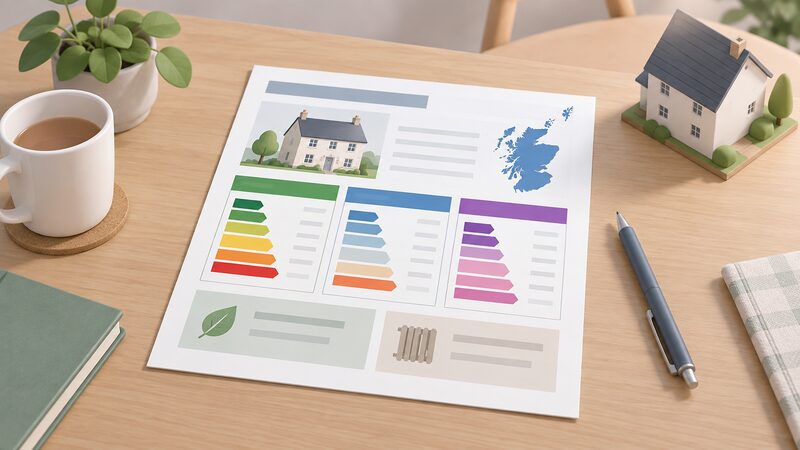
The reformed domestic certificate replaces a single headline rating with several. The final reformed EPC format and design for domestic buildings will include a Heat Retention Rating, a Heating System Rating and an Energy Cost Rating, as well as carbon dioxide emissions associated with the building and the type of heating system used6.
Each rating answers a different question. The Energy Cost Rating is a standardised rating to reflect the cost of running the home5. The Heat Retention Rating is a rating based on the annual heat demand in kWh/m2 of the building5. The Heating System Rating provides new information about the home's current heating system5. The Scottish Government has also proposed renaming the energy efficiency rating cost rating and adding information to EPCs, for example on the heating system13.
The separation matters for a household thinking about independence. A single band conflates the fabric of the building with the fuel and equipment serving it. Splitting heat demand from heating system from running cost lets a reader see whether a poor result comes from the walls and roof or from the boiler or heat pump, and therefore what kind of intervention would change it. It also makes the certificate a more honest document about dependence: a well-insulated home on an expensive fuel and a poorly insulated home on a cheap one no longer collapse into the same letter.
The redesigned certificate is based on a first phase of user testing, to be followed by a second phase prior to regulations coming into force, with introduction timed to coincide with the regulations bringing the new rating system into force7.
How the reform fits Scotland's wider heat and efficiency targets
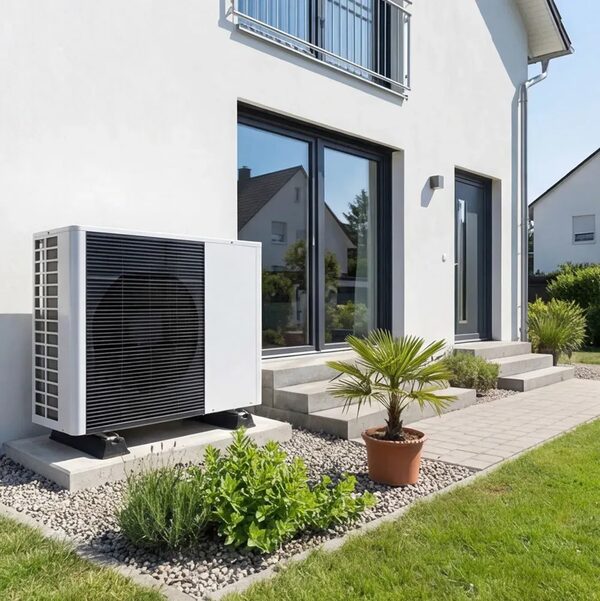
The EPC reform sits inside a broader programme on heat in buildings. The Scottish Government's commitment to decarbonising heat in buildings by 2045 remains firm14. Alongside that, the government has consulted on proposals to mandate a minimum of EPC band C on all domestic properties offered for sale or which undergo major renovation15, and intends all privately rented properties, as far as possible, to reach the equivalent of EPC C under the new reformed EPC5.
The private rented sector is where the standards bite first. The Scottish Government consultation proposes new minimum energy efficiency standards for private landlords to meet by 202816. A separate proposal would require homeowners in Scotland to install clean heating systems after purchasing a property, within a grace period of two to five years of completing the purchase17.
The baseline is not high. In 2023, 56% of Scottish homes were rated EPC band C or better using existing EPC ratings18. Meeting EPC C was assessed as having a simple payback over ten years for half of all homes19, which indicates that for the other half the economics are less straightforward.
A shorter validity period interacts with all of this. Standards expressed as a minimum band need a current certificate to be enforceable and to be checked at the point of sale or let. A five-year cycle keeps the register closer to the housing stock it describes, at the cost of more frequent assessment for owners. For a household, the reform is best understood as a tightening of the information cycle rather than a direct change to the building: it does not insulate anything, and it does not reduce reliance on gas, the grid or a supplier by itself.
Lodgement fees and the assessment process
The lodgement fee is the charge for placing a certificate on the register. It is separate from the assessor's fee, which is set by the market and quoted per property. The Scottish Government has consulted on amending EPC lodgement fees to £6.00 for domestic certificates and £15.50 for non-domestic certificates4, and the same figures appear in the October 2025 update2. The scheduled increase is from £2.60 to £6.00 for domestic properties and from £12.10 to £15.50 for other properties, effective from 31 October 20262.
The fee is not simply an administrative charge. The Scottish Government intends to use the lodgement fees to support the development and delivery of a new EPC Register, a new EPC calculation methodology, and to support the establishment of a new onsite audit and inspection function within the Scottish Government4. The changes will be introduced through the Energy Performance of Buildings (Scotland) Regulations 20254, and the government has committed to reviewing lodgement fee and penalty charge levels within two years of the regulations coming into force to ensure they remain fair and proportionate4. This was the first consultation on lodgement fee levels since 20174.
On who may assess: only organisations approved by the Scottish Government can produce valid EPCs20. The Scottish EPC Accreditation Scheme remains open for new applicants who will be appointed in advance of the remainder of the 2025 Regulations2. Enforcement of the system rests with the 32 Scottish local authorities and the Scottish Government21.
Sources21 cited
- Scotland's Climate Change Plan 2026-2040, Scottish Government, 2025-11-06
- Energy Performance Certificate reform updates, Scottish Government, 2026-08-24
- EPCs explained, Elmhurst Energy, 2026-09-20
- Scottish Energy Performance Certificate register consultation, Scottish Government, 2025-10-13
- Heat in Buildings progress report 2025, Scottish Government, 2025-10-02
- Energy Performance of Buildings (Scotland) Regulations 2025: children's rights and wellbeing impact assessment, Scottish Government, 2025-10-10
- EPC reform consultation: government response, Scottish Government, 2025-01
- Energy Performance Certificate reform consultation analysis, Scottish Government, 2025-01-23
- Our response to the Scottish Government's consultation on domestic Energy Performance Certificate reform, Energy Saving Trust, 2025-10-08
- Energy Performance Certificates guide: buildings for let, Scottish Government, 2023-11-29
- Home Energy Scotland grants and loans, Home Energy Scotland, 2026-09-17
- Energy Performance Certificates guide: buildings for sale, Scottish Government, 2026-08-24
- Energy Performance Certificate reform: government response, House of Commons Library, 2026-09-17
- Heat in Buildings Bill consultation analysis and response, Scottish Parliament, 2026-01-29
- Energy Performance of Buildings (Scotland) Regulations 2025 update, Scottish Government, 2025-10
- Landlords: how to make your property more energy efficient, Energy Saving Trust, 2026-08-04
- Using home purchase regulations to grow the market for clean heating in Scotland, Nesta, 2025-05-13
- Consultation on draft energy efficiency domestic private rented property Scotland regulations, Scottish Government, 2023
- Written evidence on EPC C payback, UK Parliament, 2018
- How to spot an energy scam, Energy Saving Trust, 2026-06-19
- Energy Performance of Buildings (Scotland) Regulations 2008, legislation.gov.uk, 2026-09-17
 EPC Regulations and ReformSelling or renting out a home means you need an Energy Performance Certificate.
 Get an EPC for Your HomeSelling or renting out a home means you need an Energy Performance Certificate.
 Climate TargetsScotland aims to stop adding greenhouse gases by 2045, five years before the rest of the UK.
 Scottish Building StandardsWork on your home in Scotland may need a building warrant before you start and a completion certificate when you finish.
 Housing Stock and EPCsHow energy efficient are Scottish homes, and how many reach a good rating?
 Solid-State BatteriesAre solid-state batteries on sale yet, and should you wait for one?