

In this guide
Scotland's housing stock is old, flat-heavy and, on the official measure, mid-table. The Scottish House Condition Survey reports that 56% of Scottish homes had an EPC rating of C or better in 2024, similar to 2023 levels1. The mean energy efficiency rating of the stock under SAP 2012 was 68.1, which falls in band D1. The median environmental impact rating in the same year was 67, also band D1.
That places the typical Scottish home in the middle of the A to G scale: better than the worst-rated stock, short of the band C that the Scottish Government treats as the threshold for adequate energy efficiency. The Scottish Government classes any home with an EPC rating below C as having poor energy efficiency, which means fuel bills may be higher than they need to be2.
The direction of travel is clear. The share of homes at C or better has risen from 24% in 2010 to 41% in 2014 and 45% in 2019, reaching 56% by 20243. The Scottish Government describes the current figure as an increase of 11 percentage points since 20194. What remains is a stubborn tail: over 1.6 million homes sit in EPC band D or below5, and the Scottish Government has estimated 400,000 of those at the worst bands of E, F and G3.
How the ratings are distributed across the bands
Scottish domestic EPCs do not carry a single number. The Energy Efficiency Rating gives an A to G band and a numerical 1 to 100 rating based on the cost to run the dwelling, normalised to floor area8. The Environmental Impact Rating reports modelled CO2e emissions per square metre on the same normalised 1 to 100 scale9. Both are based on calculated energy use using building information collected by an assessor along with standard assumptions about occupant behaviour and weather9.
The distribution across the bands is bottom-heavy. The 2022-2024 local authority tables put the national average share of dwellings in bands A, B or C at 55%, and the share in bands F or G at 3%10. The Scottish House Condition Survey found 8% of properties in bands E, F or G in 2023, down from 27% in 20106. The gap between the 3% and 8% figures reflects different band groupings and survey years rather than a contradiction: one counts F and G only, the other E, F and G together.
The private rented sector shows the shape of the problem more sharply. In the stock covered by the 2026 regulations impact assessment, 34% of properties are EPC band D and 14% are rated E, F or G11. That is a sector where nearly half the stock sits at D or below, and where the regulations are designed to bite.
| Measure | Value | Band | Year |
|---|---|---|---|
| Mean energy efficiency rating | 68.1 SAP points | D | 20241 |
| Median environmental impact rating | 67 | D | 20241 |
| Mean environmental impact rating | 65 | D | 20241 |
| Dwellings in bands A, B or C | 55% national average | 2022-202410 | |
| Dwellings in bands F or G | 3% national average | 2022-202410 | |
| Properties in bands E, F or G | 8% | 20236 |

The trend over the last decade: from 24% to 56% at C or above
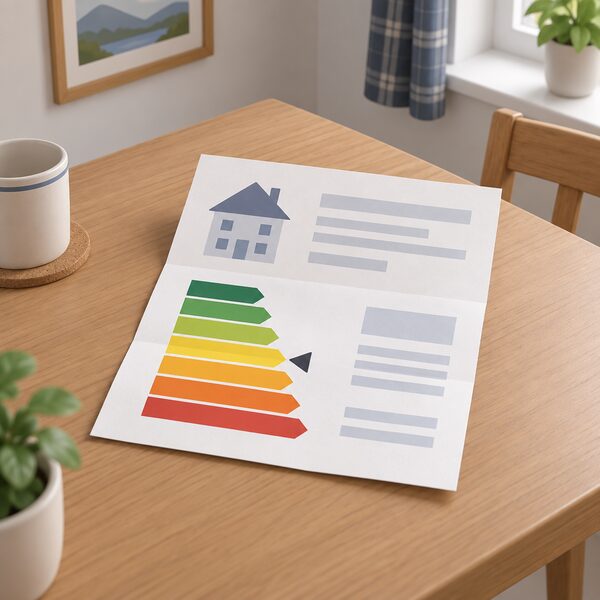
The improvement in Scottish housing energy efficiency over the past fifteen years is one of the more measurable shifts in the stock. In 2010, 24% of properties had an EPC rating of C or above; by 2014 that had reached 41%3. By 2019 it was 45%12. The Scottish House Condition Survey recorded 52% in 2022, an increase of 8 percentage points on 201913, and 56% in 2023, an increase of 3 percentage points on 20226. The 2024 figure held at 56%, similar to 2023 levels1.
The gains have not been evenly spread across tenures. Between 2019 and 2022, the share of owner-occupied dwellings achieving at least C rose from 41% to 48%, the private rented sector from 40% to 50%, and the social rented sector from 56% to 65%14. Social housing has consistently led: in 2019, 56% of social housing was at C or better against 41% of the private sector12. The Scottish Government's own framing in 2016 was that the social housing sector had the highest energy efficiency ratings, with 56% of dwellings at band C or better and only 8% below band D3.
Two cautions sit alongside the trend. First, the Scottish House Condition Survey 2023 reports 56% at C or better, while a figure of 61% appears in the same year's statistics; the two figures are unresolved and both should be treated as reported6. Second, the Scottish Government's own EPC reform consultation analysis found that around 40% of a sample of Scottish dwellings reached EPC C or better under the reformed ratings, and that around 80% of homes currently in cost-based EPC EER band C also achieve band C in the new Heat Retention Rating15. Changing the rating changes the count.
Why Scotland's stock is harder to heat: age, flats and the pre-1914 legacy
The physical profile of Scottish housing explains much of the rating distribution. Just over one third of Scottish households live in flats17, and tenements tend to be older than the rest of the housing stock, with more than a quarter being at least one hundred years old5. Twenty per cent of the stock is over 100 years old, and around 85% of the homes that will exist in 2050 have already been built3.
The private rented sector concentrates these characteristics. Nearly two-thirds of PRS properties are tenements or flats, and more than one-third were built before 191918. Among privately rented dwellings with an EPC of F or G, 82% were built before 1919, and 68% of those with an E, F or G rating were built before 1919, compared with 41% of all dwellings in the sector19. Rural areas hold a disproportionate share: 63% of PRS dwellings with an EPC of F or G, and 39% with an E, F or G, are located in rural areas, against 15% for the sector as a whole19.
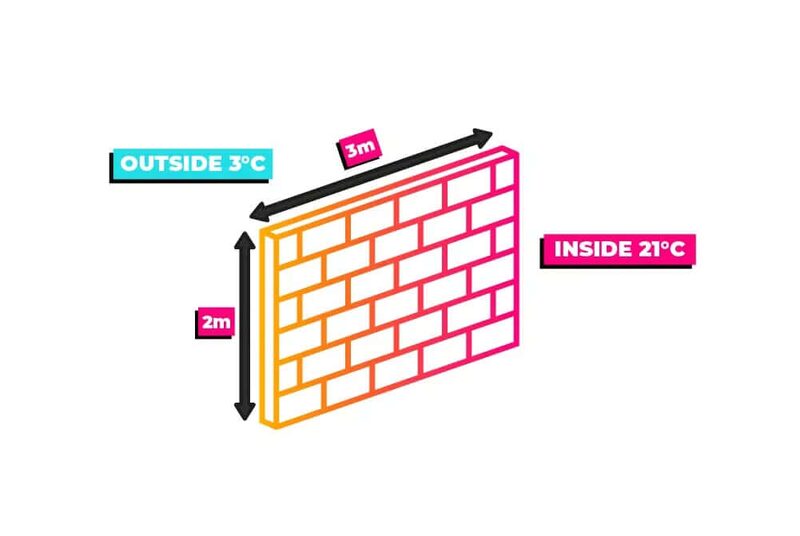
Construction age drives fabric performance directly. For solid brick walls, the starting U-value was 1.7 W/m2K before 1976, 1 for 1976 to 1983, 0.6 for 1984 to 1991, and 0.45 from 199220. A pre-1919 tenement flat with solid brick walls therefore starts from a far worse thermal position than a post-1992 house, and the measures available to it are constrained by shared walls, listed status and the need for landlord or factor consent.
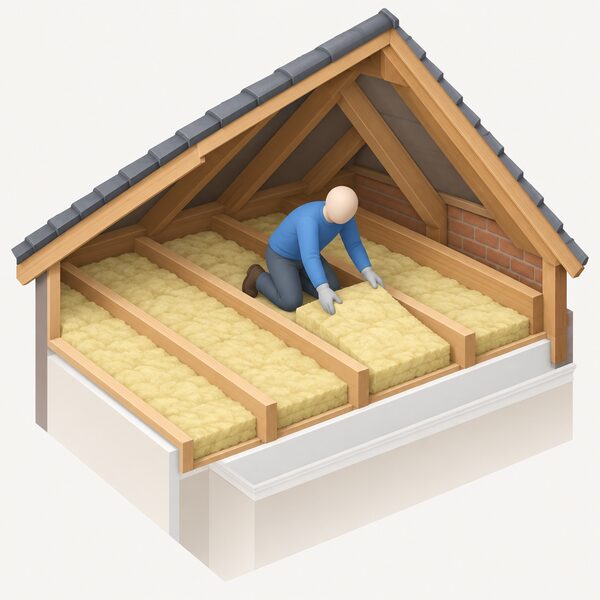
Insulation coverage reflects this. In 2023, loft insulation of 100 mm or more had been installed in 96% of dwellings, but only 55% of private sector homes had wall insulation, against 69% in the social sector6. Loft insulation is close to saturation; wall insulation is not, and it is the harder and more expensive measure in a tenement.
The 1.4 million homes still below band C, including 400,000 at E, F or G
The Scottish Government's 2016 estimate was that, out of a total of 2.3 million homes, 1.4 million were below EPC band C, of which 400,000 were the worst rated at G, F and E3. A later figure put the number of fuel poor homes below EPC band C at approximately 385,000 on average over 2017-1921. The Tenements Short Life Working Group reported over 1.6 million homes in EPC band D or below5.
The gap between these figures is partly definitional and partly temporal. The 1.4 million figure counts all homes below C; the 385,000 counts fuel poor homes below C; the 1.6 million counts homes at D or below, which excludes those at C but includes a larger group than the 1.4 million below C only if the stock has grown or the measure has shifted. The figures disagree, and the dates differ by up to seven years.
What the figures agree on is that the tail is concentrated and consequential. Households in dwellings rated EPC band C or better had a fuel poverty rate of 32% in the 2025 consultation analysis, against 48% for those in band F or G11. The Scottish House Condition Survey 2023 gives the same pair of figures: 32% at C or better, 48% at F or G6. Earlier survey years show the same pattern at lower levels: 16% at C or better against 43% at F or G in 202122, and 27% against 41% in 202213. Extreme fuel poverty follows the same gradient: 6% of households in dwellings rated C or better in 2021, against 23% for dwellings in bands F or G22.
| EPC band | Fuel poverty rate | Year |
|---|---|---|
| C or better | 32% | 20236 |
| C or better | 27% | 202213 |
| C or better | 16% | 202122 |
| F or G | 48% | 20236 |
| F or G | 41% | 202213 |
| F or G | 43% | 202122 |
Fabric performance: what a median EIR of 63 says about insulation
The Environmental Impact Rating measures modelled CO2e emissions per square metre, expressed as a normalised 1 to 100 score9. In 2017, the mean EIR for Scottish housing was 60 and the median was 63, both falling in band D23. By 2024, the mean had risen to 65 and the median to 67, still band D1. The trend between 2010 and 2017 was one of increasing median EIR, indicating that the environmental impact of Scottish housing was gradually falling23.
A median EIR in the mid-60s describes a stock that has made real progress on the cheapest measures and is now into the harder ones. Loft insulation at 100 mm or more is present in 96% of dwellings6, so the easy fabric win is largely taken. Wall insulation is present in 55% of private sector homes and 69% of social sector homes6, leaving a substantial private sector gap. The 2017 mean EER of 63 in the residential sector, calculated under SAP 2012, sits in the same band as the EIR figures19.
The practical consequence for a household is that the rating is a modelled figure, not a meter reading. It assumes standard occupancy and weather, and it is calculated from building information collected by an assessor9. Two identical flats with different heating systems or different assessor assumptions can land in different bands. The Scottish House Condition Survey 2023 found that 18% of all households said their heating keeps them warm enough in winter only sometimes, and 6% said it never does6. Poor insulation was cited by 13% of households as the reason their home is difficult to heat1.
"18% of all households found that their heating keeps them warm enough in winter only sometimes and 6% felt it never keeps them warm enough."
Fuel poverty and the distributional impacts of energy policy changes
The relationship between EPC band and fuel poverty is the strongest single pattern in the Scottish data. The overall fuel poverty rate was 33.9% of all households in 20231. In 2022, rates in the housing association (47%), local authority (48%) and private rented (44%) sectors were similar to each other22. Households in the 15% most deprived areas had a rate of 42%, against 29% elsewhere22. In 2021, the social sector rate was 34% against 15% in the private sector21.
Heating fuel matters as much as fabric. Households using electricity as their primary heating fuel had a fuel poverty rate of 52% falling to 48% between January and March 2026, a change of 4 percentage points, while those on mains gas moved from 26% to 25%, a change of 1 percentage point24. A separate analysis found 42% of households using electricity in fuel poverty in 2024, against 26% for those using other fuels25. The scenario modelling for April to June 2026 found a 1 percentage point change for the private rented sector and a 1 percentage point decrease for owner-occupied households compared with the January to March 2026 price cap period26.
The distributional picture is complicated by how support is spread. Energy Company Obligation spend in Scotland is around 10-11% of rest-of-UK spend27, and fuel poverty rates across Scotland are likely to range from around 1 in 2 to 1 in 5 households depending on geography and demographics27. The Scottish Government has estimated the total capital cost of upgrading fuel poor households to EPC C at up to £6 billion21.
Scotland's climate targets and what they demand of householders
Scotland's Climate Change Act was updated in 2019 with new legally-binding emissions reductions targets for 2020, 2030 and 2040 of 56%, 75% and 90% respectively, superseding the previous net-basis annual targets. The Scottish Government has separately committed to a net zero greenhouse gas emissions target by 2045.
For housing, the Heat in Buildings Strategy set the ambition that a large majority of buildings should achieve a good level of energy efficiency by 2030, equivalent to EPC C for homes17. The 2021 consultation set a minimum standard equivalent to EPC C at least, where technically feasible and cost-effective, by 203528. The Scottish Government has since said all homes in Scotland should meet at least EPC band C by 2033 where feasible and cost-effective7. The 2021 fuel poverty strategy committed that by 2033 all homes across Scotland will have achieved the equivalent of an EPC C, where technically feasible and cost effective, with an ambition to maximise the number of fuel poor households reaching the equivalent of an EPC B by 204021.
The interim climate change target for 2030 requires at least 1 million Scottish homes and the equivalent of 50,000 non-domestic buildings to change their heating30. The draft Heat in Buildings Strategy set a target for at least 64,000 homes to install renewable heating systems per year.
The scale of the task is visible in the gap between the target and the stock. Over 1.6 million homes sit at band D or below5, and the 2033 deadline is seven years from the 2026 position. The Scottish Government has also welcomed UK Government proposals to require lenders to disclose the average EPC performance of properties on their mortgage portfolios, with a voluntary target of a portfolio average of EPC C by 203029.
Where to get help: Home Energy Scotland and consumer advice

Home Energy Scotland provides impartial, free, tailored advice on energy efficiency and eligibility for Scottish Government schemes, available to all households in Scotland, and acts as the gateway to the Warmer Homes Scotland programme2. The Scottish Government has described growing its advice services and support to access funding and finance as part of the Heat in Buildings Strategy29.
For households in the private rented sector, the regulatory position is shifting. The Energy Efficiency (Domestic Private Rented Property) (Scotland) Regulations 2026 are the subject of a partial business regulatory impact assessment, and the stock profile they cover is 34% at band D and 14% at E, F or G11. The 2017 consultation on minimum standards noted that 63% of PRS dwellings with an EPC of F or G are in rural areas19.
Area-based schemes have delivered measurable improvement. The Heat and Energy Efficient Scotland Area Based Scheme reported that 100% of post-installation EPC assessments showed an average uplift of one EPC band31. That is the practical unit of progress: one band per intervention, on the assessments that were carried out.
For a household, the independence question is straightforward. Fabric measures reduce the amount of energy needed to keep a home warm, which reduces exposure to price movements regardless of the fuel. But the rating itself does not remove dependence: a home at band C on mains gas still depends on the gas grid and a supplier, and a home at band C with electric heating still depends on the electricity network. The EPC measures the building, not the household's exposure to the energy market. The Scottish Government's own framing is that any home below C has poor energy efficiency, which means fuel bills may be higher than they need to be2. Above C, the bill depends on what the household is buying and at what price.
Sources31 cited
- Scottish House Condition Survey 2024: Key Findings, Scottish Government, 2026
- Tackling Fuel Poverty in Scotland: A Strategic Approach, Scottish Government, 2021
- Scotland Without Fuel Poverty: Four Steps to Achieving a Sustainable Future, Scottish Government, 2016
- Scotland's Climate Change Plan 2026-2040, Scottish Government
- Tenements Short Life Working Group: Energy Efficiency and Zero Emissions Heating, Scottish Government, 2023
- Scottish House Condition Survey 2023: Key Findings Summary, Scottish Government, 2023
- Scotland's Housing and EPC Targets: Research Briefing, House of Commons Library
- Energy Performance Certificate (EPC) Reform Consultation, Scottish Government, 2023
- Reforms to the Energy Performance of Buildings Regime: Technical Annex for Chapter 2, UK Government, 2026
- Scottish House Condition Survey Local Authority Tables 2022-2024: Energy Efficiency, Scottish Government
- Energy Efficiency (Domestic Private Rented Property) (Scotland) Regulations 2026: Partial Business Regulatory Impact Assessment, Scottish Government, 2026
- Heat in Buildings Strategy Consultation, Scottish Government, 2021
- Scottish House Condition Survey 2022: Key Findings Summary, Scottish Government, 2022
- Heat in Buildings Progress Report 2024, Scottish Government, 2024
- EPC Reform Consultation: Government Response, Scottish Government, 2025
- Heat in Buildings Progress Report 2025, Scottish Government, 2025
- Heat in Buildings Strategy: Achieving Net Zero Emissions in Scotland's Buildings, Scottish Government, 2021
- Consultation on Draft Energy Efficiency (Domestic Private Rented Property) (Scotland) Regulations, Scottish Government, 2025
- Minimum Standards for Energy Efficiency in the Private Rented Sector: Partial Business Regulatory Impact Assessment, Scottish Government, 2017
- Energy Company Obligation ECO4 Guidance: Delivery V1, Ofgem, 2022
- Scottish House Condition Survey 2021: Fuel Poverty, Scottish Government, 2021
- Scottish House Condition Survey 2022: Fuel Poverty, Scottish Government, 2022
- Scottish House Condition Survey 2017: Key Findings, Scottish Government, 2017
- Scenario Modelling: Impact of the Reduction of the Renewables Obligation on Fuel Bills and Ending ECO on Fuel Poverty in Scotland, Scottish Government, 2026
- Tackling Fuel Poverty in Scotland: Periodic Report 2021-2024 Engagement Responses, Scottish Government, 2025
- Fuel Poverty Scenario Modelling Based on Ofgem Energy Price Caps up to April to June 2026, Scottish Government, 2026
- Fuel Poverty in Scotland: Research Briefing, House of Commons Library
- Heat in Buildings Strategy Consultation: Page 4, Scottish Government, 2021
- Draft Heat in Buildings Strategy Consultation, Scottish Government, 2021
- Heat in Buildings: Scotland's National Public Energy Agency Consultation, Scottish Government, 2021
- Energy Efficient Scotland Area Based Schemes, West Lothian Council, 2026
 Housing Stock Data for ScotlandScotland's housing is measured differently from England's, so the numbers you see may not compare directly.
 Efficiency of UK HomesMost UK homes now score better on energy than they did a decade ago, but older houses still lag well behind new builds.
 New Build Energy PerformanceHow energy efficient are new build homes compared with older ones?
 Housing Stock and EPCsWelsh homes are among the oldest and least energy efficient in the UK, so what does that mean for yours?
 Housing Stock Data for WalesHow energy efficient are Welsh homes, and how many have a rating?
 Housing Stock Data for EnglandHow energy efficient are English homes, and how many have insulation or low carbon heating?