
In this guide
Scotland measures fuel poverty by a statutory test set out in section 3 of the Fuel Poverty (Targets, Definition and Strategy) (Scotland) Act 2019. A household is in fuel poverty if, to maintain a satisfactory heating regime, the total fuel costs necessary for the home are more than 10% of the household's adjusted net income after housing costs, and if, after deducting fuel costs, benefits received for a care need or disability and childcare costs, the remaining adjusted net income is insufficient to maintain an acceptable standard of living. Extreme fuel poverty follows the same definition except that the fuel cost threshold is more than 20% of adjusted net income after housing costs1.
On the most recent survey measurement, 732,000 households in Scotland were in fuel poverty in 2024, a decrease of 127,000, or five percentage points, on the previous year2. Separate scenario modelling, which projects the statutory definition forward using Ofgem price caps rather than surveying homes, estimated around 820,000 fuel poor households in Scotland for October to December 2026, 32% of all households and an increase of around 20,000 households on the July to September 2026 estimate3. The survey and the modelling answer slightly different questions, and the numbers should not be read as a single time series.
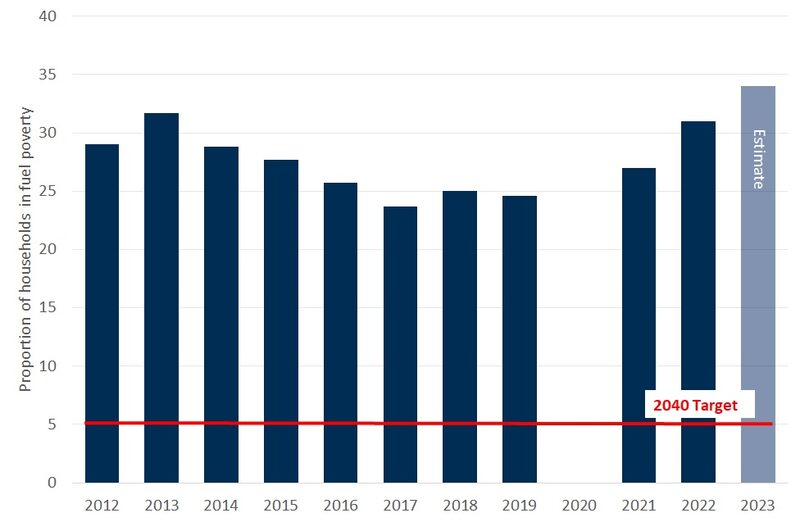
The statutory targets sit far below all of these figures. The 2019 Act requires that by 2040, as far as reasonably possible, no household in Scotland is in fuel poverty, with binding limits of no more than 5% of households in fuel poverty and no more than 1% in extreme fuel poverty4.
The two-part test that defines a fuel poor household
The Scottish definition is deliberately a two-stage test, and both stages must be failed before a household counts. The first stage is the fuel cost ratio: more than 10% of adjusted net income after housing costs, calculated on the fuel needed to maintain a satisfactory heating regime rather than on what the household actually spends. That distinction matters, because households who ration heat do not fall out of the statistics by doing so. The second stage is the residual income test. After deducting fuel costs, childcare costs and benefits received for a care need or disability, the remaining adjusted net income must be enough to maintain an acceptable standard of living, benchmarked at 90% of the UK Minimum Income Standard produced by Loughborough University6.
Extreme fuel poverty applies the same structure with the ratio raised to more than 20%1. An additional amount is added to the required fuel spend for households in remote rural, remote small town and island areas, recognising that the same warmth costs more to deliver in those places7.
This is a tighter and more explicitly income-based test than the one Scotland used before. The older definition, shared at the time with Wales and Northern Ireland, simply asked whether a household would need to spend more than 10% of its income to keep the home at a reasonable temperature, with no residual income condition8. Under that earlier measure, 27.1% of households in Scotland were recorded as fuel poor in 20129, and an estimated 748,000 households, 30.7% of all households, in 201510.
"a household is in fuel poverty if, in order to maintain a satisfactory heating regime, total fuel costs necessary for the home are more than 10% of the household's adjusted net income (after housing costs)"
The figures: survey measurement and price cap modelling
Two official series describe fuel poverty in Scotland, and they move differently.
| Period | Estimate | Basis |
|---|---|---|
| 2015 | 748,000 households, 30.7%10 | Older definition |
| 2019 | 24.6%, 613,000 households11 | Survey |
| 2021 | 495,000 households, 19.6%12 | Survey |
| 2024 | 732,000 households, down 127,000 on 20232 | Survey |
| Jan to Mar 2026 | around 800,000, 31% of all households13 | Modelled |
| Apr to Jun 2026 | around 680,000, 27% of all households14 | Modelled |
| Oct to Dec 2026 | around 820,000, 32% of all households3 | Modelled |
The modelled quarterly figures swing with the price cap, which is the point of them: they show the statutory definition responding to fuel prices before any survey can pick the change up. For January to March 2026, around 400,000 households were modelled as being in extreme fuel poverty, 16% of all households and 50% of all fuel poor households13. The same modelling tested the effect of removing the Renewables Obligation and Energy Company Obligation levies from bills, giving around 730,000 fuel poor households (29%) and 350,000 in extreme fuel poverty (14%), a reduction of around 60,000 fuel poor households (2.5 percentage points) and 50,000 extremely fuel poor households (1.9 percentage points)13.
Local variation is wide. Local authority tables covering 2022 to 2024 show rates ranging from 22% in Stirling to 51% in the Orkney Islands, against a Scotland average of 31%7. Engagement on the periodic report put the practical spread as fuel poverty rates "likely to range for something in the region of 1 in 2 to 1 in 5 households" depending on geography and demographics, against a benchmark of 24% of households in 201915.
What drives the rate

The Scottish Government identifies four key drivers: levels of household income, the price of fuel required for space and water heating, the energy efficiency of the dwelling, and the required use of fuel by households to maintain satisfactory heating regimes16. The fuel poverty strategy states the same four as poor energy efficiency of the home, low household income, high energy prices, and how energy is used in the home17. Two of the four are explicitly finance-related, energy prices and income18.
Price is the driver that moves the headline number fastest. Because the definition used in Scotland is sensitive to changes in fuel prices, the estimated rate rose substantially between 2019 and 2023, reaching 34% in Scotland19. Income sets who is exposed: in 2018 the fuel poverty rate was 95% for households in the bottom income band, below £200 per week18.
Heating fuel is the clearest structural divide. In 2024, an estimated 42% of households using electricity for heating were in fuel poverty, against 27% of those using gas for heating and 26% of those using other fuels; 13% of oil-using households were in extreme fuel poverty20. The depth of the problem follows the same line: fuel poor households using electricity as their primary heating fuel had a modelled median fuel poverty gap of around £2,000 a year for January to March 202613. The median gap for fuel poor households generally was measured at £690 in 2021, though a second figure of £620 is also reported for that period, and the two do not agree12.
Purchasing patterns compound the difficulty for off-grid households. Users of solid fuel generally purchased directly from local suppliers and often stockpiled over the summer to ensure they had enough to last through colder winter months18, which requires capital in hand months before the cold arrives. Around 170,000 children were living in fuel poverty on the 2017 to 2019 average21.
Tenure, place and household type
Fuel poverty is not evenly distributed, and the sectoral gap has widened rather than closed.
| Group | Rate | Year |
|---|---|---|
| Social sector | 49% | 20241 |
| Private sector | 22% | 20241 |
| Social sector | 61% | 202322 |
| Private sector | 25% | 202322 |
| Social sector | 48% | 202211 |
| Private sector | 26% | 202211 |
| Social sector | 34% | 202112 |
| Private sector | 15% | 202112 |
Geography cuts across tenure. Fuel poverty levels are higher in remote rural areas (43%) and remote small towns (34%) than in urban areas (24%), against a Scottish average extreme fuel poverty rate of 12% over 2018 to 201923. In 2022 the rate for rural households was 35% against 30% for urban households, and the rate for remote rural households, 47%, was higher than for all other areas11. Deprivation adds a further layer: 42% of households in the 15% most deprived areas were fuel poor in 2022, compared with 29% elsewhere11, and in 2021 the corresponding split was 30% against 18%12.
Age and ownership status matter too. Families had a lower rate of fuel poverty, 27%, than older households at 36%, and among owner occupiers 14% of those with a mortgage and 28% of those who own outright were assessed as fuel poor in 202211. Outright ownership removes a housing cost but not a heating bill, which is why owning a home outright is no protection where the fabric is poor.
The rural and urban difference is set out in more detail on rural and urban fuel poverty in Scotland, and the heating fuel split on fuel poverty by heating fuel type.
How Scotland's measure differs from the rest of the UK

Fuel poverty is a devolved matter, and each nation measures it differently, so headline rates are not directly comparable. The Scottish definition has long been described as slightly different from that used in England and Wales, with Scotland using a higher temperature standard24. Scotland's current statutory definition also carries the residual income test against 90% of the UK Minimum Income Standard and the rural uplift, neither of which has a direct counterpart in the older ten per cent measure6.
Historically the measures produced broadly similar results where the definitions were similar: in 2018, Ofgem reported 23% of Welsh households (291,000) and 26.5% of Scottish households (649,000) in fuel poverty under a definition that, for Scotland and Wales, turned on spending more than 10% of income on fuel25. Scotland's rate on its own earlier basis was 23.7%, around 583,000 households, in 201726.
Because the definitions diverge, a household moving across a border does not change its circumstances but may change its classification. Comparisons of the schemes and their logic are set out on why home energy grants differ across the four nations, and the equivalent national measures on fuel poverty in Wales and fuel poverty in Northern Ireland. Which powers sit where is covered on devolved and reserved energy powers.
The statutory targets and who reports against them
The Fuel Poverty (Targets, Definition and Strategy) (Scotland) Act 2019 requires that by 2040, as far as reasonably possible, no household in Scotland is in fuel poverty, and sets four numerical targets: no more than 5% of households in fuel poverty, no more than 1% in extreme fuel poverty, and a median fuel poverty gap of no more than £250 adjusted for 2015 prices4. The gap target is expressed as no more than £250 in 2015 prices before adding inflation5. The 5% target is restated consistently across the Heat in Buildings Strategy, the fuel poverty strategy and subsequent regulatory impact assessments4.
Progress is reported through the Scottish House Condition Survey, through periodic reports on tackling fuel poverty, and through scrutiny by the statutory Scottish Fuel Poverty Advisory Panel, which has described the Fuel Insecurity Fund as providing vital support for fuel poor people, who are amongst the most vulnerable living in Scotland29. Scotland's wider emissions commitments, which shape the heat decarbonisation programmes that carry much of the fuel poverty effort, are set out on Scotland's climate targets.
Delivery: the programmes that sit behind the target
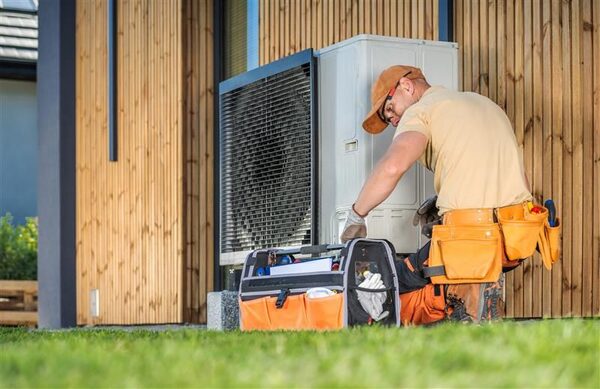
Warmer Homes Scotland helps households in, or at risk of, fuel poverty improve their heating and energy efficiency30. The national scheme was launched in September 201531 and relaunched in 2023 with increased funding for clean heating systems30. It is available to households, both owner occupiers and some private rented sector tenants, who are living in or at risk of fuel poverty and who meet the qualifying eligibility criteria31.
- Where technically suitable, households are offered clean heating systems first; if this would increase energy bills, an emission-producing system may be provided instead30.
- Clean heating is offered in the first instance only where installation will avoid pushing households into fuel poverty or worsening their depth of fuel poverty30.
- Most homes also get energy-saving upgrades, no matter which heating system is installed30.
- Renewable and micro-generation measures available have included ground source heat pumps, micro-wind, micro-hydro and micro-CHP systems31.
- All home improvements funded by the scheme must be delivered by Warmworks-approved installers, and in most cases the Scottish Government meets all the costs, though in some rare cases a household may need to pay some costs32.
- Private rented properties covered by the statutory Repairing Standard no longer receive improvements a landlord is legally obliged to provide, but remain eligible for other improvements if recommended32.
The scheme is described as offering support worth £10,000 or more for eligible households32. It has helped more than 46,000 households throughout Scotland, with around 21,000 households referred through to the fuel poverty support programme since the new scheme launched in October 202333.
Access runs through Home Energy Scotland, a network of local advice centres covering all of Scotland, funded by the Scottish Government and managed by Energy Saving Trust34. Advisors can check eligibility for financial support including Warmer Homes Scotland and the Home Energy Scotland Grant and Loan35, and the service can be contacted free by phone, email or WhatsApp on 0808 808 228235. Delivery is not instant: an industry roundtable recorded anecdotal reports of delays of up to 30 days for an initial call back, and suggested that two to three months can elapse before installation is even scheduled, with funding paid to the customer rather than directly to the contractor37. Area-based delivery is covered on HEEPS area based schemes.
What fuel poverty means for household energy independence
Fuel poverty is, at root, a measure of dependence. A household fails the test because the heat its home requires costs more than its income can absorb, and every one of the four drivers is something the household mostly does not control: the price of fuel, set in wholesale markets and mediated by the price cap; the level of income; the efficiency of the building fabric; and the heat the dwelling demands16. The quarterly swings in the modelled rate, from 31% for January to March 2026 to 27% for April to June 2026 and 32% for October to December 2026, are driven by price cap movements rather than by anything happening inside Scottish homes13.
Only one of the four drivers can be permanently changed by work on the property. Insulation and heating upgrades lower the fuel a home needs at any price, which is why the programmes attached to the 2040 target are fabric and heating programmes rather than bill support. But the same modelling shows the limit: electrically heated fuel poor households carry a modelled median gap of around £2,000 a year13, and 42% of electrically heated households were fuel poor in 2024 against 27% of those on mains gas20. Switching a poorly insulated home from a cheaper fuel to a more expensive one can deepen fuel poverty, which is why Warmer Homes Scotland will fit an emission-producing system instead where clean heating would increase bills30.
Dependence also remains on the delivery chain itself. Grant eligibility, installer availability and scheme design sit with government and its contractors, and the schemes in place have been described as requiring review to ensure they are designed for the next five to ten years37. A household that reduces its heat demand reduces its exposure to all of this. A household that cannot fund the work stays exposed to whatever the next price cap does. Household-level generation and storage, which shift part of the supply side into the home, are covered on microgeneration uptake by nation, and the wider constitutional picture on devolution and household energy independence.
Sources37 cited
- Scottish House Condition Survey 2024 Key Findings, Scottish Government, February 2026
- Scottish House Condition Survey 2024: fuel poverty tables, Scottish Government, 2024
- Fuel poverty scenario modelling: October to December 2026 price cap, Scottish Government, 2 September 2026
- Heat in Buildings Strategy, Scottish Government, 2021
- Energy Efficiency (Domestic Private Rented Property) (Scotland) Regulations 2026: partial BRIA, Scottish Government, 6 June 2025
- Fuel poverty modelled estimates for Wales: definitions and comparisons, Welsh Government, 16 October 2025
- Scottish House Condition Survey local authority tables 2022-2024: fuel poverty, Scottish Government, 26 May 2026
- Fuel poverty briefing, House of Commons Library, 2026
- Expert Commission on Energy Regulation: main report, Scottish Government, 2014
- Minimum standards for energy efficiency in the private rented sector: partial BRIA, Scottish Government, April 2017
- Scottish House Condition Survey 2022: fuel poverty, Scottish Government, 2022
- Scottish House Condition Survey 2021: fuel poverty, Scottish Government, 30 May 2023
- Scenario modelling: impact of reducing the Renewables Obligation and ending ECO on fuel poverty in Scotland, Scottish Government, 2026
- Fuel poverty scenario modelling: April to June 2026 price cap, Scottish Government, 2026
- Tackling fuel poverty in Scotland: periodic report 2021-2024, engagement responses, Scottish Government, 22 April 2025
- Scenario modelling: 2023 fuel poverty levels under 2019 fuel prices, Scottish Government, 25 March 2025
- Tackling fuel poverty in Scotland: a strategic approach, Scottish Government, 23 December 2021
- Research on the lived experience of fuel poverty in Scotland, Scottish Government, 3 September 2020
- Fuel poverty in the UK briefing, House of Commons Library, April 2025
- Fuel poverty statistics briefing, House of Commons Library, 2024
- Heat in Buildings Strategy: child rights and wellbeing impact assessment, Scottish Government, 2021
- Scottish House Condition Survey 2023: key findings summary, Scottish Government, 2023
- Heat in Buildings Strategy: island communities impact assessment, Scottish Government, 11 November 2021
- Written evidence on fuel poverty, UK Parliament, 30 December 2011
- Consumer Vulnerability Report 2018, Ofgem, November 2018
- Warmer Homes Scotland programme annual review 2018-19, Scottish Government, 2019
- Heat in Buildings Strategy: strategic environmental assessment, Scottish Government, 26 February 2021
- Changing the way we heat our homes and buildings: partial BRIA, Scottish Government, 28 November 2023
- Initial response on the Scottish Budget 2024-2025, Scottish Fuel Poverty Advisory Panel, 21 December 2023
- Warmer Homes Scotland scheme headline data, Scottish Government, 29 October 2025
- Energy saving home improvements, Scottish Government, 2026
- Warmer Homes Scotland, Home Energy Scotland, 2026
- Heat in Buildings progress report 2025, Scottish Government, 2 October 2025
- Home Energy Scotland programme page, Energy Saving Trust, 20 February 2026
- Make your home warmer, Home Energy Scotland, 2026
- Home energy efficiency advice and schemes, Argyll and Bute Council, 2026
- Heat pump roundtable report, SNIPEF, February 2026
 Fuel Poverty in the UKWho counts as living in fuel poverty, and why does the number change depending on where in the UK you live?
 Fuel Poverty PolicyWhy does fuel poverty mean something different depending on where in the UK you live?
 Fuel PovertyHow the Welsh Government defines and measures fuel poverty, the latest modelled estimate of 340,000 households (25%) as at October 2024, who is most affected, and how the Tackling Fuel Poverty Plan and the Warm Homes Nest scheme are meant to bring the figure down.
 Local Fuel Poverty StatisticsHow many households in your area struggle to afford their heating?
 Energy Policy in ScotlandWho decides how your home in Scotland is heated and improved?
 Fuel PovertyWhy does Northern Ireland have such a high rate of fuel poverty, and how many households are affected?