
In this guide
Scotland measures its housing stock differently from the rest of the UK, and the difference matters for anyone trying to read the numbers. The Scottish House Condition Survey (SHCS) is a module of the Scottish Household Survey, run by the Scottish Government, and it reports against two Scottish standards: the Tolerable Standard, the legal minimum condition for all housing, and the Scottish Housing Quality Standard (SHQS), a higher standard that applies only to social sector housing1.
The headline figures from the 2024 Key Findings are stark. In 2024, 28% of all dwellings, around 702,000, fell below the tolerable standard, and 54% of dwellings failed to meet the SHQS2. The mean energy efficiency rating of the Scottish housing stock under SAP 2012 was 68.12. More than 2 million homes use mains gas or oil as their primary heating fuel, and over 1.6 million homes sit in EPC Band D or below3.
Those numbers describe a stock that is older, colder and more mixed in its heating than the English average, and they set the baseline against which every Scottish grant, loan and regulation is measured. This page sets out what each survey covers, what the standards require, where failures concentrate, and what the data means for a household's energy independence.
What the Scottish House Condition Survey covers and how it is run
The Scottish Household Survey provides evidence on the characteristics, attitudes and behaviour of private households and individuals, and on the physical condition of Scotland's homes1. The topics covered include housing, neighbourhoods, finances, internet use, physical activity, local services, environment, volunteering, culture and childcare1. Every year a random sample of addresses in Scotland is invited to take part, so that results are representative of everyone in Scotland, not just certain groups1.
The physical condition element is the Scottish House Condition Survey, run by the Scottish Government5. The 2024 survey year produced updated fuel poverty rates, energy efficiency ratings and condition data, published in February 2026 as an Accredited Official Statistics release based on 2,902 surveyed properties6. The 2022 SHCS element surveyed 2,931 households7.
Methodology has shifted over time, and comparisons across years need care. The 2021 SHCS was undertaken using an external+ approach, and because of that change in approach the results are not directly comparable with previous waves8. The 2021 estimates under the fuel poverty definition were published as experimental statistics7. From 2022, fuel poverty estimates reflect households being placed on one of the four heating regimes defined in The Fuel Poverty (Enhanced Heating) (Scotland) Regulations 20207.
The survey also underpins scenario work. One analysis uses SHCS data from 2023 and 2019 fuel prices to model a hypothetical rate of fuel poverty under a scenario in which energy prices in 2023 remained at 2019 levels, with all other factors held constant8. That is a modelled figure, not an observed one, and should be read as such.
For a household, the practical value of the survey is that it is the evidence base behind Scottish Government policy on fuel poverty, energy efficiency and heating. It is not a live picture of any individual home. The survey contact address is shs@gov.scot, and annual methodology and fieldwork outcomes reports are published alongside the results1.
The Tolerable Standard: the minimum condition for all Scottish housing
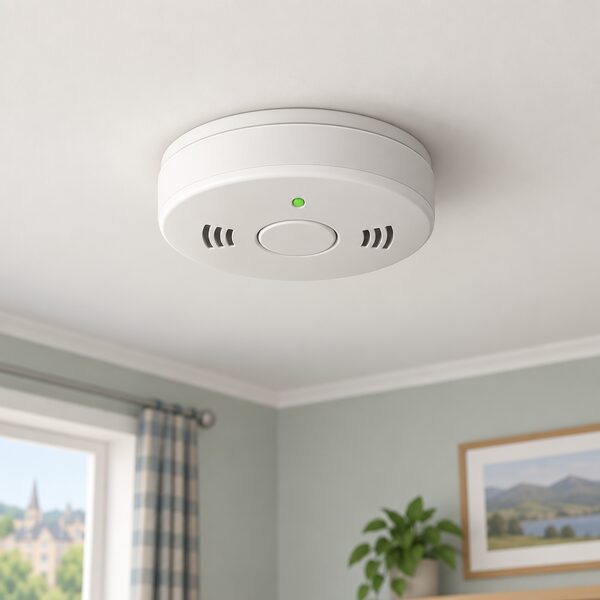
The Tolerable Standard is the legal floor for Scottish housing. It was amended by the Housing (Scotland) Act 1987 (Tolerable Standard) (Extension of Criteria) Order 2019, and from 2022 it includes a new element covering smoke, heat and carbon monoxide alarms2. The Order itself is published on legislation.gov.uk with an accompanying Policy Note9.
The standard is not an energy efficiency standard. It tests whether a house is fit to live in at all: structural stability, dampness, ventilation, water supply, drainage, and the alarm provisions added in 2022. A house meets the Tolerable Standard if it complies with the relevant requirements in relation to satisfactory carbon monoxide alarms10.
"The Tolerable Standard does not require carbon monoxide detectors to be interlinked, or to be interlinked with fire alarms."
That distinction is worth holding onto, because the interlinking question is often confused with the presence question. The standard tests whether satisfactory detection equipment is present, not how the devices communicate with each other.
The 2024 figures show how widely the standard is missed. In 2024, 28% of all dwellings, around 702,000, fell below the tolerable standard2. The rate was 32% in the private sector, higher than the social sector at 12%2. Within the private sector, the rate for private rented sector dwellings was lower at 25%, while mortgaged dwellings failed at 35%2. The 2023 survey put the figure at 27%, or 694,000 dwellings, similar to 202211.
The scale of the 2022 jump is explained by the alarm criteria. The proportion of below tolerable standard dwellings rose from 2% in 2019 to 29% in 2022, and without the two new criteria the proportion would have been 2%12. In other words, almost the entire apparent deterioration in Scottish housing condition between 2019 and 2022 is a definitional change, not a physical one.
Below tolerable standard: 28% of dwellings, and what fails most often
The failures are concentrated in alarm equipment rather than structure. In 2024, 76% of below tolerable standard dwellings, around 532,000, did not have satisfactory equipment for detecting and warning in the event of fire2. 55% of below tolerable standard dwellings, around 383,000, did not have satisfactory equipment for warning against high levels of carbon monoxide2. Unsafe electrical systems accounted for 11,000 dwellings, or 2% of below tolerable standard dwellings2.
| Failure among below tolerable standard dwellings, 2024 | Dwellings | Share of BTS dwellings |
|---|---|---|
| No satisfactory fire detection and warning equipment | around 532,000 | 76% |
| No satisfactory carbon monoxide warning equipment | around 383,000 | 55% |
| Unsafe electrical systems | 11,000 | 2% |
Source: Scottish House Condition Survey 2024 Key Findings2
The pattern by tenure is uneven. The 32% private sector failure rate compares with 12% in the social sector2. Within the SHQS framework, 32% of private sector properties failed the below tolerable standard criterion, against 36% of Housing Association properties and 44% of Local Authority properties2. Those two sets of figures measure different things, which is why they do not simply add up: one is the share of all dwellings in a tenure that fall below the standard, the other is the share failing that specific criterion within the SHQS assessment.
For a household, the practical reading is that the Tolerable Standard is a condition test, not a comfort or cost test. A dwelling can meet it and still be expensive to heat. The alarm criteria are the single largest reason Scottish dwellings fail, and they are also among the cheapest to remedy, which is why the 2022 definitional change produced such a large shift in the headline rate without any corresponding change in the physical stock.
The Scottish Housing Quality Standard: 55 elements, five criteria, and who must comply
The SHQS is made up of 55 different elements grouped into five higher-level criteria2. It was introduced in February 2004, and it means social landlords must make sure their tenants' homes are in a good state of repair2. A target was agreed that all social landlords must ensure that all their dwellings pass the SHQS by April 20152.
The standard applies only to social sector housing2. Private homeowners are not bound by it. Private rented property is regulated separately, through minimum energy efficiency standards introduced under Section 55 of the Energy Act 2011, with Energy Efficient Scotland requiring minimum energy efficiency targets to be met by all buildings in Scotland13.
The five criteria cover the fabric and services of the dwelling. The failure rates in 2024 give a sense of where the weight sits: the not Energy Efficient criterion failed at 33%, the Healthy, Safe and Secure criterion at 10%, the Modern Facilities criterion at 7%, and the Serious Disrepair criterion at 1%2.
The Scottish Government has been reviewing the Energy Efficiency Standard for Social Housing, aligning it with the 2040 target for low-carbon heat in homes14. Separately, the Heat in Buildings strategy sets a goal of all homes meeting at least the equivalent of an EPC band C by 203315. The CCC's 2026 assessment of Scotland's plan noted that it should include minimum energy efficiency standards for privately rented homes16.
For a household in social housing, the SHQS is the standard the landlord is measured against. For a private owner, it is a useful benchmark rather than an obligation, and the more relevant tests are the Tolerable Standard and, for rented property, the private rented sector regulations.
SHQS failure rates: 54% overall, and where failures concentrate
In 2024, 54% of dwellings failed to meet the SHQS2. The overall failure rate stood at 41% for the social sector and 58% for the private sector2. Households in the private rented sector had the highest failure rates at 64%2.
Most failures are narrow. In 2024, 56% of dwellings failing the SHQS did so because of a single element2. 65% of all dwellings failed due to a single criterion, with 63% in the private sector and 75% in the social sector2. The single-element breakdown was 53% of private sector, 69% of social sector, and 56% of all failing dwellings2.
| SHQS failure, 2024 | All dwellings | Social sector | Private sector |
|---|---|---|---|
| Overall failure rate | 54% | 41% | 58% |
| Failure due to a single element | 56% | 69% | 53% |
| Failure due to a single criterion | 65% | 75% | 63% |
Source: Scottish House Condition Survey 2024 Key Findings2
The 2022 survey gives the composition of those single-criterion failures in the social sector: cavity wall insulation (50%), pipe insulation (8%), full and efficient central heating (7%), fire alarms (6%), carbon monoxide alarms (6%) and secure door entry system (3%)12. Cavity wall insulation alone accounts for half of them.
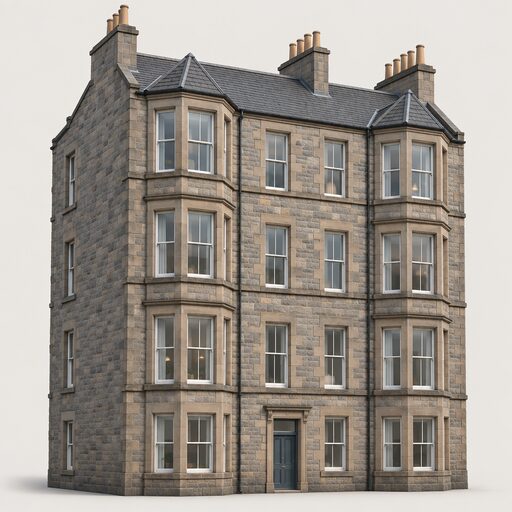
Age is the strongest predictor. The lowest failure rates are found in the newest dwellings, post-1982, at 31%2. Scotland's tenements tend to be older than the rest of the housing stock, with more than a quarter being at least one hundred years old3. Heritage and old homes account for around 22% of Scotland's housing stock17.
The 2023 survey showed the social sector failure rate at 38%, down from 60%, with 74% of social homes failing the SHQS doing so on just one of the 55 elements11. The 2022 survey noted that the Energy Efficient criterion failure rate in the social sector would be 10% if it were assumed that all social dwellings have insulated cavity walls where technically feasible, which would lower the overall SHQS failure rate in the social sector to 28%12. That is a modelled adjustment, not an observed one.
Energy efficiency failures in the SHQS: 33% of dwellings not energy efficient
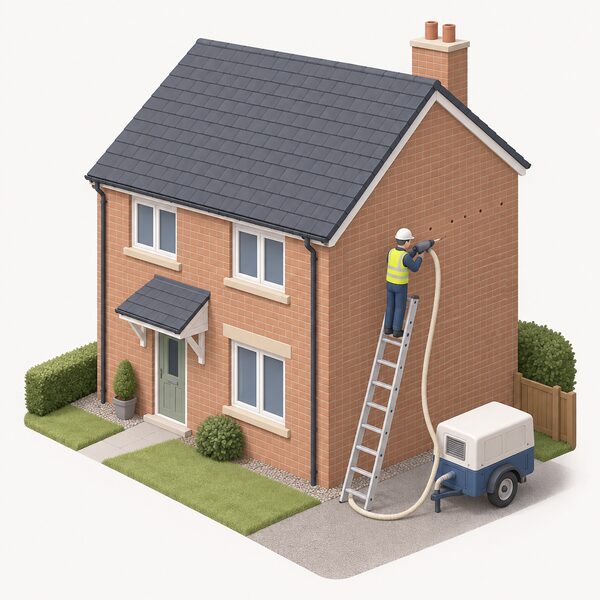
The not Energy Efficient criterion is the largest single source of SHQS failure. In 2024, the highest failure rate was with respect to the not Energy Efficient criterion at 33%2. It was 35% in the private sector and 25% in the social sector2. In the social sector, the not Energy Efficient criterion accounted for the bulk of failures, where 25% of properties failed2.
The trend in the social sector has been downward. In 2023, 26% of social sector properties did not meet the Energy Efficient criterion11. In 2022, 29% did not12. The 2022 adjusted estimate, assuming cavity wall insulation wherever technically feasible, would bring that to 10%12.
The wider stock picture is consistent with these figures. Around 55% of homes do not meet what is considered a good level of energy efficiency, according to the 2023 Heat in Buildings consultation18. The same consultation estimated that when installing the measures suggested in its list, a clear majority, around 66% of Scottish homes, could achieve that good level18. That is a modelled estimate of what is achievable, not a count of what has been done.
The mean energy efficiency rating of the Scottish housing stock under SAP 2012 (RdSAP v9.93) was 68.1 in 20242. On average across 2022-2024, 55% of dwellings had a rating in energy bands A, B and C19. A dwelling's energy efficiency rating is scored between 1 and 100 using the Standard Assessment Procedure19.
The split by tenure shows where the gap sits. 52% of owner occupied homes do not achieve EPC C, and 50% of homes in the private rented sector do not20. The share of private rented sector properties at EPC C or better was 52%, and the share of owner-occupied properties at EPC C or better was 51%21.
For a household, the energy efficiency criterion is the one that translates most directly into bills. A dwelling can pass the Tolerable Standard and still fail the energy efficiency criterion, and the two failures have very different remedies and costs.
Stock by tenure and age: what the data sources show
Scottish housing stock statistics are compiled using information from Housing Statistics Annual Returns, stock figures from the Scottish Housing Regulator, and Scottish Household Survey data24. They provide the estimated number of dwellings in Scotland by tenure, as a time series from 1993 to 2024 at Scotland level24.
Age is the defining feature of the stock. Tenements tend to be older than the rest of the housing stock, with more than a quarter being at least one hundred years old3. Heritage and old homes account for around 22% of Scotland's housing stock17. In the private rented sector, 26% of the stock is accounted for by tenements built before 1919, compared with just 9% across all tenures23.
That concentration matters for energy performance. Solid-wall pre-1919 tenements are the hardest and most expensive part of the stock to insulate, and they are over-represented in the rented sector where the landlord, not the occupant, controls the fabric. The 2017 consultation on minimum standards for the private rented sector counted 95,000 dwellings with an initial EPC of E, F or G, based on 2015 Scottish House Condition Survey estimates25.
Heating is more varied than in England. More than 2 million homes use mains gas or oil as their primary heating fuel3. At the 2022 Census, 127,570 households, 5.1%, used oil only4. Other electric heating accounted for 241,000 domestic properties, around 9.7% of all dwellings, in 202226. Combined heat and power served 6,000 domestic properties in 202321.
| Heating and stock indicator | Figure | Period |
|---|---|---|
| Homes using mains gas or oil as primary heating fuel | more than 2 million | 2023 |
| Households using oil only | 127,570 (5.1%) | 2022 Census |
| Other electric heating | 241,000 (around 9.7% of dwellings) | 2022 |
| Combined heat and power | 6,000 domestic properties | 2023 |
| Homes in EPC Band D or below | over 1.6 million | 2023 |
Sources: Scottish Government tenements report3, Commons Library briefing4, Heat in Buildings progress reports26
The fuel mix has a direct bearing on fuel poverty. Households using oil as their primary heating fuel had a fuel poverty rate of 28% in 2022, and those using other fuel types 41%12. In 2023, 52% of households using electricity as their primary heating fuel were fuel poor, higher than households using gas at 32%11. The 2024 figures put 23% of those using heating oil in fuel poverty4.
Heating and fuel mix in Scottish homes: 5% on heating oil
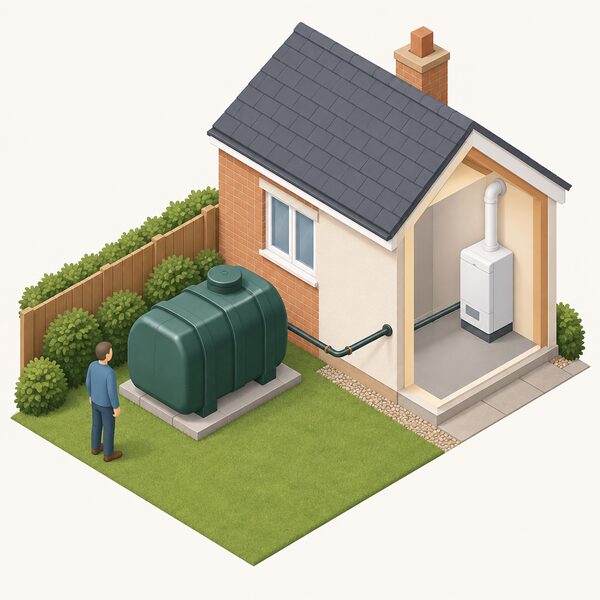
The Scottish fuel mix is the clearest point of difference from England. Off-gas-grid homes in Scotland depend on oil, electricity, LPG or solid fuel, and the fuel poverty rates attached to those fuels are consistently higher than for mains gas.
The 2022 SHCS found fuel poverty rates of 28% among households using oil as their primary heating fuel, and 41% among those using other fuel types12. The 2023 survey found 52% of households using electricity as their primary heating fuel were fuel poor, against 32% for gas11. The 2024 figures show 23% of those using heating oil in fuel poverty4.
The overall fuel poverty rate in Scotland was 31% across 2022-202426. The statutory target is that in 2040 no more than 5% of households are fuel poor, with under 1% in extreme fuel poverty26. Scenario modelling estimated around 680,000 fuel poor households in Scotland for the April to June 2026 cap period, a decrease of around 30,000 from the previous quarter26.
The 2022 survey also found that 46% of all households reported owning an energy monitoring device, an 11 percentage point increase on 201912. That is a measure of household engagement with consumption, and it is one of the few indicators in the survey that speaks directly to how much control a household has over its own energy use.
For energy independence, the Scottish picture is mixed. Mains gas connects more than 2 million homes to a national network and to imported supply3. Oil heating, at 5.1% of households, is a stored-fuel dependence: the household holds its own stock but is exposed to delivered price and to the logistics of refilling4. Electric heating, at around 9.7% of dwellings, ties the household to the grid and to whatever the electricity price is doing26. None of these is self-sufficiency, and the survey data does not measure self-generation.
Home Energy Scotland: grants, loans and where to get help
Home Energy Scotland provides tailored advice to households in Scotland on how they can improve the energy efficiency of their home, and it is the gateway to the Warmer Homes Scotland scheme27. It can also offer free advice on improving the energy efficiency of your home28. Its Funding Finder allows households to search for funding and support on improving their home's energy efficiency, reducing energy bills and making their home warmer28.
For households in Scotland, help with home energy bills is available from the Scottish government through mygov.scot29. Energyadvice.scot can be reached through its website or on 0808 196 866029. The Home Energy Scotland Grant and Loan Scheme can be contacted at heesgl@gov.scot28.
The scheme publishes processing data. Its attached spreadsheet shows monthly data from April 2025 to January 202628. That is the most recent published window for application and claim processing times.
Local authority schemes also operate. Glasgow City Council's Area Based Schemes provide home owners and landlords with access to grant funding which meets the Scottish Government's future minimum energy efficiency standards30. Edinburgh City Council publishes financial help for energy efficiency and low carbon heating improvements31. Ofgem provides general consumer guidance on getting help with home or business energy bills29.
For a household, these routes are the practical interface between the survey data and the home. The SHCS describes the stock; the grant and loan schemes are how individual dwellings are meant to move up the bands. The data does not show how many households apply, only how long applications take to process.
Local authority level data: what is published and when
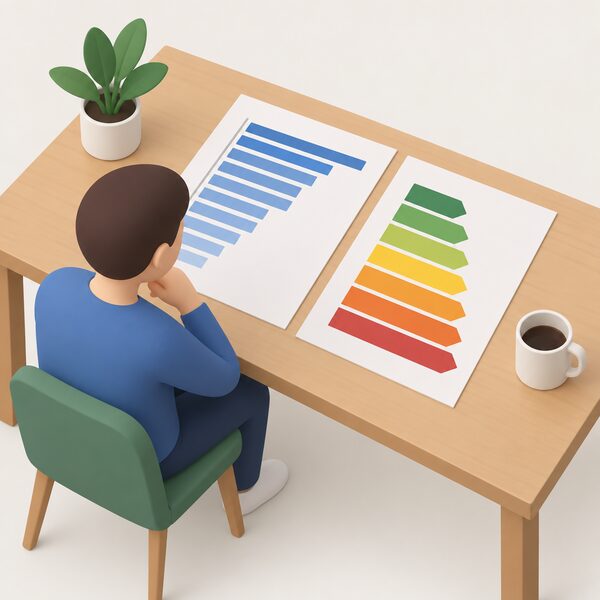
Scotland publishes local authority breakdowns on a pooled basis rather than annually, because a single year's sample is too small to support them. The Scottish House Condition Survey Local Authority Tables 2022-2024 were published on 26 May 2026, showing fuel poverty rates ranging from 22% in Stirling to 51% in Orkney Islands against a Scotland average of 31%26. Local authority level analysis based on the 2022-2024 pooled data set was expected in mid 20262.
The local authority energy efficiency tables sit alongside the fuel poverty tables, and they report the same SAP-based rating scale, scored between 1 and 10019. On average across 2022-2024, 55% of dwellings had a rating in energy bands A, B and C19.
Local authorities also have planning duties. Local Heat and Energy Efficiency Strategies and Delivery Plans were to be published by the December 2023 deadline14. The Energy Performance of Buildings (Scotland) Regulations 2008 are operated by the 32 Scottish local authorities and the Scottish Government32.
The 2022 survey found fuel poverty rates in housing association (47%), local authority (48%) and private rented sectors (44%) were similar12. That is a Scotland-level figure; the local authority tables are where the geographic variation shows.
For a household trying to understand its own area, the pooled tables are the reliable source, and the range from 22% to 51% shows how much the experience of fuel poverty varies across Scotland. The data describes the area, not the dwelling, and it is the area-level context for the national figures above.
Sources32 cited
- Scottish Household Survey collection, Scottish Government, 2026
- Scottish House Condition Survey 2024: Key Findings, Scottish Government, 2026
- Tenements short life working group: energy efficiency and zero emissions heating final report, Scottish Government, 2023
- Fuel poverty in Scotland, House of Commons Library, 2024
- Cambridge Housing Energy Tool guidance note, UK Government, 2011
- Scottish House Condition Survey 2024: key attributes of the Scottish housing stock, Scottish Government, 2026
- Scottish House Condition Survey 2022: fuel poverty, Scottish Government, 2022
- Scenario modelling of 2023 fuel poverty levels under 2019 fuel prices, Scottish Government, 2025
- The Housing (Scotland) Act 1987 (Tolerable Standard) (Extension of Criteria) Order 2019, legislation.gov.uk, 2019
- Tolerable Standard guidance: satisfactory fire and carbon monoxide detection, Scottish Government, 2023
- Scottish House Condition Survey 2023: key findings summary, Scottish Government, 2023
- Scottish House Condition Survey 2022: key findings summary, Scottish Government, 2022
- Energy efficiency in the private rented property Scotland regulations 2019: interim island communities impact assessment, Scottish Government, 2019
- Scottish emission targets: progress in reducing emissions in Scotland 2022 report to Parliament, Climate Change Committee, 2022
- Heat in Buildings strategy summary document, Scottish Government, 2021
- Scotland's plan means immediate climate targets are now within reach, says CCC, Climate Change Committee, 2026
- Technical feasibility of low carbon heating in domestic buildings, Scottish Government, 2020
- Delivering net zero for Scotland's buildings: consultation on proposals for a Heat in Buildings Bill, Scottish Government, 2023
- Scottish House Condition Survey local authority tables 2022-2024: energy efficiency, Scottish Government, 2026
- Tackling fuel poverty in Scotland: periodic report 2021-2024 engagement responses, Scottish Government, 2025
- Heat in Buildings progress report 2024, Scottish Government, 2024
- Consultation on draft Energy Efficiency (Domestic Private Rented Property) (Scotland) Regulations, Scottish Government, 2025
- Consultation on draft Energy Efficiency (Domestic Private Rented Property) (Scotland) Regulations: full document, Scottish Government, 2025
- Housing statistics: stock by tenure, Scottish Government, 2025
- Minimum standards for energy efficiency in the private rented sector, Scottish Government, 2017
- Heat in Buildings progress report 2025, Scottish Government, 2025
- Tackling fuel poverty in Scotland: a strategic approach, Scottish Government, 2021
- Home Energy Scotland grant and loan scheme: application and claim processing times, Scottish Government, 2026
- Get help with your home or business energy bills, Ofgem, 2026
- Area Based Schemes, Glasgow City Council, 2026
- Financial help for energy efficiency and low carbon heating improvements, City of Edinburgh Council, 2026
- The Energy Performance of Buildings (Scotland) Regulations 2008, legislation.gov.uk, 2008
 Housing Stock and EPCsHow energy efficient are Scottish homes, and how many reach a good rating?
 Housing Stock Data for EnglandHow energy efficient are English homes, and how many have insulation or low carbon heating?
 Housing Stock Data for WalesHow energy efficient are Welsh homes, and how many have a rating?
 Housing Stock Data for NIMost homes in Northern Ireland heat with oil, so why are the grants and help different from the rest of the UK?
 New Build Energy PerformanceHow energy efficient are new build homes compared with older ones?
 Efficiency of UK HomesMost UK homes now score better on energy than they did a decade ago, but older houses still lag well behind new builds.