
In this answer
Short answer
Scotland has the highest off-gas-grid share in Great Britain. Independent analysis states that around 20% of Scottish households are not connected to the gas network, against a Great Britain figure of 16%1. Parliamentary research puts Scotland at 19.5% of domestic properties in 2024, with Great Britain as a whole at 16.0%2.
The Scottish House Condition Survey, the official source, gives a lower figure on a different measure: approximately 12% of dwellings in Scotland were estimated to be outside the coverage of the gas grid in 2024, and approximately 11% in 20233. The gap between roughly 12% and roughly 20% is not a disagreement about Scotland. It is two different questions: whether a home sits inside the physical footprint of the gas network, and whether the household is actually connected to it.
For a household, the practical consequence is the same either way. There is no mains gas pipe to connect to, so heat comes from oil, LPG, solid fuel, electricity or a renewable system, and the household carries the storage, the ordering and the price risk that a gas connection would otherwise absorb.
Why the estimates differ: 11%, 12%, 19.5% or 20%
The range in circulation is wide because the underlying measures are not the same thing. The Scottish House Condition Survey asks whether a dwelling lies within the area the gas network covers. On that basis, approximately 11% of dwellings in Scotland were estimated to be outside coverage in 2023 and approximately 12% in 20244. A home can sit inside a gas area and still have no connection, which is why connection-based measures run higher.
Parliamentary research uses the connection measure and reports 19.5% of Scottish domestic properties off the gas grid in 2024, against 16.0% for Great Britain2. Independent analysis rounds this to around 20% of Scottish households and describes it as the highest proportion in Great Britain1. Within Scotland the burden is uneven: 55% of dwellings in rural areas are not within the coverage of the gas grid, and around 7% of Scottish households rely on oil or LPG, with rural and island areas disproportionately affected1. The highest recorded local share is Shetland Islands at 100.0% of domestic properties, which is a local authority figure rather than a national one2.
Geography explains much of the spread within Scotland. In 2023, 55% of rural dwellings were not within the coverage of the gas grid, against a national figure of approximately 11%4. Around 7% of households in Scotland rely on oil or LPG, with rural and island areas disproportionately affected5. Some entire communities, including Shetland and Orkney, are 100% off the gas grid1.
The practical reading for a householder is that the national percentage is a poor guide to any individual property. A rural or island address is far more likely to be off the grid than the national figure suggests, and the coverage measure understates how many households actually burn something other than mains gas.
Scotland has the highest off-gas-grid share in Great Britain
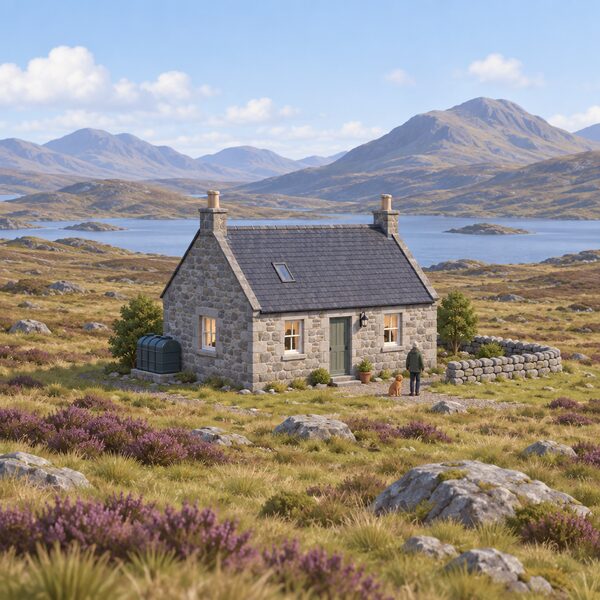
Scotland's position at the top of the Great Britain comparison is consistent across the sources that use the connection measure. Independent analysis states around 20% of Scottish homes are off the gas grid, the highest proportion in GB at 16%1. Parliamentary research gives Scotland 19.5% and Great Britain 16.0% for 20242.
The comparison is not uniform across the rest of Great Britain. Inner London recorded the highest proportion of households off the gas grid in 2024 at 26.6%, above Scotland's national figure, and Outer London at 14.9%2. Within Scotland, the East region recorded 20.3%2. The North West of England recorded 10.4%2. Wales is separately reported at 27% of homes off the gas grid6.
That pattern matters for how the statistic is used. Scotland's national share is high because a large rural and island population sits beyond the network, not because every part of Scotland is off the grid. The majority of Scottish households still heat with gas: 81% of Scottish households heat their properties with gas3. The off-gas population is a substantial minority concentrated in particular places.
"Around 20% of Scottish homes are off the gas grid, the highest proportion in GB (16%)"
What off-gas Scottish homes heat with instead
Official guidance lists the fuels used by households off the mains gas grid: heating oil, liquefied petroleum gas, solid fuels, mains electricity and microgeneration7. Independent guidance notes that homes not connected to the main gas grid typically use more carbon intensive heating methods or solutions such as oil and solid fuels8.
The Scottish numbers are specific. Approximately 142,000 Scottish households use heating oil and around 27,000 use LPG5. An earlier official estimate put around 167,000 off-gas homes on high emissions oil, LPG and solid fuels9. The Scottish Government has stated an aim that by 2030 the vast majority of the 170,000 off-gas homes that currently use high emissions oil, LPG and solid fuels convert to zero emissions heating10.
Not every off-gas home burns fossil fuel. Over 450,000 homes in Scotland do not use gas as their primary heating fuel11, a figure well above the fossil-fuel off-gas count, which indicates that a large share of non-gas homes already heat with electricity or another low emissions source. Around 9% of dwellings on the gas grid use an alternative fuel, such as electricity, as their main heating fuel3. Other forms of heating such as warm air systems and room heaters are used by 2% of dwellings3.
Older rural housing stock shows the pattern most sharply. Among pre-1919 detached houses in Scotland, 48% use an alternative fuel source other than gas and electricity for space heating and hot water4.
| Measure | Figure | Date | Source |
|---|---|---|---|
| Scottish dwellings outside gas grid coverage | approximately 12% | 2024 | 3 |
| Scottish dwellings outside gas grid coverage | approximately 11% | 2023 | 4 |
| Scottish domestic properties off the gas grid | 19.5% | 2024 | 2 |
| Scottish households not connected to the gas network | around 20% | 2026 | 1 |
| Scottish households using heating oil | approximately 142,000 | 2026 | 5 |
| Scottish households using LPG | around 27,000 | 2026 | 5 |
| Off-gas homes on high emissions oil, LPG and solid fuels | 167,000 | 2021 | 9 |
| Scottish homes not using gas as primary heating fuel | over 450,000 | 2021 | 11 |
What living off the gas grid means for energy independence
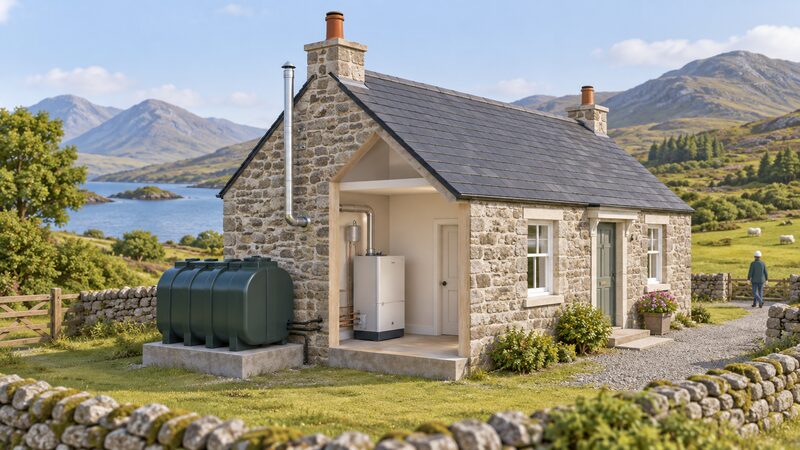
An off-gas grid home is defined in official scheme rules as one that does not use mains gas for heating purposes13, and independently as a household that is not connected to the gas network14. Both definitions point to the same condition: the household cannot draw on the national gas network for heat, and must instead hold its own fuel or generate its own.
That cuts both ways. On the independence side, an off-gas home with a heat pump, biomass boiler or solar and storage is not exposed to the gas network at all, and is not dependent on a gas supplier for its heating. On the dependence side, the household typically remains connected to the electricity grid, and where oil or LPG is the fuel, it depends on a distributor, a delivery schedule and a tank on its own land. Stored fuel is a physical asset that must be bought in advance and monitored, and the price paid is the price on the day of ordering rather than a regulated tariff.
The cost exposure is documented. Official statistics from 2016 recorded that 23% of Scottish households relied on more expensive fuel types, such as bottled gas or electricity, to heat their property15. Scottish Government analysis found that around half of homes using gas were at equivalent EPC C or better with fewer options to offset increased fuel costs, compared with around 8% of homes using oil16. Households off the gas grid in Scotland recorded a 30% fuel poverty rate in 2022, higher than households on the grid17.
Support and advice exist but are targeted. Home Energy Scotland offers free and impartial advice on saving energy, making a home warmer, exploring heating options for off-gas homes, and funding for energy-saving home improvements18. The Scottish Government has published support for households using heating oil and LPG5, and separately for households using heating oil19.
The direction of policy is towards removing fossil fuels from these homes rather than connecting them to gas. The Scottish Government recommended announcing a specific date by which new heating systems fitted to existing properties must be zero-carbon, phased with an earlier date off the gas grid and a later one on the gas grid9. The Committee on Climate Change pathway has 60% of home heating systems in Scotland still powered by fossil fuels in 203520, which indicates how long the transition is expected to take.
For a household, the independence question is therefore not whether to leave the gas grid, since there is no gas grid to leave. It is what replaces the stored fuel: a system that runs on electricity the household can increasingly generate itself, or a continued reliance on delivered oil, LPG or solid fuel with the price and supply risk that carries.
Where the figures come from and how to read them

The two headline sources are the Scottish House Condition Survey, published by the Scottish Government, and research briefings from the House of Commons Library. The survey reports dwellings outside gas grid coverage; the Library briefing reports households not connected to the grid3. Both are official statistics, and the difference between them is definitional rather than a dispute.
Independent analysis from the Energy and Climate Intelligence Unit provides the around 20% figure and the Great Britain comparison1. Regional breakdowns within Scotland and Great Britain come from the parliamentary research2. Fuel-specific counts for oil and LPG come from Scottish Government news releases5.
For households wanting the wider picture, the UK home energy statistics pillar sets out deployment, prices and fuel poverty data across the nations, and housing stock and home energy data for Scotland covers the Scottish housing stock in more detail. Fuel poverty statistics explains how the fuel poverty numbers are produced, and fuel poverty by EPC band in Scotland looks at the relationship between energy performance and fuel poverty in Scotland. Heating oil and LPG price data covers the fuels most off-gas Scottish homes depend on.
Sources20 cited
- Uptake of net zero technologies in Scottish homes, Energy and Climate Intelligence Unit, 2026
- Households off the gas grid in Great Britain, House of Commons Library, 2024
- Scottish House Condition Survey 2024: Key Findings, Scottish Government, 2026
- Scottish House Condition Survey 2023: Key Findings, Scottish Government, 2023
- Support for households using heating oil and LPG, Scottish Government, 2026
- Renewing Britain Report, MCS, 2021
- Support for People in Rural Homes, Home Energy Scotland, 2026
- Rural Households and Net Zero, Liquid Gas UK
- Heat Pump Sector Deal Expert Advisory Group: Final Report, Scottish Government, 2021
- Heat in Buildings Strategy: Achieving Net Zero Emissions in Scotland's Buildings, Scottish Government, 2021
- Heat in Buildings Strategy: Achieving Net Zero Emissions in Scotland's Buildings, Scottish Government, 2021
- Heat in Buildings Strategy: Consultation, Scottish Government, 2021
- Warm Homes: Social Housing Fund Wave 3 Scheme Guidance, UK Government, 2026
- MCS Data Dashboard Glossary, MCS, 2026
- Consumer Attitudes to Energy Networks in Scotland, Ofgem, 2020
- Heat in Buildings Strategy: Business Regulatory Impact Assessment, Scottish Government, 2021
- Scottish House Condition Survey 2022: Fuel Poverty, Scottish Government, 2022
- Households off the gas grid in Great Britain, House of Commons Library, 2024
- Help for households using heating oil, Scottish Government, 2026
- Scotland's Carbon Budgets, Committee on Climate Change
 Home HeatingMost Scottish homes are heated by mains gas, so what happens to the rest?
 Housing Stock Data for ScotlandScotland's housing is measured differently from England's, so the numbers you see may not compare directly.
 Is Off-Grid Living Legal?Can you legally live without mains gas or electricity in the UK?
 Climate TargetsScotland aims to stop adding greenhouse gases by 2045, five years before the rest of the UK.
 Energy Supply in ScotlandScotland makes far more low-carbon electricity than it uses and sends the rest south.
 Fuel PovertyHow does Scotland decide if a household is in fuel poverty, and how many homes are affected?