

In this answer
Short answer
Mains gas is the dominant heating fuel in Scotland. The Scottish House Condition Survey reports that 81% of Scottish households, around 2.1 million homes, use mains gas for heating, a figure recorded for 20241. The Energy Saving Trust puts the count at approximately 2 million homes2. Scotland's 2022 census, using a narrower definition, found that 73.4% of households used mains gas as their only central heating3.
The gap between those two numbers matters. The census counts homes where gas is the sole system, so a household with mains gas plus a secondary electric heater or a solid fuel stove falls outside it. The survey figure of 81% counts mains gas as the heating fuel regardless of what else is installed. Both describe the same housing stock from different angles, and neither is wrong.
For a Scottish household, mains gas means heat delivered through a pipe owned by a regulated monopoly, with the gas itself bought from a retail supplier. That is a different kind of dependence from an oil tank in the garden or a heat pump drawing on the electricity grid. The sections below set out where the gas comes from, who is off the network, and what the transition away from gas is expected to require.
Where the gas comes from: SGN as Scotland's gas transporter
The pipes that carry gas to Scottish homes belong to SGN, the gas transporter for Scotland8. A transporter is not a retailer: SGN owns and maintains the distribution network, and households do not buy gas from it. The company also states that it is the service partner for National Gas Metering in Scotland and the south of England, carrying out meter exchanges on National Gas Metering's behalf9.
The retail side is separate. British Gas trades under the name Scottish Gas north of the border, so a household may receive bills from Scottish Gas while the pipe outside belongs to SGN10. This split is the ordinary structure of the GB gas market rather than anything specific to Scotland, but it shapes what a household can and cannot change. Switching supplier changes who bills for the gas. It does not change the network, the meter point or the transporter.
Scotland also has a small but growing non-gas heat network sector. Just under 2% of Scotland's heat is supplied from heat networks, and official guidance estimates that up to approximately 20% of heat demand from buildings could be met by district and communal heating11. That is a potential share, not a current one. Where a home connects to a heat network, the dependence shifts from a gas transporter to the network operator.
"We're the service partner for National Gas Metering in Scotland and the south of England and carry out meter exchanges on their behalf."
The other side of the picture: around 20% of Scottish homes are off the gas grid
Around 20% of Scottish homes are off the gas grid, the highest proportion in Great Britain, where the comparable figure is 16%4. The Scottish House Condition Survey gives a narrower estimate, approximately 12% of dwellings outside the coverage of the gas grid, and a parliamentary briefing puts the share of domestic properties at 19.5% for Scotland1. The measures differ because coverage of the network and connection to it are not the same thing: a home can sit within reach of a pipe and still not be connected.
The off-gas population is not uniform. Around 142,000 Scottish households use heating oil and around 27,000 use LPG5. A 2021 report counted some 420,000 homes off the gas grid, of which only around 167,000 used fossil fuels13. Over 450,000 homes do not use gas as their primary heating fuel6. These figures come from different years and different definitions, so they should be read as a range rather than a single count.
There is also a group on the grid but not using it. Around 9% of dwellings on the gas grid use an alternative fuel, such as electricity, as their main heating fuel1. For those households, the gas connection exists but the heating decision has already moved elsewhere.

What mains gas heating means for Scotland's net zero target

Scotland's legally binding net zero target is 20452. The Heat in Buildings Strategy states that to achieve the economy-wide target, by 2045 all homes and buildings will need to significantly reduce their energy use and use a zero emissions heating system6. The draft Buildings (Heating and Energy Performance) and Heat Networks (Scotland) Bill sets the same end point in legislative language: by the end of 2045, as far as reasonably practicable, no direct emission heating system is used in any building in Scotland14.
That is a stronger formulation than a target for new installations. It reaches existing heating systems, which is why the conversion numbers are so large. Almost all Scottish homes must be using a zero direct emissions heating system by 2045, and all homes must have significantly reduced their energy use by the same date15.
The practical consequence for a household on mains gas is that the boiler in the kitchen has a defined end date in policy, even though no date is set for an individual property. The Scottish Government's own assessment of what replaces gas points to individual air and ground source heat pumps, or connections to heat networks powered by larger heat pumps, as the systems the very large majority of homes will use13.
Over one million households expected to need low-carbon heating
Official guidance states that around 50% of homes, or over one million households, will need to convert to zero emissions heating systems by 20306. The same target appears in the net zero roadmap as more than one million homes and 50,000 non-domestic buildings converting by the end of this decade13. A separate figure puts the 2030 requirement at over one million households expected to need a low-carbon heating system16.
The 2045 picture is larger. The heat transition will require around 1.9 million homes and 13,000 public buildings to move to clean heating systems7. The Scottish Government has also described switching around 1 million homes currently using mains gas to zero carbon heating systems by 203017.
Two documents disagree on the 2030 framing. One describes at least 1 million homes currently using mains gas converting to zero emissions heating; another describes over 1 million homes by 203018. The figures are close but the wording differs, and the documents are not reconciled.
Against that, current uptake is small. Just 278,000 households, around 11%, are heated using a renewable or low carbon system such as a heat pump or biomass boiler2. The installation rate is expected to peak at over 200,000 new systems per annum in the late 2020s19.
| Milestone | Requirement | Date |
|---|---|---|
| Homes converting by 2030 | around 50%, over one million households6 | 2030 |
| Non-domestic buildings by 2030 | 50,00013 | 2030 |
| Homes and public buildings by 2045 | around 1.9 million homes, 13,000 public buildings7 | 2045 |
| All homes | zero direct emissions heating, as far as reasonably practicable14 | 2045 |
Fuel poverty and the households still on gas
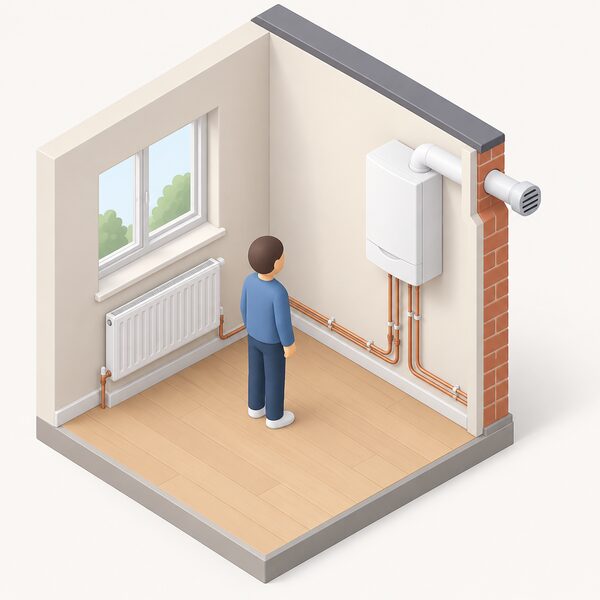
Scottish Government scenario modelling for the October to December 2026 price cap period estimates around 820,000 fuel poor households, 32% of the total, and around 440,000 in extreme fuel poverty, 17%, each up around 20,000 households on the previous quarter20. Within that, households using mains gas as their primary heating fuel saw the largest reduction in fuel poverty, a fall of around 50,000 households, with the rate moving from 26% to 25% and extreme fuel poverty from 13% to 11%20. The median fuel poverty gap for those households reduced by around £100, to £700, from around £80020.
That pattern is worth stating plainly: the fuel poverty improvement in that quarter was concentrated among gas-heated homes, not off-gas ones. Households on oil, LPG or electric heating did not see the same movement. The fuel poverty picture in Scotland and the difference by heating fuel set out the wider position.
Social housing has its own profile. Mains gas heating accounts for an 80% share of dwellings in the social rented sector, similar to the national figure21. That means the transition away from gas reaches social landlords on much the same scale as private owners, and the energy efficiency standard for social housing is the framework through which it is being addressed.
Grants and advice: Scotland's separate support system
Scotland runs its own support structure rather than relying on GB-wide schemes alone. The Home Energy Scotland Grant and Loan Scheme funds clean heating systems and energy efficiency measures22. Warmer Homes Scotland is funded by the Scottish Government and offers funding and support to eligible households struggling to stay warm and keep on top of energy bills23. The Home Energy Scotland Grant and Loan Scheme and Warmer Homes Scotland are the two routes most households encounter first.
For heat networks, the Heat Network Support Unit supports the development of heat network projects in Scotland by offering grant funding and expert advice throughout the pre-capital stages of development24. Scotland's Heat Network Fund provides capital grant funding to public and private sector organisations for the expansion and decarbonisation of existing heat networks across Scotland11. The Home Energy Scotland Scheme also offers grants to homeowners to install heat pumps25.
Off-gas households have a separate safety net. The Scottish Emergency Heating Oil Scheme is delivered by Advice Direct Scotland26. The Scottish Government has published support for households using heating oil and LPG5.
Where mains gas leaves a household dependent
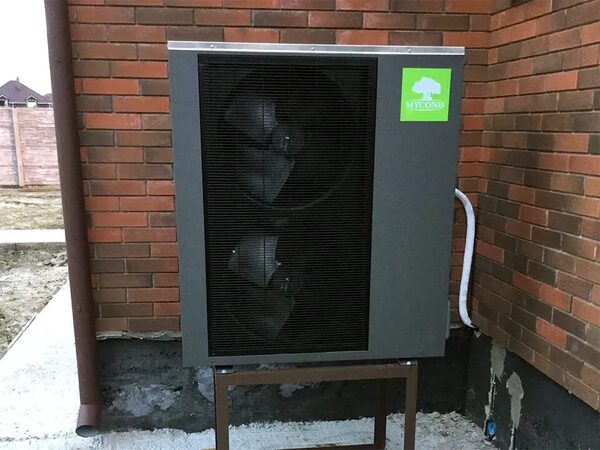
Mains gas gives a Scottish home a reliable, piped heat source with no storage, no delivery and no tank to fill. It also ties that home to a network it does not own, a transporter it cannot choose, and a retail market it can switch within but not leave without changing the heating system itself. The gas arrives through SGN's pipes, is billed by a supplier such as Scottish Gas, and is priced by a market the household has no individual influence over8.
The dependence is not only commercial. The 2045 requirement means the system itself is expected to be replaced, and the replacement will draw on electricity or a heat network rather than a gas pipe14. A household that installs a heat pump moves its dependence to the electricity grid and, in most cases, to a manufacturer's equipment and app. A household that connects to a heat network moves it to the network operator. Neither is independence in the absolute sense; both change who the household depends on.
What a Scottish household can establish now is the position it is starting from: whether the property is on the grid, what the primary heating fuel is, and what the building standards and grant rules require for any change. The wider picture of how the four nations differ sets that against Wales and Northern Ireland, where off-gas shares and support schemes diverge sharply.
Sources27 cited
- Scottish House Condition Survey 2024: Key Attributes of the Scottish Housing Stock, Scottish Government, 2024
- Net Zero by 2045: How Scotland Is Addressing the Climate Emergency, Energy Saving Trust, 2026
- Scottish Households and Mains Gas Central Heating, House of Commons Library, 2022
- Uptake of Net Zero Technologies in Scottish Homes, Energy and Climate Intelligence Unit, 2026
- Support for Households Using Heating Oil and LPG, Scottish Government, 2026
- Heat in Buildings Strategy Business and Regulatory Impact Assessment, Scottish Government, 2021
- Scotland's Climate Change Plan 2026 to 2040, Scottish Government, 2025
- How to Move Your Gas or Electricity Meter, Uswitch, 2026
- Gas Meter Exchange, SGN, 2026
- Which Energy Suppliers Are British?, Uswitch, 2026
- Heat Networks, Scottish Government, 2026
- Scotland's Off-Gas Grid Households, House of Commons Library, 2024
- Heat Pump Sector Deal Expert Advisory Group Final Report, Scottish Government, 2021
- Draft Buildings (Heating and Energy Performance) and Heat Networks (Scotland) Bill, Scottish Government, 2025
- Energy Efficiency in Social Housing, Scottish Government, 2026
- High Rise Retrofit and Upgrade Programme Phase 1, City of Edinburgh Council, 2026
- Scottish Government Hydrogen Policy Statement, Scottish Government, 2025
- Heat in Buildings Strategy: Fairer Scotland Duty Assessment, Scottish Government, 2021
- Scottish House Condition Survey 2023: Key Attributes of the Scottish Housing Stock, Scottish Government, 2023
- Fuel Poverty Scenario Modelling Based on Ofgem Energy Price Caps to October to December 2026, Scottish Government, 2026
- Energy Saving Home Improvements, Scottish Government, 2026
- Home Energy Efficiency Advice, Argyll and Bute Council, 2026
- Home Heating Advice Scotland, Home Heating Advice Scotland, 2026
- Heat in Buildings Progress Report 2025, Scottish Government, 2025
- The Heat in Buildings Programme, Scottish Government, 2026
- Rewiring Your House: An Essential Guide for Homeowners, NICEIC, 2026
- Tenements Short Life Working Group: Energy Efficiency and Zero Emissions Heating Final Report, Scottish Government, 2026
 Home HeatingMost Scottish homes are heated by mains gas, so what happens to the rest?
 Climate TargetsScotland aims to stop adding greenhouse gases by 2045, five years before the rest of the UK.
 Home HeatingMost Welsh homes still run on mains gas, so what are the alternatives in rural areas?
 Gas Boilers GuideMains gas boilers heat around 23 million UK homes.
 Housing Stock Data for ScotlandScotland's housing is measured differently from England's, so the numbers you see may not compare directly.
 Heating Off the Gas GridThe options for the four million UK households with no mains gas connection: oil, LPG, electric, heat pump, biomass and solid fuel, and how their costs, storage and supply security compare.