

In this answer
Short answer
Around half a million homes in Northern Ireland rely on oil for heating, and the share of households using oil boilers as their main heating source is more than two thirds1. The Consumer Council's Home Energy Index puts the figure at approximately 62.5% of households, while a parliamentary debate in March 2026 recorded over 60%3. Census 2021 recorded 63% of households using heating oil and 33% using mains gas5.
That concentration is the single most important fact about household energy in Northern Ireland. It shapes what a home can do about its own supply, what support is available when prices move, and how far the region is from its legally binding net zero target of 20506. It also means that for most households in Northern Ireland, energy independence begins with a tank in the garden rather than a meter on the wall.
How many homes in Northern Ireland use oil central heating: around 500,000, or roughly two thirds
The headline figure is consistent across sources even where the wording differs. The Department for Communities states that approximately 500,000 homes in Northern Ireland rely on oil as a primary heating source, and that roughly two thirds of homes rely on oil heating8. The Northern Ireland Executive's central heating guidance says more than two thirds of households use oil boilers as their main source of heating2. The Energy Saving Trust, writing in December 2025, gives the same half-million figure1.
The percentage estimates cluster more tightly than the phrasing suggests. The Consumer Council's Home Energy Index reports approximately 62.5% of households with oil central heating3. Hansard records over 60% of homes relying on oil for heat4. Census 2021 recorded 63% of households using heating oil5. Against that, one source puts the share at almost two thirds of homes relying on heating oil, and another at more than two thirds using oil boilers as their main heating source, so the range runs from roughly 60% to more than two thirds and the conflict is unresolved. The weight of official and independent evidence sits at roughly 60% to 63%, and the half-million household count is the figure to hold on to.
For context, around 1.5 million UK homes use oil for heating, including many in Northern Ireland10. Northern Ireland therefore accounts for roughly a third of the UK's oil-heated housing stock despite having a small fraction of the UK population. That is what makes the region a distinct market rather than a regional variation on a British norm.

Why oil dominates: much of Northern Ireland is off the gas grid

Oil central heating is much more common for households in Northern Ireland, many of which are not connected to a gas grid network11. The Northern Ireland Statistics and Research Agency is explicit that not all areas of Northern Ireland are connected to the gas network: urban and suburban areas tend to be well served, whereas many rural and western parts have limited or no access12.
The grid has expanded. The proportion of households using mains gas increased from 17.2% at Census 2011 to 31.6% at Census 20215. That is real growth, but it still leaves the majority of households outside the gas network, and the geography of the remaining gap is the difficult part: the homes without a connection are the dispersed rural properties that are most expensive to reach.
The Climate Change Committee has described the position bluntly, noting that with the majority of homes heated by highly emitting oil boilers, Northern Ireland should rapidly transition to low-carbon heating13. The Energy Saving Trust has separately identified high dependence on oil heating as a feature of the Northern Ireland housing stock14, and its public attitudes work records that many in Northern Ireland are heated by oil15.
What this means for a household is a specific kind of independence and a specific kind of exposure. An oil-heated home is not dependent on a gas network or, for heat, on an electricity supply that can fail in a storm. It is dependent instead on delivered fuel, on a local distributor, and on a price set by the market rather than a regulated tariff. The tank is a store of energy measured in weeks, not a supply that arrives continuously.
Oil heating and fuel poverty: the 10% indicator and a crisis without statutory targets
Northern Ireland measures fuel poverty differently from the rest of the UK. The Northern Ireland Housing Executive uses the 10% indicator, where a household is fuel poor if the fuel costs required to maintain a satisfactory heating regime are greater than 10% of household income16. The test covers all fuel use, not heating alone5. The scale of the problem is set out separately: nearly a quarter of the population experiences challenges in heating their homes adequately13.
The scale is significant. A fuel poverty consultation records that nearly a quarter of the population experiences challenges in heating their homes adequately7. That is a higher share than the headline fuel poverty rate in most of Great Britain, and it sits alongside a housing stock that is heavily oil-dependent.
The evidence on oil and fuel poverty is clearest from Scotland, where the same fuel is used in rural and island areas. Scottish Government modelling for January to March 2026 found extreme fuel poverty rates of 37% falling to 30% among households using oil as the primary heating fuel, against 13% falling to 11% for mains gas17. Overall fuel poverty rates in the same modelling were 26% falling to 25% for mains gas and 52% falling to 48% for electric heating17. Oil sits between gas and electricity, but the extreme fuel poverty rate for oil households is more than double the gas figure. No equivalent Northern Ireland breakdown by fuel is available.
What support exists: the Home Heating Oil Support Scheme and around 340,000 eligible households
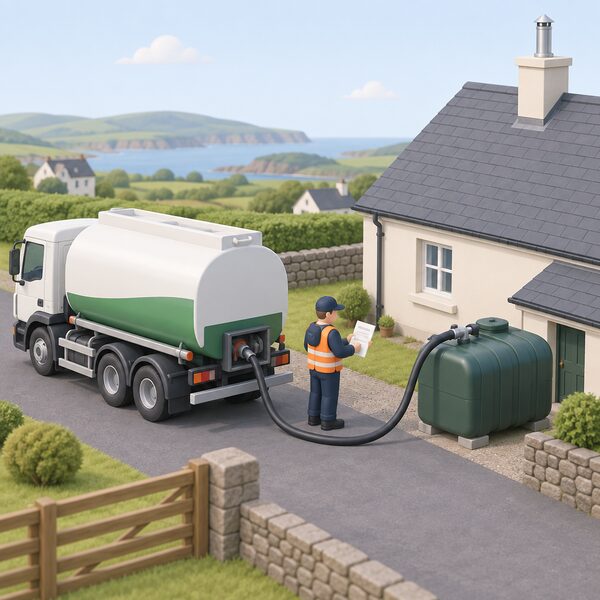
The main intervention for oil-heated households is the Home Heating Oil Support Scheme, created to help households in Northern Ireland with the cost of home heating oil9. The Executive agreed a £36.4million support package for home heating oil users in Northern Ireland8, and around 340,000 households across Northern Ireland are eligible19.
Eligibility is defined by three conditions. The scheme is open to households who use oil as their primary source of heating, are resident in Northern Ireland, and, in either of the qualifying months, are in receipt of a qualifying benefit, or a single person or couple, including pensioners, with an annual income of less than £30,000 net of allowable deductions9. Applications are made online for residents of Northern Ireland20.
The support itself is a £100 voucher that can be used for heating oil21. Once activated, the voucher can then be used to purchase home heating oil with any Northern Ireland oil supplier9. That open-supplier condition matters: it means the voucher does not tie a household to a single distributor.
| Feature | Detail |
|---|---|
| Scheme | Home Heating Oil Support Scheme |
| Support | £100 voucher for heating oil21 |
| Budget | £36.4million8 |
| Eligible households | around 340,00019 |
| Eligibility | oil as primary heating, Northern Ireland resident, qualifying benefit or income under £30,000 net9 |
| Voucher use | any Northern Ireland oil supplier9 |
The Consumer Council runs a home heating oil price checker, gathering oil prices from across Northern Ireland so that households can check whether they are getting a competitive price for an order22. Because heating oil is not a regulated tariff, that price transparency is the main consumer protection available.
Moving away from oil: no dedicated heat pump schemes and limited alternative funding
For Northern Ireland, there are no dedicated heat pump schemes23. Ground source heat pump guidance states that if you live in Northern Ireland, there isn't a specific grant currently available, though households can still get heat pump ready and apply for funding for insulation via NI Energy Advice24.
The Boiler Upgrade Scheme, which provides a grant to cover part of the cost of replacing fossil fuel heating systems with a heat pump or biomass boiler, does not extend to Northern Ireland25. The Warm Home Discount Scheme does not run in Northern Ireland either, though an Affordable Warmth Scheme is available26. The Warm Home Discount operates in England, Wales and Scotland only27.
The Northern Ireland Sustainable Energy Programme is the main funded route, and its rules are unusual. Properties with oil heating at the time of application will be able to have a replacement oil system installed if natural gas is not available28. In other words, the flagship energy efficiency programme can replace an oil system with another oil system where there is no gas alternative. The programme's annual report for 2024/25 records that customers in off gas areas with no existing central heating, where a solid fuel fire or electric room heater is used, can only convert to other forms of electric heating29.
Building Regulations proposals point in a different direction. Under Option 1 of the 2023 discussion document, heat pumps or alternative solutions, potentially biofuel, would be required in areas without access to mains gas30. That is a consultation proposal, not current law, and it signals the intended direction rather than the present requirement.

How Northern Ireland's separate regulatory system shapes the picture
Energy is devolved in Northern Ireland in ways that change what a household can expect. In Northern Ireland both consumer protection and regulation of heat networks are devolved to the Northern Ireland Assembly31. Under Part 7 heat networks regulation, the Utilities Regulator would regulate in Northern Ireland32.
For electricity and gas, there is no competitive switching market of the kind that operates in Great Britain. Instead, there's a tariff review process that the Utility Regulator oversees33. That removes the option of shopping between suppliers on price, and it places the regulatory relationship between household and supplier on a different footing.
The network side is also distinct. Northern Ireland Electricity Networks operates a central control centre which co-ordinates the restoration process and provides up to date information for customers during outages34. For an oil-heated home, that matters less for heat than for lighting, controls and pumps, but it is the visible face of the electricity dependence that remains even when the boiler itself runs on delivered fuel.
The regulatory picture also determines what support can exist. Because fuel poverty policy, energy efficiency programmes and heat network regulation are all made in Northern Ireland, the schemes available to a household here are not the schemes available in England, Scotland or Wales. The Home Heating Oil Scheme in Northern Ireland and the Affordable Warmth Scheme in Northern Ireland sit inside that devolved framework, as does the Northern Ireland Sustainable Energy Programme. The wider pattern of how powers are split is set out in which energy powers are devolved and which are reserved, and the pillar guide to how the four nations differ places Northern Ireland alongside Scotland and Wales.
Sources34 cited
- Is now a good time to get a heat pump?, Energy Saving Trust, 2025-12-12
- Central heating, nidirect, 2026-09-17
- Home Energy Index, Consumer Council, 2026
- Heating Oil Support, Hansard, 2026-03-16
- Research briefing CBP-9838, House of Commons Library, 2026-08-06
- Research briefing CBP-9888, House of Commons Library, 2026-07-10
- Fuel poverty consultation, Department for Communities, 2026-09-20
- Lyons announces agreement on Home Heating Oil Support, Department for Communities, 2026-04-16
- Home Heating Oil Support Scheme, Department for Communities, 2026-09-17
- LPG central heating, Which?, 2025-09-22
- Oil central heating, Which?, 2026-06-01
- Continuous Household Survey: Heat and Insulation 2024-25, Northern Ireland Statistics and Research Agency, 2025-11-11
- Electric technologies will benefit Northern Ireland, Climate Change Committee, 2025-03-19
- Decarbonisation in Northern Ireland: the potential of a one-stop shop, Energy Saving Trust, 2025-10-01
- What do people think about energy?, Energy Saving Trust, 2026-01-09
- Fuel poverty modelled estimates for Wales, Welsh Government, 2025-10-16
- Scenario modelling: impact of the reduction of the Renewables Obligation and ending ECO on fuel poverty in Scotland, Scottish Government, 2026
- Fuel poverty, Energy and Climate Change Committee, 2026-09-20
- Lyons announces opening date for Home Heating Oil Support Scheme, Department for Communities, 2026-08-26
- Home Heating Oil Support, nidirect, 2026-09-17
- Can I get other help with fuel as a pensioner?, Turn2us, 2026-08-05
- Home heating oil, Consumer Council, 2026
- Heat pumps, Energy Saving Trust, 2026-06-11
- Ground source heat pumps, Energy Saving Trust, 2026-07-16
- Apply for the Boiler Upgrade Scheme, GOV.UK, 2026-09-17
- Warm Home Discount, Ofgem, 2026-09-17
- Research briefing SN06163, House of Commons Library, 2026-02-26
- NISEP, Energy Saving Trust, 2026-09-07
- NISEP 2024-25 Annual Report, Utility Regulator, 2026-07
- Building Regulations discussion document 2023, Department of Finance, 2023-10-11
- Research briefing CBP-9528, House of Commons Library, 2026-09-17
- Research briefing CBP-9787, House of Commons Library, 2026-09-20
- Switching your energy supplier, Energy Saving Trust, 2026-06-26
- Response to storms, NIE Networks, 2026-09-19
 Housing Stock Data for NIMost homes in Northern Ireland heat with oil, so why are the grants and help different from the rest of the UK?
 Home HeatingWhy do so many homes in Northern Ireland run on heating oil, and will that ever change?
 Fuel PovertyWhy does Northern Ireland have such a high rate of fuel poverty, and how many households are affected?
 Housing Stock and EPCsNorthern Ireland's homes score best in the UK for energy efficiency, yet most run on heating oil.
 The Full Statistics GuideHow many homes in the UK have solar panels, heat pumps or batteries?
 Planning Permission in NIDo you need planning permission for a heat pump in Northern Ireland?