

In this guide
Northern Ireland's climate targets come from the Climate Change Act (Northern Ireland) 2022, which sets a legally binding target of net zero greenhouse gas emissions by 2050 and an interim target of a 48% reduction by 20301. The Act also introduced five-yearly carbon budgets, caps on emissions that started in 20231.
The budget periods already legislated run from 2023 to 2037. The First Carbon Budget (2023 to 2027) requires a 33% average annual reduction on 1990 levels, the Second (2028 to 2032) 48%, and the Third (2033 to 2037) 62%1. The Climate Change Committee, the independent statutory body established under the Climate Change Act 2008, advises a Fourth Carbon Budget covering 2038 to 2042 at a 77% average annual reduction below the 1990 baseline1.
That advice matters to households because of what it implies for heating. In the Committee's pathway, electrification delivers 55% of the emissions reduction needed by 2040, and buildings sit alongside domestic transport and agriculture in the group of sectors delivering over three-fifths of the reductions required for the Fourth Carbon Budget1. For a home burning oil, that is the direction of travel, though not a date by which any individual appliance must change.
What the Act requires, and by when
The Climate Change Act (Northern Ireland) 2022 is the legal instrument behind every figure on this page. It sets a legally binding target for net zero greenhouse gas emissions by 2050, with interim goals and carbon budgets attached7. The 2030 interim target is a 48% reduction in greenhouse gas emissions, with net zero by 20508.
The Act also contains a condition that shapes how the target can be met. Reaching net zero in Northern Ireland does not rely on reducing methane emissions by more than 46% below the 1990 baseline by 20501. That matters because agriculture is a large part of Northern Ireland's emissions profile, and the condition limits how much of the total can be carried by methane cuts alone.
The baseline years are specified in the Act: 1990 for carbon dioxide, methane and nitrous oxide, and 1995 for fluorinated gases1. Emissions from international aviation and shipping are not included in these targets1.
Carbon budgets are the mechanism that turns the long-term target into five-yearly caps. They started in 20231. The Committee's advice to Northern Ireland covered the 2030 and 2040 interim targets and the first three carbon budgets, and it has since advised on the fourth1.
The figures: targets, budgets and the 2040 emissions level
The headline numbers are straightforward. The 2030 target is a 48% reduction on 1990 levels, the 2040 target is 77%, and the 2050 target is 100%1. Those three figures sit above the carbon budget periods that carry the same trajectory.
| Period | Average annual reduction on 1990 levels |
|---|---|
| First Carbon Budget (2023 to 2027) | 33%1 |
| Second Carbon Budget (2028 to 2032) | 48%1 |
| Third Carbon Budget (2033 to 2037) | 62%1 |
| Fourth Carbon Budget (2038 to 2042), recommended | 77%1 |
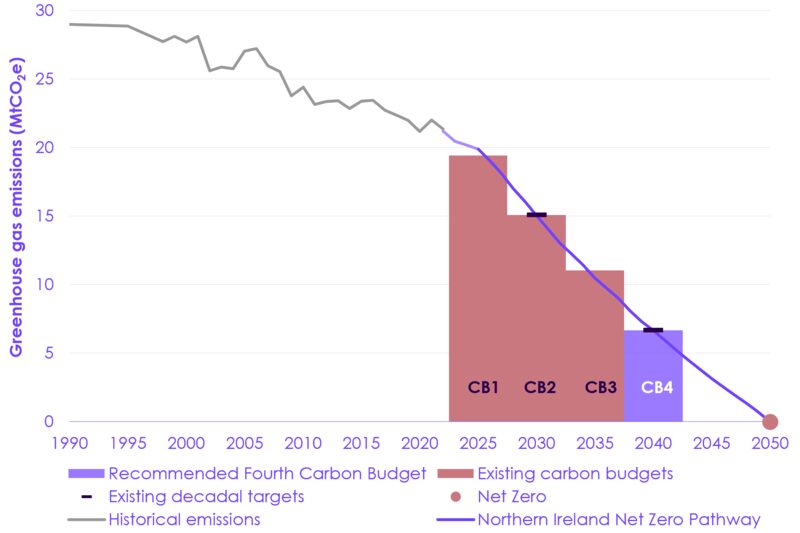
The Fourth Carbon Budget advice translates into an absolute emissions level. It would require emissions to reduce from 21.3 MtCO2e in 2022 to 6.6 MtCO2e by 20401. The step between the Third and Fourth budgets is a further 15 percentage point reduction1.
Progress so far gives a sense of the pace required. Northern Ireland's emissions in 2023 were 18.5 MtCO2e, 7% lower than in 2022 and 31% lower than 1990 levels5. Emissions have fallen by 26% over the 32 years between 1990 and 2022, and the Committee's pathway requires a similar percentage reduction over the five years between 2025 and 20301. That is the central tension in the figures: three decades of gradual reduction, followed by a requirement to match that reduction again in five years.
The Committee's pathway is modelled to narrowly meet the First and Second Carbon Budgets and the 2030 and 2040 decadal targets, slightly overperform the Third Carbon Budget by around 0.4 MtCO2e per year from 2033 to 2037, and reach net zero greenhouse gas emissions in 20501.
What drives the reductions
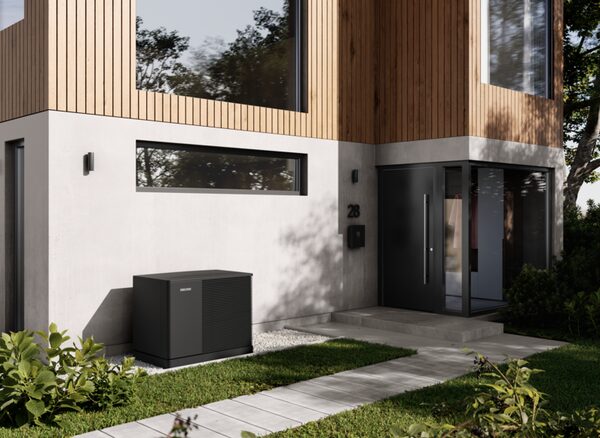
The pathway is not evenly spread across the economy. Electrification, including the supply of low-carbon electricity and its use in electric vehicles, heat pumps and other applications, accounts for 55% of the emissions reduction needed by 20401. Demand measures contribute 23% of the reduction required to meet the Fourth Carbon Budget1. Land-based actions to increase natural carbon sequestration and reduce emissions from land deliver 8% of the total emissions reduction by 2040, and low-carbon fuels with carbon capture and storage contribute a further 10%1.
That adds up to a pathway in which more than half the work is done by moving things that currently burn fuel onto the electricity system. The Committee's wider position is consistent with this: it describes the lower-cost, energy-secure future as electric, and has said the Government should plan to accelerate electrification, in particular by making electricity cheaper9. Its number one recommendation remains to make electricity cheaper by taking policy costs off electricity bills, which it describes as vital for ensuring the required scale-up of heat pump installations10.
For Northern Ireland specifically, the Committee has said that over three-fifths of the emissions reductions required to meet the Fourth Carbon Budget will come from domestic transport, buildings, and agriculture and land use4. Buildings are therefore one of three pillars, not a marginal contributor.
The Committee has also flagged where delivery is lagging. It found that only a third of the emissions reductions required to achieve the country's 2030 target were covered by credible plans, and set out a priority list of ten recommendations11. It has said a significant increase in roll-out rates is needed in many areas in the next few years, while noting some encouraging signs of progress in its delivery indicators10.
"The lower-cost, energy-secure future is electric, so we hope to see the Government plan to accelerate electrification, in particular by making electricity cheaper."
How Northern Ireland differs from Scotland, Wales and England
The four nations do not share a single target. The UK-wide Climate Change Act 2008 sets a long-term goal of net zero UK greenhouse gas emissions by 2050, and that goal was legislated in 2019 as a step up from the previous 80% reduction target6. The original 2008 Act required a reduction of at least 80% of the 1990 baseline by 205012.
Scotland moved earlier and further. The Climate Change (Emissions Reduction Targets) (Scotland) Act 2019 set net zero greenhouse gas emissions by 2045, with interim targets requiring a 75% reduction by 2030 and 90% by 204013. Earlier Scottish legislation had set at least 42% emissions reductions by 2020 and 80% by 205015.
Northern Ireland's position sits between the UK-wide framework and Scotland's. Its Act sets net zero by 2050, the same year as the UK Climate Change Act, but with its own interim target of 48% by 2030 and its own carbon budget series1. Wales has committed to net zero by 2050 while setting out ambitions to get there sooner16.
| Nation | Net zero year | Key interim target |
|---|---|---|
| Northern Ireland | 20501 | 48% reduction by 20302 |
| Scotland | 204513 | 75% by 2030, 90% by 204013 |
| Wales | 2050, with ambition to get there sooner16 | Not specified in the same form |
| UK-wide | 20506 | 80% by 2050 under the original 2008 Act12 |
The practical difference for a household is the pace implied by the interim targets rather than the end date. Scotland's 2045 date and 2030 interim target pull policy further forward than Northern Ireland's 2050 date and 48% interim target. Northern Ireland's Fourth Carbon Budget, at 77% below 1990 levels for 2038 to 2042, is the point at which its trajectory becomes steep.
The rules that carry the targets into buildings
The targets are delivered through separate legal instruments, and the building regulations are among them. The Building Regulations (Northern Ireland) Order 1979 sets out the purposes for which regulations may be made, including securing the health, safety, welfare and convenience of persons in or about buildings, furthering the conservation of fuel and power, furthering the protection and enhancement of the environment, and promoting sustainable development17.
The 2012 building regulations made under that Order are designed to further the conservation of fuel and energy18. The Order was amended in 2009 to add low or zero carbon systems and heat networks to the matters covered, along with new paragraphs on reused or recycled materials, artificial lighting and power outlets, security of buildings, pollution and nuisance, fuel or power use, and sustainable use of water17.
Alongside the regulations, the Department for Communities has a long-term ambition to improve the energy efficiency of Northern Ireland's housing stock, thereby reducing carbon emissions and helping to keep homes comfortably warm at an affordable cost19. That ambition sits with the Warm, Healthy Homes Fund, which is replacing the Affordable Warmth Scheme, which ends in March 202819.
The Committee's advice includes 18 priority recommendations for immediate action to put Northern Ireland on track to deliver the Fourth Carbon Budget1. Those recommendations are the practical bridge between the legislated targets and what happens to individual homes.
What it means for a household's energy independence
The pathway's reliance on electrification is the single most consequential fact for a household. If 55% of the emissions reduction by 2040 comes from electrification, and buildings are one of three sectors delivering over three-fifths of the reductions for the Fourth Carbon Budget, then the direction for heating is towards electricity and away from combustion1.
For a home off the gas grid, that has a specific meaning. Oil heating is common in Northern Ireland, and the pathway does not offer a route in which oil remains the long-term answer. The Committee's recommendation to make electricity cheaper by taking policy costs off electricity bills is aimed squarely at this transition, and it describes that step as vital for ensuring the required scale-up of heat pump installations10.
What the targets do not do is remove dependence. A household that switches to a heat pump remains connected to the electricity grid and to a supplier, and the emissions benefit depends on how that electricity is generated. The pathway assumes the supply of low-carbon electricity grows alongside its use1. A home that adds solar and battery storage reduces its reliance on imported electricity, but the grid connection remains for the hours it cannot cover.
The wider UK picture shows how much of the transition is still unbuilt. The Committee found that only a third of the emissions reductions required to achieve the country's 2030 target were covered by credible plans11. It has also said that a significant increase in roll-out rates is needed in many areas in the next few years10. Northern Ireland's targets are legislated; the delivery behind them is not yet demonstrated at the scale the budgets require.
The Committee's own framing of the cost is worth holding alongside the targets. It estimates the net costs of delivering its pathway at 0.2% of GDP per year on average6. That is an economy-wide modelled figure, not a household bill, and it does not tell any individual home what a change will cost.
Where the advice stands and what happens next
The Committee's role is advisory and its assessments are periodic. It is an independent statutory body established under the Climate Change Act 20082. It provides expert advice as part of the approach to climate change, and it will continue to hold the Government to account for how it delivers against its targets9.
Its assessment cycle matters for anyone tracking Northern Ireland's progress. The Committee said it would assess the merits of the Scottish Government's climate plan in its progress report early next year, and separately that it would assess the Government's plan fully in its annual progress report in June next year21. Its latest progress in reducing emissions report was published in 202622.
The Fourth Carbon Budget advice carries a deadline. The Northern Ireland Executive needs to consider the advice and set the budget by the end of 20261. Until that happens, the 77% figure remains a recommendation rather than a legal cap.
The Committee has also taken a position on how the budget should be met. It states that the Executive should not plan to use international credits, referred to as carbon units in the Act, to achieve the Fourth Carbon Budget1. That rules out buying reductions from elsewhere as a substitute for domestic action, at least in the Committee's recommended approach.
For a household, the practical sequence is: the 2030 interim target of 48% is already law, the carbon budgets to 2037 are set, and the Fourth Carbon Budget covering 2038 to 2042 is the next decision point. The heating implications follow from the pathway rather than from any single regulation, and the pace of change depends on decisions not yet taken.
Sources22 cited
- Northern Ireland's Fourth Carbon Budget, Climate Change Committee, 2025-03-19
- The Climate Change Committee and Northern Ireland, UK Parliament, 2026-07-10
- Advice Report: The Path to a Net Zero Northern Ireland, Climate Change Committee, 2026-09-19
- Electric technologies will benefit Northern Ireland, Climate Change Committee, 2025-03-19
- Progress in Reducing Emissions: 2025 Report to Parliament, Climate Change Committee, 2025
- The Seventh Carbon Budget, Climate Change Committee, 2025-02-26
- NISEP 2024 to 2025 Annual Report, Utility Regulator, 2026-07
- NISEP 2023 to 2024 Annual Report, Utility Regulator, 2025-07
- Response to the Government's Seventh Carbon Budget target, Climate Change Committee, 2026-06-02
- Response to the Government's Carbon Budget and Growth Delivery Plan, Climate Change Committee, 2025-10-29
- UK off track for Net Zero, say country's climate advisors, Climate Change Committee, 2024-07-18
- Written evidence on the Climate Change Act 2008, UK Parliament, 2019-01
- Heat and Buildings Strategy: Strategic Environmental Assessment, Scottish Government, 2021-02-26
- Heat and Buildings Strategy consultation, Scottish Government, 2021-02-05
- Warmer Homes Scotland business case, Scottish Government, 2015-07
- Wales commits to net zero by 2050, Welsh Government, 2021
- Building Regulations (Northern Ireland) Order 1979, legislation.gov.uk, 2009-03-02
- Building Control Northern Ireland: Regulations, Building Control NI, 2026
- Warm, Healthy Homes Fund screening, Department for Communities, 2026-05-19
- Climate change policy in Scotland, Scottish Government, 2026-09-17
- Response to the Scottish Government's climate change plan, Climate Change Committee, 2025-11-07
- Response to Parliament passing the Seventh Carbon Budget into law, Climate Change Committee, 2026-06-24
 Carbon Budgets and Net ZeroThe UK has promised to cut its emissions to almost nothing by the middle of the century.
 Climate TargetsScotland aims to stop adding greenhouse gases by 2045, five years before the rest of the UK.
 Home HeatingWhy do so many homes in Northern Ireland run on heating oil, and will that ever change?
 Housing Stock Data for NIMost homes in Northern Ireland heat with oil, so why are the grants and help different from the rest of the UK?
 Housing Stock and EPCsNorthern Ireland's homes score best in the UK for energy efficiency, yet most run on heating oil.
 Home Energy Planning Rules in NIDo you need planning permission for solar panels or a heat pump in Northern Ireland?