
In this guide
The Child Winter Heating Payment is a benefit from the Scottish Government that helps disabled children and young people and their families with the higher heating costs of winter. It is paid once a year, from October and through the winter, and it was first paid in 2020. The current payment is £265.501. It is a one-off, tax-free payment, and it used to be called the Child Winter Heating Assistance2.
The payment is made automatically. There is no application for families living in Scotland: Social Security Scotland identifies eligible children from the disability benefit records it already holds, and pays the money into the same bank account that the child's disability benefit is paid into. Most payments are made in October or November3. Crucially for larger families, the money is not capped at one per household: if more than one child or young person in the household qualifies, each of them gets the full payment3.
Amounts have risen each year. For winter 2025/26 the payment was £255.804, and it rises to £265.50 for winter 2026/275. Eligibility turns on a single test: entitlement to the highest rate of the care component of a disability benefit, or the enhanced rate of the daily living component, on at least one day of a qualifying week in September, for a child or young person under 194.
What the payment is and why it exists
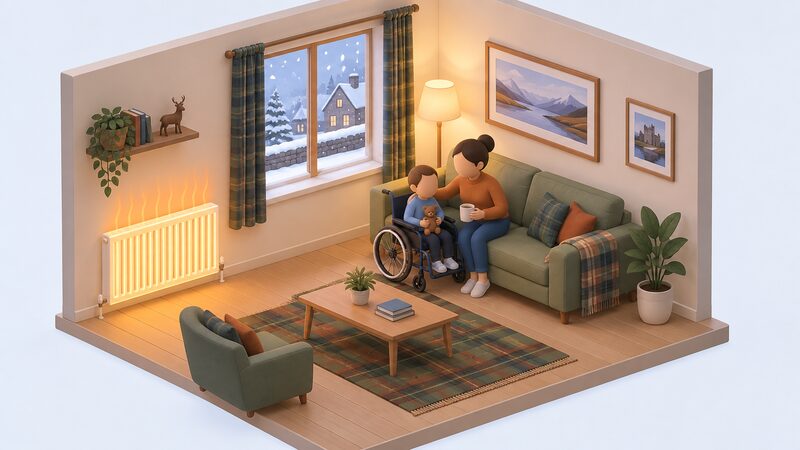
This is winter heating assistance aimed at one group: disabled children and young people and their families with increased heating costs over winter1. The Scottish Government's own policy note sets out the reasoning. The assistance is intended to provide some mitigation for the increased costs these households face, including as a result of needing to heat their homes through the night or through parts of the night because another person must provide care and support overnight, and it is expected to be used to ease the financial pressures of winter fuel bills6.
That is a different starting point from most winter help, which is tied to low income or to pension age. Here the trigger is disability, not household income, although the benefit is classed as a means-tested benefit in its administrative category2. It sits alongside the other payments Social Security Scotland describes as its range of payments to keep homes warm: pension age winter heating, child, and disability.
Child Winter Heating Assistance was introduced in November 2020 by Social Security Scotland7, the point at which Scotland began building its own winter heating support rather than relying on schemes reserved to the UK Government. It has grown steadily in value and in cost. The Scottish Government committed £11.4 million through the Child Winter Heating Payment for the winter announced in November 20258. Earlier years show the trajectory: allocations of £4.90 million in 2021-22, £5.70 million in 2022-23, £7.70 million in 2023-24 and £10.20 million in 2024-259. Consumer Scotland has recorded around 30,000 recipients in Scotland at a cost of £7.2 million, with the payment then worth £251.50 in 2024-2510.
For a household's energy independence, the honest framing is modest. A few hundred pounds does not make a home self-sufficient and does nothing to the fabric of the building or the heating system. It reduces exposure to a single winter's bills for families whose heating demand is involuntarily high. Permanent reduction in demand comes from insulation and heating measures, which in Scotland are handled through the Home Energy Scotland grant and loan scheme and HEEPS area based schemes.
Who qualifies: the care component rule and the age limit
A child or young person qualifies if they are under 19 and were entitled to one of four awards on at least one day during the qualifying week4:
- the highest rate of the care component of Disability Living Allowance for children
- the highest rate of the care component of Child Disability Payment
- the enhanced rate of the daily living component of Personal Independence Payment
- the enhanced rate of the daily living component of Adult Disability Payment11
Nothing below those rates counts. A middle or lower rate care component, or a standard rate daily living component, does not bring entitlement, and neither does a mobility award on its own. The rule is about the level of care need the award records, not about the family's income, savings or tenure.
The scheme did not start this broad. When Child Winter Heating Assistance was introduced, it covered children and young people entitled to the highest rate of the care component of Disability Living Allowance or Child Disability Payment12. The 2021 amendment regulations extended eligibility to young people entitled to be paid the enhanced rate of the daily living component of Personal Independence Payment during the qualifying week6, closing a gap that had affected older teenagers who had moved across to an adult benefit.
Residence matters too: this is a Scottish benefit, and the standard case is a child living in Scotland who gets one of the qualifying awards11. The exception for families abroad is covered below.
How much is paid: £265.50 per eligible child
The current payment is £265.501. That figure applies per eligible child or young person, not per household3.
| Winter | Amount per eligible child | Source type |
|---|---|---|
| 2020, at introduction | £200 annual payment for each eligible child or young person6 | official |
| 2022-2023 | £214.1013 | independent |
| 2024-25 | £251.5010 | independent |
| 2025/26 | £255.804 | official |
| 2026/27 | £265.505 | independent |
The current published amount on the Scottish Government's own service is £265.501, consistent with the rise to £265.50 in winter 2026/275. The payment is uprated annually, which is why any figure quoted in older guidance will be lower than the one in payment now.
The scale of this payment compared with Scotland's other winter payments is worth noting. The Winter Heating Payment for low income households is currently £62.0014, having been £59.75 in winter 2025/264. The Pension Age Winter Heating Payment is between £105.55 and £316.70 depending on circumstances15. The child payment is therefore several times the value of the general low income winter payment, reflecting the higher and longer heating demand that the policy note identifies in homes where overnight care is given6.
The qualifying week in September and how eligibility is decided

The qualifying week is the third full week in September3. For winter 2025/26 that week ran from 15 to 21 September 20254. Entitlement to a qualifying award on any single day of that week is enough; it does not have to run for the whole week4.
Social Security Scotland decides eligibility from the data it already holds on disability awards, rather than from anything the family submits. The same data-led method is used across Scotland's winter payments: for the Winter Heating Payment, Social Security Scotland uses your data to decide if you get it14. That has a practical consequence. If the award in question was disputed, suspended or being reassessed across that September week, the record may not show entitlement on the relevant day even where the family believes it existed, and that is the most common reason a payment does not appear.
The choice of a fixed week is deliberate. Unlike the Cold Weather Payment used elsewhere in the United Kingdom, eligibility does not depend on a period of cold weather where the household lives4. The Scottish Government made the same point about its low income winter assistance: unlike the UK Government's Cold Weather Payments, the benefit will not be dependent on cold weather in a specific area to trigger a payment. For families that means certainty in September about money arriving in the autumn, rather than an unpredictable payment that may or may not be triggered by a cold snap.
Hospital, residential care and other absences
If the child or young person usually gets paid one of the eligible benefits but was not paid it between 15 and 21 September, for example because they were in hospital or residential care, they will still be paid automatically16. This is a more generous position than applies to Scotland's pension age payment, where a year or more of free hospital treatment covering the qualifying week, or a full qualifying week in a care home alongside certain benefits, can remove entitlement17.
No application needed: how the automatic payment works
There is no application for the Child Winter Heating Payment. Eligible children and young people living in Scotland do not need to apply and will receive their payment automatically13. Citizens Advice Scotland puts it plainly:
"You do not need to apply for Child Winter Heating Payment. You'll get it automatically if you're eligible."
The steps behind the scenes run in this order:
- Social Security Scotland identifies children and young people under 19 with a qualifying award live during the third full week of September3.
- Entitlement is confirmed from the benefit record, with no form or means test for the family.
- The payment is issued into the same bank account as the child's DLA for children, Child Disability Payment, PIP or Adult Disability Payment3.
- Where more than one child in the household qualifies, a separate payment is issued for each3.
Automatic payment removes the barrier of a claim, but it makes the accuracy of the underlying benefit record the single point of failure. A change of bank account, a change of appointee, or an award under reconsideration during September are all reasons to expect a query rather than a smooth payment.
When the payment arrives and where it goes

The payment is made once a year from October and through the winter1. Most payments are made in October or November3, and independent guidance describes the grant as usually available and paid from the end of October through November18. The Scottish Government's equality impact assessment describes the scheme as designed to ensure that this financial support is delivered by 31 December each year12.
It is paid directly into the same bank or building society account where the disability benefit is normally paid5. There is no voucher, no credit to an energy account and no requirement to spend it on fuel: it is cash, and the household decides how to use it. That matters for families on prepayment meters or buying heating oil in bulk, where the timing of the money against a delivery or a top-up can be as important as the amount.
The timing is deliberately earlier than Scotland's other winter payments. The Winter Heating Payment for low income households is paid from December and through winter each year14, with most payments made automatically from December. The child payment lands before the coldest months and before the heaviest bills, which suits households buying oil or LPG ahead of winter, as discussed in how Scottish homes are heated.
More than one eligible child: the household rule
Each eligible child or young person in the household gets the payment3. There is no household cap and no tapering for the second or subsequent child: if there is more than one child or young person who qualifies in the household, each of them will get a payment16. Independent debt guidance describes the scheme the same way, as available to families of disabled children and young people with an extra payment for each eligible child19.
This is the opposite of the rule that applies to Scotland's pension age support, which is limited to one per household [19 note: see below]. The difference follows the logic of the benefit. The pension age payment is framed around the dwelling; the child payment is framed around the individual care need recorded in each child's disability award, and two children needing overnight care generate roughly twice the additional heating demand of one.
For a household with two qualifying children at the current rate, that means two payments of £265.501.
Living outside Scotland during the qualifying week

Families who were not living in Scotland during the qualifying week are not automatically excluded. If the family lived in a certain European Economic Area country or Switzerland during the qualifying week, they might still be eligible, but they must be able to prove a genuine and sufficient link to Scotland16. Six countries are ruled out: there is no eligibility for those living in Greece, Portugal, Spain, Cyprus, France or Malta16.
This is the one route into the scheme that requires an actual claim rather than an automatic award. Where a claim succeeds, the family might get a back payment for each year that they were eligible16, which can make a claim worth pursuing for several winters at once rather than only the current one.
Contact routes for these claims:
| Route | Detail |
|---|---|
| Telephone from outside the UK | +44 (0)138 293 100020 |
| British Sign Language | Contact Scotland service20 |
| Post | Child Winter Heating Payment, PO Box 10317, Dundee, United Kingdom, DD1 9GR20 |
| Telephone, Social Security Scotland | 0800 182 222221 |
How the payment affects other benefits and tax
It is a tax-free payment5, and getting it should not affect your other benefits3. More precisely, a Child Winter Heating Payment does not count as income when working out entitlement to other benefits5.
Two specific treatments are worth knowing:
- Universal Credit: the payment will not be counted as savings for 52 weeks3. For a household close to the capital limits, that disregard runs long enough to cover the whole winter and the following autumn.
- Council Tax Reduction: if you apply for Council Tax Reduction, the payment should not be taken into account as income3.
The same principle runs across Scotland's winter payments: getting the Winter Heating Payment does not affect any other benefits you may get14, and it is likewise not taxable. None of these payments needs to be declared as taxable income or reported as a change in circumstances for income purposes.
If a payment does not arrive, and how to challenge a decision
If no Child Winter Heating Payment has been paid by 31 December, contact Social Security Scotland5. That date matches the delivery target built into the scheme's design12. Before contacting, it is worth checking that the child's disability award was in payment at the qualifying rate during the third full week of September, and that the bank details held for that award are current, since the money follows the disability benefit account3.
Where Social Security Scotland has decided that no payment is due, the challenge route is a redetermination. There are 42 days after the day you are told by Social Security Scotland that you are not getting the payment to ask for a redetermination3. For Social Security Scotland benefits generally, if you still disagree with the decision after a re-determination, you can appeal to an independent tribunal17.
For the related Winter Heating Payment, the Scottish Government describes what happens when a missed payment is queried: Social Security Scotland will look at your data again, consider whether you are eligible or not, and then either pay you if you are eligible or write to you to explain their decision14. The same pattern of re-checking held data, rather than asking the household to evidence the claim, applies to automatic awards.
Child Winter Heating Payment and Winter Heating Payment compared
These are two separate Scottish benefits and a household can be in scope of both, since they test different things.
| Child Winter Heating Payment | Winter Heating Payment | |
|---|---|---|
| Who it targets | Disabled children and young people under 19 and their families4 | Low income households on qualifying benefits11 |
| Current amount | £265.501 | £62.0014 |
| Per child or per household | Each eligible child or young person is paid3 | A single payment per eligible household14 |
| Qualifying week | Third full week in September3 | Week beginning the first Monday in November; 3 to 9 November 2025 for winter 2025/264 |
| Payment window | From October and through winter, most in October or November1 | From December and through winter14 |
| Weather dependent | No1 | No14 |
The Winter Heating Payment replaced the Cold Weather Payment in Scotland19, and the Scottish Government committed an estimated £28.3 million through it alongside the £11.4 million for the child payment8. Both are fixed annual sums rather than weather-triggered awards, which is the fundamental divergence between Scotland and the rest of the United Kingdom on this kind of help. The wider pattern of divergence is set out across the four nations guide and in why home energy grants differ across the four nations.
What it does, and does not, do for a household's energy security

The payment gives a family with a disabled child a predictable, tax-free sum in the autumn, independent of the weather, of the energy supplier and of the fuel used. Unlike a discount applied to an energy account, it is cash in the household's own bank account, so it can go towards an oil delivery, a prepayment top-up or a direct debit as the household chooses.
The dependence that remains is complete. The payment does not reduce the amount of heat the home needs, does not change the price per unit paid, and can be altered or ended by Scottish Ministers in any future year, as the rising and changing amounts since 2020 show. It relies on Social Security Scotland holding accurate benefit data, and it relies on the child's disability award continuing at the highest or enhanced rate. It also stops at 19, with no transition built into this benefit for the year after. Households whose heating costs are structurally high because of poor fabric or expensive fuel will find the underlying position unchanged, which is why the Scottish Government treats this payment as mitigation of costs rather than a fix, and why it sits alongside the retrofit programmes covered in fuel poverty in Scotland.
Sources21 cited
- Child Winter Heating Payment, mygov.scot, 2026-09-17
- What is a Child Winter Heating Payment, Turn2us, 2025-10-21
- Child Winter Heating Payment guidance, Citizens Advice Scotland, 2026-09-20
- Winter fuel and heating payments briefing, UK Parliament, 2026-02-26
- How much Child Winter Heating Payment will I get, Turn2us, 2026
- Winter Heating Assistance for Children and Young People Amendment Regulations 2021: policy note, Scottish Government, 2021-09-23
- Child Winter Heating Assistance statistics: winter 2021/2022, Scottish Government, 2022-04-26
- Helping households to manage their bills, Scottish Government, 2025-11-03
- Tackling fuel poverty in Scotland: periodic report 2021 to 2024, Scottish Government, 2025-04-22
- Designing energy support for disabled consumers, Consumer Scotland, 2024-11-28
- Grants and benefits to help pay energy bills, Citizens Advice Scotland, 2026-09-17
- Winter Heating Assistance for Children and Young People Amendment Regulations 2021: draft EQIA, Scottish Government, 2021-09-24
- A guide for heating oil users, UKIFDA, 2022-11-25
- Winter Heating Payment, mygov.scot, 2026-09-17
- Pension Age Winter Heating Payment, mygov.scot, 2026-09-17
- Can I get a Child Winter Heating Payment, Turn2us, 2025-10-21
- How do I challenge a Pension Age Winter Heating Payment decision, Turn2us, 2026-08-10
- Energy grants guide, Confused.com, 2026
- Government help with gas and electric bills, StepChange, 2026-09-20
- How do I claim a Child Winter Heating Payment, Turn2us, 2025-10-21
- Energy bill support this winter, British Gas Energy Trust, 2026-08-26
 Tariffs in ScotlandWhy do Scottish electricity bills differ from the rest of Great Britain, and why do standing charges cost more in the north?
 The Full Heat Pumps GuideWill a heat pump keep my house warm in winter, and what does one cost to buy and run?
 Community Energy in ScotlandCommunity energy in Scotland lets you join a local scheme for cheaper, greener heat and power, or get advice and funding to make your own home warmer and cheaper to run.
 Smart Meters in ScotlandWhen will you get a smart meter in Scotland, and what happens if yours still runs on the old radio signal that switches heating and hot water?
 Older People and Home EnergyOlder people often pay more to keep warm and can miss out on help they are entitled to.
 Energy Policy in ScotlandWho decides how your home in Scotland is heated and improved?