

In this guide
Devolution changes what a household in Scotland, Wales or Northern Ireland can install, insulate and claim, but it does not change the terms on which that household buys and sells electricity. The Scottish, Welsh and Northern Irish administrations hold building standards, planning for many home energy installations, fuel poverty strategies, grant schemes and their own climate targets. Westminster and Ofgem retain supply licensing, metering, export payments and most consumer protection. A home in Glasgow, Cardiff or Belfast therefore faces a different set of grants and standards from a home in England, but the same grid, the same wholesale market and, in Great Britain, the same supplier rules.
The practical effect is a patchwork. Scotland has legislated for net zero greenhouse gas emissions by 2045, with interim targets of a 75% reduction by 2030 and 90% by 20401. Wales has a legal commitment to net zero by 2050 and an ambition to get there sooner2. Northern Ireland works to five-yearly carbon budgets that began in 2023, with the first requiring a 33% average annual reduction on 1990 levels3. Each of those targets implies work on the housing stock, because homes are a large share of what each nation consumes.
For a household, the question is narrower: does any of this reduce dependence on the grid, on a supplier, or on imported gas and oil? The answer is that devolved policy can reduce how much energy a home needs and can fund the equipment that generates some of its own, but it cannot disconnect the home from the network or from a licensed supplier. What follows sets out the figures, what drives them, how the four nations differ, the rules that bind them all, and what independence realistically means.
What devolution actually changes for a household
The levers a devolved government holds are real but bounded. Building standards are devolved, which is why Scotland can model energy improvements for new domestic buildings against its own standards, including a flat primary energy figure of 71 kWh/m2/yr at 2015 standards7. Planning is devolved, which is why permitted development rights for domestic air source heat pumps and non-domestic solar panels were consulted on separately in Scotland8. Fuel poverty strategy is devolved, which is why Scotland funds Home Energy Scotland to provide impartial advice and support to fuel poor households covering all four drivers of fuel poverty4. Grant design is devolved, which is why the Welsh and Scottish governments appear alongside each other as delivery bodies for home energy efficiency support9.
What is not devolved matters just as much. Section 62 of the Energy Act 2015, which deals with the settlement of disputes and consumer redress, extends to England, Wales, Scotland and Northern Ireland10. The Energy Prices Act 2022, which underpinned the universal support payments of that period, extends in part to England and Wales and Scotland, and in its other provisions to all four nations11. The Energy Bills Support Scheme, which distributed money through electricity suppliers, covered England, Wales and Scotland12. The Energy digitalisation framework, which sets the direction for a coordinated and connected energy system, applies to England, Scotland and Wales13.
The result is a split that a household feels directly. A devolved administration can pay for a heat pump, an insulation measure or an advice service. It cannot set the standing charge, the export tariff, the metering standard or the licence conditions under which the supplier operates. Those sit with Ofgem and Westminster, and they are the same for a home in England, Scotland and Wales. Northern Ireland is a further case again, with its own regulator and its own programme.
"Energy use in our homes accounts for around a quarter of Scotland's total energy consumption"
The figures behind each nation's targets
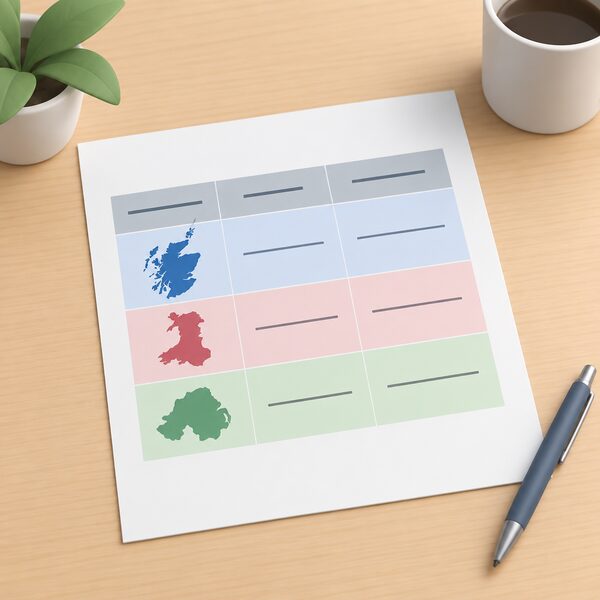
The targets are the clearest expression of what each administration is aiming at, and they differ in date and in structure.
| Nation | Target | Interim milestones | Source |
|---|---|---|---|
| Scotland | Net zero greenhouse gas emissions by 2045 | 75% reduction by 2030; 90% by 2040 | 1 |
| Wales | Net zero greenhouse gas emissions by 2050 | 89% reduction by 2040 | 14 |
| Northern Ireland | Net zero by 2050 | 48% reduction by 2030; 77% by 2040 | 3 |
| UK-wide context | Net zero by 2050 | England, Wales and Northern Ireland have committed to 2050 | 15 |
Scotland's framework is the most detailed. The Climate Change (Emissions Reduction Targets) (Scotland) Act 2019 set net zero by 2045 with interim targets of a 75% reduction by 2030 and a 90% reduction by 204016. A separate Scottish Government consultation records the same structure and adds a 2032 greenhouse gas emissions target of 78%17. The Climate Change Committee, reviewing progress, concluded that the net zero date of 2045 and the 2040 interim target of a 90% reduction remained appropriate, and that changes in emissions accounting methodology did not imply the need to change them18.
Wales' position has moved over time. The Climate Change Committee set out in December 2020 that net zero by 2050 was the right target for Wales, to be legislated in the first half of 202119. The Welsh Government then confirmed a legal commitment to achieve net zero emissions by 2050 while pushing to get there sooner2. The Welsh Government's own net zero plan records a 2050 target and an 89% reduction by 204014. The Committee's 2023 progress report found that Wales was not yet on track to meet its targets for the second half of this decade and beyond14.
Northern Ireland's structure is different again. The Climate Change Act (Northern Ireland) 2022 introduced five-yearly caps on emissions, known as carbon budgets, starting in 20233. The first budget, covering 2023 to 2027, requires a 33% average annual reduction on 1990 levels; the second, 2028 to 2032, 48%; and the third, 2033 to 2037, 62%3. The Committee's recommended fourth budget, covering 2038 to 2042, is a 77% reduction, a further 15 percentage point step down from the third3. Emissions would need to fall from 21.3 MtCO2e in 2022 to 6.6 MtCO2e by 20403.
What drives the differences
Three forces explain most of the variation between the nations: the age and condition of the housing stock, the fuel mix, and the budget each administration chooses to spend.
On spend, the pattern is long-standing. Written evidence to a parliamentary committee recorded Northern Ireland and Wales spending three times and twice as much respectively per capita on energy efficiency as England, as of 201720. That is a measure of effort rather than of outcome, but it shows that the devolved administrations have been willing to put their own money into the housing stock.
On fuel mix, the nations diverge sharply. Northern Ireland has a large share of homes off the mains gas grid, which is why it operates its own sustainable energy programme and why a home heating oil support voucher scheme opened for applications in September 2026 for 340,000 eligible households5. Scotland's generation profile is also distinctive: in the 2011 to 2014 period covered by the Energy Trends special feature, Scotland's renewable share of electricity generation stood well above the UK average, which was 29.3% for the UK as a whole and 25.6% for the rest of the UK excluding Scotland21. More recently, Scotland accounted for 12.24% (0.79 GW) of installed capacity in the Feed-in Tariff quarterly report, second only to the South East's 11.29% (0.73 GW)6. An earlier Feed-in Tariff annual report recorded Scotland with 762 MW of installed capacity as at 31 March 202022.
On data, the nations are not measured identically, which itself shapes policy. The National Energy Efficiency Data-Framework applies to England, Scotland and Wales23, as does the Household Energy Efficiency Statistics headline release12. Northern Ireland's energy rating of housing statistics are published as Official Statistics in Development24. The domestic electricity consumption indicator notes that Northern Ireland local government district figures are only available from 2015 onwards, and that Northern Ireland estimates refer to financial years running 1 April to 31 March25. The Welsh energy use report draws on a long list of sources including the DESNZ Energy Consumption in the UK 2021, StatsWales employment data, ONS census data and the Climate Change Committee's Sixth Carbon Budget26.
How the four nations differ in practice
The differences a household encounters are concrete: which scheme exists, who runs it, and what it pays for.
Scotland. Home Energy Scotland provides advice funded by the Scottish Government, covering all four drivers of fuel poverty4. Scotland's planning regime for home energy equipment is set separately, following consultation on permitted development rights for domestic air source heat pumps8. Scotland's building standards modelling uses a flat primary energy figure of 71 kWh/m2/yr at 2015 standards7. The Scottish Government has also consulted on a Heat in Buildings Bill, which would sit alongside the 2045 net zero target and the 75% and 90% interim targets16.
Wales. The Welsh Government is named as a delivery body for home energy efficiency support9. Wales has set sectoral goals alongside its 2050 target, including a decarbonised and resilient power system by 2035, no new buildings connected to the gas grid from 2025, and a 70% recycling target for 202514. The Welsh Government established a Net Zero 2035 Challenge Group in January 2023 to examine potential pathways to net zero by 203524. The Committee's assessment is that Wales is not yet on track14.
Northern Ireland. Northern Ireland operates the Northern Ireland Sustainable Energy Programme, run by the Utility Regulator, and the Affordable Warmth Scheme. Its energy efficiency statistics for housing are published as Official Statistics in Development24. The Department for the Economy has announced that smart meter rollout for all homes will begin in 20285. A home heating oil support voucher scheme opened for applications on 9 September 2026 for 340,000 eligible households5.
England. England sits within the Great Britain arrangements for the Energy Bills Support Scheme12, the National Energy Efficiency Data-Framework23 and the Household Energy Efficiency Statistics12, but has no separate devolved administration setting its own targets or grant schemes.
The rules that bind all four nations
Whatever a devolved government decides, a set of reserved rules applies across the whole of the UK or across Great Britain.
Consumer redress and dispute settlement under section 62 of the Energy Act 2015 extend to England, Wales, Scotland and Northern Ireland10. The Energy Prices Act 2022 extends in its other provisions to all four nations, while sections 1 to 4, sections 9 and 10 and Schedule 1, section 20 and Schedule 3 extend to England and Wales and Scotland11. The Energy digitalisation framework applies to England, Scotland and Wales13. The Flexibility and Net Zero Survey 2025, which tracks domestic energy consumers' use of low carbon and flexible products and services, covers Great Britain, meaning England, Scotland and Wales27.
Energy performance certificates follow a further split. The Find an energy certificate service covers England, Wales or Northern Ireland28. Scotland operates its own EPC register separately.
The practical consequence is that a household can receive devolved support to install equipment, and then sell its surplus electricity under reserved rules it had no part in setting. The Feed-in Tariff, now closed to new applicants, was administered on a Great Britain basis, with quarterly reports breaking down capacity by region, including Scotland's 12.24% (0.79 GW) share6. Successor export arrangements are set by Ofgem and apply to licensed suppliers across Great Britain.
What this means for household energy independence
Devolution gives a household in Scotland, Wales or Northern Ireland more routes to reduce its dependence than a household in England has, in the sense that more schemes exist and more money has historically been spent per head on the housing stock20. It does not give that household more control over the terms of its connection.
What a devolved administration can do is reduce the amount of energy a home needs, through building standards and insulation programmes, and fund the equipment that generates some of its own, through grant schemes. Scotland's target structure, with net zero by 2045 and a 75% reduction by 2030, implies substantial work on a housing stock that accounts for around a quarter of the nation's energy consumption4. Wales' 2050 target and its 2035 power system goal point the same way14. Northern Ireland's carbon budgets, starting at a 33% average annual reduction and rising to 62% by the third budget, set a trajectory that its housing stock will have to follow3.
What remains outside any devolved government's reach is the grid itself, the licensed supplier, and, for most homes, the fuel. A home in Northern Ireland heated by oil remains exposed to oil prices whatever the carbon budget says. A home in rural Scotland or Wales off the gas grid faces the same import exposure. A home connected to mains gas depends on a network whose gas is largely imported. And every home with a smart meter, an export tariff or a supply contract deals with a framework set in Westminster and by Ofgem, not in Edinburgh, Cardiff or Belfast.
The honest summary is that devolution changes the support a household can claim and the standards its home must meet. It does not change the fact that the home remains connected, supplied and metered under rules made elsewhere. Independence, in the household sense, comes from reducing demand and generating on site; devolution affects how much help a household gets in doing so, not whether the grid is still there at the end of it.
Sources28 cited
- Northern Ireland's fourth carbon budget, Climate Change Committee, 2025
- Domestic electricity consumption indicator (Northern Ireland), Office for National Statistics, 2025
- Domestic electricity consumption indicator, Office for National Statistics, 2026
- Energy efficiency support delivery bodies, House of Commons Library, 2026
- Northern Ireland Sustainable Energy Programme and smart meter rollout, Consumer Council for Northern Ireland, 2026
- Feed-in Tariffs Quarterly Report, Issue 64, Ofgem, 2026
- Energy Use in Wales report 2022, Welsh Government, 2024
- Delivering net zero for Scotland's buildings, Scottish Government, 2023
- Modelling energy improvements in new domestic buildings, Scottish Government, 2019
- Energy Act 2015, section 62, legislation.gov.uk, 2016
- Tackling fuel poverty in Scotland, Scottish Government, 2020
- Household Energy Efficiency Statistics, October 2022, GOV.UK, 2022
- Energy digitalisation framework, GOV.UK, 2026
- Wales Net Zero 2035 Challenge Group report, Welsh Government, 2024
- Net zero Wales by 2050, Climate Change Committee, 2020
- Reducing emissions in Wales progress report, Climate Change Committee, 2023
- Scottish emission targets progress report, Climate Change Committee, 2022
- Wales commits to net zero by 2050, Welsh Government, 2021
- Find an energy certificate, EPC NI Register, 2026
- Warm Home Discount Scheme response, GOV.UK, 2026
- Energy Trends: electricity generation and supply by nation, GOV.UK, 2015
- Feed-in Tariff Annual Report, Year 10, Ofgem, 2020
- National Energy Efficiency Data-Framework, GOV.UK, 2025
- Energy efficiency of housing in Northern Ireland, Department for Communities, 2024
- Edinburgh Local Heat and Energy Efficiency Strategy, City of Edinburgh Council, 2023
- Heat in Buildings Bill regulatory impact assessment, Scottish Government, 2023
- Flexibility and Net Zero Survey 2025, Ofgem, 2025
- Wales' fourth carbon budget, Climate Change Committee, 2025
 Devolved vs Reserved PowersWho decides what you pay for gas and electricity, and who decides how your home is insulated or improved?
 The Full Scotland, Wales and Northern Ireland GuideWhy a householder in Glasgow, Cardiff or Belfast faces different schemes, standards, targets and markets from one in England.
 Why Energy Grants DifferWhere you live in the UK changes which home energy grants you can get.
 The Full Rules and Regulation GuideConfused about who actually decides what you pay for gas and electricity, or why rules differ in Scotland and Wales?
 Energy Policy in ScotlandWho decides how your home in Scotland is heated and improved?
 Energy Policy in WalesWhat help can you get in Wales to make your home warmer and cheaper to run?