

In this guide
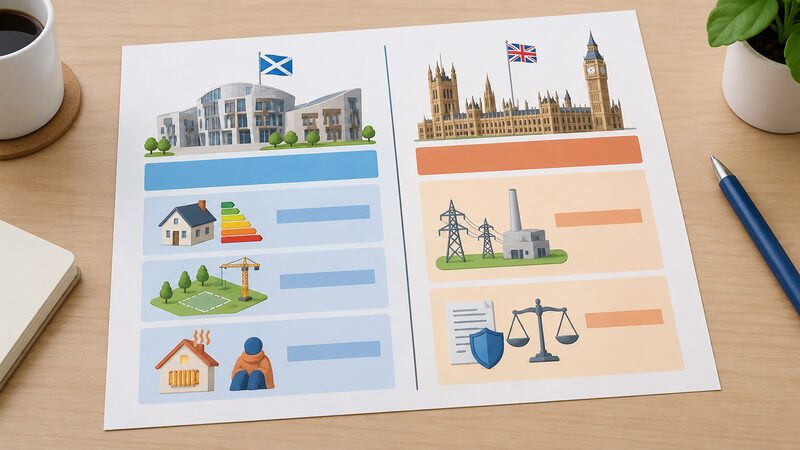
Home energy policy in Scotland is split. The Scottish Government holds the powers that shape the fabric of a house and the heat inside it: building standards, planning, housing quality, fuel poverty and heat policy. It has committed to using its "existing devolved powers around consumer advocacy, heat policy and the design of energy efficiency schemes"1. What it does not hold is the machinery of the energy market itself. Supply licensing, the price cap and the regulation of suppliers are reserved to the UK Parliament, and the split can run through a single subject: for heat networks, policy is devolved in Scotland while consumer protection is reserved2.
The scale of the task is set by the stock. Scotland has around 2.45 million homes, varied in type, use, size, age, construction and energy efficiency3. Homes and buildings account for around 30 per cent of Scotland's total energy consumption, some 44 TWh4. Against that, the Scottish Government has committed £1.8 billion to 2026 to support delivery of its heat in buildings strategy, and runs its own grant, loan and advice programmes rather than relying on UK-wide schemes alone5.
For a household, the practical consequence is that the rules on what may be installed, what a new home must be built to, and what grant may be claimed are Scottish rules, while the tariff, the meter and the supplier are governed from Westminster and Ofgem. That division decides which door to knock on when something goes wrong, and it limits how far Scottish policy alone can change what a household pays.
Devolved, reserved, and the line between them
The clean division that people expect does not exist. Scotland's devolved competence covers building standards and the building warrant system, planning and permitted development, housing quality standards, the statutory definition of fuel poverty and the design of energy efficiency and clean heat schemes. The Scottish Government has framed its energy consumer work as an attempt to "place consumer considerations at the heart of Scotland's energy policy", covering local energy, energy efficiency and electric vehicles, and to influence change across Great Britain rather than only within Scotland1. That phrasing is itself an admission of the constitutional limit: on the reserved market, Scottish ministers can advocate but not legislate.
Heat networks show the seam most clearly. Heat policy is devolved, but consumer protection for heat network customers is reserved to the UK Parliament2. A Scottish household on a heat network therefore sits under Scottish zoning and licensing policy while its rights as a consumer are set elsewhere. The same pattern applies to bill support. The Warm Home Discount operates for Scotland under devolution arrangements set out in amendments to the Energy Act 2010 made by the Scotland Act 2016, and Scottish ministers could in future develop their own regulations within the funding limit8. The power exists; it has not been separately exercised to date.
Minimum standards in the private rented sector also began from reserved legislation. Scottish minimum energy efficiency standards for privately rented homes were to be introduced under Section 55 of the Energy Act 20119. Devolution here is a matter of Scottish regulations made under a UK Act, which is why Scottish and English rules can share a legal root and diverge in content.
For the wider constitutional picture, see UK home energy regulation and policy, Ofgem and DESNZ.
The figures: stock, energy use and performance
Scotland's homes are a large share of its energy demand, and older statements put the share higher still for particular fuels. Households use more than a third of the electricity and more than half of the heat consumed in Scotland10. Heat accounted for 51 per cent of the energy consumed by Scotland's homes and businesses11. A 2020 assessment put energy use in homes at around a quarter of Scotland's total energy consumption, against the around 30 per cent for homes and buildings together in 202112. The figures are not contradictory so much as differently scoped, and the date and the scope should be read together.
Performance has improved but is uneven. In 2021 the Scottish Government recorded that 45 per cent of Scotland's homes had a good level of energy performance, equivalent to EPC Energy Efficiency Rating C7. At the other end, across 2022 to 2024 an average of 3 per cent of Scottish dwellings had an F or G energy rating13. Heating fuel matters for what any standard can achieve: in 2023, 11 per cent of Scottish households, some 270,000, used electricity as their primary heating fuel14.
| Measure | Figure | Period | Source |
|---|---|---|---|
| Homes in Scotland | around 2.45 million | 2026 guidance | 3 |
| Homes and buildings share of energy consumption | around 30 per cent (44 TWh) | 2021 | 4 |
| Heat share of energy used by homes and businesses | 51 per cent | 2017 | 11 |
| Homes at EPC C or equivalent | 45 per cent | 2021 | 7 |
| Dwellings rated F or G | 3 per cent | 2022 to 2024 average | 13 |
| Households heating primarily with electricity | 11 per cent (270,000) | 2023 | 14 |
Delivery volumes are smaller than the stock they must eventually cover. In 2024-25, 2,000 energy efficiency measures and 5,400 renewable or clean heat measures were installed through the Home Energy Scotland Grant and Loan Scheme, which launched in December 202215. In 2023-24 the same scheme recorded 8,989 other renewables and clean heat measures, and Warmer Homes Scotland recorded 3,607 energy efficiency measures installed under the current scheme16.
Heat in Buildings Strategy: the targets that drive everything else

The Heat in Buildings Strategy is the frame for Scottish domestic energy policy. Its vision is for over 1 million homes in Scotland to convert to zero emissions heating by 2030, along with the equivalent of 50,000 non-domestic buildings6. Emissions from heat in buildings will have to fall by 68 per cent by 2030 as compared to 20206. Alongside decarbonisation runs an efficiency standard: by 2030 a large majority of buildings should achieve a good level of energy efficiency, which for homes is at least equivalent to an EPC Band C, with all homes meeting at least this standard by 2033, where technically and legally feasible and cost-effective6.
The economic case attached to the strategy is a net gain in employment. Research cited in the business and regulatory impact assessment suggests the additional jobs supported in 2030 will exceed those displaced by an estimated 16,400 as a result of investment in zero emissions heat17.
What the standard means in practice was tested in the Heat in Buildings Bill consultation, which found that when installing the measures suggested in its list, a clear majority, around 66 per cent, of Scottish homes could achieve a good level of energy efficiency18. That leaves a substantial minority for whom a measures-based route does not reach the standard, which is the group that technical feasibility and cost-effectiveness caveats are written for.
Funding has been attached in stages. The 2021 consultation committed to directly investing £465 million in domestic energy efficiency over the following five years19, within the wider £1.8 billion to 2026 for the strategy as a whole5. In November 2025 the Scottish Government reported supporting over 20,000 households to save up to £500 on their energy bills through heat in buildings programmes20.
The delivery bodies and the schemes
Scottish programmes are designed by government and delivered by intermediaries. Home Energy Scotland is administered by the Energy Saving Trust on behalf of the Scottish Government21, and provides free and impartial advice on energy efficiency and energy saving measures to all households in Scotland22. It is the gateway to the Warmer Homes Scotland scheme23, and acts as a referral partner for Area Based Scheme eligibility enquiries24. It can be called free on 0808 808 2282, with lines open Monday to Friday 8am to 8pm and 9am to 5pm on Saturdays25, and calls are free from landlines and most mobile networks26. A Funding Finder tool allows households to search for funding and support on improving a home's energy efficiency, reducing bills and making the home warmer27.
The main routes are these:
- Home Energy Scotland Grant and Loan Scheme. Grants and loans to all domestic owner-occupiers in Scotland to install clean heat and energy efficiency measures16, with an optional interest free loan available for both clean heating and energy efficiency28. The scheme offers grants to homeowners to install heat pumps5.
- Warmer Homes Scotland. Funded by the Scottish Government, it helps households in, or at risk of, fuel poverty improve their heating and energy efficiency29, funding the installation of a range of heating measures, including renewable and micro-renewable heating, and insulation23.
- Area Based Schemes. Home Energy Efficiency Programmes for Scotland target fuel-poor areas to provide energy efficiency measures to a large number of Scottish homes30, and have helped deliver measures to over 100,000 households since 201330.
- Community and Renewable Energy Scheme. Encourages community ownership of renewable energy projects across Scotland and seeks to ensure the delivery of community energy comes with benefits for people in Scotland31.
The grant and loan scheme sits outside statute. Its requirements are not set out in legislation or regulations; terms and conditions are set by the Scottish Government, and the Energy Saving Trust does not set policy, for example on second homes32. Eligibility is therefore a matter of published scheme terms that can change, not of a statutory entitlement33. Published performance statistics also exclude applications which have received advanced drawdown or been part paid, where funding for one or more measures is still to be claimed34.
Related background is set out on the Energy Saving Trust and fuel poverty policy.
The rules: EPCs, new homes and rented property
Energy performance certificates
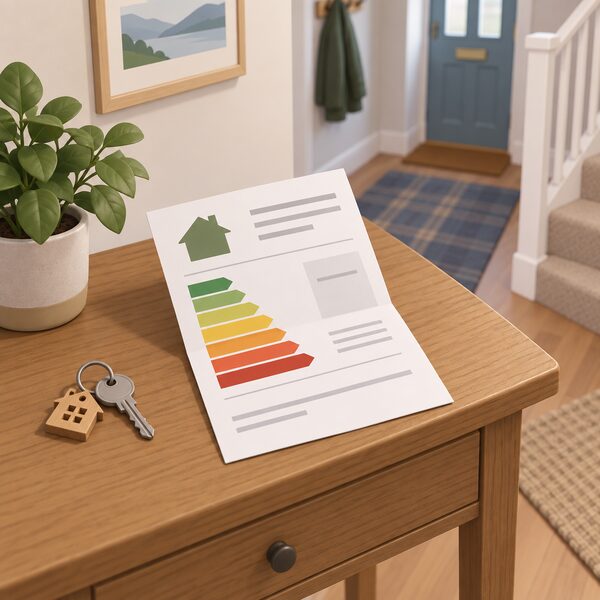
The requirement for EPCs was brought into force in Scotland via the Energy Performance of Buildings (Scotland) Regulations 200835. The Energy Performance of Buildings (Scotland) Regulations 2025 adopt the UK Government's new Home Energy Model as the calculation methodology for producing domestic EPCs in Scotland, and introduce new ratings for non-domestic buildings35. The plan is to bring the new regulations into force in the second half of 2026, to align with the introduction of the UK Home Energy Model calculation methodology36. That timing is conditional: the Scottish Government's EPC reform response records it as pending confirmation from the UK Government that the Home Energy Model will become available in the second half of 202637. A devolved reform is therefore gated on a reserved technical decision. See the Home Energy Model and EPC regulations and reform.
Private rented property
The Energy Efficiency (Private Rented Property) (Scotland) Regulations 2019 were new policy, aimed at improving the energy efficiency of the worst performing private rented sector housing to help reduce energy consumption and the emission of greenhouse gases38. The Energy Efficiency (Domestic Private Rented Property) (Scotland) Regulations 2020 shared that aim and formed part of the Energy Efficient Scotland Route Map launched in May 201812. The draft Energy Efficiency (Domestic Private Rented Property) (Scotland) Regulations proposed a prohibition on the letting of domestic properties which do not meet EPC HRR band C39. Minimum standards were to be introduced under Section 55 of the Energy Act 20119. The detail is covered on energy efficiency standards for privately rented homes in Scotland and housing quality standards.
New homes
The Scottish Government stated it would introduce new energy standards for new homes in 2021 and 2024, taking account of consultation responses23, and has legislated for clean heat in new homes40. That is a devolved building standards power exercised ahead of comparable change elsewhere in the UK: see Scotland's New Build Heat Standard and Scottish building standards and the building warrant system.
Owner occupiers
The Scottish Government has proposed a Heat in Buildings Bill to require homeowners in Scotland to meet a minimum energy efficiency standard by 203341. Until that Bill is enacted, owner occupiers face no domestic statutory efficiency standard, only the incentives of grants, loans and advice.
How Scotland differs from the rest of the UK
Scotland's average performance is comparatively strong. The House of Commons Library records the highest average energy efficiency rating in Northern Ireland, "followed by Scotland and England, with the lowest average rating in Wales"42. Consumption tells a different story: Scottish Government consultation material notes that the rate of energy consumption is still higher than elsewhere in the UK43, which is consistent with a colder climate and a stock that is varied in age and construction3.
| Dimension | Position in Scotland | Source |
|---|---|---|
| Average energy efficiency rating | Second highest of the four nations, after Northern Ireland | 42 |
| Rate of energy consumption | Higher than elsewhere in the UK | 43 |
| Heat policy | Devolved | 2 |
| Heat network consumer protection | Reserved to the UK Parliament | 2 |
| Warm Home Discount | Devolution arrangements under the Energy Act 2010 as amended by the Scotland Act 2016 | 8 |
| Domestic EPC methodology | Home Energy Model adopted, planned in force second half of 2026 | 35 |
Structurally, Scotland has run its own long-term efficiency programme. The Energy Efficient Scotland programme is a Scottish Government initiative aimed at improving energy efficiency in homes44, and its route map envisaged all domestic properties achieving EPC C by 2040 at the latest, where technically feasible and cost effective22. For fuel poor households, the Scottish Government committed to investing in Warmer Homes Scotland and Area Based Schemes to maximise the number of households in fuel poverty reaching energy efficiency equivalent to EPC C by 2030 and EPC B by 204045. Those dual dates, one for the stock and a tighter one for fuel poor homes, are a distinctively Scottish framing.
Comparisons with the other nations are set out on energy and buildings policy in Wales, building regulations in England and the Utility Regulator in Northern Ireland.
Consumer advocacy and the limits of a devolved voice
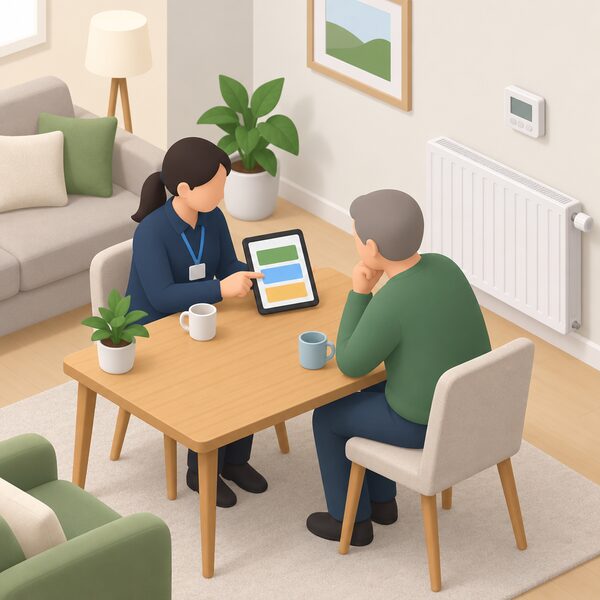
Scotland's Energy Strategy carries a commitment to "promote consumer engagement and protect consumers from excessive or avoidable costs, prevent new forms of social exclusion and promote the benefits of smarter domestic energy applications and systems"1. The energy consumer action plan built a framework around that, covering local energy through to electric vehicles, and explicitly aiming to influence change across Great Britain1. The choice of the word influence matters. Supplier licensing, tariffs and redress remain outside devolved control, so Scottish consumer policy works through advice, scheme design and advocacy rather than direct market regulation.
Advice is the largest single instrument. Home Energy Scotland is funded by the Scottish Government to provide impartial advice and support to fuel poor households covering all four drivers of fuel poverty46, and is described in local authority guidance as a free independent advice and referral scheme28 offering free impartial advice on energy efficiency and renewable energy in Scotland26. Loans have been used alongside it: the Home Energy Scotland Loan Scheme funded measures such as external or internal wall insulation, double glazing, boilers, warm air units and other forms of renewable technology for use in the home47, and the earlier Home Renewables Loans Scheme was delivered by the Energy Saving Trust48.
Ownership models have also been tried. Our Power was an energy supply company established by housing associations and local authorities in Scotland with the aim of reducing heat and fuel costs to the tenants in their communities49. It is no longer operating, and the general lesson for households is set out on supplier licensing and supplier failure. Where a household has a complaint about a supplier, the route runs through the reserved system described on energy complaints and redress.
What Scottish policy does, and does not, do for energy independence
Devolved policy acts on the parts of a home a household actually owns: the fabric, the heating system and, through planning and permitted development, the right to put equipment on the building. Grants and interest free loans for clean heating and energy efficiency28, area based insulation programmes targeted at fuel poor areas30, and a new build standard that legislates for clean heat40 all shift homes away from imported fossil fuel and towards electricity generated within Great Britain. Community ownership of renewable generation is supported through a dedicated scheme intended to keep benefits with people in Scotland31.
The dependencies that remain are real and worth stating plainly. Electrification transfers reliance from a gas supplier to the electricity network and the reserved market that prices it: the price cap, supplier licensing and redress are not Scottish instruments2. Scheme access depends on terms and conditions set by the Scottish Government rather than on statute, so eligibility can change and is not an entitlement a household can enforce32. The EPC reform that will govern how a home is rated depends on a UK Government methodology becoming available37. And the 2030 and 2033 efficiency standards in the strategy are qualified by technical and legal feasibility and cost-effectiveness6, which is where hard-to-treat homes, flats and traditional construction sit.
The honest position is that Scottish policy can make a house need less energy and take a different form of it. It cannot, within devolved competence, decide what that energy costs or who is licensed to sell it. For what the rules permit a household to do at home, see regulation and energy independence and permitted development rights for home energy equipment.
Sources49 cited
- Energy Consumer Action Plan, Scottish Government, 2019-05-15
- Heat networks briefing, House of Commons Library, 2026
- Energy efficiency in homes, Scottish Government, 2026
- Heat in Buildings Strategy, Scottish Government, 2021-10-07
- The Heat in Buildings Programme, Scottish Government, 2026
- Heat in Buildings Strategy: Fairer Scotland Duty assessment, Scottish Government, 2021
- Heat in Buildings Strategy consultation, Scottish Government, 2021-02-05
- Continuing the Warm Home Discount scheme: government response, UK Government, 2026-01-30
- Private rented property standards consultation, Scottish Government, 2026
- Microgeneration planning advice, Scottish Government, 2013-03-04
- Scottish Energy Strategy, Scottish Government, 2017-12-20
- EQIA: private rented sector regulations, Scottish Government, 2020-01-31
- Scottish House Condition Survey local authority tables 2022-2024, Scottish Government, 2022-2024
- Scottish House Condition Survey 2023 key findings, Scottish Government, 2023
- Energy efficiency in homes briefing CBP-9889, House of Commons Library, 2026
- Heat in Buildings progress report 2024, Scottish Government, 2024-10-10
- Heat in Buildings Strategy: business and regulatory impact assessment, Scottish Government, 2021
- Delivering net zero for Scotland's buildings: Heat in Buildings Bill consultation, Scottish Government, 2023-11
- Heat in Buildings Strategy consultation: investment, Scottish Government, 2021-02-05
- Helping households to manage their bills, Scottish Government, 2025-11-03
- Home energy efficiency briefing CBP-9585, House of Commons Library, 2026-05-13
- Energy Efficient Scotland route map, Scottish Government, 2018-05-02
- Tackling fuel poverty in Scotland: strategic approach, Scottish Government, 2021-12-23
- Home energy efficiency advice, Argyll and Bute Council, 2026
- Energy Efficient Scotland Area Based Schemes, West Lothian Council, 2026
- Domestic RHI: who to contact, Ofgem, 2026
- Financial help for energy efficiency and low carbon heating, City of Edinburgh Council, 2026
- Heat in Buildings progress report 2025, Scottish Government, 2025-10-02
- Warmer Homes Scotland headline data, Scottish Government, 2025-10-29
- Energy saving home improvements, Scottish Government, 2026
- Local and small scale renewables, Scottish Government, 2026
- FOI 202300391064, Scottish Government, 2024-05-15
- HES Grant and Loan Scheme processing times, Scottish Government, 2026-03-12
- HES Grant and Loan Scheme awards, Scottish Government, 2025-05-12
- Energy Performance of Buildings (Scotland) Regulations 2025: CRWIA, Scottish Government, 2025-10-10
- Scottish EPC register consultation, Scottish Government, 2025-10-13
- EPC reform consultation: government response, Scottish Government, 2025-01-21
- Energy Efficiency (Private Rented Property) (Scotland) Regulations 2019: EQIA, Scottish Government, 2019-06-17
- Consultation on draft Energy Efficiency (Domestic Private Rented Property) (Scotland) Regulations, Scottish Government, 2025-06-06
- Heat in Buildings Bill update from the Cabinet Secretary, Scottish Parliament, 2025-11-18
- Energy efficiency standards briefing CBP-8830, House of Commons Library, 2026
- Energy efficiency of homes briefing CBP-9889, House of Commons Library, 2026
- Permitted development rights programme: sustainability appraisal, Scottish Government, 2019-06
- Energy Efficient Scotland Transition Programme survey evaluation, Scottish Government, 2022-08-08
- Tackling fuel poverty in Scotland: continued investment, Scottish Government, 2021-12-23
- Tackling fuel poverty in Scotland: drivers, Scottish Government, 2021-12-23
- Green home loans, Scottish Government, 2017-05-02
- Microgeneration strategy for Scotland, Scottish Government, 2012-06-22
- A Scotland without fuel poverty is a fairer Scotland, Scottish Government, 2016-10-24
 The Full Rules and Regulation GuideConfused about who actually decides what you pay for gas and electricity, or why rules differ in Scotland and Wales?
 Energy Policy in WalesWhat help can you get in Wales to make your home warmer and cheaper to run?
 Devolution and Energy PowersLiving in Scotland, Wales or Northern Ireland can mean different grants and building rules for your home than in England.
 Devolved vs Reserved PowersWho decides what you pay for gas and electricity, and who decides how your home is insulated or improved?
 Community Energy in ScotlandCommunity energy in Scotland lets you join a local scheme for cheaper, greener heat and power, or get advice and funding to make your own home warmer and cheaper to run.
 Fuel PovertyHow does Scotland decide if a household is in fuel poverty, and how many homes are affected?