
In this guide
Going off grid is legal in the UK. No rule forces a household to remain connected to the electricity network, and no statute requires a home to buy gas or electricity from a licensed supplier. The regulatory position is permissive on the question of leaving, and the constraints that actually shape a household's energy independence sit elsewhere: in connection standards, certification requirements, metering rules and the consumer protections that only apply while a supply contract exists.
The practical answer is more nuanced than the legal one. A grid connection is not mandatory, but it enhances the value of a behind-the-meter system by enabling the export of surplus electricity1. That single sentence captures the trade-off. Independence from the grid is achievable; independence from the regulatory framework is not, because the framework follows the equipment, the installer and the money even when the wires are cut.
The short answer: going off grid is legal, but staying connected usually makes more sense
The legal position is straightforward. Nothing in the connection framework obliges a household to take a supply, and the Welsh Government's guidance on behind-the-meter energy systems states the position plainly: while not mandatory, a grid connection enhances the value of BTM systems by enabling the export of surplus electricity1. A household that disconnects keeps its generation and storage but loses the ability to sell or shift surplus power, and loses the resilience that a connection provides when generation is low.
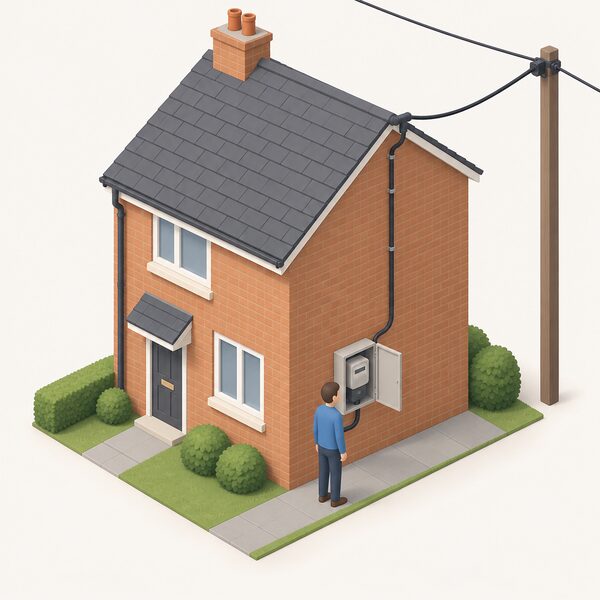
What a household cannot do is treat the meter as its own property. National Energy System Operator guidance is unambiguous: it is illegal to move the meter yourself, so the supplier must be contacted in the first instance2. That rule applies whether the household is staying connected or leaving, and it is the single most common point at which a self-generation plan meets a legal obstacle.
The dependence that remains after disconnection is worth stating firmly. A home that leaves the grid depends on its own generation, its own storage and its own maintenance, with no fallback. It also depends on the equipment manufacturer for spares and support, and on whatever app or cloud service the inverter or battery uses. Independence from the network is not independence from the supply chain.
What the law actually requires: no rule forces you to disconnect from the grid
There is no statutory duty to disconnect, and equally no statutory duty to stay. The obligations that bind a household are contractual and protective rather than connective. A supplier cannot cut off a supply where a payment plan has been agreed and kept to: all fuel suppliers, electricity and gas, follow a code of practice to that effect8. For domestic premises where an occupant has a medical condition meaning they need to receive, or may need to receive, a supply of heating or hot water throughout the year, disconnection for unpaid charges is prohibited at any time9.
Back-billing rules limit what can be recovered. Ofgem's rules mean a household does not have to pay for energy used more than 12 months ago where no accurate bill or statement of account was provided, or where a Direct Debit was set too low3. That protection applies to a connected home and is one of the concrete ways regulation improves the position of a household that is struggling, rather than constraining it.
The enforcement architecture behind these protections is statutory. GB non-domestic relief regulations may provide for civil penalties and for obligations to be enforceable as relevant requirements under section 25 of the Electricity Act 1989 or section 28 of the Gas Act 198611. For equipment, Regulation 12 places a duty on a manufacturer who considers, or has reason to believe, that electrical equipment placed on the market is not in conformity with Part 2 to take corrective measures immediately, including withdrawal of the equipment, in England, Wales and Scotland12.
"Traders cannot contract out of UK consumer law."
That last point matters for anyone buying generation or storage equipment. A warranty term that purports to remove statutory rights does not do so. There is, however, no statutory compulsory licensing scheme for builders in the UK, so the quality of installation work rests on certification schemes rather than on a licence13.
Grid connection standards G98 and G99: what they mean for home generation
Connection standards are where a household's generation meets the network operator's rules, and they are the clearest example of regulation shaping what is technically possible rather than merely permitted. Engineering Recommendation G98 Issue 2 Amendment 1, current for 2026, restricts plug-in solar to one device per household on the GB network6. That is a hard limit on a category of product that would otherwise be the simplest route to self-generation for a flat or a rented home.
The distinction between G98 and G99 turns on scale and type. G98 covers smaller, standard connections that can be notified after the event; G99 covers larger or non-standard connections that require prior approval from the network operator before the system is energised. The plug-in solar specification sits within the G98 framework, which is why the one-device limit is expressed as a network requirement rather than a product rule6.
For a household, the practical consequence is that the size and type of generation determines the administrative burden. A small, standard installation follows a notification route. A larger array, a battery with non-standard behaviour, or a connection that could affect network voltage follows an application route with a decision point before commissioning. The network operator, not the supplier, is the body that decides.
MCS certification: the quality mark your installation needs for incentives and compliance

MCS is an independent certification scheme for microgeneration installation companies and products14. Its scope is defined by size: microgeneration means small scale renewable technologies of 50kW or smaller4. Within that scope, MCS sets and maintains technical standards for installations and products, certifies installers and products against those standards, issues MCS certificates for completed eligible installations, and assists certification bodies in reviewing cases and consumer issues relating to installers or products14.
Certification is not optional where public money is involved. Installers under UK Government schemes must be TrustMark registered or MCS certified15. For the Boiler Upgrade Scheme specifically, all installations must be carried out by MCS-certified installers who are members of a consumer code approved by the Secretary of State5. Under the Feed-in Tariff scheme, eligible installations within Great Britain must either be MCS-certified or equivalent, or ROO-FIT accredited16.
The scheme also has a product side. MCS product certification ensures compliance with UK regulations and covers electrical technologies up to 50kW17. That is a compliance function, not a performance guarantee, and the distinction is developed below.
| Requirement | Applies to | Source |
|---|---|---|
| MCS certification or equivalent, or ROO-FIT accreditation | FIT eligible installations, Great Britain | 16 |
| MCS certification plus approved consumer code membership | Boiler Upgrade Scheme installations | 5 |
| TrustMark registration or MCS certification | Installers under UK Government schemes | 15 |
| MCS product certification, 50kW electrical limit | Microgeneration products | 17 |
What MCS certification does and does not guarantee
Certification guarantees that a standard was met at the point of design and installation. It does not guarantee that the system performs as predicted, and the scheme's own documentation is explicit about the gap. MCS requires installers to provide a design-stage prediction of system efficiency, not to verify actual performance18. It does not require remediation of systems that are underperforming relative to their design18.
Several specific requirements that a householder might assume are mandatory are not. Weather compensation is not mandatory under current requirements of the Microgeneration Certification Scheme18. Third party non-modulating controls are not prohibited18. On handover, MCS specifies handover documentation but not the quality of verbal explanation, household understanding, structured follow-up or ongoing support18.
"MCS does not require remediation of systems that are underperforming relative to their design."
The practical reading is that certification is a floor, not a ceiling. It establishes that the installer is certified, that the product is certified, and that a design-stage prediction exists on paper. It does not establish that the household will be warm, that the predicted efficiency will be achieved, or that anyone will return if it is not. A household seeking more than that is relying on the installer's own terms, on a consumer code, or on the general law.
Consumer protection if an installation goes wrong

The routes for redress depend on what went wrong and under which scheme the work was funded. MCS is the contact for issues with the installation process, the installer, or an MCS certificate or product19. For Energy Company Obligation installations, complaints follow Ofgem's dedicated complaints process20. Where a Feed-in Tariff is involved, the Energy Ombudsman can consider complaints about obligated electricity suppliers that do not follow the rules set by Ofgem21.
The Energy Ombudsman is approved by Ofgem, the UK energy regulator, to handle service disputes in the energy sector22. Its scope covers consumer complaints about energy bills, mis-selling, problems with energy supply and problems with switching supplier23. That is a broad remit, but it is a supplier-facing one: it addresses the commercial relationship, not the technical quality of an installation.
Enforcement against installers has teeth in the government schemes. The Welsh Government has taken immediate action to suspend installers and protect consumers under the GBIS scheme24. A proposed consumer protection service would have powers to enforce better service through contracts that hold installers and delivery partners to account, including bans from working on Government schemes if they do not meet high standards25.
For heat networks, a separate regime applies. Ofgem regulation aims to prevent suppliers from back-billing heat network consumers for heating, cooling or hot water for more than 12 months prior to the date of the bill, in circumstances where the customer is not at fault27. That mirrors the domestic back-billing protection and extends it to a category of supply that is not covered by the standard supplier licence.
The regulatory timeline: efficiency rules and the phase-out of gas boilers
The direction of travel for heating is set, but the dates differ by nation and by fuel. In England, the UK Government has consulted on exempting certain households from the phase out of fossil fuel boilers, including gas, in 203528. The same consultation proposed delaying the ban on installing oil and LPG boilers, and new coal heating, for off-gas-grid homes from 2026 to 203528.
Scotland has taken a different path. The Bute House Agreement set out phasing out the need to install new or replacement fossil fuel boilers in off gas areas from 2025 and in on gas areas from 203030. The Energy Performance of Buildings (Scotland) Regulations 2025 make provision under sections 1(1) and 49(1) of the UK Withdrawal from the European Union (Continuity) (Scotland) Act 2021 and sections 250 and 331(2) of the Energy Act 202331.
| Nation | Measure | Date |
|---|---|---|
| England | Fossil fuel boiler phase out, with exemptions consulted on | 203528 |
| England | Oil, LPG and new coal heating ban for off-gas-grid homes, delayed | 2026 to 203528 |
| Scotland | Fossil fuel boiler phase out, off gas areas | from 202530 |
| Scotland | Fossil fuel boiler phase out, on gas areas | from 203030 |
The dates are proposals and consultation positions rather than settled law in every case, and the England and Scotland timetables do not align. A household in an off-gas area of England faces a different deadline from one in an off-gas area of Scotland, and the exemptions consulted on in England have no direct equivalent in the Scottish timetable.
What regulation means for household energy independence

Regulation cuts both ways, and the balance differs by what a household is trying to do. On generation, the framework is enabling: permitted development rights have been widened, with the solar strategy increasing non-domestic permitted development rights for non-domestic solar panels to 1 megawatt, up from 45kW, in England32. On connection, the framework is permissive but bounded, with the plug-in solar limit of one device per household the clearest example of a rule that caps what a home can install6.
On heating, the framework is directional. The phase-out dates for fossil fuel boilers set the outer boundary of a household's choices, and the exemptions consulted on in England acknowledge that not every home can make the transition on the same timetable28. Scotland's earlier dates for off gas areas create a different planning horizon north of the border30.
The dependence that remains is layered. A household that generates its own electricity still depends on the network for export value and for backup, on a supplier for billing and settlement, on a manufacturer for equipment and spares, and on a certification body for the paperwork that unlocks incentives. Going off grid removes the first of those dependencies and leaves the rest intact. The regulatory framework is not the obstacle to energy independence; it is the structure within which independence is defined, measured and, where things go wrong, enforced.
Sources32 cited
- Behind-the-meter energy systems guidance, Welsh Government, 2026
- Domestic and homeowners connections guidance, National Energy System Operator, 2026
- What to do if you get a back bill, Ofgem, 2026
- Warm Homes and Social Housing Fund wave 3 addendum, Department for Energy Security and Net Zero, 2026
- Boiler Upgrade Scheme guidance for property owners, Ofgem, 2026
- Plug-in solar interim product specification, Department for Energy Security and Net Zero, 2026
- The Electricity (Northern Ireland) Order, Article 27, legislation.gov.uk, 2012
- Overdue utility bills, nidirect, 2026
- Heat networks consumer protection draft guidance, Ofgem, 2025
- What to do if you get a back bill, Ofgem, 2026
- Energy Prices Act 2022, legislation.gov.uk, 2022
- Electrical Equipment (Safety) Regulations, Regulation 12, legislation.gov.uk, 2016
- Consumer protection and the off-grid market, House of Commons Library, 2026
- Boiler Upgrade Scheme, Ofgem, 2026
- Consumer protection in home energy schemes, House of Commons Library, 2026
- Feed-in Tariffs guidance for licensed electricity suppliers, Ofgem, 2021
- Certifying your product, MCS, 2026
- Heat pump transition report, Department for Energy Security and Net Zero, 2026
- Domestic Renewable Heat Incentive contacts, Ofgem, 2026
- Energy Company Obligation contacts and guidance, Ofgem, 2026
- Feed-in Tariffs, Energy Ombudsman, 2026
- Frequently asked questions, Energy Ombudsman, 2026
- Problems with services, Isle of Anglesey County Council, 2025
- Written statement on GBIS and ECO4, Welsh Government, 2025
- Energy market consumer protection debate, Hansard, 2026
- Boiler Upgrade Scheme guidance for installers, Ofgem, 2026
- Heat networks regulation consumer protection decision, Ofgem, 2026
- Delivering net zero for Scotland's buildings, Scottish Government, 2023
- Heat in Buildings Bill consultation, Scottish Government, 2023
- Heat in Buildings Bill regulatory impact assessment, Scottish Government, 2023
- The Energy Performance of Buildings (Scotland) Regulations 2025, legislation.gov.uk, 2025
- Permitted development rights impact assessments, Scottish Government, 2026
 The Full Energy Independence GuideCan you really run your home on your own power in the UK, and how far can that go before the grid still matters?
 Energy Security for HouseholdsCan a household really protect itself from gas and electricity price shocks, and what actually makes a difference?
 Tech and Energy IndependenceAssesses which technologies in development would genuinely increase a household's control over its own energy, and which deepen dependence on suppliers, networks or cloud services.
 Energy IndependenceHow the choice of installer or retailer shapes a household's long-term control over its energy system, from certification and consumer codes to spare parts, servicing access and what happens when a firm stops trading.
 Grants and Energy IndependenceCan you get a grant for solar panels or a battery?
 Cooling and Energy IndependenceExplains how passive measures, efficient cooling and on-site generation reduce a household's dependence on grid electricity in summer.