
In this guide
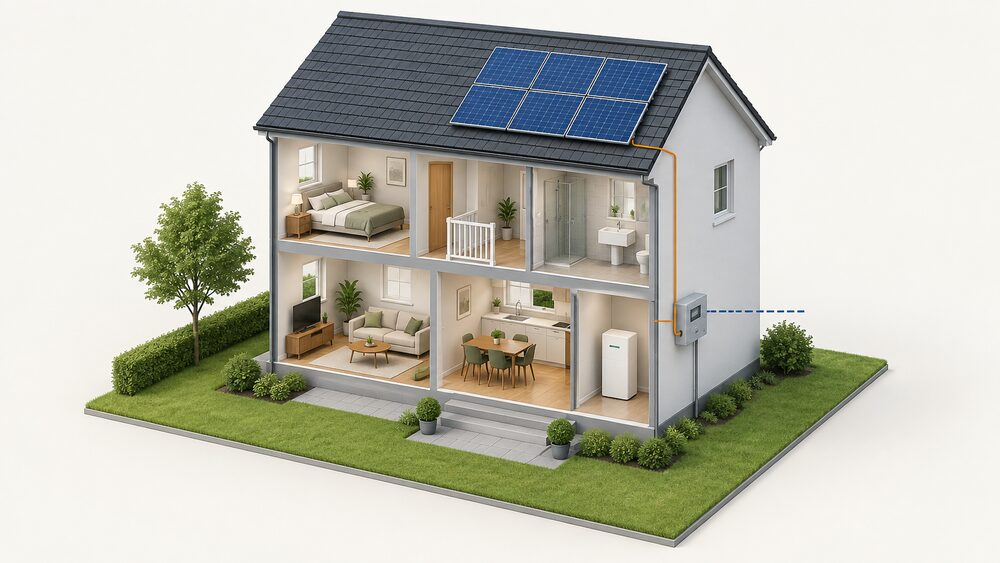
A behind-the-meter energy system is any generation, storage or flexible load installed on the customer's side of the electricity meter. The meter is the boundary. Everything upstream of it belongs to the network and the supplier; everything downstream belongs to the site. Welsh Government guidance defines behind-the-meter (BTM) systems as "localised energy solutions installed at a specific site, typically featuring on-site generation like rooftop solar PV, often paired with battery storage"1.
The definition has a hard edge: BTM systems "fundamentally require on-site generating technology"1. A battery on its own, charged from the grid, is a behind-the-meter asset but not a behind-the-meter generating system, and the distinction matters for what the metering has to do and what the household can claim.
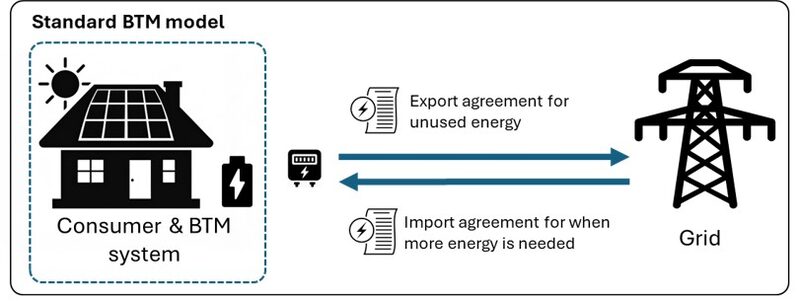
The practical consequence is that the boundary decides what is measured, what is charged and what is paid for. Electricity generated and consumed on the domestic side of the meter never crosses a settlement boundary, so it is never bought at retail price and never sold at export price. A grid connection is not mandatory, but it "enhances the value of BTM systems by enabling the export of surplus electricity"1. Independence, in this framing, is a matter of how much of the meter's import a household can avoid, and how much of the surplus it can move across the boundary on favourable terms.
What a behind-the-meter energy system is
The term describes a location, not a technology. A BTM system sits at a specific site, behind the meter that records the site's import and export, and it can be assembled from several components: a generator, a store, a controllable load, or a combination. Welsh Government guidance, first published on 29 June 2026 and last updated on 28 July 2026, sets out the definition and the regulatory frame around it1.
The electricity generated is "primarily used on-site"1. That is the whole point of the arrangement. A unit of electricity consumed in the kitchen has avoided a unit bought at the retail rate, including its network and policy costs. A unit exported has been sold at whatever the export arrangement pays. The gap between those two values is the economic engine of every behind-the-meter decision, and it is why smart energy management is built to "prioritise on-site use of generated electricity"1.
The boundary also determines who can see what. Smart meters record energy use automatically in half-hour periods, which is what allows accurate billing and time-based products3. Behind the meter, the household's own monitoring sits on the domestic side and is not part of settlement. In front of the meter, the distribution network operator can access smart meter data for "regulated purposes" only, and must agree a privacy plan with Ofgem before doing so4.
For a household, the useful mental model is a line drawn through the meter. Generation and storage on the domestic side reduce import. Anything that crosses the line becomes a transaction with a supplier or the network. The rest of this page works through what sits on each side of that line, what it costs, and what it delivers for independence.
On-site generation: the technology every system needs
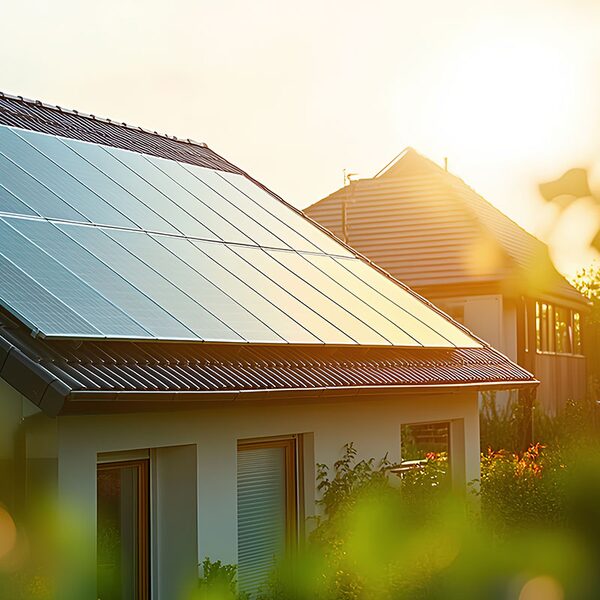
Generation is the non-negotiable element. Without it, a site has storage and control but nothing to store except purchased electricity, and the guidance is explicit that BTM systems "fundamentally require on-site generating technology"1. In UK domestic practice that generator is almost always a photovoltaic array, though the same rules cover wind turbines and other renewable technologies5.
Building regulations now push generation into the fabric of new homes. Approved Document L requires on-site renewable electricity generation systems capable of "generating a reasonable output taking account of the building's design and surroundings", and designed to make generated electricity "available for the use of residents of the dwellings"6. The requirement applies to new buildings containing dwellings. Where an existing dwelling replaces an on-site generator, the consultation version of the guidance states the new system should have a kWp output "at least that of the original installation"5.
The metering follows the generation. For installations under the Feed-in Tariff, a generation meter must be able to calculate the electricity generated by the installation separately from any other energy source, unless pro-rating is available7. Where an installation exports all its electricity, a separate generation meter is not required, but a compliant export meter is8. Those rules belong to a legacy scheme, but they encode the principle that applies to any metered arrangement: the meter has to be able to tell the installation's output apart from everything else on site.
For the household, generation is what converts a passive electricity account into a producing asset. It is also the element most exposed to the building itself: roof orientation, shading and structural condition set the ceiling on output long before any equipment choice does. The self-consumption rate then decides how much of that output is worth retail price rather than export price.
Battery storage, heating and EV charging: what pairs with it
BTM systems are "adaptable, integrating with technologies like battery storage, heating and Electric Vehicle (EV) charging"1. Each of those additions changes the shape of the household's demand rather than the amount of generation available, and each has its own metering consequence.
| Addition | What it changes | Metering condition |
|---|---|---|
| Battery storage | Moves generation from midday to evening | Must sit on the domestic side of the utility meter9 |
| EV charging | Adds a large, schedulable load | May be added to an accredited installation without affecting accreditation, if metering criteria still met7 |
| Heating (heat pump) | Adds a large, schedulable load | Same separate-measurement condition applies7 |
Battery storage is the most common pairing. MCS defines an electrical energy storage system as one "installed within the same domestic electrical system as the solar PV system and loads i.e. on the domestic side" of the utility meter9. That is the behind-the-meter position stated as an installation standard. For accredited Feed-in Tariff installations, battery storage or an EV charging station "may be added to an installation without affecting its accreditation", provided the installation continues to comply with the metering criteria7. The condition is the important part: the meter must still be able to measure the amount of electricity generated or exported by the installation separately from any other source, unless pro-rating is allowable7.
Heating and EV charging are the two loads large enough to absorb a home's generation rather than export it. Smart metering is described as a bridge for the energy system and as central to tariff and consumption arrangements, with a shift visible in the installation of behind-the-meter assets including EVs, vehicle-to-grid batteries and heat pumps10. In practice, a heat pump or an EV charger turns a modest solar array from an exporter into a self-consumer, because both can be scheduled into the middle of the day.
The independence question here is about control. A battery keeps the value of generation inside the house. A heat pump or EV charged from the roof does the same for two of the largest loads in a home. What none of them remove is the reliance on the grid for the residual, on a supplier for the import tariff, or on a manufacturer's app and cloud service for scheduling and monitoring, which is the subject of local control versus the manufacturer's cloud.
Grid connection: not mandatory, but it unlocks export
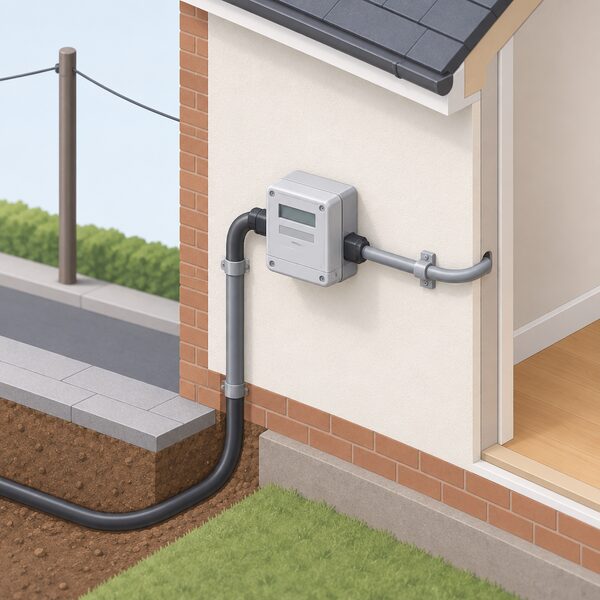
A grid connection is optional. The guidance is clear that it is "not mandatory" but that it "enhances the value of BTM systems by enabling the export of surplus electricity"1. A household can install generation and storage and never export a unit. What it gives up is the revenue, and the resilience argument cuts both ways: a connected system is subject to the network's operating rules, while an unconnected one has to size storage for the worst week of the year.
Where export happens, the metering has to be right. An export meter is "always located at the point where the installation connects into the distribution or transmission network" and must measure export separately from any other energy source, unless pro-rating is available7. Where a shared meter is an export meter and pro-rating is available, the electricity exported can be accurately measured, but deemed export payments are not available7. That is a real trade-off for anyone sharing a supply.
The connection itself is a network matter. Electrical grid connection requires approval from the distribution network operator11. Small systems usually only need the electricity network operator to be notified, while larger systems, over 3.68kW, "will usually need the DNO's approval before they can be connected to the grid"1. The threshold is a connection threshold, not a cap on generation for on-site use, and it is the single most commonly misunderstood number in domestic installation.
For independence, the grid connection is best understood as an option rather than a dependency. It converts surplus into income and provides the backup that lets a system be sized for average rather than worst-case conditions. The cost is exposure to network approval, to supplier export arrangements, and to the fact that a connected inverter will normally shut down in a power cut, which is covered in islanding and anti-islanding.
Smart energy management and exporting surplus
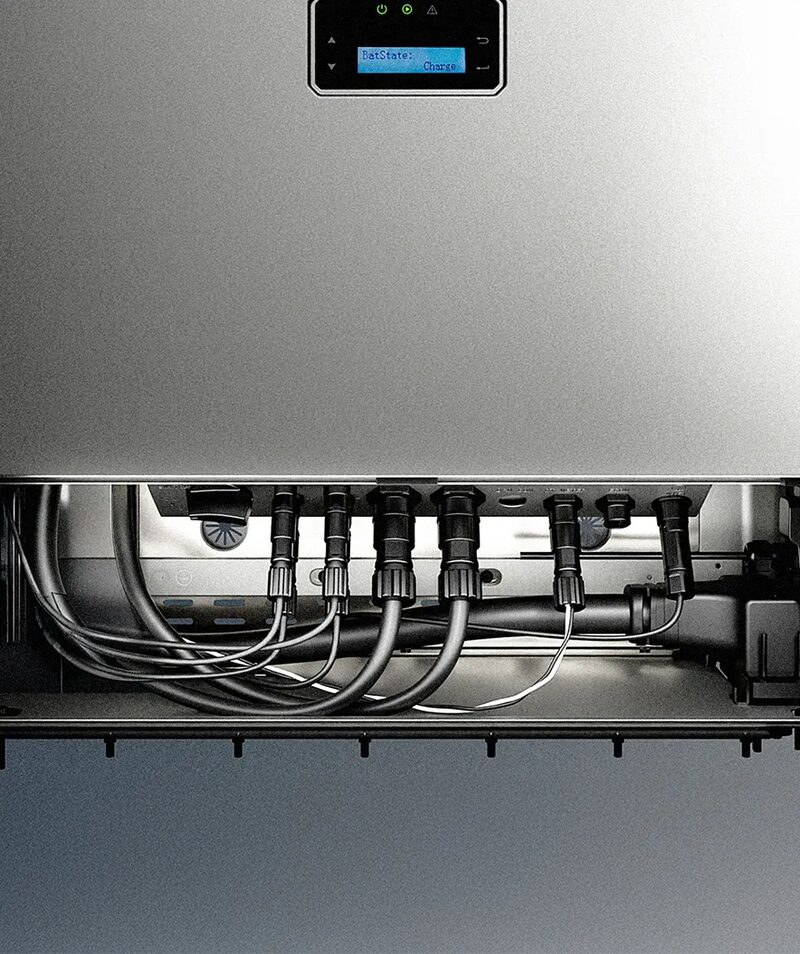
Smart energy management is the control layer that decides, moment by moment, whether a unit of generation is used on site, stored, or exported. The guidance describes systems that "use smart energy management to prioritise on-site use of generated electricity", and notes that surplus energy "can often be exported"1. The ordering is deliberate: on-site use first, export second.
That ordering reflects the value gap. Self-consumed electricity avoids a retail purchase; exported electricity earns an export payment. The control layer exists to keep as much generation as possible on the first side of that gap, and to shift flexible loads into the hours when generation is highest. Smart meter data supports this: it is used to bill for energy used, to offer new products and services such as new tariffs where permission has been given, and to help make the energy system more efficient by recording demand more accurately12. The DCC network allows smart meter data to be shared securely between authorised users, supporting smart energy services across the sector13.
The limits are worth stating. Control depends on the meter, the communications and the platform. A system whose scheduling lives in a manufacturer's cloud is only as independent as that service, and a household that changes supplier or tariff may find the optimisation logic no longer matches the product it was built around. The energy data ownership question sits underneath all of this.
Where it fits: domestic and commercial settings
BTM systems suit "both domestic and commercial buildings"1. The physics is the same; the scale, the metering and the approval route differ. A domestic installation is typically a single-phase array with a battery, notified to the network operator. A commercial site may have three-phase supply, larger arrays, and a metering arrangement built around half-hourly settlement.
Domestic electricity consumption statistics classify meters with a profile class of 1 or 2 as domestic meters in Great Britain14. That classification is how the industry separates the domestic segment, and it is the segment most of the consumer-facing rules address. Any household that pays for energy, whether owning or renting, should be able to book a smart meter installation where it is expected to work in the property3. Smart meters are accompanied by an in-home display, a portable touchscreen device showing near real-time energy usage data15.
For domestic batteries supported under the Warm Homes: Social Housing Fund, the scheme guidance requires that the battery is installed where there is a functioning electricity smart meter, or installed alongside one if one is not already present17. That condition ties storage support to metering capability, and it is a useful signal of where policy expects the boundary to be measured.
The independence picture differs by setting. A domestic household with a battery and a smart meter can shift load and reduce import, but remains dependent on the grid for winter and on a supplier for the tariff that makes the battery worthwhile. A commercial site with the same technology has more load to absorb generation and more scope to contract directly, but also more regulatory surface. In both cases the meter remains the point at which the site meets the system.
Permissions and network approval: what you need before installing
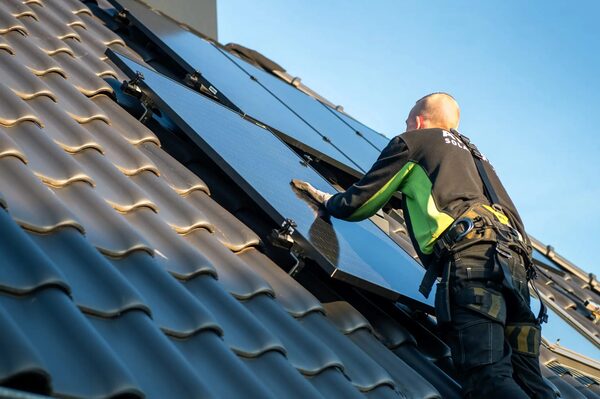
Two separate approvals can apply: planning permission from the local authority, and connection approval from the distribution network operator. The guidance notes that BTM systems "may be subject to certain regulatory requirements, such as permission from planning authorities and District Network Operators"1.
On planning, the installation of BTM equipment "typically falls under permitted development"1. Solar equipment on domestic premises can be installed or altered under permitted development rights subject to prior approval, and the same applies to non-domestic premises18. Where solar equipment is to be installed on a flat roof on Article 2(3) land, the developer must apply to the local planning authority for prior approval18. Ground source heat pump installation within the curtilage of a house or block of flats does not require planning permission, but listed building consent may be required if the property is listed19. Prior approval is a separate consent route that some permitted development rights require, and it is not the same as a full planning application20.
On the network, the threshold is the operative fact. Small systems usually only need the electricity network operator to be notified; larger systems, over 3.68kW, will usually need the DNO's approval before connection1. Applications covering installations over 3.68kWp require prior approval from the DNO and fall outside the scope of the smaller-scale route21. Guidance for larger installations exceeding 3.68kWp directs applicants to "apply to connect" and to a G99 application22.
Scotland has its own legislative track. The draft Buildings (Heating and Energy Performance) and Heat Networks (Scotland) Bill includes provision for heat network zone requirements, including requirements that buildings within a heat network zone, other than buildings in which no direct emission heating system is used, be connected to a district heat network23. It also provides for a zone co-ordinator to issue a notice requiring information about a source of thermal energy located on premises that may be suitable to supply a district heat network23. Those powers sit alongside, not instead of, the planning and connection rules above.
Battery-only systems: cost, savings and payback
A battery without generation is a different proposition from a battery paired with solar, and the evidence is blunt about it. Independent guidance states that not many people run a battery-only setup, "as the savings you get are unlikely to pay off the cost of the battery"2. That is the central fact for anyone considering storage as a standalone purchase.
The reason is structural. A battery without generation cannot create a unit of electricity; it can only move one in time. The saving is the difference between the price paid to charge and the price avoided at discharge, minus round-trip losses. That spread depends entirely on the tariff. Independent guidance points battery-only households to "either a dynamic tariff or Economy 7"2. A dynamic tariff exposes the household to half-hourly price movement; Economy 7 gives a fixed cheap overnight window. Both require the household to charge at the cheap time and discharge at the expensive one, reliably, for years.
Where solar is present, the tariff picture widens. A dedicated solar and battery tariff is designed for the combination, and a good export tariff matched with a dynamic import tariff or an Economy 7 tariff is the alternative2. For a household with a heat pump, solar panels and a battery, a solar and battery tariff is worth considering if a good export rate is not available from a company with a good import tariff, especially where the solar system is bigger than average or the heat pump smaller than average2.
On payback, the only published test in the material is a building regulations economic feasibility test: a measure passes if it achieves "a payback of the initial cost within 15 years through energy savings"5. That is a regulatory threshold for assessing measures, not a forecast for any particular battery, and it should be read as such. Prices for domestic batteries are installer-quoted, and no published figure is available here.
Grid-tied storage versus going off-grid
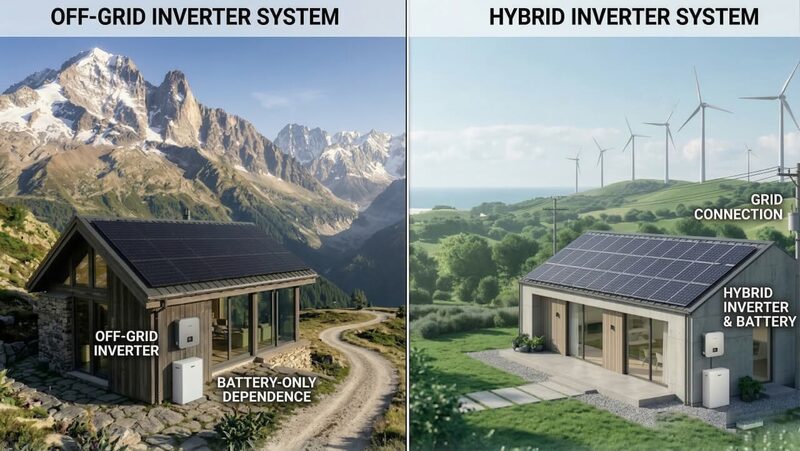
The choice between staying connected and disconnecting turns on what the household is trying to achieve. A grid-tied system keeps the connection as a backup and an export route, and sizes storage for daily cycling rather than seasonal survival. An off-grid system has to cover the worst case, which in the UK means winter, and the winter gap is the constraint that drives everything else.
The measurement that separates the two is the self-sufficiency ratio. MCS defines grid electricity independence or self-sufficiency as "the percentage of electricity consumed in the property over a year which is met by either behind the meter solar or electrical energy storage"9. That definition is useful because it counts only behind-the-meter supply, and it is annual, which means a system can score well on the ratio while still importing heavily in December and January.
| Grid-tied | Off-grid | |
|---|---|---|
| Storage sized for | Daily cycling | Worst week of the year |
| Export route | Available | None |
| Backup | The grid | Own equipment only |
| Residual dependence | Network, supplier, tariff | Manufacturer spares, monitoring platform |
A grid-tied household can improve that ratio with generation, storage and load shifting, and can keep the connection as the residual supplier. An off-grid household has to hold enough storage and enough generation to cover the worst week without any import at all, which changes the sizing calculation completely. The sizing question is where the two paths diverge most sharply.
What remains dependent in either case is worth naming. A grid-tied home depends on the network for backup and on a supplier for the tariff that makes storage worthwhile. An off-grid home depends on its own equipment, on a manufacturer for spares and support, and often on a cloud service for monitoring and control. Neither path removes dependence; they move it. The full guide to household energy independence sets out how those dependencies stack up across generation, storage, heat and transport.
Sources23 cited
- Behind-the-meter energy systems guidance, GOV.WALES, 2026-07-28
- Tariffs for renewable technology, Energy Saving Trust, 2026-08-12
- Smart meters: your rights and expectations, GOV.UK, 2025-08-08
- Data protection and smart meter data, Open Energy, 2026-09-20
- Approved Document L Volume 1 consultation version, GOV.WALES, 2026-09-17
- Approved Document L Volume 1: Dwellings, GOV.UK, 2026
- Guidance for FIT Generators V18, Ofgem, 2026-04-01
- FIT Guidance for Licensed Electricity Suppliers V17.1, Ofgem, 2024-09-06
- MCS 032 2025 V1.0, MCS Certified, 2025-01-01
- How smart can a smart meter be in the connected home, Smart DCC, 2024
- Generating your own energy: solar electricity, GOV.WALES, 2018-09
- Get help with your smart meter, Ofgem, 2026-09-17
- How do smart meters help the environment, Smart DCC, 2026
- Domestic electricity consumption indicator, Office for National Statistics, 2025-12-18
- Smart meters and decarbonisation, Smart DCC, 2026
- Get help with your smart meter, Ofgem, 2026
- Warm Homes: Social Housing Fund wave 3 scheme guidance addendum, GOV.UK, 2026-06
- Planning permission: solar equipment mounted on a house or a block of flats or on a building, Planning Portal, 2026-09-17
- Heat pumps, New Forest District Council, 2026-09-17
- Prior approval, Planning Portal, 2026-09-17
- Notice builder file download, Sell2Wales, 2026-06-15
- Building regulations renewables guidance, Bedford Borough Council, 2026-09-17
- Draft Buildings (Heating and Energy Performance) and Heat Networks (Scotland) Bill, Scottish Government, 2025-11-18
 The Full Smart Meters GuideDo smart meters really save you money, and how do you use one to cut your bills?
 Baseline Your Energy UseBefore spending money on a heat pump, solar panels or a battery, you need to know what your home actually uses now.
 Sizing a System With DataWhat does your smart meter data actually show about how your home uses power?
 Take Control of Your EnergyHow do you read your own energy use and keep hold of your meter readings?
 Who Owns Your Home Energy DataYour smart meter records how much gas and electricity you use, and that information belongs to you, not your supplier.
 Meters and Energy IndependenceDo smart meters really save you money, and can you still get one fitted for free?