In this guide
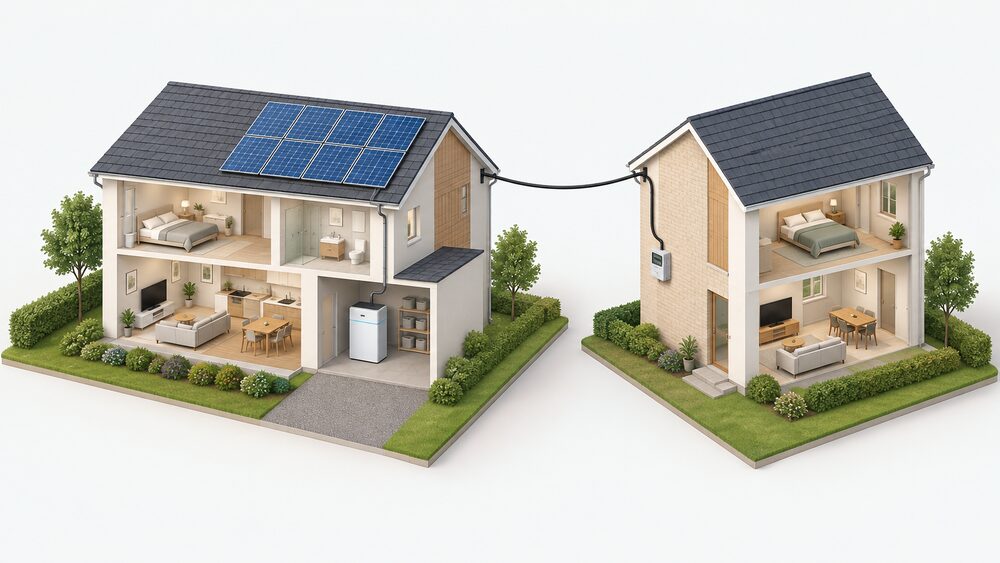
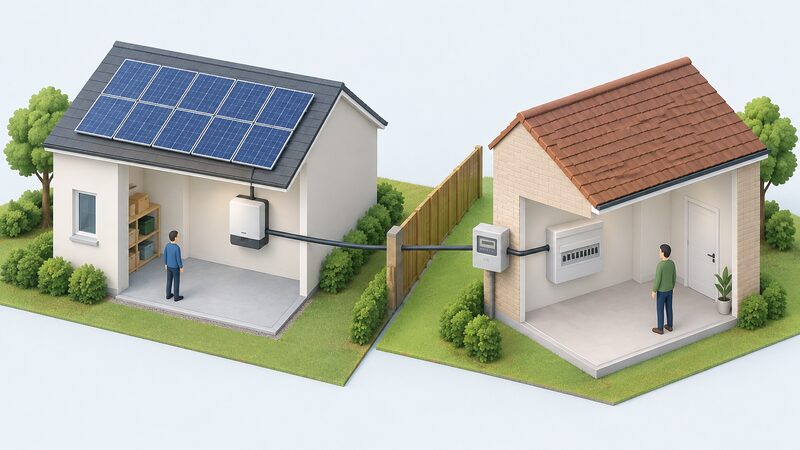
A private wire is a physical electrical connection that carries electricity from where it is generated to where it is used, without passing through the public distribution network. The generation and the consumption sit on the same site or on adjacent sites, and a Private Wire Power Purchase Agreement governs the terms of the electricity transfer between them1. The wire itself is the whole point: it is what allows a generator to serve a nearby building directly rather than selling into the grid and buying back at retail.
The arrangement sits inside a wider category that official guidance calls behind-the-meter energy systems: localised energy solutions installed at a specific site, typically featuring on-site generation such as rooftop solar PV, often paired with battery storage, and used in both domestic and commercial buildings1. A grid connection is not mandatory for such a system, but it enhances the value by enabling the export of surplus electricity1. That single sentence frames the trade-off for every household considering a private wire: independence from the public network is possible, and it costs the export route.
What follows is the regulatory and practical picture for a UK household or community group. The licensing position is the hardest part, the planning and network consent rules are the most commonly missed, and the funding landscape for community schemes has moved recently.
What a private wire network is: electricity supplied directly to another building
A private wire is best understood as the physical layer of a direct supply arrangement. Official guidance is explicit that a physical electrical connection is required to transfer the electricity between where the energy is generated and where it is consumed, and that a Private Wire Power Purchase Agreement governs the terms of that transfer1. The wire and the contract are separate things, and both are needed.
The generation side is usually on-site renewable technology. Behind-the-meter systems fundamentally require on-site generating technology, and they use smart energy management to prioritise on-site use of generated electricity1. That priority matters for a private wire: the more generation is consumed where it is produced, the less needs to be moved, metered and accounted for. Where a solar array is the source, the wiring includes a converter to convert the direct current electricity from the panel to alternating current so it can be connected to the building's main electricity distribution board3.
The closest regulated analogue is a heat network, and the comparison is instructive. Heat networks are described in official guidance as natural monopolies, where one entity is the supplier for all homes and businesses on the network4. A private wire electricity arrangement creates a similar relationship on a smaller scale: the household on the far end of the wire has one source for the power it takes, and the terms are set by the agreement rather than by a competitive market. Heat networks operated on a not-for-profit basis can be classed as domestic supply, and so covered by the price cap, under certain circumstances5. That precedent is worth knowing because it shows how a shared local supply can attract consumer protection, but it applies to heat, not to private wire electricity.
For a household, the independence gain is real but bounded. A private wire removes the public network from the path between generation and use, which cuts transmission and distribution charges on the units that travel down it. What remains is dependence on the generator on the other end of the wire, on the terms of the agreement, and on the physical cable itself.
How private wires fit behind the meter: on-site generation as the foundation
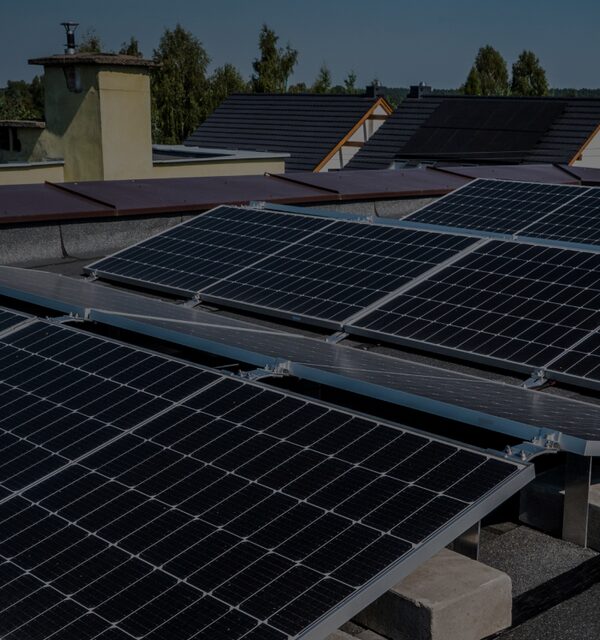
Behind-the-meter systems are the category a private wire belongs to, and the guidance describing them is the clearest official statement of how the pieces fit. Such systems are localised energy solutions installed at a specific site, typically featuring on-site generation like rooftop solar PV, often paired with battery storage, and they serve both domestic and commercial buildings1. The private wire is the mechanism that extends the site boundary to include a second building.
The logic of behind-the-meter operation is that generation is consumed before it reaches any meter that a supplier reads. Smart energy management prioritises on-site use of generated electricity1, which is the same principle that drives household self-consumption. A private wire simply applies that principle across a property boundary rather than within one building. The self-consumption page sets out how much of a household's own generation is typically used on site, and the same arithmetic governs how much a private wire needs to carry.
Metering is where the arrangement becomes commercial. The public network's meters are not involved in the units that travel down a private wire, so the parties need their own measurement and their own settlement. The wider metering landscape is changing: smart meters are now installed in half of UK properties6, and electricity meters with a profile class of 1 or 2 are classified as domestic meters7. Neither fact determines how a private wire is metered, but both show that the metering infrastructure a household already has is designed around supplier relationships, not around direct local supply.
The foundation, then, is generation on site, storage where it helps, and a wire to the building that will use the power. Everything else, licensing, planning, network consent, follows from that physical arrangement. A household that already has rooftop generation and a battery has most of what a private wire needs; what it does not have is a legal route to sell to a neighbour without care.
Licensing: why selling power locally is difficult for smaller generators
Supplying electricity is a licensed activity, and the licence regime is built for suppliers serving many customers, not for a generator serving the building next door. The clearest recent illustration of how the regime works is the grant of an electricity supply licence to Tesla Energy Ventures Limited, authorising it to supply electricity to domestic and non-domestic consumers in Great Britain, with the licence applying to electricity supply activities in Great Britain only8. A company that wants to sell power to homes and businesses needs that licence, and the process is a formal one.
The exemptions that matter for small generators are narrow. Microgeneration is defined in legislation by an electricity capacity limit of 50 kilowatts9, and the Feed-in Tariff scheme, now closed to new applicants, spread its costs across all licensed electricity suppliers in Great Britain through the levelisation process, based on their share of the electricity supply market10. The Smart Export Guarantee enables small-scale low-carbon electricity generators in Great Britain to receive payments from licensed suppliers11. Both schemes route small generators through licensed suppliers rather than allowing them to sell directly, which is the structural reason local selling is difficult.
The plug-in solar consultation makes the boundary vivid. At present, solar plug-in microgenerators cannot be legally sold, supplied, or used in the UK due to constraints arising from existing product safety legislation12. That is a product safety constraint rather than a licensing one, but it shows how many separate regimes a small generator has to satisfy before its output can reach another party.
"At present, solar plug-in microgenerators cannot be legally sold, supplied, or used in the UK due to constraints arising from existing product safety legislation"
For a household, the practical position is that a private wire serving buildings under the same ownership or control is a different proposition from a private wire selling power to a third party. The local energy supply page covers the arrangements that have grown up around local selling, and the peer-to-peer energy trading page covers the trading models. Neither removes the need to establish whether a supply licence or an exemption applies to a particular scheme.
Grid connection: not mandatory, but it changes what a private wire is worth
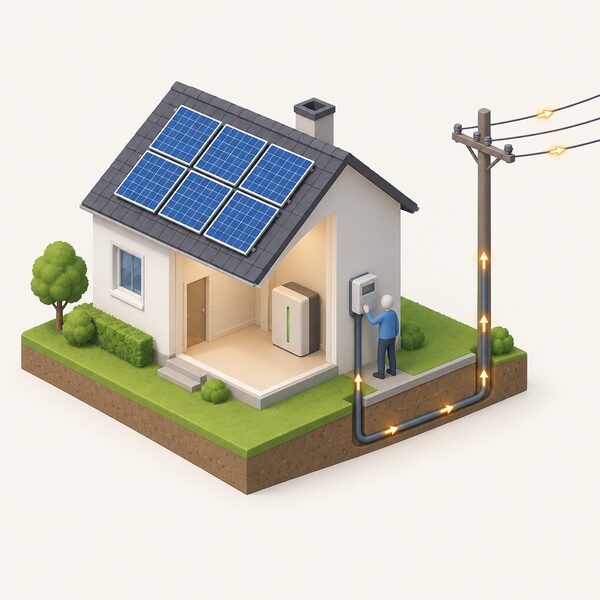
The single most useful sentence for anyone weighing a private wire is that a grid connection is not mandatory, but it enhances the value of behind-the-meter systems by enabling the export of surplus electricity1. A private wire can operate without any connection to the public network. What it loses is the ability to sell what it does not use.
That loss has a price, and the price cap gives a sense of the retail value of a unit. For 1 October to 31 December 2025, the South East cap level was £165.45 at nil consumption and £960.22 at 3,100 kWh on a single-rate tariff, with £166.99 and £1,194.07 for the multi-register annual figures on the Other Payment Method13. In North Wales and Mersey the same period shows £272.95 at nil consumption and £1,136.66 at 3,100 kWh single-rate, with £272.72 and £1,386.93 for the multi-register annual figures on Standard Credit13. 22 and £935.82 in the same source, and on the corresponding multi-register figure, which appears as both £1,194.07 and £1,162.60. Both sets of figures are given here because the conflict is unresolved.
The regional spread matters for a private wire because it sets what the units travelling down the wire are worth relative to what the household would otherwise pay. A household in a higher-cap region gets more value from each unit it generates and consumes locally. The household import dependence page sets out how much of a typical home's energy comes from outside, and the cost of energy independence page covers what the alternatives cost.
Export is not the only route to value. Surplus energy can often be exported1, but where no grid connection exists the surplus has to be stored, used, or curtailed. That is the same problem the winter gap describes at household scale, and a private wire does not solve it. It moves power sideways, not through time.
Regulatory requirements: planning permission and District Network Operator consent
Behind-the-meter systems may be subject to regulatory requirements such as permission from planning authorities and District Network Operators1. Those are two separate consents, and a private wire scheme can need both.
On planning, the starting position is permissive. The installation of behind-the-meter equipment typically falls under permitted development1. But permitted development is conditional, and the conditions bite. Householder permitted development rights in England are set out in technical guidance that applies to England14, and roof alterations require Householder or Full Planning Permission if the limits and conditions are not met, or if permitted development rights have been removed in the area15. Permission is also required where an Article 4 Direction has been put in place16. Listed buildings bring a further layer: a local listed building consent order for solar panels on Grade II listed buildings in Kensington and Chelsea requires details of the position, size, fixing, colour and finish of the solar PV array and associated equipment to be submitted to and approved in writing by the Local Planning Authority before works commence17.
On the network side, electrical grid connection requires approval from the distribution network operator3. The device owner must ensure the DNO has granted authorisation before the work is carried out18. That is a sequencing rule, not a formality: work done before authorisation is work done outside the connection agreement.
Building regulations add a third layer where the work touches a dwelling. Electrical work in new dwellings and extensions to existing dwellings is notifiable to Cumberland Council unless the installer is a member of a Competent Persons Self Certification Scheme, and the same applies to the rewiring of existing dwellings19. There is no official regulatory body governing electricians in the UK20, so the competent person scheme membership is the check that matters. The behind-the-meter systems page covers the wider consent picture for on-site generation.
System size thresholds: what systems over 3.68kW must do
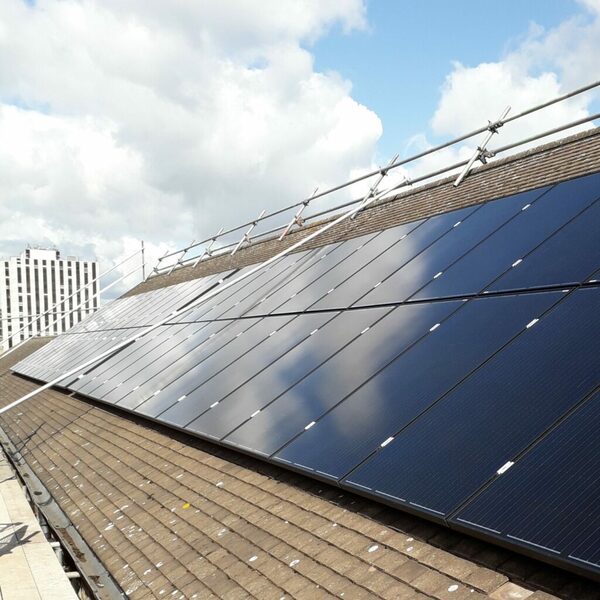
The threshold that decides how much paperwork a private wire scheme generates is 3.68kW. Small systems usually only need the electricity network operator to be notified, while larger systems over 3.68kW will usually need the DNO's approval before they can be connected to the grid1. Apply to connect is for larger installations exceeding 3.68kWp and requires a G99 application21.
The distinction is between notification and application. Below the threshold, the network operator is told what is being connected. Above it, the operator assesses the connection before it is made. Generation and demand-side response projects above 50kW holding connection agreements are listed in DNOs' Embedded Capacity Registers2, which is the point at which a scheme becomes visible in the network's published data.
| System size | What the network operator requires |
|---|---|
| Small systems | Usually only notification to the electricity network operator1 |
| Over 3.68kW | DNO approval usually needed before connection1 |
| Exceeding 3.68kWp | Apply to connect, requiring a G99 application21 |
| Above 50kW with a connection agreement | Listed in DNOs' Embedded Capacity Registers2 |
For a private wire serving a single neighbouring building, the generation is often below the threshold and the process is light. For a community scheme serving several buildings, the array will usually exceed 3.68kWp and the G99 route applies. The sizing a self-sufficient home system page covers how array size is chosen, and the microgrids and local energy systems page covers what changes when several buildings share a supply.
Compatible technologies: battery storage, heating and EV charging alongside a private wire
Behind-the-meter systems are adaptable, integrating with technologies like battery storage, heating and electric vehicle charging1. A private wire sits alongside those technologies rather than replacing them, and each one changes the shape of the load the wire has to carry.
Battery storage is the most directly complementary. It lets generation be moved through time rather than only sideways, which is what a private wire cannot do. The home battery versus hot water tank comparison covers the storage choice, and the how much battery increases self-consumption page covers the effect on the proportion of generation used on site.
Electric vehicle charging is the largest new load a household is likely to add. Public charging infrastructure in the UK stood at 121.3 devices per 100,000 population as of 1 July 2025, of which 24.7 were 50kW and above devices per 100,000 population22. Those are public figures, but they show the scale of the charging demand that a private wire might serve. Approved Document S covers building regulation in England for the installation of electric vehicle charge points or cable routes23, and it applies to England23. In Scotland, the policy proposals for electric vehicle charge points for new buildings set out a separate approach24. EV chargepoint grants do not cover costs associated with grid reinforcement25, which matters where a private wire scheme needs a network upgrade to proceed.
Heating is the third load. A private wire can serve an electrically heated building, but the whole-home energy system design page sets out how generation, storage, heat and EV charging interact when they share one supply. The can a behind-the-meter system export page covers the export question that follows from adding these loads.
Community energy and private wires: shared ownership, community funds and local benefit
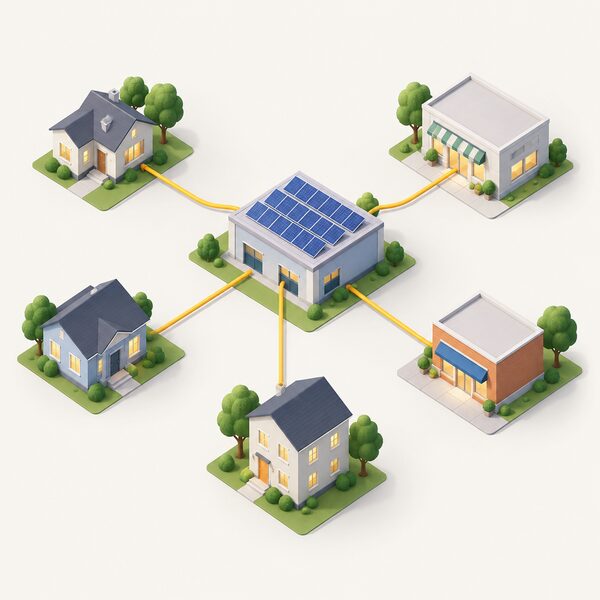
Community energy is where private wires have the most room to grow, because a shared local supply is the natural model for a group of buildings served by one generator. The policy direction is set out in the solar roadmap: on 21 May 2025 the government published a community benefits and shared ownership working paper, seeking views on introducing a mandatory community benefit fund scheme and facilitating shared ownership of renewable generation infrastructure2. Solar Energy UK published its Community Engagement Good Practice Guidance for engagement with people local to solar farm developments on 16 July 20252.
The scale of the ambition is reported in parliamentary work. The community energy target is 8GW by 2030, and GB Energy is reported to have committed to support at least 1,000 local and community projects by 203026. The Energy Security and Net Zero Committee published its first report of Session 2026 to 2027 on 17 June 2026, making recommendations to the Government on community energy26. Energy Saving Trust published research on community renewable shared ownership in Scotland on 24 September 20252.
The consumer protection question is live. Heat networks are natural monopolies where one entity supplies all homes and businesses on the network4, and the draft guidance on heat network consumer protection is the model being developed for shared local supply. A private wire electricity scheme raises the same question: what protects the household at the end of the wire when there is only one supplier and no switching route. The community energy page covers how UK projects are structured, and the community energy share offers page covers co-operative ownership.
For a household, the independence gain from a community private wire is shared rather than individual. The building is served by local generation, but the terms of supply, the price and the continuity all depend on the organisation running the scheme. That is a different kind of dependence from the grid, and it is worth naming plainly.
Funding and support: Local Net Zero Hubs, the Community Energy Fund and Redress Funds
Support for community schemes has been announced in stages, and the dates matter for anyone applying. On 21 March 2025 the government announced an additional £6.8 million for Local Net Zero Hubs across England, and launched the Great British Energy Community Fund, providing £5 million in grant funding for community energy groups2.
The Energy Redress Scheme opened further on 23 July 2026, when community energy organisations in England, Scotland and Wales became eligible for the Main Fund, around 75% of scheme funding, following Community Energy England lobbying27. The Ofgem Energy Industry Voluntary Redress Scheme page covers how the scheme works.
Two funds have near deadlines. The Bristol City Leap Community Energy Fund closes to applications on 23 September 202627. Applications to the feasibility and delivery streams of the ninth round of the London Community Energy Fund close at 11:59pm on 30 September 2026, and the development stream of that fund opens in October 2026 with more details to follow27.
Advice is available separately from funding. Homeowners should seek independent advice on solar panels, heat pumps, and other energy efficiency measures from organisations such as the NI Energy Advice service28. There is no financial support available for homeowners who wish to generate their own electricity through domestic renewable technologies in Northern Ireland28, which is a material difference from the position in Great Britain, where the Smart Export Guarantee operates11.
The community energy funding page covers the wider funding landscape, and the local power plan page covers Great British Energy's community role. For a household, the practical point is that the funding exists for groups rather than for individual private wires, and the deadlines are real.
Sources28 cited
- Behind-the-meter energy systems guidance, GOV.WALES, 2026-07-28
- UK Solar Roadmap, DESNZ, 2025-03-21
- Generating your own energy: solar electricity, GOV.WALES
- Heat networks consumer protections draft guidance, Ofgem, 2025-09-05
- Heat networks research briefing, House of Commons Library, 2026-09-17
- Smart meters research briefing, POST, 2026-06-07
- Domestic electricity consumption indicator, ONS, 2025-12-18
- Tesla Energy Ventures Limited granted electricity supply licence, Ofgem, 2026-03-12
- The Microgeneration Certification Scheme (Northern Ireland), legislation.gov.uk
- Feed-in Tariffs (FIT), Ofgem, 2026
- Smart Export Guarantee 2022-23 Annual Report, Ofgem, 2023-09
- Plug-in solar consultation document, GOV.UK, 2026-06-16
- Energy price cap levels, 1 October to 31 December 2025, Ofgem, 2025
- Permitted development rights for householders: technical guidance, GOV.UK, 2026-09-17
- Roof planning permission, Planning Portal, 2026-09-17
- Solar panels planning guidance, East Herts Council, 2026-09-17
- Local Listed Building Consent Order for solar panels on Grade II listed buildings, Royal Borough of Kensington and Chelsea, 2022-01
- Register energy devices in homes or small businesses, GOV.UK, 2021-03-31
- Electrical safety, Cumberland Council, 2026-09-17
- Everything you need to know about choosing an electrician, NICEIC, 2025-11-21
- Building regulations renewables guidance, Bedford Borough Council
- Electric vehicle public charging infrastructure statistics, July 2025, GOV.UK, 2025-07-01
- Infrastructure for charging electric vehicles: Approved Document S, GOV.UK, 2021-12-15
- Electric vehicle charge points for new buildings: consultation response, Transport Scotland
- Electric vehicle chargepoint and infrastructure specifications, GOV.UK, 2023-10-10
- Community energy report, Energy Security and Net Zero Committee, 2026-06-17
- Energy Industry Voluntary Redress Scheme, Community Energy England, 2026-07-23
- Support to generate your own electricity, nidirect, 2025-09-22
 Distribution Networks and DSOsWho actually owns and runs the cables and substations bringing power to your home?
 The Transmission NetworkWondering who owns the pylons near your house, or why the grid needs upgrading before you can run a heat pump or an electric car?
 Peer-to-Peer Energy TradingSharing power with your neighbours sounds simple, so why does it need a supplier in the middle?
 Charging Without a DrivewayParking on the street makes charging an electric car at home tricky.
 Energy Independence RulesExamines how the regulatory framework helps or hinders a household trying to generate, store and use its own energy, from connection rules to export arrangements and metering obligations.
 Energy Independence for RentersHow far a renter or flat dweller can cut reliance on grid supply without owning the building: smart meters and prepay, portable heating and its safety limits, Economy 7 timing, and the planning rules that govern a heat pump on a block of flats.