
In this guide
- What the Ratio Measures
- Why Households Care
- Behind-the-Meter Generation
- Metering Generation Not Import
- Smart Energy Management
- Exporting Surplus and Grid Value
- Smart Meters and Whole-Home Use
- Accurate Billing Readings
- Tariffs and Flexibility
- Planning and 3.68kW
- Batteries Heat and EV Charging
- What a Smart Meter Cannot Do
- Remaining Dependence
A self-sufficiency ratio is the share of a household's energy demand that is met from its own generation rather than bought in. It is a simple idea with a slippery definition, because the answer depends entirely on what sits in the denominator. Count only electricity and a home with solar and a battery may be described as highly independent. Count the gas burned for heating and hot water, and the petrol or diesel in the car, and the same house may still be importing most of the energy it consumes. The figure is not wrong in either case: the two numbers are measuring different things.
Two related metrics do the rest of the work. Self-consumption is the mirror measure, the share of what you generate that you use on site rather than export. A behind-the-meter system with smart energy management "prioritises on-site use of generated electricity", which raises self-consumption and, with it, the self-sufficiency ratio1. Days of autonomy describes how long the house could run on stored energy alone, which matters far more in December than in June. And import dependence states the same thing from the other direction: how many kilowatt hours still arrive through a meter.
Measurement is the foundation of all of it. Without metering at both the generation point and the boundary with the grid, a self-sufficiency ratio is an estimate. A smart meter automatically sends electricity and gas readings to the supplier, giving billing "based on accurate meter readings and not estimates", but it measures what is bought, not what is made2. A separate generation meter "measures how much electricity is being generated"3. Both numbers are needed before a ratio means anything.
What the self-sufficiency ratio actually measures
The ratio is generation used on site divided by total energy demand over a stated period. Everything turns on three choices: the period, the fuels counted and the boundary drawn around the house.
The period matters because UK generation and UK demand run in opposite directions through the year. A ratio quoted over a summer month flatters; a ratio quoted over a calendar year is the honest version; a ratio quoted over a winter week is the one that tells you whether the system could stand alone. This is the seasonal mismatch that makes annual averages misleading for resilience planning.
The fuels counted matter because most UK homes still take heat from gas. An electricity-only ratio ignores the largest single energy flow in a gas-heated house. Official work on how buildings are rated shows the same definitional problem in policy. A "primary energy" metric, as described in the consultation on reforming the Energy Performance of Buildings regime, "would intend to take account of the upstream processes which go into producing and transporting" fuels before final consumption8. CIBSE has stated it "has concerns about the reliance on primary energy as a key metric" and considers it "more appropriate to use energy use (total delivered, from all sources including on-site renewables)"9. The disagreement is exactly the one a householder faces: measure delivered energy at the door, or measure the whole upstream chain.
The headline EPC rating carries a related warning. It is called the Energy Efficiency Rating but, as Energy Systems Catapult has put it, that is "something of a misnomer because it is" a measure of the cost of the property's energy use10. It is nonetheless "the only metric currently used in government policies targeting domestic buildings"8. A cost-based rating and an energy-based self-sufficiency ratio can move in opposite directions.
Why households care about the number
Research by Nesta into how the British population views domestic energy found that the appeal of self-sufficiency "was strongly linked with the desire for protection against external factors out of participants' control", alongside a need for certainty and a shared distrust of energy companies11. Cost came next: self-sufficiency was understood as ultimately leading to cutting costs, particularly among certain population segments. Environmental motivation appeared too, but "always coupled with cutting costs"11.
That matters for how the ratio is used. If the motive is protection from outside events, days of autonomy and winter performance are the meaningful numbers, not an annual percentage. If the motive is cost, the relevant measure is imported kilowatt hours and the price paid for them. Solar Energy UK's position, put simply, is that "more homegrown energy means greater energy independence"12, but independence at the level of a single house and independence at national level are different accounting exercises.
Behind-the-meter generation: what raises the ratio
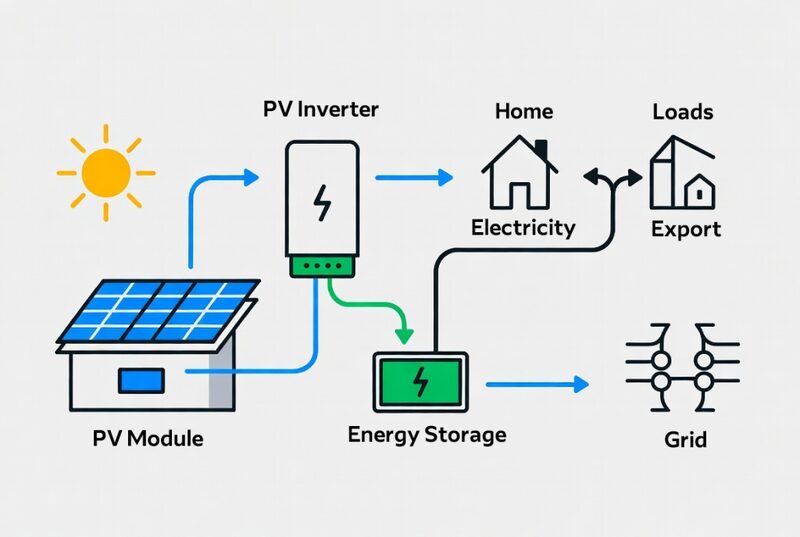
Welsh Government guidance defines behind-the-meter systems as "localised energy solutions installed at a specific site, typically featuring on-site generation" such as rooftop solar PV, often paired with battery storage, in both domestic and commercial buildings1. Critically, such systems "fundamentally require on-site generating technology"1. Efficiency measures reduce demand and therefore reduce imports, but they do not create a self-sufficiency ratio: only generation does.
Building regulations use a similar concept for new dwellings. Requirement L3 asks that on-site renewable electricity generation be "capable of generating a reasonable output taking account of the building's design and surroundings"13. Guidance on sizing points to the on-site energy demand, the capacity and nature of available infrastructure "including export limits set by the District Network Operator", the relationship between export limits, generation and on-site demand, and other site characteristics14. Those four factors are, in effect, the design inputs behind any achievable self-sufficiency ratio.
For sites with no mains connection, micro hydro is the exception that can deliver near-total autonomy. Planning Portal guidance states that "for houses with no mains connection but with access to a micro hydro site, a good hydro system can generate a steady, more reliable electricity supply than other renewable technologies at a lower cost", and that total system costs "can be high but often less than the cost of a grid connection and with no electricity bills to follow"15. Most homes have no such site, which is why going off-grid remains a minority route.
Metering the generation, not just the import
A household cannot calculate a ratio from a supply meter alone. In an Energy Saving Trust case study, the householder describes having two meters, "one is a generation meter, which measures how much we're generating"3. NIE Networks describes the generation meter as recording "all the units generated by your renewable system", and it is the units from this meter on which Renewables Obligation Certificates are paid16.
Ofgem's guidance for Feed-in Tariff generators makes metering separation a formal condition where storage or EV charging is added: "the meter must be able to measure the amount of electricity generated/exported from the installation separately from any other source (unless pro-rating is allowable)"17. The same document confirms that "battery storage or an EV charging station may be added to an installation without affecting its accreditation", provided metering criteria continue to be met17.
| Meter | What it records | Ratio it supports |
|---|---|---|
| Generation meter | All units generated by the renewable system16 | Total generation, denominator for self-consumption |
| Import meter (smart) | Electricity and gas bought from the supplier2 | Import dependence |
| Export meter | Surplus sent to the grid1 | Generation not self-consumed |
| In-home display | Energy bought from the supplier, in near real time18 | Household demand, partial |
The in-home display is often misread. Smart Energy GB is explicit that the display "will show you how much energy you are buying from your supplier and in the future, may also be able" to reflect self-generated energy such as from solar panels18. Treated as a whole-home energy figure in a house with solar, it will understate consumption and overstate nothing.
Smart energy management and on-site priority
Behind-the-meter systems "use smart energy management to prioritise on-site use of generated electricity", with the electricity generated "primarily used on-site"1. That priority order is what moves self-consumption upwards, and it is a control decision rather than a hardware one. Storage holds midday surplus for evening demand; controllable loads are moved to hours of generation.
Heat is the largest movable load in most homes, and the controls that shift it sit alongside, not inside, the metering system. Smart heating controls "automatically optimise your heating settings to save you money and energy", while Energy Saving Trust is clear that "smart meters are different to smart heating controls, and you can use one without the other"19. A smart meter automatically sends electricity and gas readings to the supplier, so bills come from accurate readings rather than estimates, and its in-home display shows how much energy is being used through the day, which is what lets a household find ways to save money using up-to-date information on its energy use19. Suppliers provide the meter free19. None of that is a measurement of how much of a home's own generation it consumes on site; it is visibility and control, and the household still depends on the supplier, the tariff and the communications network behind the meter.
There is a limit worth stating early. Smart control raises the share of generation used on site, but it cannot generate energy that is not there. In a UK winter, a control system can only redistribute a small output. The whole-home system design question is how generation, storage, heat and EV charging are sized together, not how cleverly they are sequenced.
Exporting surplus, and what a grid connection is worth
Welsh Government guidance is direct: "while not mandatory, a grid connection enhances the value of BTM systems by enabling the export of surplus electricity"1. Without a connection, surplus generation is curtailed or wasted, and the self-sufficiency ratio can be high while total useful output is low.
With a connection, the surplus has a market. Solar Energy UK notes that where a solar PV system generates more power than is needed, "the surplus will be put onto the grid"20, and Electricity North West describes customers being able to "sell any you don't need back to the grid"21. For small wind, NI Direct states that "any unused or excess electricity can be exported to the grid and sold to the local electricity supply company"22. Where a battery is fitted, Solar Energy UK notes tariffs that mean homeowners "can sell power they have produced and stored in a battery back to the grid automatically"23.
Export income does not raise the self-sufficiency ratio. It changes the economics, not the physics. The ratio only rises when generation displaces import, which Energy Saving Trust puts plainly: home renewable generation "lowers the amount of electricity you import and pay for from the grid"24. A household optimising for export revenue and a household optimising for autonomy will make different decisions about when to discharge a battery, and the two goals are in tension on a self-consumption basis.
How smart meters measure whole-home use
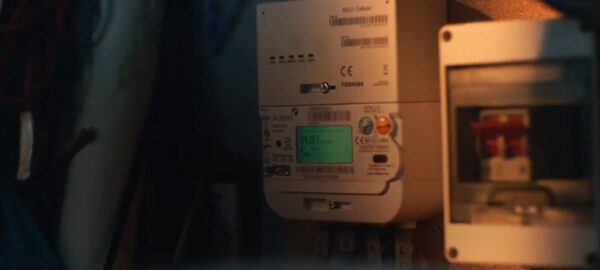
Smart meters "measure how much gas and electricity you're using and send those readings automatically to your energy supplier"19, and Welsh Government guidance confirms the meter "automatically sends your energy usage data to your supplier using a secure network"25. The in-home display "shows you how much energy you're using during the day"26, in near real time27.
Readings go to the supplier at least once a month, automatically and wirelessly5. Monthly is the minimum; daily and half-hourly are optional settings28. The Data Communications Company, which runs the network, states that "when you have a smart meter installed, all the readings are automatically sent via the DCC's secure network to your energy supplier"29, and that the data "puts you in control of your energy usage" so energy-saving steps can be taken30. The DCC network also supports prepayment, allowing credit to be added "through an over-the-air top-up over our network"31.
For a self-sufficiency calculation, the value of this is the denominator: an accurate, half-hourly record of what the house actually consumed from the grid, with gas measured alongside electricity. It is the one figure most households can obtain without additional equipment.
Accurate billing: readings, not estimates
Government guidance states that smart meters "enable accurate billing by automatically recording energy use in half-hour periods"32, and Ofgem that households "get bills based on accurate meter readings and not estimates"33. The DCC describes suppliers receiving "accurate and reliable readings automatically" over its network, enabling billing only for energy used34, and says the effect is "ensuring you only pay for the energy you've used, not the approximate costs of an estimated bill"29. Smart Energy GB frames the same benefit as bringing "an end to the 'bill shock' that estimates" cause35.
Without a smart meter, the obligation falls on the householder: "if you don't have a smart meter, you will still need to submit manual meter readings to your energy supplier to avoid getting an estimated bill"5.
Tariffs and flexibility: what needs a smart meter
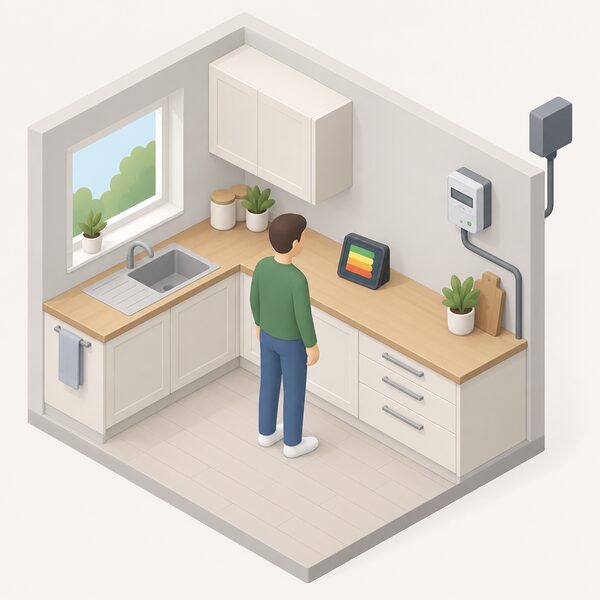
Ofgem states that households with a smart meter "can access more flexible tariffs, including dual-rate tariffs"33. Welsh Government guidance describes access to time-of-use tariffs as meaning "cheaper rates during off-peak hours and incentives for energy usage on high-supply days"25.
Smart Energy GB is specific about the technical condition: "to access any new flexible time-of-use tariffs, you will need to have a smart meter that is set to send readings every half an hour"7, and "customers will need a smart meter to get all the benefits from new flexible energy tariffs"7. The same body notes that a smart meter is needed "to access all the benefits of these new flexible tariffs and schemes"27. Under ECO4, guidance on smart technologies provides that a measure "can be combined with a time-of-use tariff and will be used with a functioning electricity smart meter"38.
This is where independence metrics and tariff design meet. A household on a time-of-use tariff can cut costs by importing at cheap hours without raising its self-sufficiency ratio at all, because the energy is still imported. Cost independence and energy independence are separate goals, and only the second is captured by the ratio. Citizens Advice notes the corollary of refusal: "if you refuse a smart meter, you might find it hard to access all tariffs"36.
Planning, network operators and the 3.68kW threshold
Installation of behind-the-meter equipment "typically falls under permitted development", though systems "may be subject to certain regulatory requirements, such as permission from planning authorities and District Network Operators"1. Small systems "usually only need the electricity network operator (DNO) to be notified", while "larger systems (over 3.68kW) will usually need the DNO's approval before they can be connected to the grid"1.
The 3.68kW figure derives from a current limit. NIE Networks explains that "the 16 amps per phase threshold equates to 3.68kW per phase"39, and that for a microgenerator "the limits are 3.68kW single phase and 11.04kW three phase"39.
| Route | Applies to | Source |
|---|---|---|
| Connect and notify (G98/NI) | Generation up to 3.68kW single phase or 11.04kW three phase4 | NIE Networks |
| Apply to connect (G99) | Installations exceeding 3.68kWp, requiring a G99 application40 | Local authority guidance |
| Apply to connect (G99/NI) | Generation over 3.68kW single phase or 11.04kW three phase4 | NIE Networks |
| Small scale renewable generation | Greater than 3.68kW and up to 17kW single phase; greater than 11.04kW and up to 5MW three phase39 | NIE Networks |
Northern Ireland operates its own versions of the engineering recommendations, G98/NI and G99/NI, through NIE Networks rather than a Great Britain DNO, and the connection process includes a defined metering stage41. The practical consequence for a self-sufficiency ratio is that the DNO's export limit, named in official sizing guidance alongside on-site demand, can cap the size of array a household is permitted to connect, and therefore caps the ratio achievable on that roof14. The rules governing these thresholds are covered further under off-grid legality and rules.
Batteries, heat and EV charging in the same system
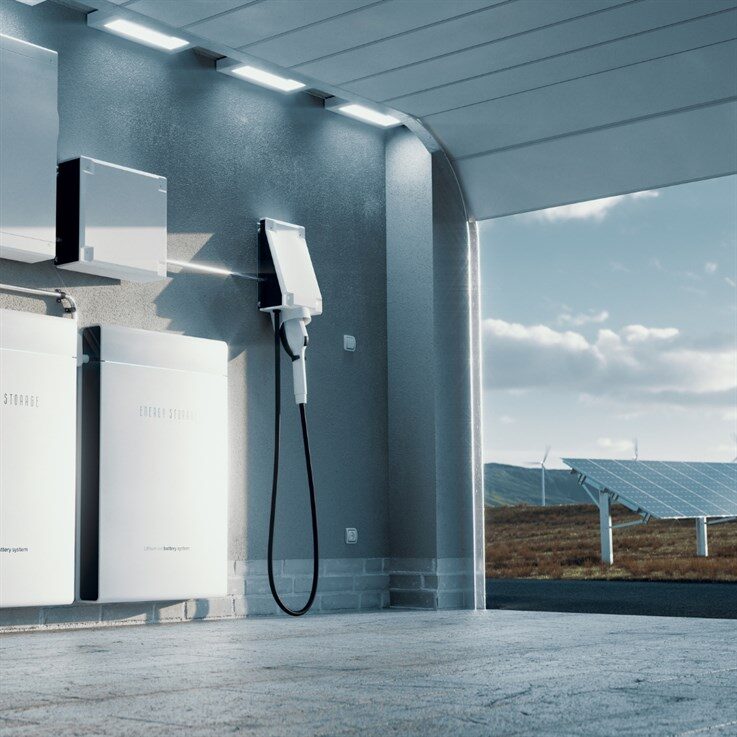
Behind-the-meter systems "are adaptable, integrating with technologies like battery storage, heating and Electric Vehicle (EV) charging"1. Each changes the ratio differently. Storage shifts generation in time and directly raises self-consumption. Electrified heat and EV charging enlarge electricity demand, which can lower the ratio even as total imported energy across all fuels falls, because petrol and gas leave the denominator and electricity enters it. That arithmetic is the single most common reason two quoted percentages for the same household disagree.
Ofgem's Feed-in Tariff guidance confirms batteries and EV charge points can be added to an accredited installation without affecting accreditation, subject to the metering criteria being met17. In Scotland, the domestic charge point grant "is funded by Transport Scotland and managed by Energy Saving Trust"42, one of the points where provision differs between the nations. Energy Saving Trust itself is "an independent organisation and trusted voice on energy efficiency solutions"43.
What a smart meter does not do
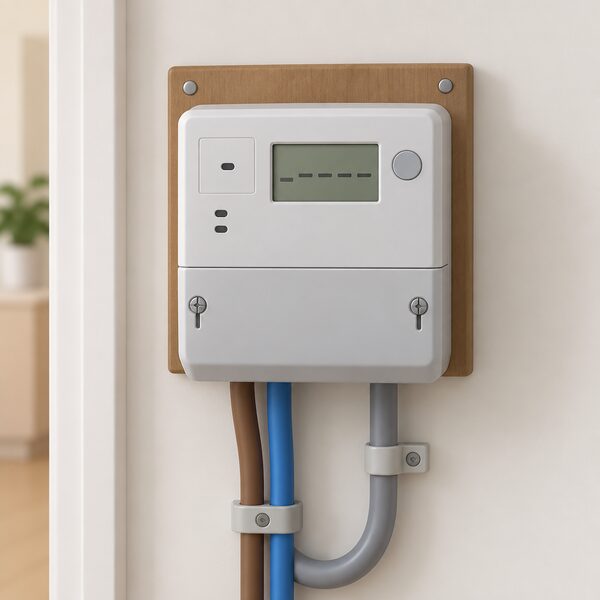
A smart meter is a measurement device, not a control system. Smart Energy GB states that smart meters "can only measure the amount of energy you use" and "don't hold information like your name or address"44. The meter itself "won't show your spending", only the in-home display shows standing charges45.
Nor does the meter give a household control of price. The DCC puts it bluntly: "except by switching, you don't control the tariff your energy supplier sets, but you can change how much energy you use"29. And the meter does not control heating: smart meters and smart heating controls are separate systems, usable independently19.
On data, the DCC states that "only your supplier (or third parties when given explicit permission from the consumer) can see how much energy you are using and when"46. Government guidance confirms the household has "control over who can access the energy use data from your smart meter; including how often and for what purposes", except where required for regulated purposes such as billing32. That control sits alongside the wider question of who owns your home energy data.
Meters can also fail. Ofgem notes a smart meter "may stop recording the energy you use, or may no longer send readings to your supplier"33, in which case manual readings remain possible47. On switching, a second-generation meter keeps all smart functions with no interruption, while a first-generation meter "may lose some smart functionality"48; Ofgem warns the meter "may not work in smart mode when you move to the new supplier" and that manual readings may then be needed, though smart mode "may work again if you change tariffs or suppliers"49. Anglesey trading standards guidance similarly warns a new supplier "might not offer all the smart meter services" and that the meter may need replacing50.
The dependence that remains
A high self-sufficiency ratio does not mean no dependence. A grid-connected home still relies on the network operator for the connection and its export limit, on a supplier for imported units and the tariff attached to them, and on the DCC network for the data that produces an accurate bill. A gas-heated home remains dependent on the gas network regardless of how much electricity its roof produces. Beyond the meter, support arrangements exist for vulnerable households: Cadent's Services Beyond the Meter refers customers to "National Energy Action and Groundwork UK" alongside its own dedicated engineers52.
There is also a supplier-level illusion to avoid. Buying a renewable tariff is not the same as generating. Ecotricity's own account describes its renewable electricity as either "generated by Ecotricity itself (10%) or purchased on the wholesale market from other renewable generators"53. Contractual greenness changes nothing in a self-sufficiency ratio, which counts only electrons produced on the premises.
CIBSE's framing of the wider challenge places "enabling effective energy management" among its priorities for the energy capacity gap54. At household scale that is the same instruction: measure what is generated, measure what is imported, be clear which of the two any quoted percentage describes, and state the period it covers. A figure without those qualifiers is a marketing number, not a measurement. What energy independence costs and whether a UK home can be fully self-sufficient are the questions that follow once the metric is properly defined, and both are treated in the full guide to household energy independence.
Sources54 cited
- Behind-the-meter energy systems: guidance, GOV.WALES, 2026-06-29
- Get help with your smart meter, Ofgem, 2026
- Installing solar panels to help reduce your carbon footprint, Energy Saving Trust, 2025-09-24
- Help to select a connection application, NIE Networks, 2026-09-19
- Smart meters vs home energy monitors, Smart Energy GB, 2026-08-17
- Do you have to have a smart meter by law?, Smart DCC, 2026
- Energy flexibility, Smart Energy GB, 2026-08-17
- Technical annex: what EPCs measure, GOV.UK, 2026-03-09
- The Future Homes and Buildings Standards consultation response, CIBSE, 2026-09-17
- What next for Energy Performance Certificates, Energy Systems Catapult, 2024-08-20
- How the British population views heat pumps, Nesta, 2026-07-02
- Solar Energy Scotland manifesto, Solar Energy UK, 2026-09-17
- Approved Document L, Volume 1: Dwellings, GOV.UK, 2026
- Approved Document L frequently asked questions, GOV.UK, 2026-09-08
- Hydro electricity for home energy generation, Planning Portal, 2026
- Import and export meters, NIE Networks, 2026-09-20
- Guidance for FIT generators, version 18, Ofgem, 2026-04-01
- Smart meter FAQs, Smart Energy GB, 2025-08-08
- Guide to smart meters, Energy Saving Trust, 2026-07-15
- Smart Export Guarantee, Solar Energy UK, 2026-05-12
- Renewable energy and net zero, Electricity North West, 2026-09-19
- Wind energy for the home, nidirect, 2026-05-18
- Batteries in the home, Solar Energy UK, 2026-09-17
- Generating renewable electricity, Energy Saving Trust, 2025-12-11
- Smart meters, Welsh Government Climate Action, 2026
- Getting a smart meter, Ofgem, 2026
- The cost of a smart meter, Smart Energy GB, 2026-04-07
- What is a smart meter?, Smart Energy GB, 2026-08-10
- How do smart meters save energy?, Smart DCC, 2026
- Smart meters and decarbonisation, Smart DCC, 2026
- How do smart meters send readings?, Smart DCC, 2026
- Smart meters: your rights and expectations, GOV.UK, 2025-08-08
- Get help with your smart meter, Ofgem, 2026-09-17
- How accurate are smart meters?, Smart DCC, 2026
- Smart meter disadvantages, Smart Energy GB, 2026-03-16
- Getting a smart meter installed, Citizens Advice, 2026-09-17
- Smart meters and carers, Smart Energy GB, 2026-08-19
- ECO4 new measures and products guidance, version 3.0, Ofgem, 2026-03-26
- Generation connections FAQs, NIE Networks, 2026-09-19
- Building regulations renewables guidance, Bedford Borough Council, 2026-09-17
- Energising your connection, NIE Networks, 2026-09-19
- Domestic charge point funding, Energy Saving Trust, 2026-08-27
- Additional help, National Energy Action, 2026-04-21
- What is a smart meter: easy read, Smart Energy GB, 2026-03-16
- Do smart meters cost more?, Smart Energy GB, 2026-03-16
- Protecting data on the smart meter network, Smart DCC, 2026
- How can I read a smart meter?, Smart Energy GB, 2026-08-17
- Myth busting smart meter problems, Smart Energy GB, 2026-09-17
- What happens if your energy supplier goes out of business, Ofgem, 2026
- Problems with services: consumer advice, Isle of Anglesey County Council, 2025-10
- Smart meters, Energy Ombudsman, 2026-09-20
- Services beyond the meter, Cadent Gas, 2026-09-20
- Green energy tariffs, Uswitch, 2026-09-04
- Energy capacity position statement, CIBSE, 2026-09-17
 Suppliers and IndependenceCan you really cut your energy bills by making your own power, and how much of your supplier do you still need?
 The Full Energy Independence GuideCan you really run your home on your own power in the UK, and how far can that go before the grid still matters?
 Energy Security for HouseholdsCan a household really protect itself from gas and electricity price shocks, and what actually makes a difference?
 Data and Energy IndependenceHow many UK homes actually make their own power, and is that number really growing?
 Solar and Energy IndependenceHow far domestic solar cuts dependence on suppliers and the grid, what self-consumption really looks like across the year, what a battery, diverter or EV adds, and the grid-outage limit of ordinary inverters.
 Self-ConsumptionHow much of the electricity from your own solar panels do you actually use, and how much goes to the grid?