

In this guide
A community energy share offer is an invitation to buy shares in a community benefit society or co-operative that owns renewable generation, usually a solar array, a wind turbine or a hydro scheme. The society is owned by its members, and the return comes from the electricity or heat the scheme sells rather than from a guaranteed rate. Buying shares gives a household a financial stake in generation somewhere else. It does not give that household electricity, and it does not lower its bill.
The distinction matters for energy independence. A share offer pools capital so a community can build generation it could not fund alone, and the society keeps the income local. But the member's own home remains connected to the grid and supplied by a licensed supplier, and the member's exposure is financial rather than physical. No universal interest rate applies to these offers, because each society sets its own target in its own rules.
The surrounding framework is what shapes any offer: the grant schemes that sit alongside share offers, the rules on community benefit, the legislation that lets community sites sell power locally, and the territorial differences between England, Scotland, Wales and Northern Ireland. This page sets out that framework, states the risks plainly, and explains where a share offer fits against installing your own solar.
What a share offer actually is
A community energy share offer raises capital by selling shares in a society. The society is usually registered as a community benefit society, which is owned by its members on a one-member-one-vote basis, or as a co-operative. The money raised buys the generation asset. The society then sells the electricity or heat and uses the income to cover running costs, service any debt, pay a community benefit, and pay interest to members if the rules and the year's finances allow.
The structure is what separates this from ordinary investing. A community benefit society exists to benefit the community it serves, not to maximise a return to shareholders, and its rules usually cap the interest payable to members. That cap is a feature, not a defect: it keeps the surplus in the scheme rather than distributing it. The trade-off is that a member's return is modest and conditional.
No single national figure exists for the interest rate on these offers, and none should be assumed. Each society states its own target in its offer document, and that target is a projection, not a promise. Where a society's income falls short, the board can reduce or suspend member interest, and the rules normally allow it to do so.
The scale of the surrounding support is considerable. The Community and Renewable Energy Scheme in Scotland has offered advice to over 900 organisations, and has provided enablement grant funding of up to £25,000 for non-capital aspects of projects2. In Wales, the Ynni Cymru capital grants scheme is open to community energy organisations, social enterprises, public sector bodies and SMEs3. These grants reduce the capital a share offer has to raise, which in turn reduces the risk carried by members.
What drives the figures
The figures behind a share offer are driven by three things: the cost of the asset, the income the asset earns, and the grant funding that reduces the first. Grant support is the most visible driver, and it varies sharply by nation.
In Scotland, the Community and Renewable Energy Scheme provides advice and funding support to community groups and other eligible organisations seeking to explore their renewable energy options6. Its enablement grant funding of up to £25,000 covers non-capital aspects of projects, which is the feasibility, legal and development work that has to happen before a share offer can be launched1. That matters because a failed feasibility stage is money a society cannot recover from members.
In Wales, the Ynni Cymru Grant Capital Scheme is aimed at helping communities use clean energy to cut costs, create jobs and build stronger local infrastructure, and it is open to community energy organisations, social enterprises, public sector bodies and SMEs3. A separate Welsh scheme provides £10 million to support community led energy projects across Wales7. Welsh Government guidance on engaging mid Wales communities states that community benefits should be integral to any development, with transparency about what is and is not possible8.
The income side is governed by how the electricity is sold. The Community and Smaller-scale Electricity Supplier Services Scheme requires eligible licensed suppliers to offer an agreement allowing registered sites to sell electricity to local consumers via a community or smaller-scale energy tariff, having regard to the export price paid to that site9. The same legislation requires the supplier to return any money raised through the sale of energy under the tariff to the community or smaller-scale energy site, save for a permitted fee9. It also allows the supplier to limit the number of consumers so that the total annual energy sold under the tariff is broadly equivalent to the total annual energy generated by the site9. That last rule is what keeps a community tariff tied to real generation rather than becoming a marketing label.
How the nations differ
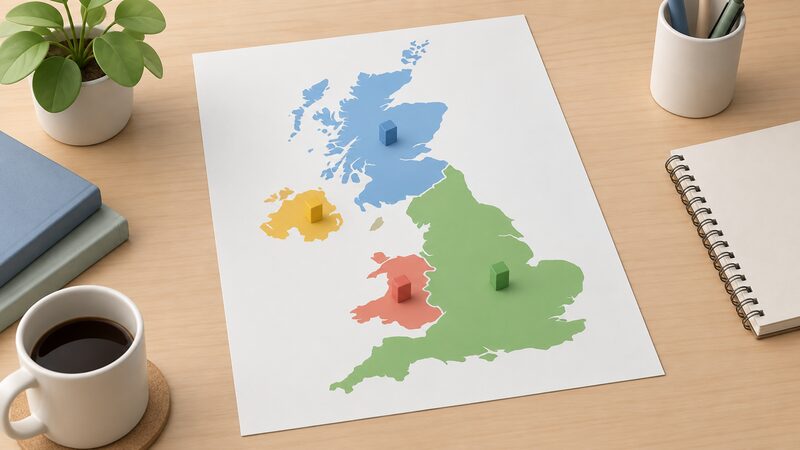
Community energy is devolved in practice, and the support landscape differs across England, Scotland, Wales and Northern Ireland. The differences are in the grant schemes, the advisory bodies and the regulatory context, not in the basic legal form of a community benefit society.
| Nation | Support and context |
|---|---|
| Scotland | CARES advice to over 900 organisations2; enablement grant funding up to £25,000 for non-capital project costs1; a pilot giving communities access to wind farm repowering10 |
| Wales | Ynni Cymru capital grants open to community energy organisations, social enterprises, public sector bodies and SMEs3; £10 million for community led energy projects7; guidance that community benefits should be integral to any development8 |
| Northern Ireland | Different regulator (the Utility Regulator for Northern Ireland), no price cap and an entirely different set of suppliers from Great Britain5 |
| Great Britain | Community and Smaller-scale Electricity Supplier Services Scheme sets the community tariff route to local sale9 |
Scotland has the most developed advisory structure. The Community and Renewable Energy Scheme has offered advice to over 900 organisations2, and it funds both advice and enablement work6. Scotland also has a pilot scheme to provide new opportunities for communities to benefit from renewable energy developments through community access to wind farm repowering10. Scottish renewable generation has historically run well ahead of the rest of the UK: official statistics put the renewable share of electricity generation at 29.3% for the UK as a whole, or 25.6% for the rest of the UK excluding Scotland11.
Wales has capital grant funding through Ynni Cymru, open to community energy organisations, social enterprises, public sector bodies and SMEs3, and a £10 million programme for community led energy projects7. Welsh guidance is explicit that community benefits should be integral to any development, with transparency about what is and is not possible8.
Northern Ireland is different in a way that matters for any community supply model. There is a different regulator, the Utility Regulator for Northern Ireland, no price cap and an entirely different set of suppliers from Great Britain5. That means a community tariff structure built around the Great Britain supplier licence does not transfer directly. Northern Ireland does have its own community supply history: Ovo Communities operates mainly in southwest England and provides a model for local authorities, communities and co-operatives that want to supply energy directly to their tenants, communities or members12, and Robinhood Energy's tariff was available on a UK-wide basis12. Both are cited in Scottish Government work on fuel poverty as examples of the model, not as current UK-wide offers.
The rules that govern a share offer

The rules come from three layers: the society's own registered rules, the legislation covering community supply, and the grant scheme conditions attached to any public money the society receives.
The society's rules set the maximum interest payable to members, the circumstances in which withdrawals can be suspended, and how a community benefit is calculated. These are registered with the Financial Conduct Authority for a community benefit society, and they bind the board. A member cannot demand a return the rules do not permit.
The legislation layer covers how a community site sells power. Under the Community and Smaller-scale Electricity Supplier Services Scheme, eligible licensed suppliers must offer an agreement allowing registered sites to sell electricity to local consumers via a community or smaller-scale energy tariff, having regard to the export price paid to that site9. The supplier must return the money raised through the tariff to the site, save for a permitted fee9, and may limit consumer numbers so that annual energy sold is broadly equivalent to annual energy generated9. This is the legal basis for a community tariff, and it is what distinguishes it from a conventional supply contract.
The grant layer adds conditions. Where a society takes public money, the scheme's eligibility rules apply. The Ynni Cymru capital grants scheme is open to community energy organisations, social enterprises, public sector bodies and SMEs3. The Community and Renewable Energy Scheme provides advice and funding support to community groups and other eligible organisations6. Grant conditions typically require the asset to remain in community use and may restrict disposal.
Where the money goes, and what a member gets
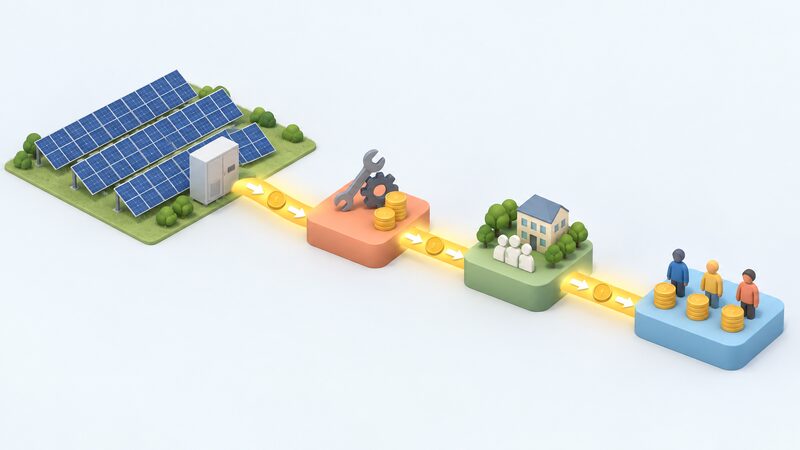
A share offer's income is split in a fixed order, and understanding that order explains why member interest is the most variable element.
- Running costs and debt service, because the asset has to keep operating.
- A community benefit payment, if the rules require one.
- Member interest, and only if the year's surplus allows.
That order is why the grant figures matter so much. Enablement grant funding of up to £25,000 in Scotland covers the non-capital development work1, which means the share offer does not have to fund feasibility from member capital. Capital grants in Wales reduce the amount the society has to borrow or raise3. Every pound of grant is a pound of risk that members do not carry.
The community benefit element is separate from member interest, and Welsh guidance is clear that community benefits should be integral to any development, with transparency about what is and is not possible8. In practice this means a society may pay into a local fund, offer discounted energy to local residents, or provide other benefits defined in its rules. No standard percentage applies to this, because there is not one.
For the household, the return is financial. A member receives interest if the society declares it, and a vote at general meetings regardless of the size of the holding. What a member does not receive is electricity. The society's generation is sold through a licensed supplier under the community tariff arrangements9, and the member's own home is still supplied by whichever supplier it has chosen.
What it means for household energy independence
A community energy share offer does something specific for a household, and it is worth being exact about what. It converts savings into a stake in local generation, and it keeps the income from that generation in the community rather than with an external owner. That is a real form of independence, but it is financial and collective, not physical and individual.
The dependence that remains is substantial. The member's home stays connected to the grid and supplied by a licensed supplier. The society's own income depends on a supply agreement with a licensed supplier under the community tariff rules9, so the scheme is not independent of the licensed supply market either. If the supplier fails or the agreement ends, the society's income is affected. Northern Ireland shows how differently this can work where the regulator and supplier set differ5.
There is also a governance dependence. A member's influence is one vote at a general meeting, exercised through the society's rules. That is meaningful but slow, and it does not give a household control over its own supply.
Set against that, the collective model reaches households that individual generation cannot. A rooftop array serves one property. A share offer can fund a wind turbine or a hydro scheme that no single household could build, and the grant structure in Scotland and Wales is designed to make that viable1. The Energy Security and Net Zero Committee has reported a community energy target of 8 GW by 2030, and GB Energy is reported to have committed to support at least 1000 local and community projects by 20304. Those are targets and commitments rather than delivered capacity, and should be read as such.
For a household weighing this against its own roof, the two are complements. Self-consumption measures how much of a home's own generation it uses directly, and that is where a rooftop system earns its return. A share offer earns a dividend instead. A household can hold both, and the community energy page covers the wider project landscape.

Sources12 cited
- Heat in Buildings Strategy: achieving net zero emissions in Scotland's buildings, Scottish Government, 2021-10-07
- Heat in Buildings Strategy 2022 update, Scottish Government, 2022-10-31
- £129 million to support Welsh communities transition to renewable energy, Welsh Government, 2026-03-03
- Community Energy England: Energy Industry Voluntary Redress Scheme, Community Energy England, 2026-07-23
- Domestic Renewable Heat Incentive Quarterly Report, Ofgem, 2022-02-28
- Heat in Buildings Strategy: achieving net zero emissions in Scotland's buildings, Scottish Government, 2021-10-07
- £10 million to support community led energy projects across Wales, Welsh Government, 2025-05-01
- Preparing Wales for a renewable energy 2050, Welsh Government, 2023-10
- Community and Smaller-scale Electricity Supplier Services Scheme, UK Parliament, 2023-02-24
- Local and small-scale renewables, Scottish Government, 2026-09-17
- Annual Energy Statement 2019, Scottish Government, 2019-05-15
- Scotland without fuel poverty: a fairer Scotland in four steps, Scottish Government, 2016-10-24
 Community Energy in the UKWhat community energy means in practice, the legal structures used, and the types of project householders can join or benefit from.
 Community Energy in EnglandCommunity energy lets neighbours own their own power together, often through solar panels, and share the money it makes.
 Community Energy in NICan a community group in Northern Ireland sell power to its neighbours, and is there funding to get a project off the ground?
 Land and Asset RightsGetting the land or roof is often the hardest part of a community energy project.
 Local Energy Supply ClubsJoining a local energy club means your area's wind or hydro power is matched to your home's use, so you pay less for the electricity you use when it is being generated nearby.
 Community Wind and HydroExplains how community-owned wind and hydro projects are organised, financed and shared with local households, and the scale of installed community capacity across the UK.