
In this comparison
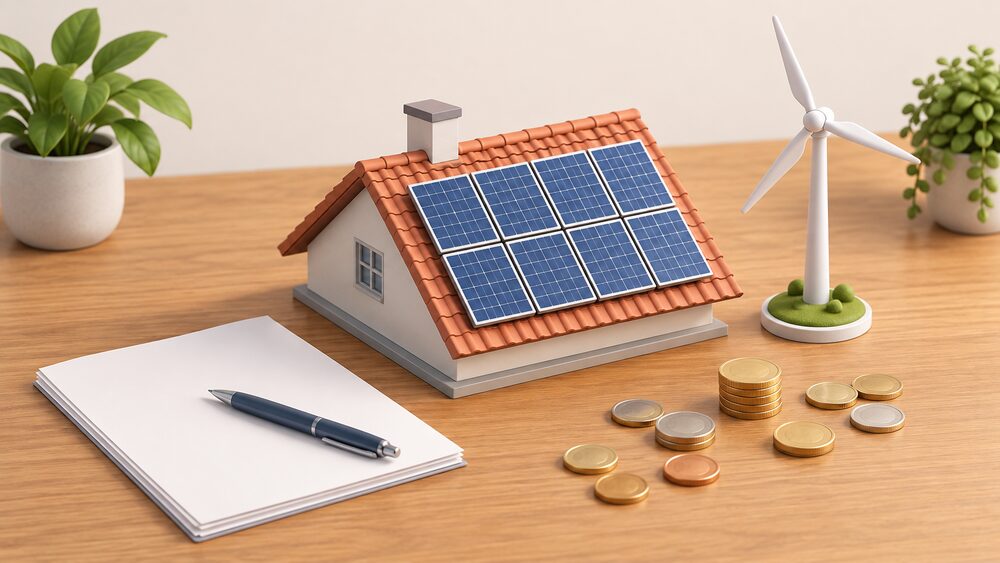
The core difference is ownership of the asset. A community energy scheme pools money and generation so that people and communities take democratic control over their energy future, by understanding, generating, using, owning and saving energy in their communities1. Your own solar puts the generating asset on your roof, and the electricity it makes is yours to use behind the meter2. One route buys a share in something shared; the other buys a system you control directly.
The money follows that split. A typical domestic rooftop system of around 3.5 kilowatts costs about £6,100 in 2026, and installing domestic solar below 4 kW cost £2,170 per kW in 2024/20253. Community energy is financed differently, through community shares and crowdfunding from local people, retail, public sector and social impact investors1. Membership does not usually replace your electricity bill; it buys a stake in a project, and the return depends on the society's rules.
For a household that cannot put panels on its own roof, the community route is often the only one available. For a household with a suitable roof and the capital, own solar delivers savings directly against a tariff. The rest of this page sets out how each works, what each costs, and where the two can be combined.
Community energy scheme vs own solar: the core difference
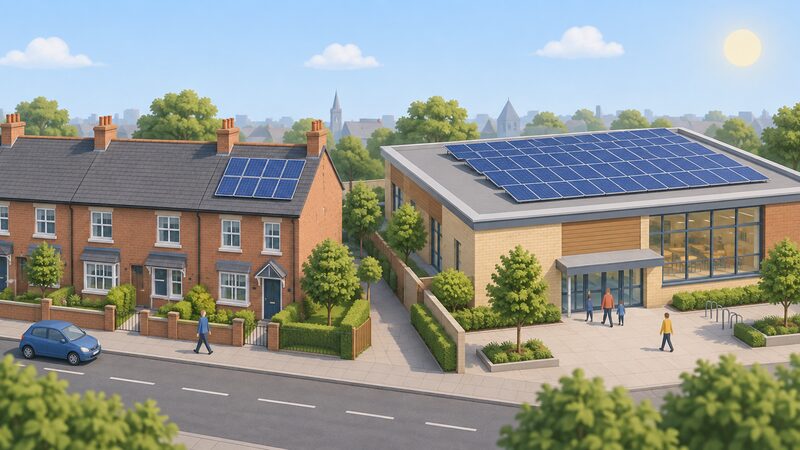
Community energy is a category, not a single product. It covers community-owned wind, where a turbine or wind farm is locally owned by individuals or groups in a community7, shared solar on council buildings and other public roofs8, and the cooperative and charitable structures that hold them. Community energy allows people and communities to take democratic control over their energy future, by understanding, generating, using, owning and saving energy in their communities, as well as working together across regions and nationally1. The household's relationship is with a society or project, not with a generating asset on its own property.
Own solar is a direct asset. Solar PV generates your own electricity instead of relying on the grid9, and sunlight is free, so once the initial installation is paid for, electricity costs are lower10. The measure of success is different: self-consumption is the amount of solar electricity generated by a domestic system that is subsequently consumed within the property and not exported to the distribution network2, and self-sufficiency is the percentage of electricity consumed in the property over a year met by behind-the-meter solar or electrical storage2. Those two numbers describe how independent a home actually is.
The scale of the installed base shows how mainstream the own-solar route has become: there are over 1.5 million domestic solar installations in the UK6. Community generation sits alongside it. Solar PV forms the largest proportion of capacity supported under the feed-in tariff scheme at 79.32%11, which is a legacy of small-scale deployment rather than a guide to current support.
The practical difference for a household comes down to three things: whether you have a roof you control, whether you have capital to deploy, and whether you want a return in kilowatt hours on your own meter or a return through a society. Community energy suits the first constraint; own solar suits the second and third.
How the money works: bills, savings and returns compared
Own solar earns its return by displacing imported electricity. Rates for selling electricity to the grid are much lower than tariffs for using electricity from the grid, so using solar electricity yourself is much more cost-effective than exporting it13. That single fact drives the economics: the value of a home array depends on how much of its output the household consumes on site, which is why battery storage changes the calculation. Solar Energy UK suggests that combining rooftop solar with a battery could enable 80% of a household's annual electricity consumption to be low carbon3.
The published savings figures for home solar are modest at the small end and larger at the system end. A plug-in solar setup has been calculated to save £110 a year, giving a five year payback on a £500 upfront cost3. A full solar energy system was estimated to add £1,800 to the value of an average home and save over £300 on energy bills14. Savings from electricity bills are the primary income stream for a domestic system9.
Community energy returns work through the society. Community energy uses social enterprise, cooperative and charitable business models, backed by community shares and crowdfunding from local people, retail, public sector and social impact investors1. Community-owned wind groups use wind energy to support and reduce energy costs in the local community7. Community solar on council buildings can lower costs for public services while strengthening the sector8.
The clearest published discount figure comes from outside the UK: subscribers to US community solar projects get a discount of between 5% and 20% on their energy bills4. That is a subscription model rather than a UK share offer, and it is included here because no equivalent UK percentage is published. A UK innovation trial, CommUNITY, gave each household an allocation of solar power, with any excess sold to their neighbours4.
| Own solar | Community energy membership | |
|---|---|---|
| What the household buys | A generating system on its own roof9 | A share or subscription in a shared project1 |
| Main financial return | Savings on electricity bills9 | Society surplus, local cost reduction or bill discount7 |
| Published figure | £300-plus annual bill savings for a full system14 | 5% to 20% bill discount for US subscribers4 |
| Effect on the electricity bill | Reduces units imported13 | Usually leaves supply and billing unchanged1 |
Upfront cost and who pays what
Own solar is a capital purchase. The average domestic solar panel system is 3.5 kW and costs around £6,100 in 20263, and the total cost of installing domestic solar below 4 kW was £2,170 per kW in 2024/20253. Rooftop solar installation may also be 10% cheaper for new builds, according to Solar Energy UK3. Where a system is not bought outright, the paperwork should set out the up-front cost of the system if purchased outright, the up-front cost if purchased with a loan, legal ownership of the system, who will be responsible for removing it at the end of its useful life, and any additional charges15.
Cost is the main barrier reported by households. One in three households (35%) are put off installing solar panels due to the upfront cost5. That figure sits alongside the motivation: three in 10 (29%) want more control over rising energy costs5.
Community energy spreads the capital requirement. Projects are backed by community shares and crowdfunding, drawing on local people, retail, public sector and social impact investors1. The amount an individual puts in is set by each share offer, and no published UK price range for a share exists, so any figure a household sees will come from the project's own offer document.
Grant funding exists but is narrow. Under the Energy Company Obligation, a household can contact any of the obligated energy suppliers to find out how they may be able to help, even if that supplier is not the current energy provider16. For privately rented homes, ECO 4 requires an energy efficiency rating of E, F or G and the owner's permission17. Warm Homes: Local Grant covers privately rented properties with an EPC rating of Band D or E18. In Northern Ireland, homeowners without grant support may still find attractive payback from solar panels, heat pumps and other energy efficiency measures19.
Control and independence: what each gives the household
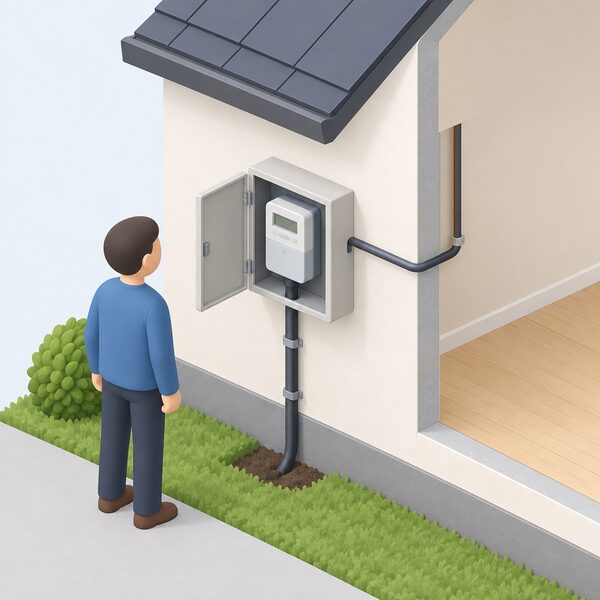
Own solar gives a household direct control of a generating asset and a measurable independence ratio. Self-sufficiency is defined as the percentage of electricity consumed in the property over a year met by behind-the-meter solar or electrical storage2. That is the number a home array moves, and it moves further with a battery. The limit is that most homes remain connected to the grid, buy at night and in winter, and export at rates far below import tariffs13.
Community energy gives a different kind of control: democratic ownership rather than physical self-supply. Community energy allows people and communities to take democratic control over their energy future1. The Caerau mine water scheme in Wales was designed to supply 100% community energy, all of which is renewable and off-grid, through a proposed private wire solution22. That is an unusually complete example, and it shows what community generation can do when it is built around a local network rather than the national grid.
What remains dependent in each case is worth stating plainly. A community energy member still depends on a licensed supplier for the units delivered to the home, on the society's governance, and on the project's income. An own-solar household still depends on the grid for everything the array does not cover, on a supplier for import and export payments, and on the manufacturer for inverter and monitoring equipment. Neither route removes the connection.
The two are not the same claim. Own solar raises the self-sufficiency ratio of a single property2. Community energy raises local ownership of generation, which may or may not reduce any individual member's bill. A household weighing them should decide which of those two outcomes it is actually buying.
Effort, maintenance and responsibility
Own solar carries an ongoing obligation. Guidance for listed buildings states that maintenance of the solar system should be conducted by either a licensed electrician or the installer at least once a year23. The associated electrical works fall under building regulations24, and the installation itself may need consent depending on the building. Adding renewable energy solutions such as solar panels or air and ground source heat pumps might be acceptable on a listed building but will require listed and or planning consent25.
Planning is less of a barrier than many households assume. In many cases, even in conservation areas, homes can have solar panels without requiring planning permission from the council under permitted development26. The installation of solar panels and equipment on residential buildings may be permitted development with no need to apply to the local authority27, and the permitted development rights relating to solar panels are set out as Class A and Class B for domestic premises28. Stand-alone solar panels need full planning permission for flats or householder planning permission for houses when any trigger applies29. Solar panels are also listed among energy-saving materials in the relevant legislation30.
Community energy shifts the operational burden to the project. Turbines, arrays and private wires are maintained by the society or its contractors, and the member's obligation is financial and governance-based rather than technical. That is a real advantage for a household without the appetite or the access for a rooftop installation.
The trade is transparency. An own-solar household can see generation, self-consumption and export on its own monitoring, and self-consumption should be communicated in both estimated annual kWh and percentage of solar PV electricity consumed2. A community member sees the society's accounts and reports instead. Both are legitimate; they answer different questions.

Where each fits: which homes suit which route
Own solar needs a roof the household controls, a suitable aspect, and either capital or access to finance. It suits owner-occupiers who expect to stay long enough to see the return, and it is cheapest at the point of new build, where installation may be 10% cheaper3. It also suits households that want a measurable self-sufficiency ratio and are prepared to add storage to raise it2.
Community energy suits households that cannot install: renters, flat dwellers, those in listed buildings or conservation areas where consent is uncertain, and those without capital. Membership does not require a roof. It also suits households that want a local ownership stake rather than a physical asset, and it can be combined with grant-funded efficiency measures where eligibility rules are met17.
Small wind is a separate question and rarely a substitute. A domestic wind turbine may be a suitable renewable energy option if the house is in an exposed or isolated location10. For most urban and suburban homes, that condition is not met, which leaves solar or community membership as the realistic routes.
Geography matters for the community route. Community energy groups and local authorities work together on projects8, and the Scottish Government supports local and small-scale renewables through the Community and Renewable Energy Scheme, delivered by Local Energy Scotland8. Support structures, planning practice and grant rules differ across England, Scotland, Wales and Northern Ireland, so a household should check the position where it lives rather than assume a scheme operates uniformly.
| Household situation | Own solar | Community energy |
|---|---|---|
| Owner-occupier, suitable roof, capital available | Fits well3 | Possible alongside1 |
| Renter or flat dweller | Usually not available | Fits well1 |
| Listed building or conservation area | Consent may be required25 | Fits well1 |
| New build | Installation may be 10% cheaper3 | Depends on the development |
| Exposed or isolated location | Solar, or small wind10 | Depends on local projects |
Combining both: membership and panels together
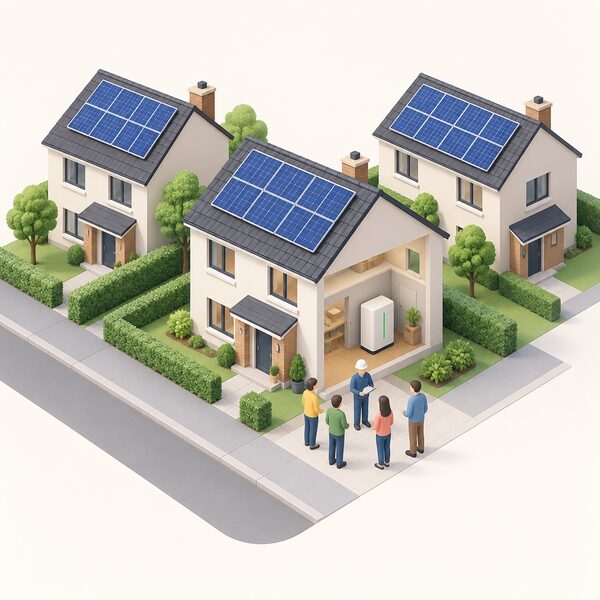
The two routes can be held at once, and several schemes are built around exactly that. Solar Together is a group-buying scheme for solar panels and battery storage26, and Solar Together Wirral brings households together to get high-quality solar panels at a competitive price29. Group buying is not community ownership, but it is a collective route to a private installation, and it sits between the two models.
Battery retrofits extend the combination to households that already generate. Switch Together Norfolk allows households with existing solar panels to register to have battery storage added to maximise the benefits of the system31. That is the clearest published example of a scheme designed for homes that already have their own array.
The technical case for combining is straightforward. Solar panels can be used in the building where they are fitted32, and using solar electricity yourself is much more cost-effective than exporting it because export rates are much lower than import tariffs13. A battery raises the share of generation consumed on site, and Solar Energy UK suggests that combining rooftop solar with a battery could enable 80% of a household's annual electricity consumption to be low carbon3.
For a household's independence, the combination is additive rather than duplicative. The rooftop array raises the property's self-sufficiency ratio2; the community stake adds local ownership of generation and, depending on the society, a financial return or a local cost benefit1. Neither removes the grid connection, and neither removes the need for a supplier. What they do is shift a larger share of the household's energy position into assets it owns or co-owns, which is the practical meaning of energy independence for a home that stays connected.
"Community energy allows people and communities to take democratic control over their energy future, by understanding, generating, using, owning, and saving energy in their communities, as well as working together across regions and nationally"
Sources32 cited
- What is community energy?, Community Energy England, 2026-09-20
- MCS 032: solar PV self-consumption, MCS, 2025-01-01
- Postnote: solar technologies, Parliamentary Office of Science and Technology, 2026-06-25
- Community energy delivers affordable power, Energy Saving Trust, 2025-09-22
- Three million households plan to get solar panels, Uswitch, 2026-05
- UK solar roadmap, Department for Energy Security and Net Zero, 2025-06
- What are the benefits of community-owned wind power?, Energy Saving Trust, 2026-09-17
- Local and small-scale renewables, Scottish Government, 2026-09-17
- Solar PV, Flexi-Orb, 2025-04-22
- Generating renewable electricity, Energy Saving Trust, 2025-12-11
- Feed-in Tariffs quarterly report, issue 63, Ofgem, 2026-03-30
- Feed-in Tariffs quarterly report, issue 60, Ofgem, 2025-03-31
- Solar panels, London Borough of Hammersmith and Fulham, 2026-09-17
- The value of solar property, House of Commons Library, 2025-01-15
- Information regarding free solar PV systems, Renewable Energy Consumer Code, 2026-09-17
- Energy Company Obligation: homeowners and tenants, Ofgem, 2026-09-17
- ECO 4 and ECO Flexible Eligibility, Breckland Council, 2026-09-17
- Warm Homes Local Grant, Greater Manchester Combined Authority, 2026-09-17
- Support to generate your own electricity, nidirect, 2025-09-22
- Energy in buildings: heat and buildings, Department for Energy Security and Net Zero, 2025-06
- Warm Homes Plan technical annex, Department for Energy Security and Net Zero, 2026-09-17
- Smart Living Initiative annual report, Welsh Government, 2019-07
- Clifton local listed building consent order guidance, Bristol City Council, 2025-02
- Solar panels guidance, City of York Council, 2026-09-17
- Making alterations to a listed building, Bristol City Council, 2026-09-17
- Solar panels and permitted development, London Borough of Richmond upon Thames, 2026-07-06
- Solar photovoltaic panels, London Borough of Bromley, 2026-09-17
- Solar panels and planning permission, Cornwall Council, 2026-09-17
- Solar panels, Wirral Council, 2026-09-17
- Energy-saving materials, Schedule 8, legislation.gov.uk, 2026-09-17
- Solar Together Norfolk, South Norfolk and Broadland Council, 2026-09-17
- Solar panels, East Hertfordshire District Council, 2026-09-17
 Community Energy Share OffersHow community energy share offers work in community benefit societies and co-operatives, what returns and risks are stated, how withdrawal works, and how owning shares differs from owning generation on your own roof.
 The Full Your Type of Home GuideLiving in a flat, an old listed house or somewhere off the gas grid changes what energy help you can get and what you are allowed to install.
 Local Energy Supply ClubsJoining a local energy club means your area's wind or hydro power is matched to your home's use, so you pay less for the electricity you use when it is being generated nearby.
 Permitted Development by HomeCan you put up solar panels or a heat pump without asking the council?
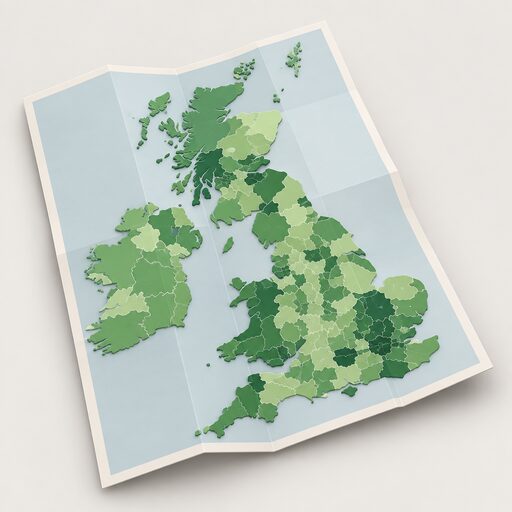 MCS Data by Local AuthorityHow many solar panels, heat pumps or batteries have gone into homes in your council area?
 Community Energy in the UKWhat community energy means in practice, the legal structures used, and the types of project householders can join or benefit from.