In this guide
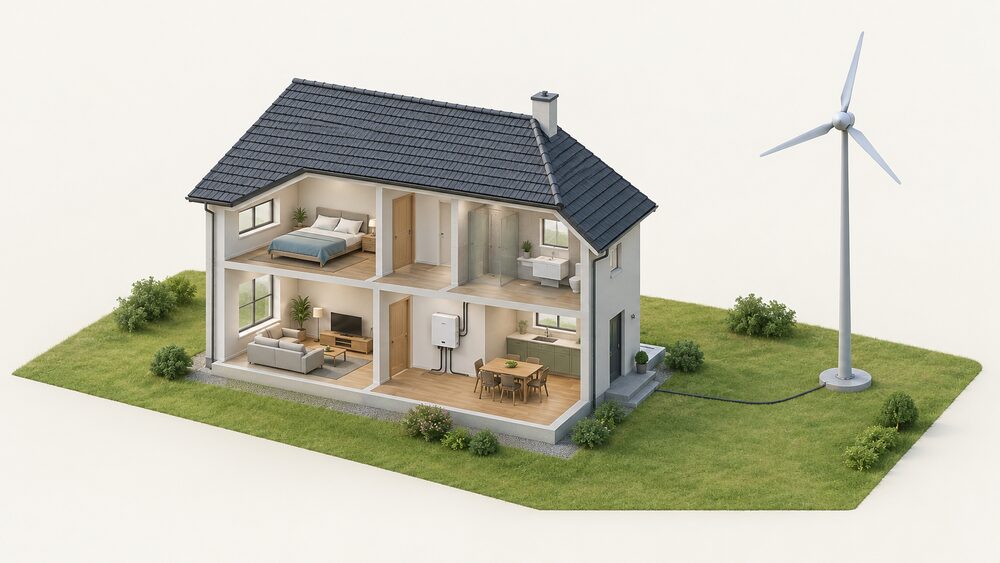
A domestic wind turbine is a small generator driven by the wind: the wind forces the rotor blades round, and they drive a turbine that produces electricity1. Machines sold for homes span a wide range, from windchargers of a few hundred watts that top up a battery to mast-mounted turbines of several kilowatts. Northern Ireland government guidance puts a typical domestic system at 2.5 to six kilowatts (kW), depending on the location and size of the house2, while a Scottish retrofit adviser gives the domestic range as 1kW to 15kW3.
What a turbine produces depends overwhelmingly on the wind at its site. The Energy Saving Trust states that a well-positioned 6kW turbine can generate around 9,000 kWh of electricity a year3, and that a well-sited 6kW turbine could save around £650 a year in Great Britain and £800 in Northern Ireland4. Guidance is consistent that a site needs an annual average wind speed of about five metres per second (m/s) or more2, and that turbines generally are not suitable in built-up areas1.
A pole-mounted 6kW system costs around £31,000 to £35,000 installed, depending on the source4. That is a large outlay for a machine whose value rests almost entirely on the site, which is why measuring the wind first, and understanding planning rules in each of the four nations, matter as much as the choice of turbine.
How a domestic wind turbine makes electricity
When the wind blows on a turbine, the blades are forced round, driving the generator7. The relationship between wind and output is steep: the faster the wind, the more energy produced7, and, as the siting section below shows, the gain is not proportional but cubic.
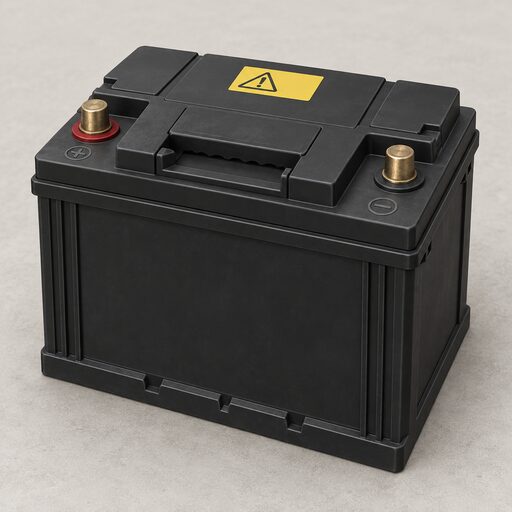
What happens to that electricity next splits turbines into two families. Northern Ireland guidance states that most small wind turbines generate direct current (DC) electricity and store it in a battery2. These are battery-charging machines, the windchargers used on boats, remote cottages and off-grid sites, which are covered in detail on the page on off-grid wind power. The second family is grid-connected: a device called an inverter connects the turbine to the main wiring in the house8, so the home uses the turbine's power first and draws on the grid or exports when output and demand do not match.
The distinction matters for independence. A battery-charging system can run a home or outbuilding with no grid connection at all, but only as far as the wind and the battery allow. A grid-connected system cuts the electricity bought from a supplier but still relies on the grid as a backstop and, usually, as a buyer of surplus. Connections for home generators are covered under G98 and G99, and in Northern Ireland under G98/NI and G99/NI.
Pole-mounted, roof-mounted and battery-charging units

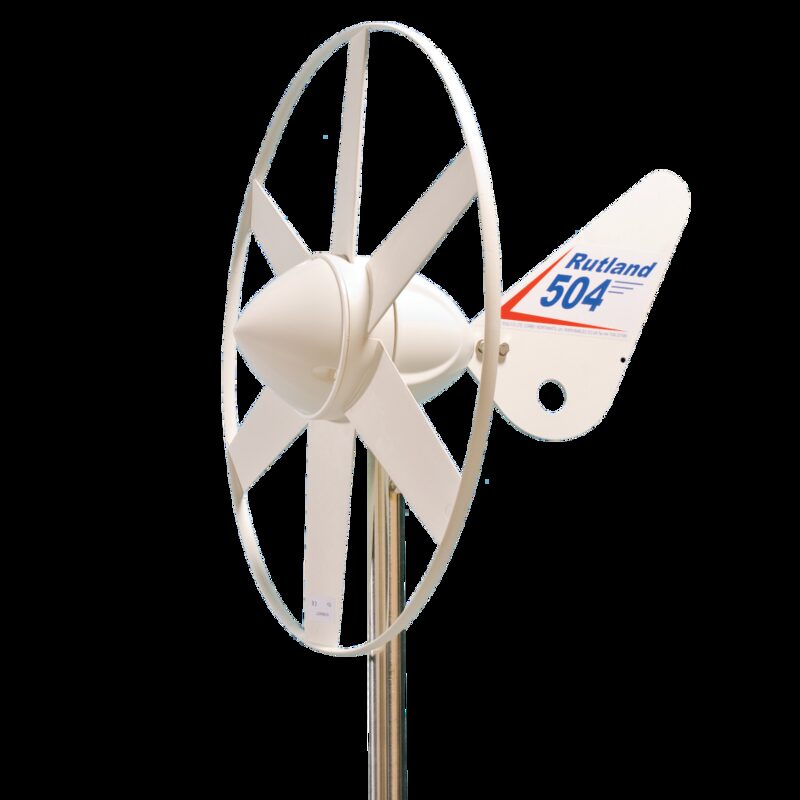
There are two main types of domestic wind turbine in the UK: the freestanding or pole-mounted turbine, and the roof-mounted turbine9. A third category, small battery-charging units of around 100W9, overlaps with both and is usually mounted on a short pole, a boat or a building.
Pole-mounted turbines
Pole-mounted turbines stand on their own pole, usually placed in a clear, open area where there is plenty of wind10. The Energy Saving Trust describes them as free-standing turbines that work best in a large open place exposed to the wind4. They are the machines behind the headline output figures: the typical domestic system of 2.5 to 6kW is pole-mounted.
Building-mounted turbines
Building-mounted turbines are smaller machines that can be installed on rooftops or building sides10. They cost less to install than pole-mounted ones, but they tend to be smaller and less efficient4, and studies show them to be far less effective in built-up urban areas owing to lower wind speeds9. A turbine fixed to a house also brings structural and building regulations issues, set out below. The page on roof and building-mounted wind turbines goes further, and a side-by-side view is given in pole-mounted vs roof-mounted wind turbines.
Battery-charging windchargers
At the bottom of the range, small units that generate around 100W charge a battery9. They suit loads such as lighting, an electric fence or a caravan rather than a whole house. UK examples include the Rutland windchargers made by Marlec Engineering and Leading Edge micro wind turbines.
Sizes and outputs: from 100W chargers to 15kW home turbines
Individual wind turbines range from a few hundred watts to two or three megawatts2; the domestic end runs from small battery chargers to machines of around 15kW. The rated output (in kW) is the power a turbine delivers at a specified wind speed, not what it produces on an average day. Annual energy (in kWh) depends on how often the wind blows at useful speeds on the particular site.
| Category | Rated size or output | Source |
|---|---|---|
| Small battery-charging unit | around 100W | 9 |
| Units for homes and businesses | 0.6 to 50kW | 9 |
| Domestic turbine range | 1kW to 15kW | 3 |
| Typical domestic system | 2.5 to 6kW | 2 |
| Small turbine powering a single property | may have a capacity of 10kW | 5 |
| Building-mounted turbine | around 2kW | 4 |
| 6kW turbine, well positioned | around 9,000 kWh a year | 3 |
| Rotor about 1 metre across, good site | a few hundred kWh a year | 11 |
Physical size follows output. Small wind turbines are usually between two and eight metres high12, and the Centre for Alternative Technology notes that a rotor of about 1 metre on a site with good average wind speeds could give a few hundred kWh a year11. MCS gives pole-mounted turbines a typical output of 3 to 15kWh and building-mounted turbines around 1 to 2kWh10, without stating the period, so these figures are best read alongside the annual figures above rather than as a daily or yearly total.
Size also sets how a turbine connects. For generators of 50kW or less, one distribution network operator states there are generally no network capacity constraints or reinforcement costs in most areas13. Northern Ireland's network operator treats wind generation up to 250kW as small-scale14. Every domestic turbine therefore sits well inside the smallest connection category, which keeps the grid side simple. Sizing a turbine to a home's use is covered in how much electricity a home wind turbine produces.
Site suitability: wind speed, exposure and obstructions
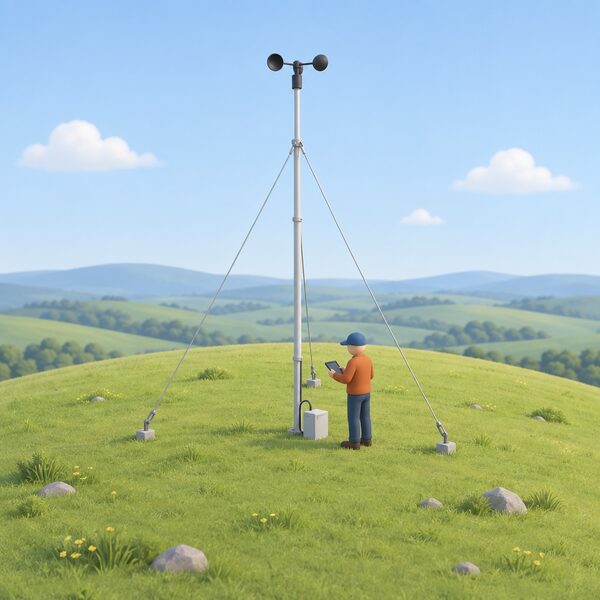
The most important fact about a small wind turbine is that the site decides whether it works. Official and independent guidance agree on the threshold: consider a turbine where the local annual average wind speed is five metres per second or more2. The Centre for Alternative Technology puts it as generally needing an average of more than 5 m/s15.
The Energy Saving Trust states that domestic wind turbines generally are not suitable in built-up areas, but that a house in an exposed or isolated location could suit one16. Turbines work best in exposed, windy locations and are less suitable for built-up or sheltered areas4. MCS adds that turbines should ideally sit on a hilltop or raised structure, away from obstructions such as trees or other buildings10, and the Centre for Alternative Technology describes the ideal as:
"An ideal site is a smooth hilltop with a clear open stretch, at least in the prevailing wind direction."
The UK is well placed in general, with an estimated 40% of Europe's wind blowing over it9, but national averages say little about one garden. Trees, buildings and the shape of the land slow and disturb the wind close to the ground.
Measuring the wind before buying
Advice on measurement is consistent in method and varies in duration:
- An anemometer, or wind gauge, in the intended location for at least three months, as the Energy Saving Trust recommends9.
- A wind gauge for a couple of months near the property, as one network operator suggests5.
- At least a year's worth of anemometer data, as a Scottish retrofit adviser advises3.
The difference reflects a trade-off: a full year captures the seasonal swing between windy winters and calmer summers, while a few months gives a quicker, rougher check. The Centre for Alternative Technology notes it could be worth spending a few hundred pounds on wind monitoring equipment, such as a mast and data logger, before spending thousands on a turbine11. For a first estimate, the average wind speed can be looked up from a grid reference in the wind speed database, or with the Carbon Trust's wind yield estimation tool9. More detail is on wind speed and siting, finding the wind speed at a postcode and how long to measure wind before installing.
Why siting outweighs almost everything: rotor size, height and wind speed
Two physical rules explain why small differences in site produce large differences in output. The Centre for Alternative Technology sets them out plainly: when the diameter of a rotor doubles, the swept area becomes four times as big; and doubling the wind speed yields eight times as much power11. Rotor size therefore matters a great deal, and wind speed matters even more.
Height is the practical lever on wind speed. Higher placements catch stronger, steadier winds10. This is why a pole turbine in an open field can outperform a larger rated machine on a roof in a town. The Warwick Wind Trials put a figure on the gap: a turbine on a good site, in an open area on a high tower, would generate 20 to 30 times as much electricity as those on the poor sites in the study15.
| What changes | Effect on the turbine | Source |
|---|---|---|
| Rotor diameter doubled | Swept area four times as big | 11 |
| Wind speed doubled | Eight times as much power | 11 |
| Good site vs poor site (Warwick Wind Trials) | 20 to 30 times as much electricity | 15 |
The same physics sets the limits on roof turbines. A house cannot safely carry a big rotor high above the ridge: for turbines attached to a house, the Planning Portal notes that the size, weight and force exerted on fixed points would be considerable17, which is why building regulations apply. At the other end, the Centre for Alternative Technology points out that larger UK turbines, from makers such as SD Turbines and Britwind, have rotors several metres in diameter on high towers and so are not suitable for most homes15.
What a domestic wind turbine costs
The published costs cluster around one reference system, a 6kW pole-mounted turbine, and include equipment and installation. Costs cover the turbine, mast, inverters, battery storage where needed, and installation2.
| System | Price | Source |
|---|---|---|
| 6kW pole-mounted, equipment and installation | around £35,000 | 4 |
| 6kW pole-mounted | around £31,000 | 5 |
| 6kW turbine, including installation | around £31,000 | 3 |
| Turbine, tower and installation, per rated kW | £2,500 to £6,000 | 11 |
| Domestic battery, typical 5kWh | around £4,600 (up to £10,000 depending on size) | 18 |
The two 6kW figures differ by £4,000 (£35,000 against £31,000) because they come from different advisers; neither states the VAT position or the date the price was set, and actual prices are installer-quoted. The per-kilowatt range from the Centre for Alternative Technology shows how widely costs vary with turbine size, tower height and site access11. Building-mounted turbines cost less to install than pole-mounted ones but are smaller and less efficient4, so a lower price does not mean cheaper electricity. A fuller breakdown is on how much a domestic wind turbine costs, and funding is covered under grants for wind, hydro and micro-CHP.
Running costs, maintenance and lifespan
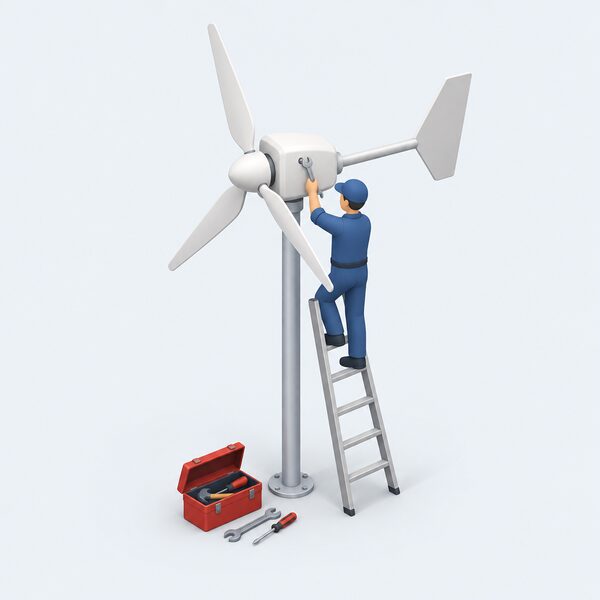
Wind has no fuel cost: once the installation is paid for, the electricity it produces saves money on bills16. The running costs are servicing and replacement parts, because turbines have moving parts and require regular servicing5.
- Service checks: needed every few years, generally costing around £100 to £200 a year depending on the turbine size6. MCS gives the same range10.
- Inverter: likely to need replacing during the turbine's life; for a larger system this usually costs £1,000 to £2,00010.
- Batteries: in off-grid systems the batteries also need replacing9; typical battery life is around six to ten years, depending on the type2.
- Turbine life: up to 22.5 years with service checks every few years2; MCS states over 20 years with regular upkeep10.
Over a 20-year life, then, a battery-based system can expect to replace its batteries at least once and its inverter possibly once. Where the original maker has failed, spare parts and servicing may depend on independent specialists. In Wales, a permitted development stand-alone turbine must be removed as soon as reasonably practicable when no longer needed for microgeneration19. Practical detail is on installing and maintaining a domestic wind turbine and maintenance costs.
Planning permission differs in each nation
Planning is where the four nations differ most. Independent guidance states that residents in all British nations will usually need to apply for planning permission before starting installation work9. Permitted development rights exist in England, Scotland and, for stand-alone turbines, Wales, but only within tight limits. The Planning Portal's advice holds everywhere: always check with the Local Planning Authority before a system is installed20.
England
Under permitted development, some domestic turbines can be installed without a planning application, provided specified limits and conditions are met20. For a stand-alone turbine, no part including the blades may be closer to any point on the property boundary than the turbine's overall height plus 10 per cent21. For building-mounted turbines, rights apply only to detached houses (not blocks of flats) and other detached buildings within the grounds22. Rules common to both include:
- Only the first turbine is permitted development, and only if there is no existing air source heat pump at the property21.
- No rights within the curtilage of a listed building or scheduled monument, or on designated land other than conservation areas, such as national parks, the Broads, Areas of Outstanding Natural Beauty and World Heritage Sites22.
- For building-mounted turbines, no blade swept area over 3.8 square metres, no protrusion more than 3 metres above the highest part of the roof (excluding the chimney) or overall height over 15 metres, whichever is less, and at least 5 metres between ground level and the lowest part of any blade23.
- Building-mounted permitted development does not apply where a stand-alone turbine is already installed within the curtilage23.
"Development is not permitted by Class H unless the wind turbine complies with the MCS Planning Standards or equivalent standards"
Turbines attached to the house also fall under building regulations; an installer registered with the relevant competent person scheme may be able to self-certify the work17. See planning permission in England, boundary distances and MCS installers and permitted development.
Scotland
Class 6G permits a free-standing turbine within the curtilage of a dwelling, and Class 6HC permits a turbine on a detached dwellinghouse24. A free-standing turbine must be at least 110% of the blade tip height from the curtilage of another dwelling25. The consultation on wall or roof-mounted turbines proposed excluding conservation areas, National Parks, National Scenic Areas, Sites of Special Scientific Interest, World Heritage Sites and the curtilage of listed buildings26. See planning permission in Scotland.
Wales
Welsh Government guidance states that a stand-alone turbine within the boundaries of a house can be permitted development provided all the limits and conditions are met, including the boundary distance of overall height plus 10 per cent, and that additional turbines need a planning application19. Building-mounted turbines always need a planning application in Wales19. The Energy Saving Trust states that in Wales planning permission is needed before installing a wind turbine4; the two documents disagree on stand-alone turbines. See planning permission in Wales.
Northern Ireland
Northern Ireland guidance states simply that planning approval is needed for small-scale wind turbines2, and the Energy Saving Trust agrees4. See planning permission in Northern Ireland.
Noise and shadow flicker often shape planning decisions; they are covered on wind turbine noise and neighbours.
Savings, batteries and solar: what a turbine does for independence
The reference savings figure is the Energy Saving Trust's: a well-sited 6kW turbine could save around £650 a year in Great Britain and £800 in Northern Ireland4. MCS cites a prediction of around £700 a year on electricity10. These apply to well-sited machines; a poorly sited turbine, as the Warwick trials showed, can produce a small fraction of this.
Wind pairs naturally with storage and solar. A battery can store surplus electricity from turbines and solar panels to use later4. Battery storage helps households make the most of electricity from solar panels, wind turbines and hydro turbines27. MCS notes that a wind and solar hybrid system means a home is covered in low light and low wind conditions10, which matters in the UK where the windiest months are often the darkest. For fully off-grid systems, Northern Ireland guidance notes it is common to run a diesel generator for periods of low wind2.
In independence terms, a well-sited turbine can supply a large share of a rural home's electricity from a free, local resource, and small wind is especially practical for remote areas where connecting to the grid may be costly or challenging10. The dependencies that remain are real. A grid-connected system still relies on the grid when the wind drops and on a supplier to buy exports (see selling electricity from a wind generator). An off-grid system trades that for dependence on batteries with a six to ten year life, and often on diesel for calm spells. Every turbine relies on parts, inverters and servicing from a maker and installer, and the history of failed UK turbine companies shows that support can disappear. The broader picture is on micro wind, hydro and CHP and energy independence, micro wind vs solar for an off-grid home and the microgeneration hub.
Sources27 cited
- Are home renewables right for you?, Energy Saving Trust, 2025-12-11
- Wind, nidirect (Northern Ireland Government), 2026-05-18
- Domestic wind turbines, Changeworks, 2026-06-01
- Wind turbines, Energy Saving Trust, 2026-05-20
- Wind power, Electricity North West, 2026-09-19
- Wind turbines, Home Energy Scotland, 2026-09-20
- Could you generate your own energy?, Energy Saving Trust, 2024-04-12
- What is domestic distributed generation?, UK Power Networks, 2026-09-17
- Wind turbines for homes, Uswitch, 2026-01-06
- Small wind turbines, MCS, 2026-08-18
- Wind power information, Centre for Alternative Technology, 2025-06-27
- Microgeneration energy guide, Uswitch, 2026-06-08
- Generation connections, SSEN, 2026-09-19
- Micro, small-scale and large-scale renewable generation, NIE Networks, 2026-09-19
- Domestic wind power, Centre for Alternative Technology, 2023-10-01
- Generating renewable electricity, Energy Saving Trust, 2025-12-11
- Wind turbines: building regulations, Planning Portal, 2026
- POSTnote 771, Parliamentary Office of Science and Technology, 2026-06-25
- Planning permission: wind turbines, Welsh Government, 2026-09-17
- Wind turbines, Planning Portal, 2026-09-17
- Planning permission: stand-alone wind turbines, Planning Portal, 2026-09-17
- Planning permission: building-mounted wind turbines, Planning Portal, 2026-09-17
- Class H: wind turbine on domestic premises, legislation.gov.uk, 2026-09-17
- Circular 1/2024: householder permitted development rights, Scottish Government, 2024-05-28
- The Town and Country Planning (General Permitted Development) (Scotland) Amendment Order 2024, legislation.gov.uk, 2024-05-24
- Review of permitted development rights phase 3: consultation analysis, Scottish Government, 2024-03-28
- Storing energy, Energy Saving Trust, 2026-07-15
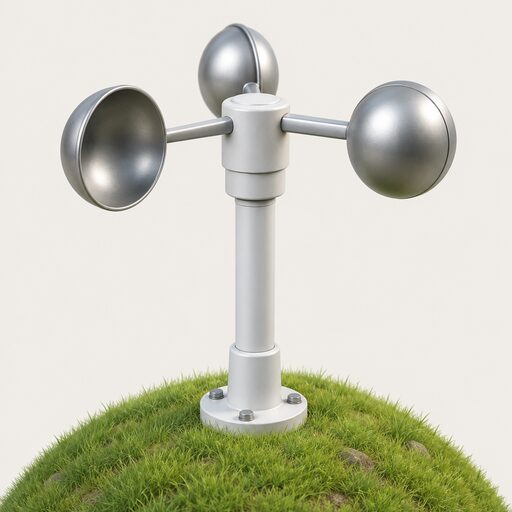 Wind Turbine Output and SizingHow much electricity a home wind turbine makes depends far more on your wind than on its size.
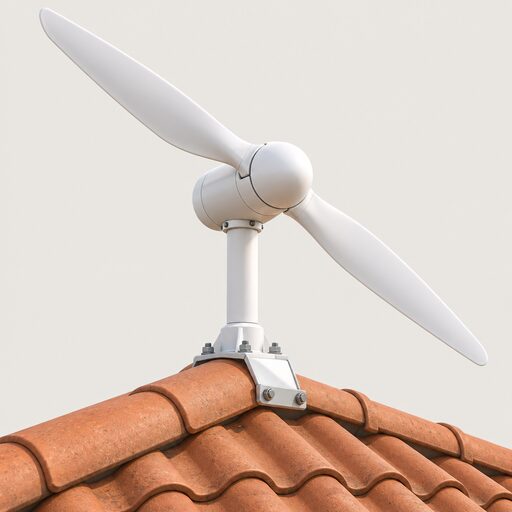 Building-Mounted Wind TurbinesWill a wind turbine on your roof actually make enough electricity to be worth it?
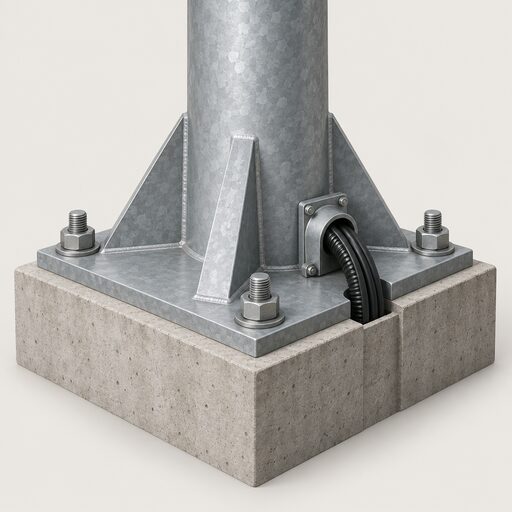 Wind Turbine InstallationWill a wind turbine actually pay for itself in a normal British garden, and how much wind does your spot really need?
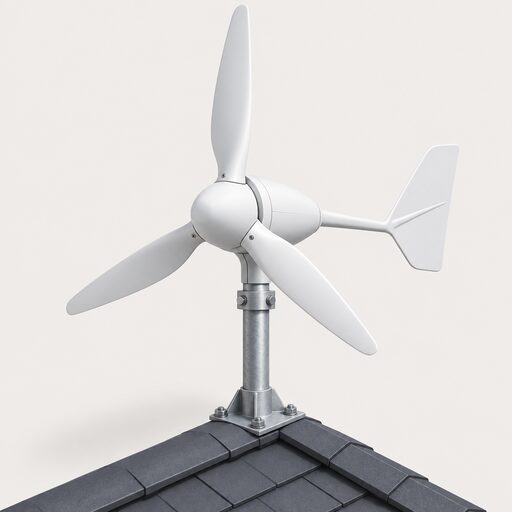 Domestic Wind Turbine CostA home wind turbine usually costs between nine thousand and nineteen thousand pounds, but the real price depends on its size and how it is mounted.
 Off-Grid Wind PowerHow much power can a small wind turbine actually make for a house, boat or caravan that is not on the grid?
 Small Wind Turbine StandardsA small wind turbine needs the right certificate before it can go up, and that affects whether you need planning permission and whether you can get paid for the electricity you send to the grid.