In this guide
A domestic wind turbine is quoted in the UK at between £9,000 and £19,000 for the turbine and its installation1. That headline masks a very wide spread by size and mounting. A small roof-mounted machine of 1 kW is listed at up to £3,0001, while a 6 kW pole-mounted system, the size most often described as a whole-house installation, is put at around £35,000 by the Energy Saving Trust for equipment and installation2 and at around £31,000 by Electricity North West3. The two figures disagree, and both are quoted as approximations rather than fixed prices.
The most useful way to read those numbers is per rated kilowatt. A turbine plus tower and installation might cost between £2,500 and £6,000 per rated kilowatt4. On that basis a 5 kW free-standing machine has been put at between £20,000 and £25,000, rising to £30,000 to £40,000 once planning permission, site preparation and grid connection are added5. That last figure dates from 2021 and is a supplier estimate, but it makes the important point: the turbine itself is only part of the bill. Costs would include the turbine, mast, inverters, battery storage if needed, and installation6.
Against that outlay, the Energy Saving Trust estimates savings of around £700 a year on electricity7, and a well-sited 6 kW turbine is put at around £650 a year in Great Britain and £800 in Northern Ireland2. Estimates of the time taken to recover the investment vary widely, from 6 to 20 years8. Everything turns on the wind at the exact spot where the turbine stands.
Cost by system type: roof-mounted, pole-mounted and free-standing
There are two main types of domestic wind turbine in the UK, the freestanding or pole-mounted turbine and the roof-mounted turbine9. Electricity North West describes the same split as roof mounted and free-standing3. The price gap between them is large, and so is the gap in what they produce.
| System | Indicative cost | Source type |
|---|---|---|
| 1 kW roof-mounted | up to £3,0001 | distributor, 2026 |
| Very small windcharger | a few hundred pounds, output a fraction of a kilowatt4 | independent, 2025 |
| 5 kW free-standing | £20,000 to £25,0005 | supplier, 2021 |
| 5 kW free-standing, all-in | £30,000 to £40,000 including planning, site preparation and grid connection5 | supplier, 2021 |
| 6 kW pole-mounted | around £35,0002 / around £31,0003 | independent guidance |
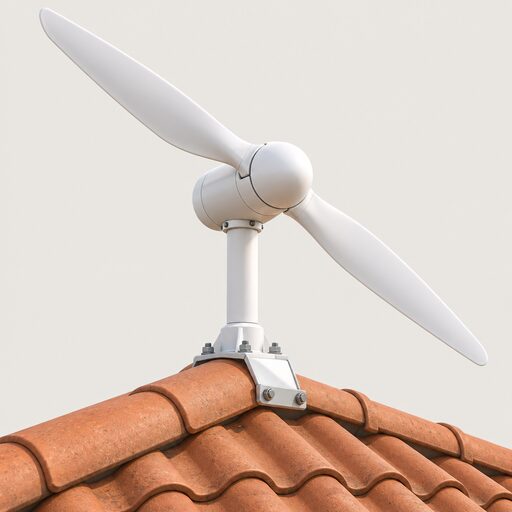
Building-mounted turbines cost less to install than pole-mounted ones, but they tend to be smaller and less efficient2. In built-up urban areas studies show building-mounted machines to be far less effective, owing to lower wind speeds9. There is also a structural question that adds cost even where planning is straightforward: for a turbine attached to a house, the size, weight and force exerted on fixed points would be considerable10.
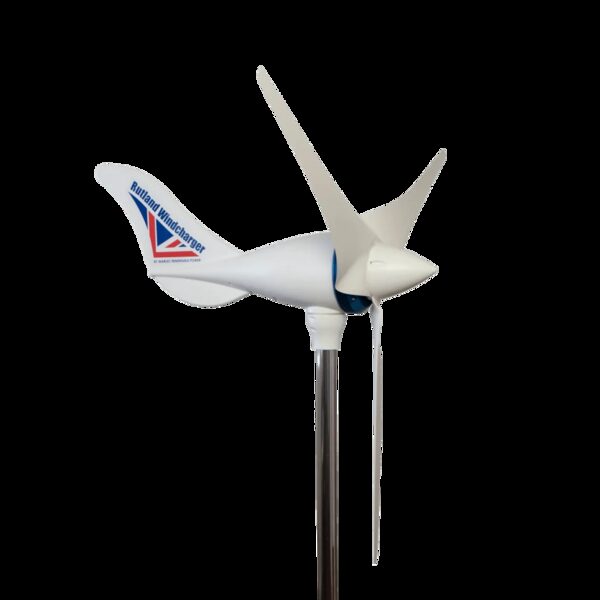
At the smallest end the economics are different again. Marlec and Leading Edge make small turbines in the UK that can generate a few hundred watts of power in a strong wind, used on boats and at remote cottages11. Mounting hardware for this class of machine is sold separately, with wind power mounting kits priced from £29.48 through £1,405.3612. These windchargers are not house-scale generation: they charge a battery bank, and are a different purchase decision from a 6 kW mast. Further detail is on the pages for roof and building-mounted wind turbines and pole-mounted vs roof-mounted wind turbines.
What the price per kilowatt covers
The £2,500 to £6,000 per rated kilowatt range covers the turbine, its tower and installation4. Read alongside the list of cost components, which adds inverters and, where used, battery storage6, it explains why quoted totals for the same nameplate rating can differ by many thousands of pounds.
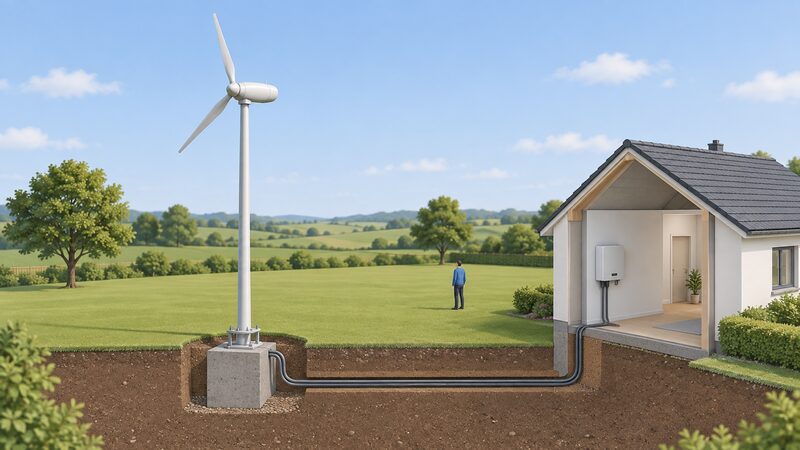
The tower is not a minor item. Wind speeds increase significantly with height, so even small turbines need to be mounted on a high tower, away from buildings and trees4. That means groundworks, a foundation and a mast, and for a stand alone machine on a domestic plot it means enough clear land to meet the separation rules described below. Grid connection is a separate cost line, listed as one of the items that lifts a 5 kW machine from £20,000 to £25,000 up to £30,000 to £40,0005.
Prices at the domestic scale are installer-quoted. The figures here are published guidance ranges, not a price list, and no fixed price exists for a site-specific installation. For comparison of scale, the Energy Saving Trust calculates that the average domestic solar array is 3.5 kW and costs around £6,100 in 202613. A turbine of similar rated output on a mast is a considerably larger civil and electrical job.
Why site and wind speed decide what you get for the money
The stronger the wind, the more energy produced14. The relationship is not linear: doubling the wind speed will yield eight times as much power4. That is why the same turbine at the same price can be a reasonable investment on one plot and close to worthless a mile away.
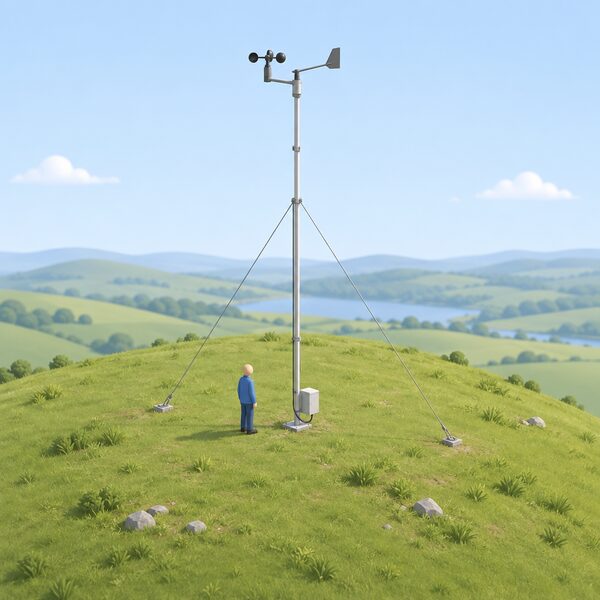
The threshold repeatedly cited is a local annual average wind speed of five metres per second or more6, which the Energy Saving Trust gives as the condition for installing at all9. The Centre for Alternative Technology puts the same figure as generally needing an average of more than 5 m/s11, and Electricity North West describes an optimum wind speed of around five metres per second3. Location and height are major factors in the performance of the turbine15. An ideal site is a smooth hilltop with a clear open stretch, at least in the prevailing wind direction4, and turbines should ideally be on a hilltop or raised structure, away from obstructions like trees or other buildings, because higher placements catch stronger, steadier winds7.
Average wind speed can be estimated from a grid reference using the wind speed database or the Carbon Trust's wind yield estimation tool9, and the Energy Saving Trust publishes a wind speed predictor that indicates whether it is worth installing a turbine16. These are screening tools. For a purchase of this size, nidirect states that ideally a professional assessment of the local wind speed should be carried out for a full year at the exact location where the turbine is to be installed6. MCS 033 sets out a method for consumers willing to wait and pay for a more accurate assessment: erect wind speed monitoring and data-logging equipment for at least six months, then combine that data with the characteristics of the proposed turbine to predict annual energy generation17. The Energy Saving Trust suggests installing an anemometer where the turbine is planned and leaving it there for a couple of months5. Monitoring equipment such as a mast and data logger costs a few hundred pounds, which is worth weighing before spending thousands on a turbine4. See also wind speed and siting for a home wind turbine.
Sizing the turbine: rotor diameter, output and what it can power
Rotor diameter, not nameplate rating, is the physical driver of output. When the diameter of a rotor is doubled, the swept area becomes four times as big, so a rotor with a 10 metre diameter captures one hundred times as much wind as one with a one metre diameter4. A turbine with a rotor of about 1 metre on a site with good average wind speeds could give a few hundred kilowatt-hours of electricity per year; to get as much energy per year as a whole solar roof array, a rotor about 4 metres across would be needed4.
Individual turbines range from a few hundred watts to two or three megawatts6. Domestic machines sit at the bottom of that: small domestic turbines typically have capacities of around 1 to 10 kW18, bigger units for homes and businesses generate between 0.6 and 50 kW, and the smallest units generate around 100 W and charge a battery9. A typical domestic system for a home would be 2.5 to 6 kW, depending on location and house size6. A turbine that can power a single property may have a generating capacity of 10 kW3. Small turbines are usually between two and eight metres high19.
Output claims should be read against capacity factor. Large commercial turbines generally produce only 30 to 40% of stated capacity, depending on wind speed and air density20, and small turbines usually produce less than 100 kilowatts per day20. Pole-mounted turbines are described as typically producing 3 to 15 kWh7, and a small domestic turbine may generate a few thousand kilowatt-hours of electricity per year depending on wind conditions18. More detail sits on how much electricity a home wind turbine produces.
Planning permission and the permitted development limits
Under permitted development rights it is in some cases possible to install a domestic wind turbine without an application for planning permission, so long as specified limits and conditions are met; in other cases an application to the local planning authority is required21. Planning permission may be required prior to installation19, and local authorities may charge a fee for pre-application advice21. The rules differ across the four nations.
| Nation | Key limits |
|---|---|
| England, stand alone | Highest part including blades not to exceed 11.1 metres; blades at least 5 metres above ground level; part of the turbine must be at least the overall height plus 10% of that height from any point on the boundary21 |
| England, building-mounted | No part, including blades, more than 3 metres above the highest part of the roof excluding the chimney, and not more than 15 metres overall, whichever is the lesser23 |
| Scotland | Free-standing blade tip height not to exceed 15 metres, lowest blade at least 5 metres from ground level; on a detached dwellinghouse, no part more than 3 metres above the highest part of the roof excluding any chimney24 |
| Wales | A stand alone turbine within the boundaries of a dwellinghouse can be permitted development if all limits are met, with the highest part not exceeding 11.1 metres; a building-mounted turbine needs a planning application26 |
| Northern Ireland | Planning approval is needed, with applications to the local council planning department6 |
In England only the first installation of any wind turbine is permitted development, and only if there is no existing air source heat pump at the property; additional turbines or heat pumps require a planning application21. The same one-turbine restriction applies in Wales, where additional wind turbines or air source heat pumps at the same property require an application26, and where development is permitted only if the installation complies with the Microgeneration Certification Scheme Planning Standards or equivalent26. Nesta describes the Welsh position as homeowners not needing to apply for planning permission provided there is only one turbine and it meets certain criteria, while being required to minimise its effect on the amenity of the area27.
Nation-specific detail is set out on the pages for England, Scotland, Wales and Northern Ireland.
Running costs over a 20-year life
Wind is free, so once the installation is paid for the household saves money on electricity bills14. It is not maintenance-free. Because turbines have moving parts, they require regular servicing3. Maintenance checks are generally needed every few years, typically costing between £100 and £200 depending on the size of the system7. Home Energy Scotland puts the cost at around £100 to £200 per year depending on turbine size28. The two figures share a range but are stated on different bases, one per check every few years and the other per year, so the annual cost over a 20-year life could differ considerably depending on which applies to a given turbine and service arrangement.
The inverter is the main planned replacement. It converts the turbine's energy into usable electricity and may need replacing once during the system's lifetime, usually costing between £1,000 and £2,000 for a larger system7. Some moving parts of the turbine may also have to be replaced during its lifetime of around 20 years4.
On life expectancy the sources broadly agree. Small wind turbines can last over 20 years with regular upkeep7; a supplier puts the lifespan at 20 to 25 years18; nidirect states that wind turbines can have a life of up to 22.5 years, but need service checks every few years to make sure they work efficiently6. Where battery storage is part of the system, typical battery life is around six to ten years depending on the type, so batteries may have to be replaced within the turbine's life6. Over a 20-year horizon, then, a realistic running-cost picture is periodic servicing, one inverter, possibly two sets of batteries, and occasional component replacement. That is set out in more depth on installing and maintaining a domestic wind turbine.
Savings and payback against the upfront cost

The saving figures in circulation cluster around £700. MCS cites The Eco Experts and the Energy Saving Trust predicting that wind turbines could save around £700 a year on electricity7. The Energy Saving Trust's own figure is more specific: a well-sited 6 kW turbine could save around £650 a year in Great Britain and £800 in Northern Ireland2. The Northern Ireland premium reflects higher electricity prices there rather than better wind at a given site.
Set £650 to £700 a year against around £31,000 to £35,000 for a 6 kW pole-mounted system2 and simple payback runs long. Electricity North West is blunt that estimates for recovering the investment vary widely, from 6 to 20 years8. The short end of that range is only plausible on a strong site with a large share of generation used in the home, because electricity displaced at the import price is worth more than electricity exported. Any unused or excess electricity can be exported to the grid and sold to the local electricity supply company6; export rates are covered on selling electricity from a wind, hydro or CHP generator.
Grant support is thin. Home Energy Scotland lists a wind turbine at £2,500, with that sum available as a loan and no grant available29. That covers a fraction of a house-scale installation. See grants and funding for micro wind, hydro and micro-CHP for the wider picture.
Pairing wind with batteries and solar
A wind solar hybrid system means cover in both low light and low wind conditions7, which matters because the two resources peak in different seasons. If battery storage is fitted, excess electricity from wind turbines and solar panels can be stored for later use2, and a battery can be paired with small turbines to hold surplus generation for when it is most needed7.
Storage adds cost. The Energy Saving Trust puts battery storage at around £5,000 to £8,00030. Which? reports that buying and installing a battery usually costs upwards of £2,000, with a range from less than £2,000 up to £10,000 depending on capacity, type, brand and lifespan31. The Energy Saving Trust also warns of the return: adding a battery to a solar panel system can increase bill savings, but often not enough to recover the cost of the battery within its expected lifetime, particularly where households already have access to a good export tariff32. That finding is drawn from solar, but the arithmetic of battery cost against cycle life is the same for wind.
At the small end, battery-charging wind turbines can be supplied for DIY installation, while larger turbines require professional installation33. That is the off-grid pattern rather than the house-scale one, and is covered on off-grid wind power.
What a turbine does, and does not do, for independence
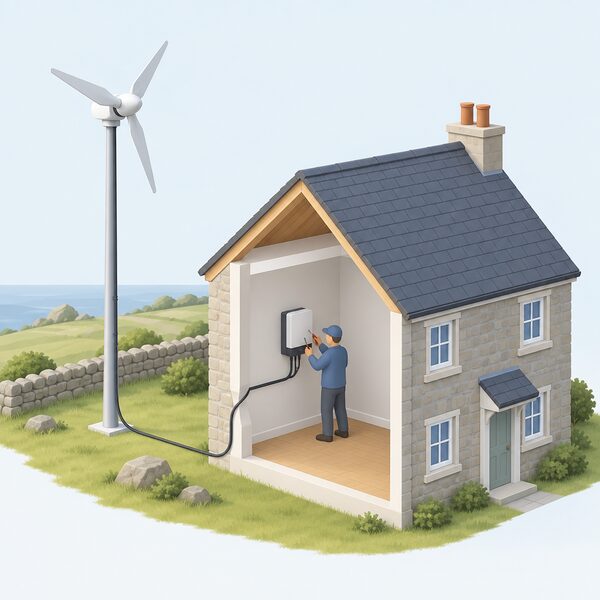
A turbine generates on site from a fuel nobody bills for, and that is a genuine shift. It suits particular properties: the Energy Saving Trust states that if a house is in an exposed or isolated location, a turbine could be a suitable renewable energy option34, and MCS notes that small wind is especially practical for remote areas where connecting to the grid may be costly or challenging7.
The dependencies that remain are real. A grid-connected system still relies on the network for the hours when the wind is low, and on a supplier to buy the export6. Output at any moment is set by the weather, and large turbines generally deliver only 30 to 40% of stated capacity20. The household stays dependent on an installer and a manufacturer for servicing every few years and for an inverter replacement costing £1,000 to £2,0007. Batteries reduce the grid dependence but add a component with a six to ten year life6 and a cost that may not be recovered within it32. A domestic wind turbine on a windy, unobstructed site displaces a substantial share of a household's imported electricity. On a sheltered suburban plot it does not, at any price.
Sources34 cited
- How to generate your own electricity, Sunsave, 2026-08-05
- Wind turbines advice, Energy Saving Trust, 2026-05-20
- Wind power, Electricity North West, 2026-09-19
- Wind power information service, Centre for Alternative Technology, 2025-06-27
- Home wind turbines: pros, cons and how much they cost, OVO Energy, 2021-05-06
- Wind, nidirect, 2026-05-18
- Small wind turbines, MCS, 2026-08-18
- Renewable energy FAQs, Electricity North West, 2023-02-23
- Wind turbines guide, Uswitch, 2026-01-06
- Wind turbines: building regulations, Planning Portal, 2026
- Domestic wind power, Centre for Alternative Technology, 2023-10-01
- Rutland FM910-4 Furlmatic windcharger, Marlec, 2026-08-07
- Rooftop solar, POST, 2026-06-25
- Generating renewable electricity, Energy Saving Trust, 2025-12-11
- Troubleshooting a windcharger system, Marlec, 2025-01-31
- Energy tools and calculators, Energy Saving Trust, 2025-12-12
- Updates to small wind turbine standards, MCS, 2024-12-06
- How does wind energy work, Power NI, 2026-04-09
- Microgeneration energy guide, Uswitch, 2026-06-08
- Renewable energy statistics, Uswitch, 2025-05-13
- Planning permission for stand alone wind turbines, Planning Portal, 2026-09-17
- Class H: installation or alteration of a wind turbine on domestic premises, legislation.gov.uk, 2026-09-17
- Planning permission for building-mounted wind turbines, Planning Portal, 2026-09-17
- The Town and Country Planning (General Permitted Development) (Scotland) Amendment Order 2024, legislation.gov.uk, 2024-05-24
- Circular 1/2024: householder permitted development rights, Scottish Government, 2024-05-28
- Planning permission for wind turbines, Welsh Government, 2026-09-17
- What could the next Senedd do on heat pump planning, Nesta, 2026-01-26
- Wind turbines, Home Energy Scotland, 2026-09-20
- Grants and loans, Home Energy Scotland, 2026-09-17
- Solar panels advice, Energy Saving Trust, 2026-08-27
- Solar panel battery storage, Which?, 2026-05-14
- Supporting households with low carbon technology combinations, Energy Saving Trust, 2026-07-15
- Off-grid wind turbines, Wind & Sun, 2026-09-20
- Are home renewables right for you, Energy Saving Trust, 2025-12-11
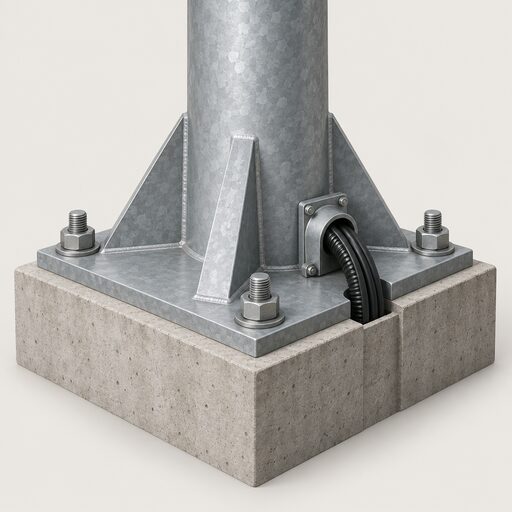 Wind Turbine InstallationWill a wind turbine actually pay for itself in a normal British garden, and how much wind does your spot really need?
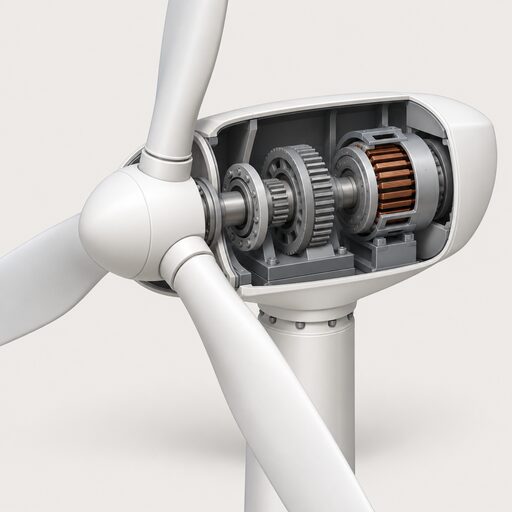 Domestic Wind TurbinesCan a wind turbine really power a home, and is your site windy enough?
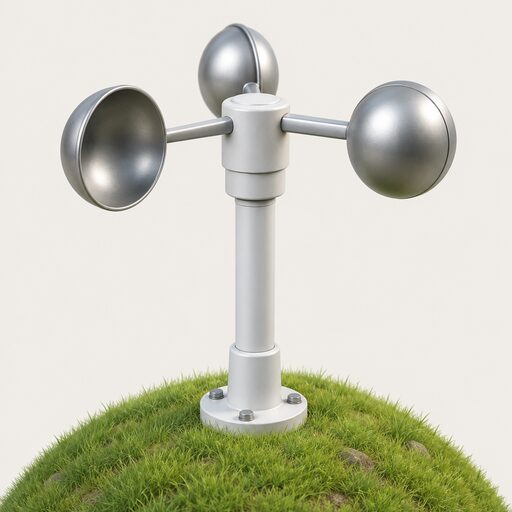 Wind Turbine Output and SizingHow much electricity a home wind turbine makes depends far more on your wind than on its size.
 Building-Mounted Wind TurbinesWill a wind turbine on your roof actually make enough electricity to be worth it?
 Home Battery CostA home battery usually costs between one and a half and ten thousand pounds fitted, depending on size.
 Solar Panel CostsA typical UK home pays somewhere between four and eleven thousand pounds for solar panels fitted, with most landing in the middle.