In this guide
A Proven Energy wind turbine is a machine whose maker no longer exists. Proven Energy, the Scottish small wind manufacturer whose 6kW machines went onto farms, smallholdings and community sites across the UK, entered administration, and the business that continued the design work is Kingspan Wind, based at Stewarton in Ayrshire. For a household still running a Proven turbine, that history is the single most important fact about the equipment: there is no manufacturer to call, no maker-backed spares channel and no warranty to rely on.
What remains is the hardware, the site and the paperwork. The turbine itself is a mechanical and electrical machine that independent small wind engineers can still inspect and repair, and the components most likely to need attention, blades, bearings, the tower and the inverter, are not brand-specific. An inverter replacement is the largest single item, and for a larger system that replacement usually costs between £1,000 and £2,0001. Routine maintenance checks are generally needed every few years, typically costing between £100 and £200 depending on the size of the system1.
The energy independence picture is mixed and worth stating plainly. A working turbine on a windy site generates electricity on the household's own land, and any unused or excess electricity can be exported to the grid and sold to the local electricity supply company2. But a grid-connected turbine still depends on a network connection, a licensed supplier for export payments, and an inverter that must be replaced roughly once in the machine's life1. Independence from the manufacturer is total, because the manufacturer has gone; independence from the grid is not.
Proven Energy entered administration: what it means for owners
The failure of a small wind manufacturer leaves three separate problems, and they are often confused with one another. The first is the warranty. A guarantee is a contract with the company that issued it, and where that company has failed there is no party left to claim against. No successor business is obliged to honour the terms of a warranty it did not give, and a household should treat any remaining paperwork as a record of what was promised rather than as an asset it can enforce.
The second is spares. Proven machines used proprietary parts, and with no factory there is no parts counter. Owners have historically relied on the second-hand market, on refurbishment of existing components, and on generic items such as inverters and controllers that are specified by electrical rating rather than by brand. That last category is the one that keeps most turbines turning, because the inverter is the part most likely to fail first.
The third is the paperwork that still has legal force. If the turbine was accredited under the Feed-in Tariff, the owner is a FIT generator, and FIT generators are the owners of accredited installations3. They are responsible for registering with a FIT licensee, from whom they receive payments, and for providing meter readings3. That obligation survives the manufacturer entirely. Where a licensee fails, the guidance is to contact a new energy supplier who is a FIT licensee and ask them to take over the FIT payments as soon as possible3. The Renewables and CHP Register, maintained by Ofgem, is where FIT generators with ROO-FIT installations apply for accreditation and record changes to it4.
Kingspan Wind: the successor company and its Stewarton base
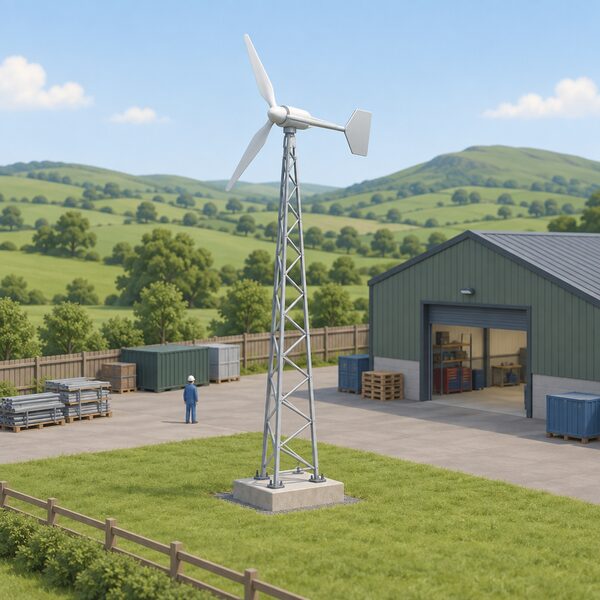
The design lineage of the Proven machines passed to Kingspan Wind, which continued manufacturing small wind turbines from a base at Stewarton in East Ayrshire. For owners, the practical significance is limited but real: the successor business is the closest thing to a technical reference for the turbine design, and it is a UK manufacturer rather than an overseas one, which keeps some engineering knowledge and tooling within reach.
It is important not to overstate what succession means. A business that acquires a product line does not automatically acquire the liabilities of the company that failed, and it does not inherit a servicing obligation to existing owners. A household with a Proven turbine should not assume that contacting the successor will produce a warranty repair, a free part or a service visit. What it may produce is advice, and in some cases a route to compatible components.
The wider UK small wind manufacturing base has thinned considerably. Several British makers of small machines have failed or withdrawn over the same period, and the pattern is consistent: a small domestic market, long product lives, and a service burden that outlasts the sales revenue. That matters for anyone weighing a new installation, because it is the reason the servicing question should be asked before purchase rather than after.
Community wind has moved in a different direction. Community-owned wind projects are one of the priorities for Great British Energy2, and the Scottish Government has identified ten onshore wind sites under 50 megawatts on public land to pilot a community access to repowering approach6. That support is aimed at shared schemes rather than single domestic machines, and it does not extend to keeping an orphaned Proven turbine running.
The turbine range owners may still have on their land
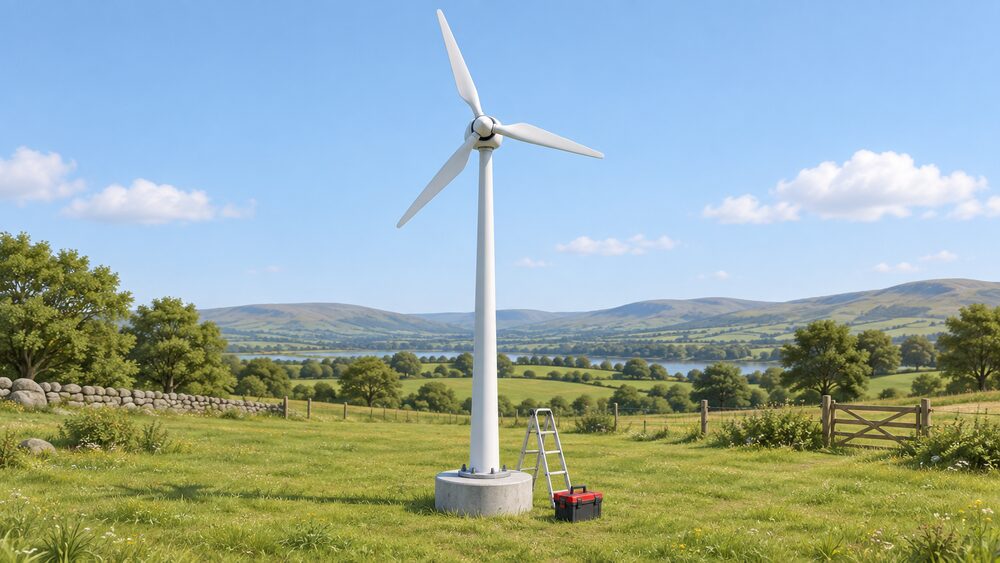
Proven machines were pole-mounted, three-bladed upwind turbines, typically in the small kilowatt classes used on farms, rural businesses and off-grid sites. The 6kW unit on a 28 metre tower erected in 2002 was one of the first community-owned wind turbines in the UK, which gives a sense of both the scale and the era of the fleet.
For context on what a domestic machine looks like today, individual wind turbines vary in size and power output from a few hundred watts to two or three megawatts, where one megawatt equals 1,000 kilowatts2. A typical domestic system for a home would be 2.5 to six kilowatts, depending on the location and size of the house2. Proven's domestic and small commercial output sat squarely in that band.
| Machine class | Typical use | What owners face now |
|---|---|---|
| Small domestic, 2.5 to 6kW2 | Home or small business1 | Independent servicing, generic inverter |
| Small commercial, around 6kW | Farm, rural business, community site | Second-hand parts, refurbishment |
| Off-grid installations | Remote sites with no cheap grid connection | Battery and controller replacement |
Small wind is especially practical for remote areas where connecting to the grid may be costly or challenging1, which is why so many Proven machines went to exactly those sites. That also explains why so many are still in service: for an off-grid property, the alternative to repairing the turbine is a generator or a much larger battery bank.
Support, spares and servicing under the new ownership
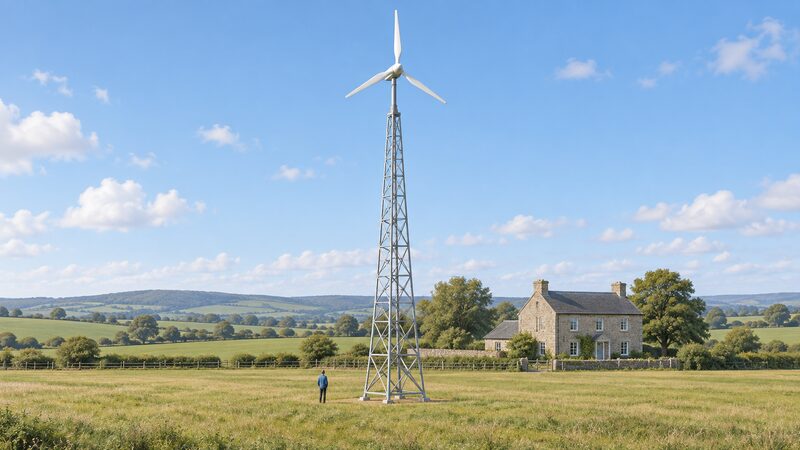
Servicing a Proven turbine today is a matter of finding an independent small wind engineer rather than a brand representative. The work itself is not exotic: blade inspection and balancing, bearing and yaw checks, tower and foundation inspection, brake and dump load testing, and inverter diagnostics. Small wind turbines generally need maintenance checks every few years1, and with regular upkeep a small wind turbine can last over 20 years1. Official guidance puts the working life of wind turbines at up to 22.5 years, but notes they need service checks every few years to make sure they work efficiently7.
The inverter is the predictable major cost. You may need to replace the inverter, which helps convert the turbine's energy into usable electricity, once during its lifetime1, and for a larger system this replacement usually costs between £1,000 and £2,0001. Routine maintenance is far cheaper, typically between £100 and £200 depending on the size of your system1.
On completion of a professionally installed system, a household receives a handover pack including key information such as product details and workmanship warranty1. For a Proven owner, that pack is now the main record of what was installed and when, and it is worth keeping with the FIT accreditation paperwork.
Where a fault cannot be resolved by the original installer, the escalation routes are administrative rather than manufacturer-led. For problems relating to late, incorrect or missing bills, back billing, being overcharged, a faulty meter, poor customer service, or a refusal to refund credit, the contact is the energy supplier8. Where a supplier has failed and a case is already open with the Energy Ombudsman, the Ombudsman will contact the household to discuss next steps9. Disputes can be registered with the Energy Ombudsman via website, telephone, email or post10.
What owning a small wind turbine means for household energy independence
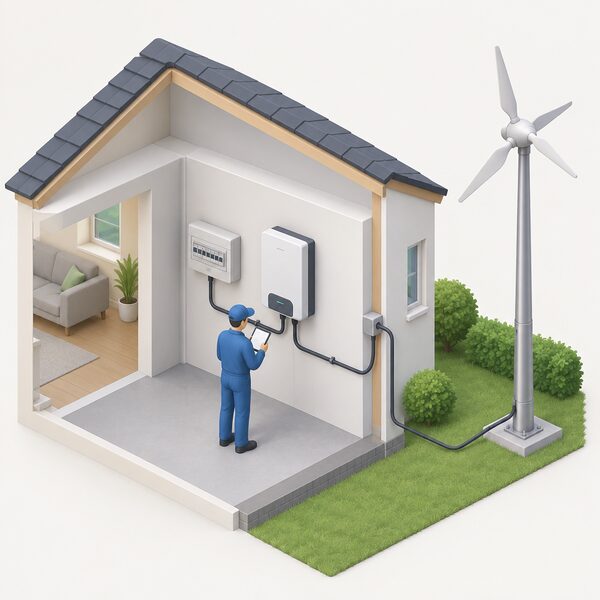
A working small wind turbine delivers a genuine but partial form of independence. It converts wind into electricity1 on the household's own land, which means the fuel is not purchased from anyone. On a good site, that removes a share of the household's electricity demand from the market entirely, and any unused or excess electricity can be exported to the grid and sold to the local electricity supply company2.
The dependencies that remain are worth naming precisely. A grid-connected turbine depends on the network for export, on a licensed supplier for payments, and on the Feed-in Tariff administrative machinery for accreditation and metering. It depends on an inverter, a piece of power electronics with a finite life, and on whoever can supply and fit a replacement. And it depends on physical access for maintenance, which on a tall tower is a specialist job.
Off-grid installations trade one set of dependencies for another. A battery bank, a charge controller and a dump load replace the grid connection, and the household becomes responsible for the whole system rather than for a single machine. It is common to run a wind system with a diesel generator for use during periods of low wind speeds2, which is a frank admission that wind alone is not a year-round answer in most UK locations.
The manufacturer dependence, at least, is gone. There is no app to lose access to, no cloud service to be withdrawn and no company whose failure can strand the equipment. That is an unusual position in modern home energy equipment, and it is the one clear advantage of owning a machine from a maker that has already failed.
Where small wind works, and where it falls short
Small-scale turbines generate electricity from wind, and output depends on wind speed and location11. That single sentence explains most of the variation in real-world performance. Systems work best in exposed, windy locations and are less suitable for built-up or sheltered areas2. Generally, higher placements catch stronger, steadier winds1, and turbines should ideally be located on a hilltop or raised structure, away from obstructions like trees or other buildings1.
The Energy Saving Trust sets two conditions for considering a turbine at all: the local annual average wind speed is five metres per second or more, and there are no major obstacles nearby such as buildings, trees or hills that are likely to reduce the wind speed or increase turbulence7. Both conditions are site tests, not equipment tests, and no turbine specification can compensate for failing either.
Building-mounted machines are a separate case. Building-mounted turbines cost less to install than pole-mounted ones, but they tend to be smaller and less efficient2, and although building-mounted turbines can work in urban settings if there's consistent wind1, the structural question is serious: size, weight and force exerted on fixed points would be considerable12. Vertical axis designs, sometimes marketed for roofs, tend to be less efficient than horizontal turbines2.
"there are no major obstacles nearby such as buildings, trees or hills that are likely to reduce the wind speed or increase turbulence"
Planning is the other gate. Guidance on the Planning Portal relates to the planning regime for England, and the policy in Wales may differ13. The same territorial caveat applies to the stand-alone and building-mounted wind turbine pages14, and the Welsh Government publishes its own planning permission guidance for wind turbines15. In Wales, a stand alone wind turbine means a wind turbine which is not fixed to a building16. In Scotland, permitted development for domestic microgeneration is set out in householder permitted development rights guidance, where a free-standing turbine must be used only for the purposes of domestic microgeneration17. Northern Ireland publishes separate guidance on wind7.
Building regulations apply alongside planning. For a turbine attached to the house, an installer registered with the relevant competent person scheme may be authorised to self-certify the work without involving local authority building control12. For electrical work on a turbine not attached to the house, the same self-certification route applies where the work is listed in Row 12 of Schedule 3 of the Building Regulations and the installer is a member of a competent person scheme listed against that row12. Always check with your Local Planning Authority about planning issues before you have a system installed13.
Costs and practicalities of keeping a turbine running
The running costs of a small wind turbine are modest compared with the capital cost, but they are not zero and they arrive in lumps. Maintenance checks are generally needed every few years, typically costing between £100 and £200 depending on the size of your system1. The inverter replacement, once in the machine's life, is the large item at £1,000 to £2,000 for a larger system1.
There is a VAT dimension that has changed recently and matters to anyone repairing or reinstalling. Wind turbines qualify for a lower rate of VAT, in Great Britain only18, and water turbines are treated the same way18. The history behind that is worth knowing because it explains gaps in older paperwork: the UK was required to exclude wind and water turbines from the list of qualifying energy-saving materials under the 2019 changes19, and wind and water turbines will also be permanently added to the list of qualifying ESMs, along with changes to the social policy conditions20. During the excluded period, wind turbines and water turbines did not qualify as energy-saving materials21. Wind turbines are listed among the qualifying materials in the relevant order22.
Grant funding for a replacement machine is limited and geographically uneven. The Home Energy Scotland Grant and Loan supports wind turbine eligible costs, but will not cover the cost of any extended warranty beyond the one-year warranty all certified installers must offer free of charge23. Support schemes elsewhere differ: Wales operates the Nest home energy support scheme, whose customer charter commits to deal fairly, honestly, consistently, and appropriately with all customers24, and English local authority schemes vary by council, with Bristol and Birmingham publishing their own grant and loan routes25 and Torridge publishing energy efficiency advice27. None of these is a manufacturer support scheme, and none restores a Proven warranty.
For a household deciding what to do with an existing machine, the arithmetic is straightforward: a few hundred pounds every few years plus a possible four-figure inverter replacement, set against the electricity the turbine generates and any export payments it earns. Where the turbine is off-grid and the alternative is a generator, repair usually wins. Where it is grid-connected on a mediocre site, the case is weaker, and the honest answer is that the site, not the machine, decides.
Sources27 cited
- Small wind turbines, MCS Certified, 2026-08-18
- Wind turbines, Energy Saving Trust, 2026-05-20
- Feed-in Tariffs: FIT generators, Ofgem, 2026-09-17
- Key terms explained: Feed-in Tariffs, Ofgem, 2026-09-17
- Energy Market Consumer Protection, Hansard, 2026-06-17
- Local and small-scale renewables, Scottish Government, 2026-09-17
- Wind, nidirect, 2026-05-18
- Complain about your energy supplier or network operator, Ofgem, 2026
- What happens if your energy supplier goes out of business, Ofgem, 2026
- We may be able to help resolve your energy dispute, Energy Ombudsman, 2026-09-20
- Sustainable home energy solutions, Planning Portal, 2024-09-02
- Building regulations, Planning Portal, 2026
- Wind turbines, Planning Portal, 2026-09-17
- Planning permission introduction, Planning Portal, 2026
- Planning permission: wind turbines, Welsh Government, 2026-09-17
- The Town and Country Planning (General Permitted Development) Order 2012, article 2, legislation.gov.uk, 2012
- Householder permitted development rights guidance, Scottish Government, 2021-04-01
- Tax on shopping: energy saving products, GOV.UK, 2026-09-17
- Explanatory Memorandum to the VAT (Energy Saving Materials) Regulations 2022, legislation.gov.uk, 2026-09-17
- Explanatory Memorandum to the VAT (Energy Saving Materials) Regulations 2023, legislation.gov.uk, 2026-09-17
- VAT energy saving materials and grant funded heating supplies, HM Revenue and Customs, 2026-09-17
- The VAT (Energy Saving Materials) Regulations 2022, legislation.gov.uk, 2022-03-23
- Home Energy Scotland Grant and Loan terms and conditions, Home Energy Scotland, 2026-09-17
- Nest home energy support scheme customer charter, Welsh Government, 2024-04-01
- Get a grant or loan to improve your home energy efficiency, Bristol City Council, 2026
- Getting help with your energy bills, Birmingham City Council, 2026-04-15
- Energy Efficiency Advice, Torridge District Council, 2026-09-17