
In this answer
Short answer
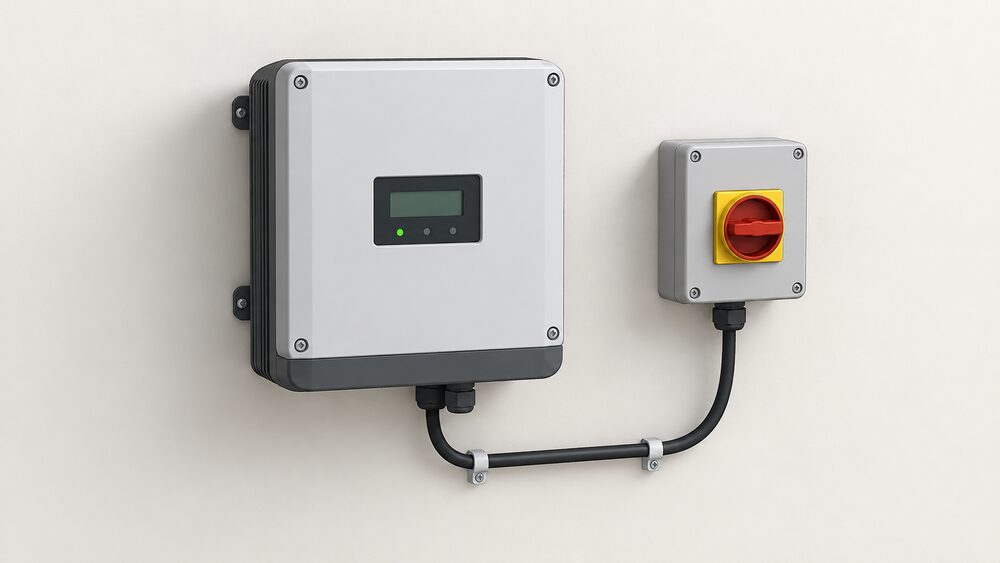
A small wind turbine inverter connects to the grid under Engineering Recommendation G98 when its output is 16 amps per phase or less. That is 3.68kW on a single-phase supply and 11.04kW on three-phase1. G98 is not a product standard or a planning rule: it is a set of protection settings regulations that generating and storage assets must comply with in order to connect to the network, and the settings exist to protect both the network and the asset from faults2.
The protection settings themselves are not chosen by the householder or dialled in by the installer. They are built into the inverter by its manufacturer, confirmed by type testing, and recorded in the ENA Type Test Register, where manufacturers must always lodge their declarations of full compliance3. The householder's obligations are lighter: notify the distribution network operator after installation, and keep the paperwork.
This page sets out what G98 covers, the settings a small wind inverter carries, the trip and reconnection behaviour behind them, and how compliance is proved. It also notes where Northern Ireland differs, because G98/NI is a separate arrangement with its own equipment register4.
G98 in a nutshell: what it covers and when it applies
G98 and G99 are technical standards for the protection settings required for generators or storage assets to connect to electricity networks, acting as a safety mechanism to protect both the network and the equipment from faults2. The distinction between them is one of size and process rather than of principle. G98 applies to all generation installations up to 16 amps per phase, which is single-phase systems up to 3.68kW and three-phase systems up to 11.04kW1. G99 covers installations over 3.68kWp, which require prior approval from the DNO8.
For a domestic wind turbine, the practical effect is that a machine whose inverter output sits at or below 3.68kW per phase takes the simpler route. The G98 process applies to smaller systems up to 3.68kW single phase, requiring notification after installation9. The purpose is stated plainly by the network operator: G98 ensures small-scale generation installations connect to the grid safely and do not compromise network stability, safety or power quality1.
Two conditions attach to that simplicity. The first is equipment: all small generation installation categories demand that all generating units must be connected via either EREC G99 or G98 type tested inverters10. The second is that the installation stays within the limit. Where a scheme crosses 3.68kWp, it moves to G99 and needs approval before connection rather than notification after it8.
The scope is technology-neutral. G98 is described as covering small-scale electricity generation such as solar panels or wind turbines with a capacity of 3.68kW or less per phase2. A wind turbine is treated the same way as a solar array of equivalent inverter rating, which is why the settings discussed below are familiar to anyone who has read a solar inverter datasheet.
The protection settings a small wind inverter must have
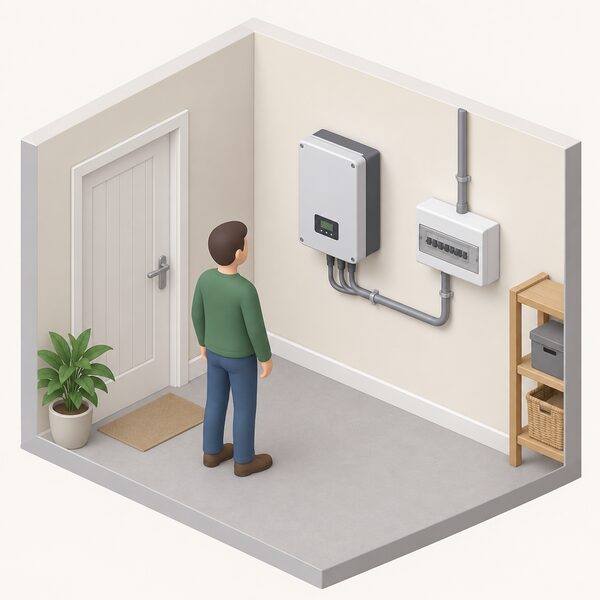
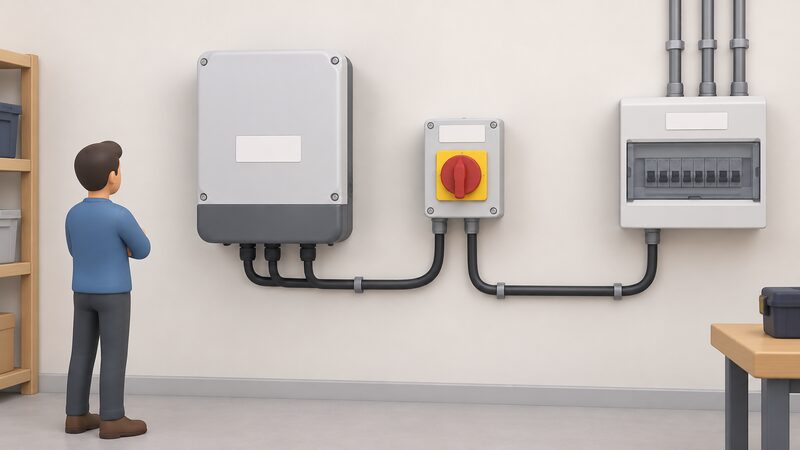
The settings a G98 inverter carries are not a single number but a set of functions that together decide when the machine disconnects from the network and when it stays connected. The core functions are voltage protection, frequency protection and loss of mains protection. A mains protection relay product sold for this market describes its offering as adjustable voltage, frequency and loss of mains protections11, which is a fair summary of the categories involved, though on a domestic inverter these are fixed in the type-tested configuration rather than adjustable by the user.
Loss of mains protection is the function that matters most for network safety. If the grid disappears, the inverter must stop exporting, because a generator that keeps energising a dead network is a hazard to anyone working on it. Voltage and frequency protection cover the slower disturbances: a supply that drifts outside the permitted band, or a frequency excursion that signals a mismatch between generation and demand.
The equipment condition is absolute. Generating units connected through the fast track process must use EREC G99 or G98 type tested inverters6, and the same requirement applies across the small generation installation categories10. Type testing is what turns a general claim of protection into a verified one: the manufacturer lodges a declaration of full compliance in the ENA Type Test Register3.
For a household, the independence point is straightforward. The inverter is the component that lets a wind turbine run in parallel with the grid rather than in isolation from it. It also introduces a dependence: the settings are the manufacturer's, the register entry is the manufacturer's, and if the company behind the inverter withdraws from the market the settings do not change but the support around them may. A small wind turbine inverter may need replacing once during the turbine's lifetime7, and the replacement must itself be a type tested unit for the connection to remain valid.
Frequency and voltage trip settings: the numbers that matter
The trip settings are the thresholds at which the inverter disconnects. They are defined by the engineering recommendation and verified by type test, which is why a compliant inverter's datasheet carries them as declared values rather than as options. The reason the numbers matter is that they are the boundary between a generator that supports the network and one that trips unnecessarily or, worse, fails to trip when it should.
The capacity figures that sit alongside the trip settings are the ones a householder will actually encounter. G98 applies up to 16 amps per phase, which is 3.68kW single-phase and 11.04kW three-phase1. The G98 notify-after-install pathway applies for inverter output of up to 3.68kW per phase for most domestic installations9. In Northern Ireland the same 16 amps per phase limit governs eligibility, with G98/NI type tested inverters and G99/NI Type A type tested inverters permitted for installations up to that figure4.
| Parameter | Value | Applies to |
|---|---|---|
| G98 capacity limit | 16 amps per phase | Single-phase 3.68kW, three-phase 11.04kW1 |
| G98 notify-after-install threshold | Up to 3.68kW per phase | Most domestic installations9 |
| G99 threshold | Over 3.68kWp | Requires prior DNO approval8 |
| Northern Ireland permitted inverters | G98/NI and G99/NI Type A | Installations up to 16 amps per phase4 |
| Rating assumption for Form B | Inverter's continuous steady state rating | Installations including an inverter1 |
That last row is worth pausing on. Where an installation includes an inverter, the rating of the installation is assumed to be the inverter's continuous steady state rating1. The inverter, not the turbine's nameplate, is what the network operator counts. A turbine rated above 3.68kW paired with a smaller inverter can still sit inside G98 on that basis, and a turbine rated below it paired with a larger inverter cannot.
Reconnection settings after a trip
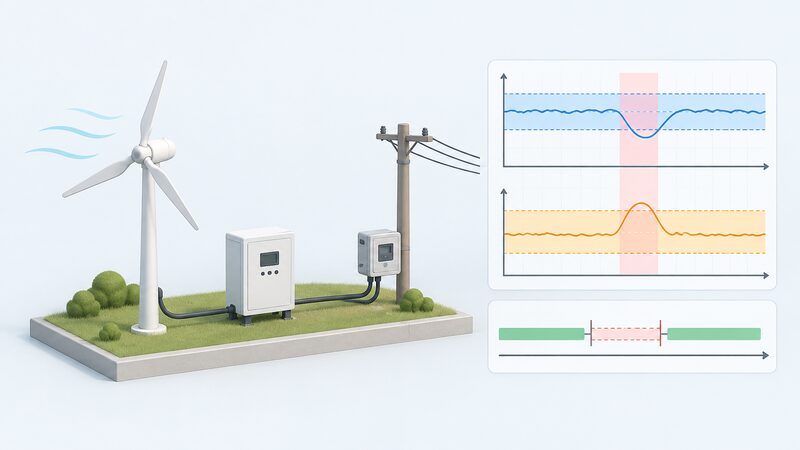
A trip is not the end of the event. The inverter has to decide when it is safe to reconnect, and that decision is governed by reconnection settings that are part of the same type-tested configuration. The general principle is that the inverter waits for the supply to return and stabilise before it resumes export, rather than chasing a flickering supply and repeatedly energising the network.
The practical sequence after a loss of supply is described in inverter support material: restore grid supply if interrupted, tighten or repair AC connections as needed, and restart the inverter after confirming stable AC voltage presence12. That is a fault-finding sequence rather than a statement of the G98 reconnection delay, but it shows the logic the inverter applies: supply present, voltage stable, then reconnect.
Some protection relays keep a record of recent events. A mains protection relay sold for this market logs the last five trips11, which is the kind of evidence that helps when a recurring trip needs diagnosing. On a domestic wind inverter the equivalent information is usually held in the inverter's own event log, and access to it may depend on the manufacturer's monitoring platform or app. That is a dependence worth naming: the protection settings are autonomous, but reading what they did often is not.
Reconnection behaviour also interacts with the turbine rather than only with the grid. A wind turbine that has been disconnected may be running unloaded, and the inverter's restart has to be coordinated with whatever control the turbine uses. Where a scheme includes a separate protection relay, the relay's settings and the inverter's settings both have to be correct, and the relay is a second device that can itself fail or be misconfigured.
Compliance and witness testing: proving the settings are right
Compliance under G98 rests on documentation rather than on a site measurement of every threshold. The manufacturer's declaration of full compliance sits in the ENA Type Test Register3, and the installer's job is to connect equipment that appears there. For a fast track connection application, the documents required include an approved inverter type test certificate and a G100 declaration6.
The forms differ by site. G98 Form A covers installations of generation or storage at multiple premises, and G98 Form B covers a single premises8. For a single domestic wind turbine, Form B is the relevant one. The notification itself is not optional even where no prior approval is needed: whether a scheme is G98 or G99 compliant, the network operator needs to be told so it can update its records6. For systems able to export up to 3.68kWp, that notification can be made within 28 days of installation5. Small systems usually only need the electricity network operator to be notified13.
Witness testing is the point at which the declared settings are checked against the installed equipment. The evidence trail is the type test certificate, the register entry and the completed form. Ongoing responsibilities do not end at commissioning: maintenance of the equipment is listed among them14.
"requires that manufacturers must always lodge their declarations of full compliance in the ENA Type Test Register."
In Northern Ireland the route is separate. G98/NI uses approved equipment, and the eligibility condition is that the installation is within the 16 amps per phase limit and uses approved equipment15. The compliant equipment list is maintained by NIE Networks4. A household in Northern Ireland therefore checks a different register from one in Great Britain, even though the capacity threshold is the same.

Where G98 stops and G99 begins
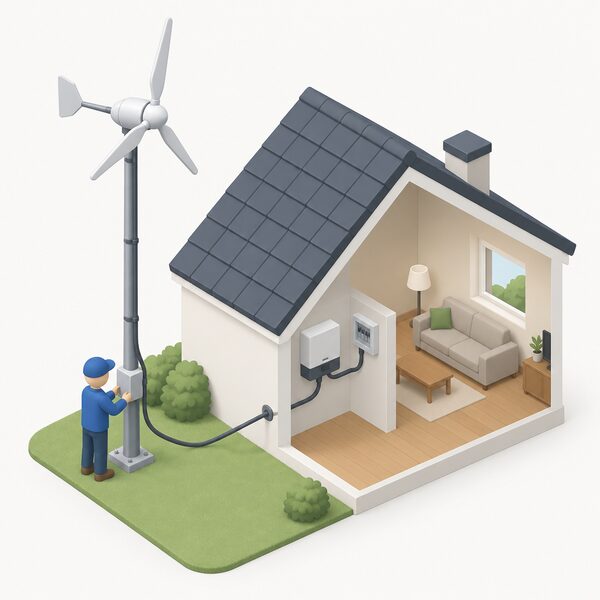
The boundary is 3.68kWp. Installations over that figure require prior approval from the DNO and fall outside the notify-after-installation arrangement8. For a wind turbine, that boundary is reached more easily than for solar, because a turbine's rated output and its inverter's continuous rating are not the same thing, and it is the inverter rating that is assumed for the installation1.
Above the threshold, the G99 fast track process applies, and any generating units connected through it, including electricity storage, must use EREC G99 or G98 type tested inverters6. The equipment requirement does not relax as the scheme grows; it tightens, because approval comes before connection rather than after.
For a household weighing a small wind turbine, the practical reading is this. A machine that stays within 16 amps per phase connects on notification, with the protection settings inherited from a type-tested inverter and evidenced by a certificate. A machine that exceeds it needs approval first. Either way, the settings themselves are not a household decision. They are the manufacturer's declaration, the register's record and the network operator's condition, and the household's part is to keep the connection notified and the equipment maintained.
Sources15 cited
- Micro-generation and storage connections, Electricity North West
- Micro-generation connections: installations up to 3.68kW per phase at a single premises, SSEN
- Connecting generation to the electricity networks, Energy Networks Association
- G99/NI compliant equipment, NIE Networks
- Solar panels: green energy safety advice, Electrical Safety First
- G99 fast track process, Electricity North West
- Small wind turbines, MCS Certified
- Notice builder document, Sell2Wales
- Solar panel installation in Truro, Fuse Energy
- G99 fast track process and SGIs, UK Power Networks
- ComAp MainsPro G99 mains protection relay, Alternergy
- Growatt no AC connection, Growatt
- Behind-the-meter energy systems guidance, Welsh Government
- G98 Single Premises Summary Guide, Energy Networks Association
- What is G98/NI?, NIE Networks
 G98 and G99 Grid ConnectionConnecting a wind turbine, hydro turbine or micro-CHP unit at home raises the question of whether it needs G98 or G99.
 Small Wind Turbine StandardsA small wind turbine needs the right certificate before it can go up, and that affects whether you need planning permission and whether you can get paid for the electricity you send to the grid.
 Telling the Network OperatorFitting a generator, solar panels or a battery that works alongside the grid usually means telling your network operator.
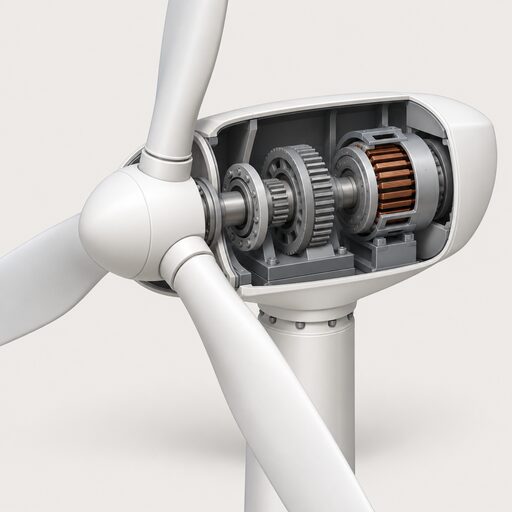 Domestic Wind TurbinesCan a wind turbine really power a home, and is your site windy enough?
 Electrical Safety for GenerationWho signs off the wiring when you fit solar panels or a small wind turbine, and how do you know it is safe?
 G98 and G99 NotificationAdding a home battery usually means telling your network operator first, but sometimes you can just let them know afterwards.