
In this answer
Short answer
Permitted development for a domestic wind turbine is not a free pass. It is a conditional right, and the condition that catches most households is who does the work. Under permitted development rights it is possible in some cases to install domestic wind turbines without an application for planning permission, so long as specified limits and conditions are met1. One of those conditions is that the equipment is installed by an installer certificated through the Microgeneration Certification Scheme using a certificated product2.
So the short answer is yes: an MCS certified installer is required if the installation is to sit inside permitted development. A stand-alone turbine within the boundaries of a dwellinghouse can be considered permitted development, not needing an application for planning permission, provided all the limits and conditions are met3. Development is permitted only if the installation complies with the Microgeneration Certification Scheme Planning Standard, MCS 020, or equivalent standards3. The same wording governs building-mounted turbines4.
The practical consequence is that the installer's certification, the product's certification and the planning standard are three separate tests, and all three have to be satisfied at the point of commissioning, not at the point of quote.
MCS 020: the planning standard your installation must meet
MCS 020 is the Microgeneration Certification Scheme Planning Standard. In legislation it is defined as the standards specified in the Microgeneration Certification Scheme for air source heat pumps (MCS 020 a, the air source heat pump sound calculation for permitted development installations) and for small and micro wind turbines (MCS 020 b, the wind turbine sound calculation for permitted development installations)8. For a wind turbine, MCS 020 b is the part that matters.
The standard is not optional decoration. Development is permitted only if the stand-alone wind turbine installation complies with the Microgeneration Certification Scheme Planning Standard or equivalent standards3, and the identical condition applies to building-mounted turbines4. The MCS Planning Standards document itself is published by MCS and sets out the noise assessment method that permitted development relies on5.
There is an important limit inside the standard. Compliance with the MCS Planning Standard on its own does not bestow permitted development rights5. Meeting the noise calculation is necessary but not sufficient: the installer certification condition, the product condition and the other limits in the legislation still have to be met. MCS Contractors are under a duty to ensure compliance with the MCS Planning Standard in relation to any installation carried out as permitted development5, which places the responsibility for the assessment on the contractor rather than the householder.
The same standard family governs air source heat pumps under permitted development, where installations must comply with MCS 020(a), which sets installation standards including assessment of sound impact on neighbours9. That parallel matters because the two technologies share a restriction: only the first installation of any wind turbine would be permitted development, and only if there is no existing air source heat pump at the property4.
Who may install: an MCS-certified contractor under MIS 3003

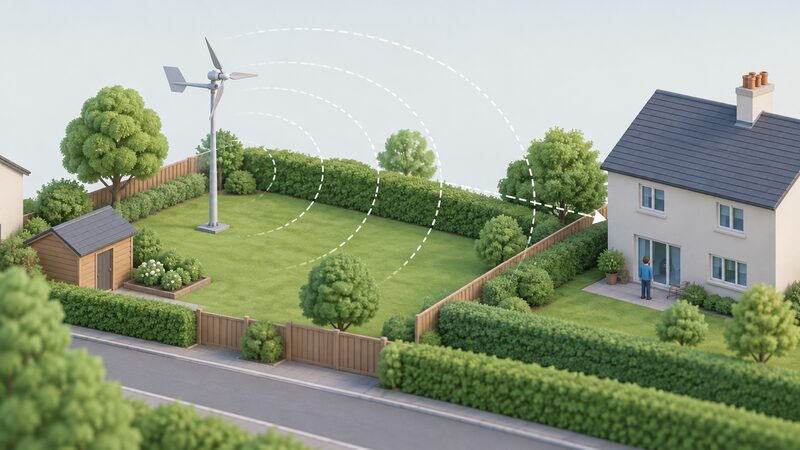
The installer condition is explicit. The wind turbine shall be installed by an MCS Contractor certificated in accordance with MIS 30035. MIS 3003 is the MCS installer standard for wind turbines, and it is the certification that a contractor must hold for the work to count.
MCS certification is not a single badge. Certified installers install renewable technologies to industry standards while adhering to recognised safety practices6, and the scheme covers a range of technologies under separate installer standards. Solar PV sits under MIS 3002, where MCS installers must provide completed structural and wind loading calculations in relation to the specific mounting system being installed, evidence of how weather-tightness has been maintained following installation, evidence of how fire performance has been maintained, and confirmation that the system components are compatible with one another, plus written confirmation from the installer that the final installation is in accordance with the manufacturer's instructions10. Those requirements are for PV rather than wind, but they show the shape of an MCS installer's obligations: documented design evidence, not just a fitting service.
The certification requirement is not confined to planning. All BUS installations must be carried out by MCS-certified installers11, and eligible renewable technology under the Domestic Renewable Heat Incentive must be installed and commissioned by an MCS certified installer who can provide an MCS certificate12. To qualify for government incentive schemes such as the Renewable Heat Incentive or Green Homes Grant, installation contractors must be certified by MCS and install MCS certified products13.
For a household, the certification is the mechanism that makes the installation traceable. It is also the mechanism that makes the planning position defensible if a neighbour or a local authority asks what was installed and by whom.
Certified product and certified installer: both are needed
Permitted development rights for wind turbines and air source heat pumps will only be accorded for equipment installed by an installer who has been certificated through the scheme using a certificated product2. The two halves are joined by the word "and". A certificated installer fitting an uncertified machine fails the test, and a certified machine fitted by an uncertified contractor fails it too.
On the product side, certified installers use MCS certified small wind turbines, which means the product being used has been tested for quality, reliability and performance6. MCS product certification covers 50kW for electrical technologies10, which is the scope within which a small wind turbine sits.
The equivalent-products route does not loosen the installer requirement. MCS equivalent products can be used, and if available the prevailing government incentives can be claimed, provided the installation is completed by an MCS certified installer6. The same condition appears in MCS's own product certification guidance: equivalent products can be used if the installation has been carried out by an MCS certified installer10.
"MCS equivalent products can be used, and if available, the prevailing government incentives can be claimed, provided the installation is completed by an MCS certified installer."
There is a further trap that has nothing to do with the equipment. MCS has warned about a non-certified business targeting and encouraging MCS certified installers to break scheme requirements, and states that these installations are deemed non-compliant with MCS requirements where the non-certified business simply employs an MCS certified installer to sign off14. The contract-holder matters, not only the person on site.

Where the 50kW threshold applies and what it covers
The 50kW figure is widely misread as a permitted development size limit. It is not. It is the capacity ceiling for the MCS or equivalent certification route. Wind with a declared net capacity of 50kW or less goes through the MCS-scale accreditation route7, and an MCS-FIT installation is a solar PV or wind installation with a declared net capacity at or below 50kW, or a micro CHP installation with a capacity up to the 2kW scheme maximum15. MCS product certification covers 50kW for electrical technologies10, and MCS data work covers up to 50kW for electrical technologies such as solar PV16.
The threshold recurs across the scheme documents because it defines the boundary between MCS-scale generation and larger plant. PV and wind with a declared net capacity of 50kW or less, and micro CHP with an electrical capacity of 2kW or less, sit on the MCS or equivalent certification route17. FIT Licensees are responsible for managing the MCS application process for solar PV and wind with a declared net capacity of 50kW or less, and micro-CHP installations18.
For a domestic turbine the ceiling is not the binding constraint. A household machine is far below 50kW, so the tests that decide the planning position are the MCS 020 compliance, the MIS 3003 installer certification and the product certification, not the capacity figure. The capacity figure matters for which accreditation route applies and for the incentive schemes attached to it.
Where a stand-alone turbine falls short
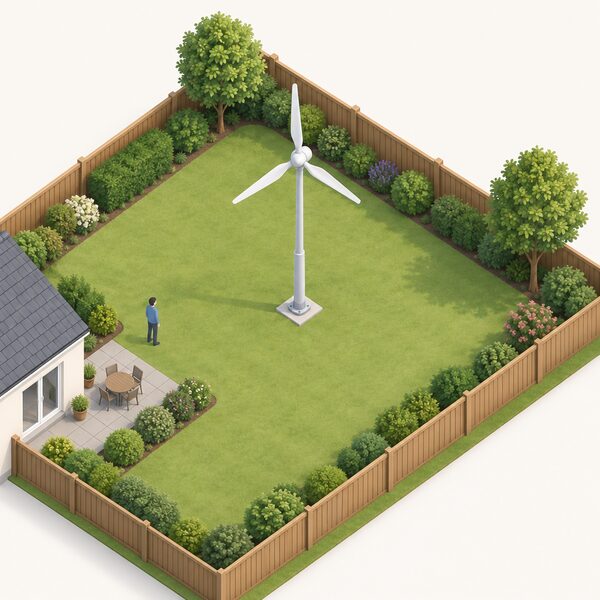
Stand-alone permitted development is conditional on more than certification. Any part of the wind turbine, including blades, positioned so that it would be within 5 metres of any boundary of the curtilage means development is not permitted8. That is a hard geometric limit, and it is measured to the blade tip, not the mast.
Building-mounted permitted development is narrower still. Permitted development rights for building-mounted wind turbines apply only to installations on detached houses, not blocks of flats, and other detached buildings within the boundaries of a house or block of flats4. Only the first installation of any wind turbine would be permitted development, and only if there is no existing air source heat pump at the property; additional wind turbines or air source heat pumps at the same property require an application for planning permission4.
Where compliance with the standard is not achieved, a planning application will be required19. That is the general consequence across the permitted development regime, and it applies to wind as it does to heat pumps.
Equivalent standards: when non-MCS compliance can count
The legislation does not say "MCS" alone. Class H provides that development is not permitted unless the wind turbine complies with the MCS Planning Standards or equivalent standards8. The Planning Portal uses the same formulation for both stand-alone and building-mounted turbines3.
Scotland has its own version. Under Class 6G, the wind turbine must comply with MCS Planning Standards for wind turbines or equivalent standards20, and the Scottish statutory instrument repeats the wording for a free standing wind turbine within a dwelling curtilage21. Wales publishes separate guidance on planning permission for wind turbines22.
The equivalent standards route is real but narrow. MCS operates a product scheme equivalency process under which equivalent products can be used and incentives claimed, provided the installation is completed by an MCS certified installer6. The installer requirement survives the equivalence. And the standard itself is not a right: compliance with the MCS Planning Standard on its own does not bestow permitted development rights5.
If the installer's certification lapses before commissioning

The permitted development condition is that the equipment is installed by an installer certificated through the scheme2. Certification is therefore a live status, not a historical one. If a contractor's MCS certification lapses between quote and commissioning, the installation no longer satisfies the condition on which the planning right depends.
The paperwork trail matters here. Under one published scheme specification, MCS commissioning certification is to be issued to the employer within 14 days of commissioning, and no later than 10 working days after commissioning the installation must be registered by the MCS Contractor on the MCS Installation Database and an MCS Certificate generated23. Those deadlines are scheme rules rather than universal law, but they show what a complete MCS record looks like and why the certificate date is worth checking against the commissioning date.
For MCS certified installations, a complaint can be made no more than two years after the date that the system was commissioned24. That window is the backstop if the certification position turns out to be wrong.
What this means for a household's energy independence
A permitted development wind installation keeps the household off the planning application route, which removes cost, delay and the risk of refusal. It does not remove dependence. The turbine still needs a grid connection and a licensed supplier for import and export, and the connection itself is governed by the engineering standards for small generators rather than by MCS. Certification is a quality and traceability mechanism, not a route to self-sufficiency.
The dependence that remains is threefold. The installer's certification is a company status that can change after the work is done. The product certification ties the machine to a manufacturer whose support and spares may or may not outlast the installation. And the planning right itself is conditional, so a later addition, such as a heat pump or a second turbine, can push the property back into needing an application4.
What MCS certification does deliver is a documented chain: a certificated product, a contractor certificated under MIS 3003, and an installation assessed against MCS 020. That chain is what makes the permitted development position stand up, and it is the part of the process a household can verify before work starts.
Sources24 cited
- Planning permission: wind turbines introduction, Planning Portal, 2026
- The Microgeneration Certification Scheme, Planning Portal, 2026
- Planning permission: stand-alone wind turbines, Planning Portal, 2026-09-17
- Planning permission: building-mounted wind turbines, Planning Portal, 2026-09-17
- MCS 020 Planning Standards, Issue 1.2, MCS, 2015-05-01
- Small wind turbines, MCS, 2026-08-18
- Feed-in Tariffs guidance for licensed electricity suppliers V17.1, Ofgem, 2024-09-06
- Class H: installation of wind turbine on domestic premises, legislation.gov.uk, 2026-09-17
- Planning permission: heat pumps and MCS 020(a), Welsh Government, 2026-09-17
- Certifying your product, MCS, 2026-05-18
- Boiler Upgrade Scheme guidance for installers, Ofgem, 2026-07-02
- Domestic Renewable Heat Incentive: applicants, Ofgem, 2026
- Register energy devices in homes or small businesses, GOV.UK, 2021-03-31
- MCS urges certified installers to avoid non-compliant subcontracting arrangements, MCS, 2024-11-15
- Feed-in Tariffs: generators, Ofgem, 2026-09-17
- MCS data requests, MCS, 2026-04-20
- Feed-in Tariffs guidance for licensed electricity suppliers V15.0, Ofgem, 2023-04-03
- Feed-in Tariffs annual report, scheme year 13, Ofgem, 2023-12
- Changes to permitted development rights: summary of responses, Welsh Government, 2025-12
- Circular 1/2024: householder permitted development rights, Scottish Government, 2024-05
- The Town and Country Planning (Permitted Development) (Scotland) Amendment Order 2024, legislation.gov.uk, 2024-05-24
- Planning permission: wind turbines, Welsh Government, 2026
- Barcud Solar Panel Installation Scheme Specification, Sell2Wales, 2026-06-15
- Domestic RHI: who to contact, Ofgem, 2026-09-17
 Small Wind Turbine StandardsA small wind turbine needs the right certificate before it can go up, and that affects whether you need planning permission and whether you can get paid for the electricity you send to the grid.
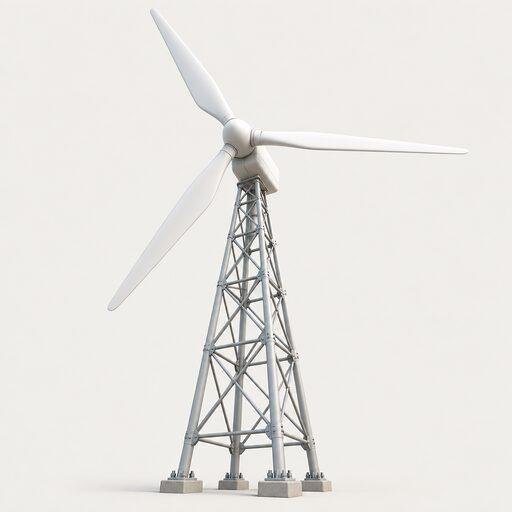 Wind Turbine Planning ScotlandScotland lets some home wind turbines go ahead without planning permission, but only if they stay within strict size and distance limits.
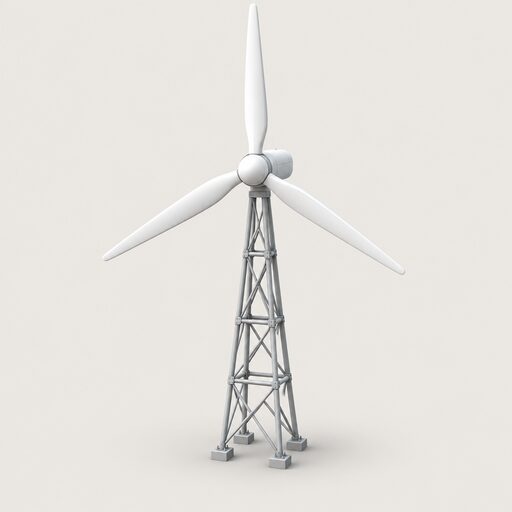 Wind Turbine Planning in NIDo you need planning permission for a home wind turbine in Northern Ireland?
 Wind Turbine Planning in EnglandCan you put up a small wind turbine at home without asking the council first?
 Installer QualificationsWhat training and qualifications should a heat pump installer actually have?
 Wind Turbine Planning in WalesDo you need planning permission for a wind turbine at home in Wales?