
In this guide
A household in Northern Ireland that wants a wind turbine should expect to make a planning application. Independent guidance from the Energy Saving Trust states plainly that "In Wales and Northern Ireland, you must have planning permission before you install a wind turbine"1. Power NI puts the same position slightly more loosely: permission is usually needed, applications are submitted to the local council's planning department, and small domestic turbines may sometimes be considered under permitted development2. Official nidirect guidance on small-scale wind states simply that "Planning approval is needed"3. The documents are not identical in tone, but none of them describes a general permitted development right for a domestic turbine in Northern Ireland of the kind that exists in England.
The legal framework is the Planning (General Permitted Development) Order (Northern Ireland) 2015, statutory rule 2015 No. 70, made on 25 February 2015 and coming into operation on 1 April 20154. It was made under sections 32 and 247(6) of the Planning Act (Northern Ireland) 2011, applies to all land in Northern Ireland, and grants planning permission for the classes of development described as permitted development in its Schedule, subject to any relevant exception, limitation or condition specified there4. Part 2 of that Schedule is headed "Installation of domestic microgeneration equipment"5. The Order was made subject to the negative resolution procedure and was a consolidation that, in the department's words, "will not alter the policy principle of permitted development", written against the transfer of planning powers to district councils6.
That is the practical shape of the answer. Permitted development for domestic microgeneration exists in Northern Ireland as a legal category, and it has been extended since 2015, most visibly for heat pumps in 2023. For wind, the guidance a householder is pointed to says an application to the council is the route. Everything that follows sets out what the Order actually is, what the conditions look like, how the four nations differ, and what else has to be cleared before a turbine can turn and export.
The short answer: apply to your district council
Three separate documents point the same way. The Energy Saving Trust's wind turbine guidance, updated 20 May 2026, groups Wales and Northern Ireland together as jurisdictions where permission must be held before installation, and contrasts them with England and Scotland where "the rules are more complex" and permission may not be needed in some specific situations1. A maker guide from 2021 uses the same pairing: in Wales and Northern Ireland an application is needed for any kind of wind turbine9. A consumer comparison site, updated 6 January 2026, generalises further, saying residents in all British nations will usually need to apply before starting installation work10.
Power NI's explainer, published 9 April 2026, is the one document that leaves the door ajar, noting that small domestic turbines may sometimes be considered under permitted development while still stating that permission will usually be required and naming the council planning department as the recipient of the application2. Read together, the sensible reading is that a householder in Northern Ireland plans on the basis of a full application, and checks with the council before assuming otherwise. Planning Portal guidance, although written for England, makes the general point that applies everywhere: always check with the local planning authority about planning issues before a system is installed, and that such guidance is an introductory guide and not a definitive source of legal information, with additional local rules capable of applying11.
What the 2015 Order is and how it has changed

The Order is the consolidating instrument for permitted development in Northern Ireland. Its opening provision grants planning permission for the classes of development described as permitted development in the Schedule, with that permission subject to any relevant exception, limitation or condition specified in the Schedule12. Part 2 of the Schedule deals with the installation of domestic microgeneration equipment5. The department's explanatory material records that the consolidation introduced a wide range of permitted development changes including small-scale domestic and commercial renewable energy projects, and that the rule was due to come into operation on 1 April 20156. The publication record gives a publication date of 10 March 201513.
Two amendments matter to the current picture:
| Amendment | Made | In operation | Effect recorded |
|---|---|---|---|
| Planning (General Permitted Development) (Amendment) Order (NI) 2020 | 30 November 202014 | 21 December 202014 | Substituted "28" for "21" in Article 7(1), extending that period to 28 days; a regulatory impact assessment was prepared14 |
| Planning (General Permitted Development) (Amendment) Order (NI) 2023 | 2023 | 4 July 20237 | Amended the 2015 Order with new permitted development rights for the installation of microgeneration equipment15 |
The 2023 change was publicised by the Department for Infrastructure in terms of heat pumps: "Air source heat pumps will now no longer require planning permission, subject to certain conditions and limitations", as long as they are at least 1 metre from the boundary of a neighbouring property and comply with the prescribed noise standard15. The legislation.gov.uk point in time view of the 2015 Order is dated 4 July 20237. A householder reading the Order should read the Schedule as amended rather than the original version as it was originally made16, and should read Part 2 in full, since permission granted by the Order is only ever as wide as the conditions attached to it12.
Conditions of the kind that attach to a domestic turbine
Northern Ireland guidance does not publish a turbine condition list of the sort found in the other nations, which is consistent with permission being sought by application. The conditions used elsewhere are nonetheless a fair guide to the issues a council will weigh, because they are the issues small wind raises everywhere: how many turbines, whether the site already has other microgeneration, noise, and certification.
- One turbine only. In England, only the first installation of any wind turbine would be permitted development, and additional turbines require a planning application17.
- Interaction with heat pumps. In England, a building-mounted turbine is permitted development only if there is no existing air source heat pump at the property, and additional wind turbines or air source heat pumps at the same property require an application18. The reverse condition also exists: development is not permitted under the air source heat pump class if a wind turbine is installed on the same building or within the curtilage of the dwellinghouse or block of flats19.
- Building type. Building-mounted rights in England apply only to installations on detached houses, not blocks of flats, and other detached buildings within the boundaries of a house or block of flats18.
- Certification. Class H in England is not permitted "unless the wind turbine complies with the MCS Planning Standards or equivalent standards"20. The equivalent stand alone class carries the same requirement21.
- Noise. The MCS Planning Standards use a noise map whose green zone is "less than permitted development noise limit of 42 dB LAeq, 5 mins"22.
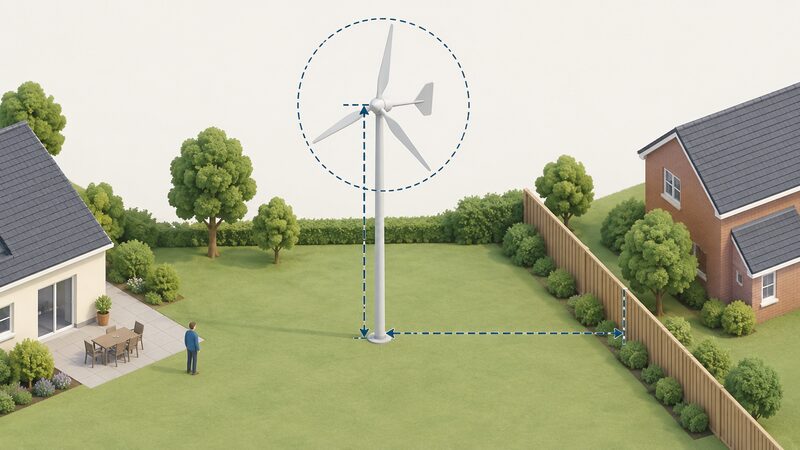
These points connect to the wider pages on wind turbine noise, shadow flicker and neighbours and on MCS certification for wind and hydro installations.
Northern Ireland compared with England, Scotland and Wales
The four nations run genuinely different regimes, and guidance written for one is routinely marked as not applying to the others. Planning Portal pages carry the statement that "Guidance here relates to the planning regime for England, the policy in Wales may differ"23, and UK building regulations guidance notes that "There are different rules in Scotland and Northern Ireland"24.
| Nation | Position on a domestic turbine |
|---|---|
| Northern Ireland | Permission must be obtained before installation1; applications to the district council planning department, with small domestic turbines sometimes considered under permitted development2 |
| England | Domestic turbines can in some cases be installed without an application, so long as specified limits and conditions are met23; in other cases an application to the local authority is required25; stand alone and building-mounted classes require compliance with MCS Planning Standards or equivalent20 |
| Scotland | For a free standing turbine within a dwelling's curtilage, application must be made to the planning authority for a determination as to whether prior approval is required for siting, design, size and external appearance26 |
| Wales | A stand alone turbine within the boundaries of a dwellinghouse can be permitted development provided all the listed limits and conditions are met, including compliance with the MCS Planning Standards or equivalent27; a building-mounted turbine requires an application to the local planning authority27; homeowners are required to minimise the effect on the amenity of the area28 |
Welsh rules also treat a second machine as outside the class: "Additional wind turbines or air source heat pumps at the same property requires an application for planning permission"27. Welsh legislation defines a stand alone wind turbine as "a wind turbine which is not fixed to a building", a definition worth holding in mind because the building-mounted and free-standing cases are consistently handled by separate classes29.
One further nation-level difference is fiscal rather than planning. Government VAT guidance lists wind turbines and water turbines as qualifying for the lower rate in Great Britain only, and separately lists them under Northern Ireland as not qualifying, at the standard 20% rate8. The same machine therefore costs more to install in Northern Ireland than in Great Britain before any planning fee is considered. See also the sibling pages on planning permission in England, in Scotland and in Wales.
Building control, connection and the other consents
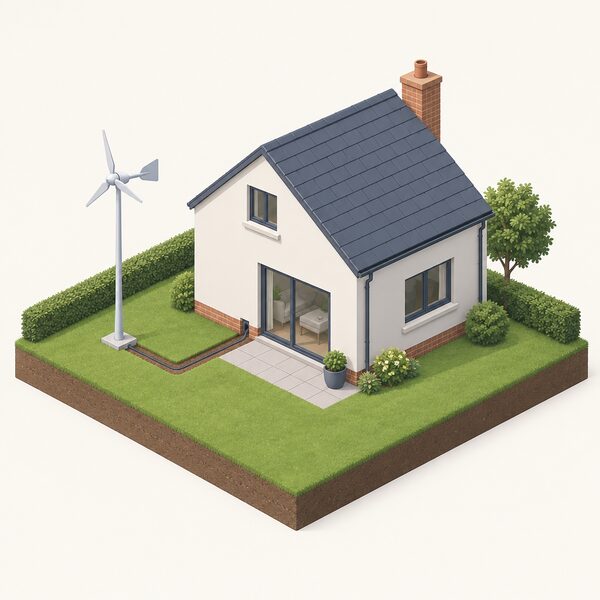
Planning permission is one consent among several. The explanatory material to the 2015 Order is explicit that applicants "will still have to make sure their development complies with any environmental and other consents that may be needed", including building regulations6. Northern Ireland's building regulations are made under the Building Regulations (Northern Ireland) Order 1979, whose purposes include securing the health, safety, welfare and convenience of persons in or about buildings, furthering the conservation of fuel and power, furthering the protection and enhancement of the environment, and promoting sustainable development30. That Order's list of energy sources includes wind, alongside biomass, biofuels, fuel cells, photovoltaics, water including waves and tides, solar power, geothermal sources and combined heat and power systems31. The current regulations are also described as designed to further the conservation of fuel and energy32.
On grid connection the documents differ by date, and both are worth knowing. Earlier official guidance stated that "A grid connection offer can only be considered once the generator has received planning permission, where appropriate"33. NIE Networks states that planning permission is no longer a pre-requisite to apply for a grid connection, dated 31 July 201534. The later, network-specific statement is the one that governs the application sequence today, but consent and connection remain two separate gates, and a turbine cannot export until both are settled. The connection process itself is covered on connecting a generator in Northern Ireland and G98 and G99.
Where public funding touches a project, approvals stack up further: the Housing Executive's grant process lists possible required documents including proof of ownership, architect or proposed plans, estimates from the builder or contractor, building control approval and planning approval, and requires that Building Control has approved the work before payment35. Building control applications in Northern Ireland may be made by way of a building notice or full plans application36.
What this means for a household's energy independence
A wind turbine converts a free, local resource into electricity on site: the wind forces the rotor blades round, driving a turbine that generates electricity37. In independence terms that is real. It is also, in Northern Ireland, the technology with the heaviest administrative gate of the common domestic options, since the stated position is that permission must be held before installation1 and approval rests with a district council applying local policy to a specific site. A household therefore takes on a planning risk that a solar array or, since July 2023, an air source heat pump meeting the one metre boundary and noise conditions does not15.
The scale of what is being decided is modest per house and significant in aggregate. Field trial work put the number of potential domestic small-scale wind installations in Ireland at 47,70038. At system level, the Climate Change Committee's advice envisages Northern Ireland's variable renewables capacity, offshore and onshore wind and solar combined, growing three-fold by 2040 to 5.5 GW39. Domestic turbines are a small part of that and are governed house by house.
Dependence does not disappear with a turbine on the site. The grid connection remains, and with it the network operator and the supplier arrangements through which any export is paid. The Feed-in Tariff never ran in Northern Ireland in the same form: instead, a change to the Northern Ireland Renewables Obligation Order put additional incentives in place for generating stations of certain technologies and installed capacities40. Payment for exported units is treated separately on getting paid for exported electricity in Northern Ireland. The turbine itself brings a dependence on its manufacturer for spares and on an installer for maintenance, and MCS guidance for consumers advises checking with the local council on the necessary planning permissions before installing41. Whether the site has the wind to justify any of it is a separate question, addressed on wind speed and siting and in the wider guidance on whether home renewables suit a particular property42. The pillar page for this lane is microgeneration beyond solar.
Sources42 cited
- Wind turbines advice, Energy Saving Trust, 20 May 2026
- How does wind energy work, Power NI, 9 April 2026
- Wind, nidirect, 18 May 2026
- Planning (General Permitted Development) Order (Northern Ireland) 2015, legislation.gov.uk, 25 February 2015
- Schedule Part 2: installation of domestic microgeneration equipment, legislation.gov.uk
- Explanatory memorandum to S.R. 2015 No. 70, legislation.gov.uk
- Point in time view of the 2015 Order at 4 July 2023, legislation.gov.uk, 4 July 2023
- Tax on shopping: energy-saving products, GOV.UK
- Home wind turbines: pros, cons and cost, OVO Energy, 6 May 2021
- Domestic wind turbines guide, Uswitch, 6 January 2026
- Wind turbines: planning permission, Planning Portal
- The 2015 Order as made, legislation.gov.uk, 25 February 2015
- Planning (General Permitted Development) Order (Northern Ireland) 2015 publication, Department for Infrastructure, 10 March 2015
- Planning (General Permitted Development) (Amendment) Order (Northern Ireland) 2020, legislation.gov.uk, 30 November 2020
- Changes to permitted development rights: domestic heat pumps, Department for Infrastructure, 12 June 2023
- Schedules to the 2015 Order, legislation.gov.uk
- Planning permission for stand alone wind turbines, Planning Portal
- Planning permission for building-mounted wind turbines, Planning Portal
- Class G: air source heat pumps on domestic premises, legislation.gov.uk
- Class H: wind turbine on domestic premises, legislation.gov.uk
- Town and Country Planning (General Permitted Development) (Amendment) Order 2011, legislation.gov.uk, 30 August 2011
- MCS 020 Planning Standards, Issue 1.2, MCS
- Wind turbines: introduction to planning permission, Planning Portal
- Building regulations approval: how to apply, GOV.UK
- Wind turbine planning permission introduction, Planning Portal
- Town and Country Planning (General Permitted Development) (Scotland) Amendment Order 2024, legislation.gov.uk, 24 May 2024
- Planning permission: wind turbines, Welsh Government
- What could the next Senedd do on heat pump planning, Nesta, 26 January 2026
- Town and Country Planning (General Permitted Development) (Amendment) (Wales) Order 2012, article 2, legislation.gov.uk, 2012
- Building Regulations (Northern Ireland) Order 1979 as amended, legislation.gov.uk, 2 March 2009
- Building Regulations (Northern Ireland) Order 1979, legislation.gov.uk, 19 December 1979
- Building regulations in Northern Ireland, Building Control NI
- UK Solar PV Strategy Part 2, Department of Energy and Climate Change, April 2014
- Generation connections FAQs, NIE Networks, 31 July 2015
- How long will the whole process take, Northern Ireland Housing Executive
- Stove guidance for householders, Building Control NI, November 2015
- Could you generate your own energy, Energy Saving Trust, 12 April 2024
- Location, Location, Location: small-scale wind field trial report, Energy Saving Trust, July 2009
- Northern Ireland's fourth carbon budget, Climate Change Committee, 19 March 2025
- Guidance for Feed-in Tariff generators, version 18, Ofgem, September 2024
- Small wind turbines for consumers, MCS, 18 August 2026
- Are home renewables right for you, Energy Saving Trust, 11 December 2025
 Home Energy Planning Rules in NIDo you need planning permission for solar panels or a heat pump in Northern Ireland?
 Wind Turbine Planning in EnglandCan you put up a small wind turbine at home without asking the council first?
 Planning Permission in NIDo you need planning permission for a heat pump in Northern Ireland?
 Planning Permission NIDo you need planning permission for solar panels in Northern Ireland?
 Wind Turbine Planning in WalesDo you need planning permission for a wind turbine at home in Wales?
 Planning Permission in NIDo you need planning permission for a home battery in Northern Ireland, and does it matter whether it goes inside the house or in an outbuilding?