
In this guide
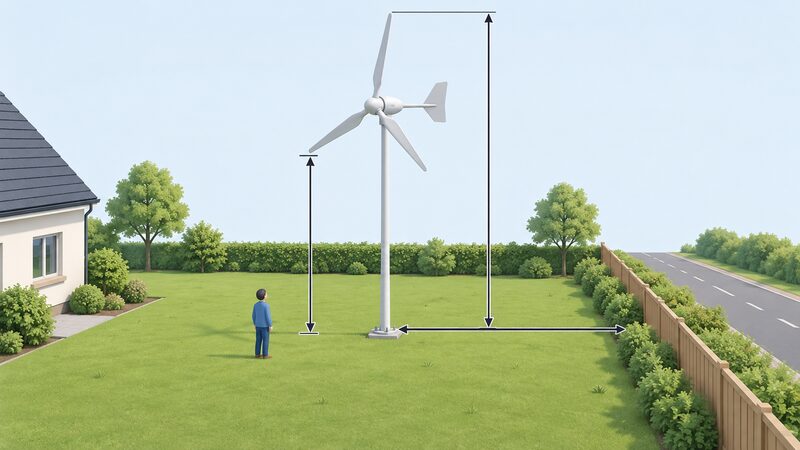
Scotland does allow some domestic wind turbines to be installed without a planning application. Two classes of householder permitted development cover them: Class 6G, the installation, alteration or replacement of a free standing wind turbine within the curtilage of a dwelling, and Class 6HC, a wind turbine mounted on a detached dwellinghouse. Both are subject to tight limits. For a free standing turbine the blade tip height must not exceed 15 metres, the lowest point of the blade tip must be at least 5 metres above ground level, and the turbine must stand at least 110 per cent of its blade tip height from the curtilage of another dwelling. For a turbine on a detached dwellinghouse, no part may protrude more than 3 metres above the highest part of the roof excluding any chimney, no part may be less than 5 metres from ground level or less than 5 metres from the boundary of the curtilage, and the swept area must not exceed 4 square metres.1
Permitted development is not the same as having nothing to do. A free standing turbine under Class 6G carries a prior notification and prior approval step: the developer must apply to the planning authority for approval of the design and size, and for a determination as to whether prior approval is required for siting and external appearance, before work begins.2 Development inside the criteria and thresholds does not need planning permission but still has to obtain non-planning consents such as a building warrant.4 Development that falls outside the criteria or thresholds is not permitted development and requires planning permission through an application.5
The classes sit within the Town and Country Planning (General Permitted Development) (Scotland) Order 1992 as updated, which lets a range of buildings, technologies and other developments go ahead without planning permission.6 The turbine provisions in their current form were made by the 2024 amendment order.1
When permission is needed and when it is not
The logic of the Scottish system is simple to state and easy to fall foul of. A proposal that meets every limit and condition of Class 6G or Class 6HC, on a site where the class is not disapplied, does not require planning permission. A proposal that misses any single limit, by a metre of height or a metre of setback, loses the right entirely and has to be submitted as a planning application. That is the general rule the Scottish Government applies across its microgeneration rights: development which does not meet the criteria or thresholds in the legislation is not permitted development and has to gain planning permission.8
Most classes of permitted development rights are subject to conditions and limitations which may specify the maximum size or scale of what is permitted and restrict or disapply the rights in certain locations, for example conservation areas or National Scenic Areas.9 The rights also do not apply to development or use of land or buildings which is itself unlawful.9
Second, permitted development removes only the need for planning permission. A building warrant may still be required before work can start, and the warrant regime is separate from planning.3 Building regulations approval in Scotland follows different rules from those in England.10 Where a turbine is attached to a house in the building regulations system, an installer registered with the relevant competent person scheme may be authorised to self-certify the work without involving local authority building control, though that route belongs to the regime applying in England rather than Scotland's warrant system.11
Third, permitted development rights do not apply where an environmental impact assessment would be required under the Town and Country Planning (Environmental Impact Assessment) (Scotland) Regulations 2017.12 For a single household machine this will rarely arise, but it is part of the class structure.
Free standing turbines: Class 6G and its conditions
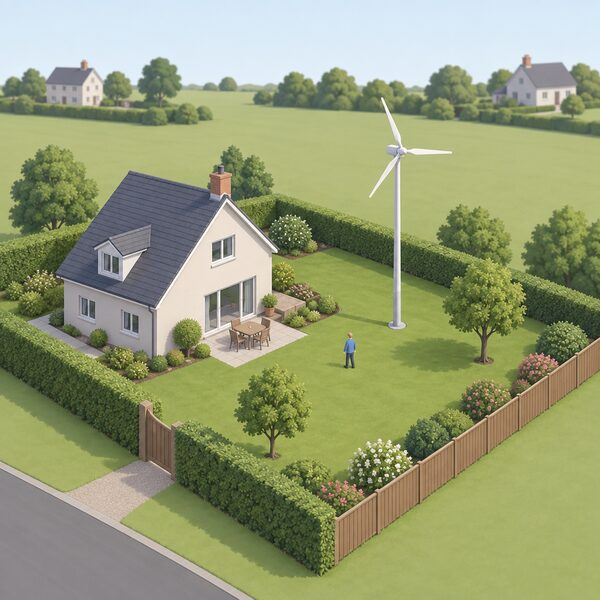
Class 6G covers the installation, alteration or replacement of a free standing wind turbine within the curtilage of a dwelling.13 The tests are cumulative. The blade tip height must not exceed 15 metres. The lowest part of the blade tip must be at least 5 metres from ground level. The turbine must be sited no closer than 110 per cent of its blade tip height to the curtilage of another dwelling, so a 15 metre machine needs a clear separation that scales with its own height rather than a fixed figure. The rights are not available if the work would result in the presence within the curtilage of a dwelling of more than one free standing wind turbine. The turbine must comply with MCS Planning Standards for wind turbines or equivalent standards.1
The prior approval step is what distinguishes Class 6G from most householder rights. Before beginning development the developer must apply to the planning authority for approval of the design and size of the turbine, and for a determination as to whether prior approval will be required as to its siting and external appearance.9 In practice a person wishing to carry out development of this kind must notify the planning authority, provide details of the proposal and pay the relevant fee.3 The effect is that the authority still sees the scheme and can influence where the machine goes and what it looks like, but the principle of the development is settled by the class rather than argued in a planning application.
For a household, the significance of Class 6G is that it sets the practical ceiling on a self-supply machine that can be installed without an application: a pole mounted turbine no more than 15 metres to blade tip, sited well inside its own plot. Sites with close neighbours frequently fail the 110 per cent test long before they reach the height limit, which is why the siting and wind speed assessment and the planning check need to happen together rather than in sequence.
Turbines on a detached dwellinghouse: Class 6HC
Scotland also has a class for a wind turbine mounted on a detached dwellinghouse, Class 6HC. Its limits are stricter than the free standing class because the machine is attached to the building. No part of the turbine may protrude more than 3 metres above the highest part of the roof, excluding any chimney, of the dwellinghouse. No part may be less than 5 metres from ground level. No part may be less than 5 metres from the boundary of the curtilage of the dwellinghouse. The swept area must not be more than 4 square metres. As with Class 6G, the turbine must comply with MCS Planning Standards for wind turbines or equivalent standards.1 The class is also carved out of the general improvements and alterations right, so wind turbines mounted on detached dwellinghouses are dealt with only under 6HC.3
Guidance published before the 2024 order stated that a roof mounted wind turbine in Scotland required planning permission, and contrasted that with the position in England.14 That advice predates the current legislation; the class now in force on legislation.gov.uk is the authoritative statement of the position.1
Building mounted machines remain the harder case in practice. They are attached to a structure that transmits vibration, the mounting cannot be moved once installed, and the class allows only 4 square metres of swept area. Households considering one should read the limits alongside roof and building-mounted wind turbines.
The size limits that matter: height, clearance and swept area
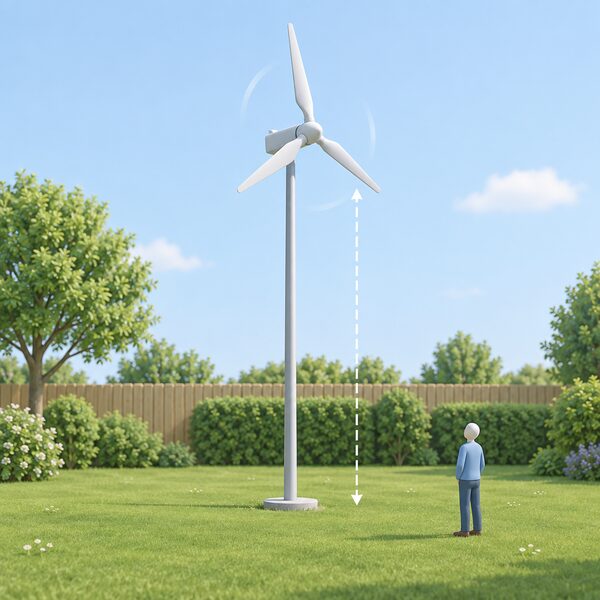
The three figures that decide most cases are overall height, ground clearance under the blades and swept area. Scotland treats them differently for the two classes, and differently again from the rest of the UK.
| Limit | Class 6G, free standing, Scotland | Class 6HC, on a detached dwellinghouse, Scotland |
|---|---|---|
| Maximum height | 15 m blade tip height1 | 3 m above the highest part of the roof, excluding chimney1 |
| Minimum blade clearance above ground | 5 m1 | 5 m1 |
| Maximum swept area | not specified in the class | 4 square metres1 |
| Distance to boundary or neighbour | at least 110% of blade tip height from the curtilage of another dwelling2 | not less than 5 m from the boundary of the curtilage2 |
| Number permitted | one per curtilage of a dwelling1 | covered by the class as a single turbine1 |
| Standards | MCS Planning Standards for wind turbines or equivalent1 | MCS Planning Standards for wind turbines or equivalent1 |
For comparison, the English permitted development class for stand alone turbines caps the highest part of the turbine at 11.1 metres and the swept area of any blade at 3.8 square metres, with 5 metres of blade clearance and a setback of the overall height plus 10 per cent of that height from any point on the boundary.15 The English building mounted rules limit the turbine to 3 metres above the highest part of the roof excluding the chimney, or 15 metres overall including building, hub and blade, whichever is the lesser, with 3.8 square metres of swept area and no part within 5 metres of any boundary.16 Wales allows a stand alone turbine up to 11.1 metres with a swept area of up to 9.6 square metres.17 In Northern Ireland the official position is that planning approval is needed.18 An independent guide summarises the picture as more complex in England and Scotland, where in some specific situations permission may not be needed, while in Wales and Northern Ireland permission must be held before installation.19 Our separate pages cover England, Wales and Northern Ireland.
Siting rules, neighbours and one turbine per curtilage
The Scottish setbacks are aimed at neighbouring homes rather than at boundaries in the abstract. Under Class 6G the controlling distance is 110 per cent of blade tip height from the curtilage of another dwelling, which for the tallest permitted machine means a substantial separation from the next property's garden ground, not merely from its house.2 Under Class 6HC the test is a flat 5 metres from the boundary of the curtilage of the dwellinghouse.2 A Scottish Government consultation on wall and roof mounted domestic turbines proposed that a turbine be located at least 5 metres from any curtilage boundary, and responses on that distance argued both that it was too low and that it was too high.20
Only one free standing turbine is allowed within the curtilage of a dwelling under the class.1 A second machine is a planning application, judged on its own merits, whatever its size.
Noise, shadow flicker and visual dominance are the issues neighbours raise, and none of them is settled by the setback figures alone. The noise and neighbours page covers what the assessment involves. Planning Portal guidance for England states that a turbine must be sited, so far as practicable, to minimise its effect on the external appearance of the building and its effect on the amenity of the area, a formulation that reflects the general approach to domestic microgeneration.15
Where the rights do not apply: designated and historic sites
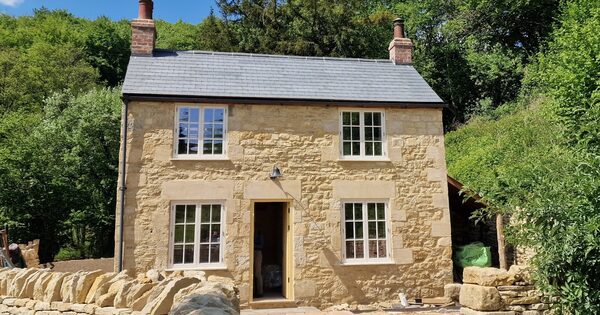
Both Scottish classes are disapplied in sensitive locations. The free standing class does not permit development within a conservation area, the curtilage of a listed building, a World Heritage Site, a site of special scientific interest or a site of archaeological interest.1 The class for turbines on detached dwellinghouses is not permitted in a conservation area, a World Heritage Site, a site of special scientific interest, on a listed building or within the curtilage of a listed building.1
In those locations a turbine is not ruled out, but it has to be applied for and assessed against the development plan and the effect on the designated interest. Householders in a national park or National Scenic Area should assume close scrutiny of visual impact. Further reading: listed building consent for microgeneration.
MCS Planning Standards: a condition of the right, not an option
Both Scottish classes make compliance with MCS Planning Standards for wind turbines, or equivalent standards, a condition of the permitted development right.1 The Scottish policy note for the 2024 order puts it as the turbine being installed in accordance with MCS planning standards applicable to domestic wind turbines or an equivalent standard.21 The Scottish consultation on wall and roof mounted turbines referred specifically to compliance with MCS 020 planning standards.21 MCS describes MCS 020 as a standard that helps make sure air source heat pumps and small wind turbines can be installed in homes without needing planning permission in Scotland, Wales and Northern Ireland.22 MCS also states that a system installed under its scheme will be designed and installed in accordance with MCS Standards.23
The practical consequence is that the standard is not a quality badge sitting alongside the planning rules: it is inside them. A turbine that does not comply with the planning standard or an equivalent has no permitted development right, whatever its dimensions. See MCS certification for wind and hydro installations and small wind turbine standards for what compliance involves.
Applying to the planning authority

Where an application is needed, the first thing to do about a particular case is to contact the local planning authority, usually the planning department of the local council.24 Planning Portal guidance for domestic turbines is blunt about the sequence: always check with the local planning authority about planning issues before a system is installed.25 MCS makes the same point for small wind turbines.23
For a free standing turbine in Scotland the first step is the prior approval route rather than a full application: notify the authority, supply details of the proposal and pay the relevant fee.3 For anything outside the classes, it is a planning application, and the authority will consider siting, design, external appearance, amenity and any designation affecting the site.
Pre-application advice is worth more on a wind proposal than on most householder work because the decisive facts, the distance to the curtilage of another dwelling and the height of the machine, are fixed by the site rather than negotiable. Finding out that a 15 metre mast fails the 110 per cent test on a particular plot is cheaper before a turbine is ordered than after.
What this means for household energy independence
Planning is the first of several gates, and passing it does not by itself produce electricity. Scottish permitted development lets a household put up a single machine of modest scale, which is enough for a rural site with good exposure and thin comfort in a suburban garden. An Energy Saving Trust field trial estimated the number of potential domestic small-scale wind installations in Scotland at 172,700, a figure that describes technical potential rather than what is economic at any one address.26
Funding is limited. The Home Energy Scotland Grant and Loan, funded by the Scottish Government, lists wind turbines with grant funding unavailable and a loan of up to £2,500, interest free.27 The scheme's own table records the wind turbine grant as not available against that £2,500 figure.28 Scheme requirements are set by Scottish Government terms and conditions rather than by legislation, so they can change. Costs beyond that sit with the household: see domestic wind turbine cost and grants and funding for micro wind, hydro and micro-CHP.
The dependencies that remain after a successful installation are worth stating plainly. The planning authority retains control through prior approval and through the conditions of the class. The MCS Planning Standard, run by a private certification body, is a condition of the right, so the household depends on a scheme it does not control. A grid-connected machine depends on the distribution network operator and the connection rules covered in G98 and G99. And a turbine only reduces import where the wind blows when the load is present, which is the argument for reading this page alongside micro wind and energy independence and the wider microgeneration guidance.
Interaction with heat pumps and other microgeneration
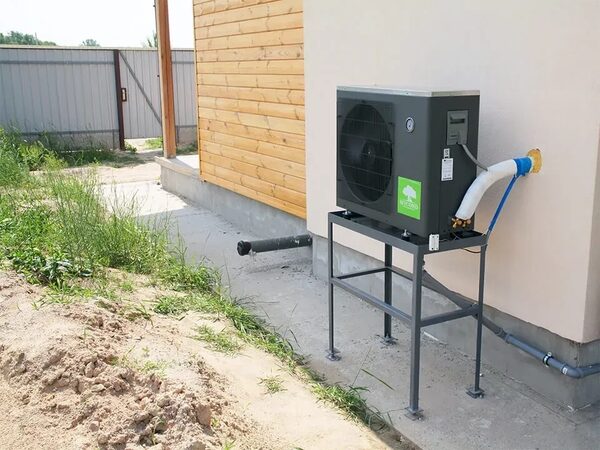
The Scottish turbine classes do not themselves bar a household from also having an air source heat pump. The restriction runs the other way in the rest of Great Britain: the English and Welsh permitted development class for air source heat pumps is not available where a wind turbine is installed on the same building or within the curtilage of the dwellinghouse or block of flats, or where a stand alone wind turbine is installed within that curtilage.29 English guidance for turbines mirrors it: only the first installation of any wind turbine is permitted development, and only if there is no existing air source heat pump at the property, with additional turbines or heat pumps requiring a planning application.16
Anyone in Scotland planning both technologies should establish the position with the planning authority rather than assume the classes stack, because the sequence of installation can determine which right remains available. The same caution applies to combining a turbine with other generation: see which microgeneration suits your home and site.
Sources29 cited
- The Town and Country Planning (General Permitted Development and Use Classes) (Scotland) Amendment Order 2024, legislation.gov.uk, 24 May 2024
- Circular 1/2024: householder permitted development rights, microgeneration, Scottish Government, 28 May 2024
- Circular 1/2024: householder permitted development rights (full text), Scottish Government, May 2024
- Consultation on permitted development rights for non-domestic solar panels and domestic air source heat pumps, Scottish Government, June 2015
- Permitted development rights: non-domestic solar panels and domestic air source heat pumps, Scottish Government, 22 June 2015
- Permitted development rights review: impact assessments, Scottish Government
- Circular 1/2024: householder permitted development rights, introduction, Scottish Government, 28 May 2024
- Review of permitted development rights: phase 3 consultation, Scottish Government, 31 May 2023
- Guidance on householder permitted development rights, updated 2021, Scottish Government, 1 April 2021
- Building regulations approval: how to apply, GOV.UK
- Wind turbines: building regulations, Planning Portal
- Permitted development rights to support the provision of new homes: consultation, Scottish Government, 3 September 2025
- Town and Country Planning (General Permitted Development) (Scotland) Order 1992, as amended, legislation.gov.uk, 24 May 2024
- Home wind turbines: pros, cons and costs, OVO Energy, 6 May 2021
- Planning permission for stand alone wind turbines, Planning Portal
- Planning permission for building-mounted wind turbines, Planning Portal
- Planning permission: wind turbines, Welsh Government
- Wind energy, nidirect, 18 May 2026
- Wind turbines advice, Energy Saving Trust, 20 May 2026
- Review of permitted development rights phase 3: analysis of consultation responses, Scottish Government, 28 March 2024
- Policy note to the 2024 amendment order, legislation.gov.uk, March 2024
- MCS 020 and permitted development, MCS, 29 May 2025
- Small wind turbines for consumers, MCS, 18 August 2026
- What is planning permission, Planning Portal
- Wind turbines: planning guidance, Planning Portal, 17 September 2026
- Location, Location, Location: small-scale wind field trial report, Energy Saving Trust, July 2009
- Wind turbines and funding, Home Energy Scotland, 20 September 2026
- Home Energy Scotland Grant and Loan terms and conditions, Home Energy Scotland
- Class G: air source heat pumps on domestic premises, legislation.gov.uk
 Wind Turbine Planning in WalesDo you need planning permission for a wind turbine at home in Wales?
 Wind Turbine Planning in EnglandCan you put up a small wind turbine at home without asking the council first?
 Wind Turbine Planning in NIDo you need planning permission for a home wind turbine in Northern Ireland?
 Turbine Noise and NeighboursHow close can a wind turbine be to a neighbour's house before it needs planning permission?
 Home Energy Planning ScotlandDo you need planning permission for solar panels or a heat pump in Scotland?
 Planning Permission in ScotlandDo you need planning permission for a heat pump in Scotland?