
In this guide
A micro hydro scheme on a UK watercourse is not simply a turbine in a stream. The intake, the screen and the way water is returned to the river are all subject to consent conditions set by the environmental regulator for the nation the scheme sits in. The screen is the component that decides whether fish and debris pass safely, and its specification, including bar spacing and approach velocity, is set case by case rather than by a single national standard.
The regulatory picture is devolved. In Scotland, a Strategic Environmental Assessment screening is undertaken in accordance with the Environmental Assessment (Scotland) Act 2005, in consultation with the statutory consultation authorities: the Scottish Environment Protection Agency (SEPA), Scottish Natural Heritage (SNH) and Historic Environment Scotland (HES)1. SEPA is also the principal regulator for water abstraction and pollution control, and it exercises both an advisory and a regulatory role, a combination noted in Scottish Government consultation analysis2.
For a household, the practical consequence is that environmental requirements sit alongside the abstraction licence and the grid connection as conditions of the project. They affect the design of the intake, the flow that must be left in the river, and the survey work needed before an application can be determined. This page sets out what those requirements cover, how screening works, and where the rules differ across England, Scotland, Wales and Northern Ireland.
What environmental requirements attach to a micro hydro consent
The environmental conditions on a hydro consent are not a single document. They are a set of obligations attached to the abstraction licence and any planning or environmental permit, and they cover three broad areas: how much water may be taken and how much must be left in the river, how the intake is screened to protect fish, and what survey and assessment work is required before consent is granted.
In Scotland, the assessment framework is statutory. A Strategic Environmental Assessment screening is undertaken in accordance with the Environmental Assessment (Scotland) Act 2005, and it is carried out in consultation with the Statutory Consultation Authorities: SEPA, SNH and HES1. That screening determines whether a fuller assessment is needed. The same principle applies in the other nations under their own regimes, though the legislation and the consultee bodies differ.
The regulator's role is not purely advisory. Scottish Government consultation analysis on heat and buildings identified SEPA, NatureScot and the Scottish water industry as the organisations most frequently cited as public bodies that exercise both an advisory and a regulatory role2. For a hydro applicant, that means the same body that gives pre-application advice may also determine the licence and enforce its conditions.
The practical effect on scheme design is significant. The residual flow condition, sometimes called the hands-off flow, sets the minimum that must remain in the channel. That figure directly reduces the flow available to the turbine, and therefore the energy the scheme can produce. Screen specification affects head loss at the intake. Both are set by the regulator, not chosen by the installer.
Screening: Coanda screens and bar spacing
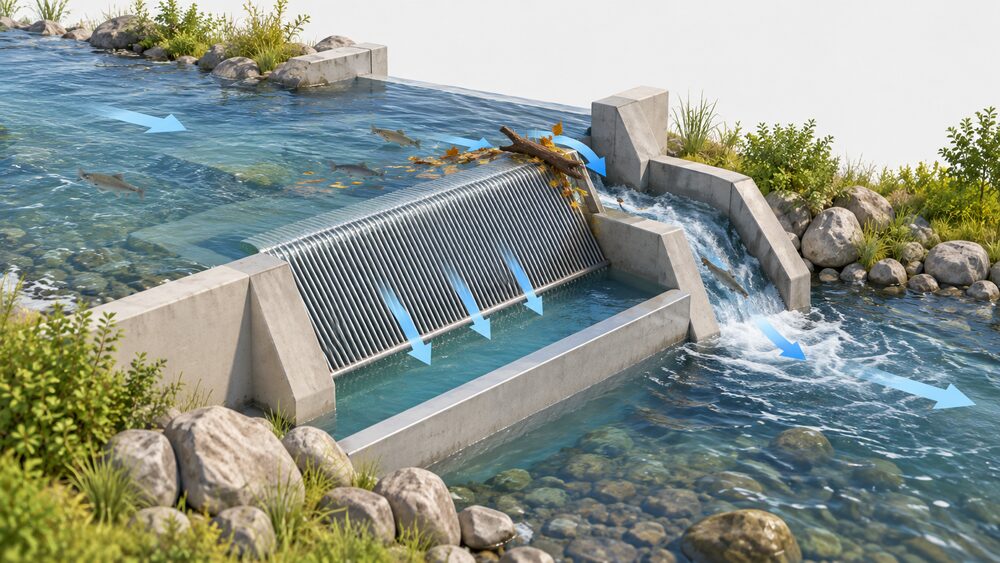
Screening is the primary physical measure protecting fish at a hydro intake. The screen sits at the point where water leaves the natural channel and enters the turbine supply, and its job is to pass water while deflecting fish, fry and debris away from the turbine.
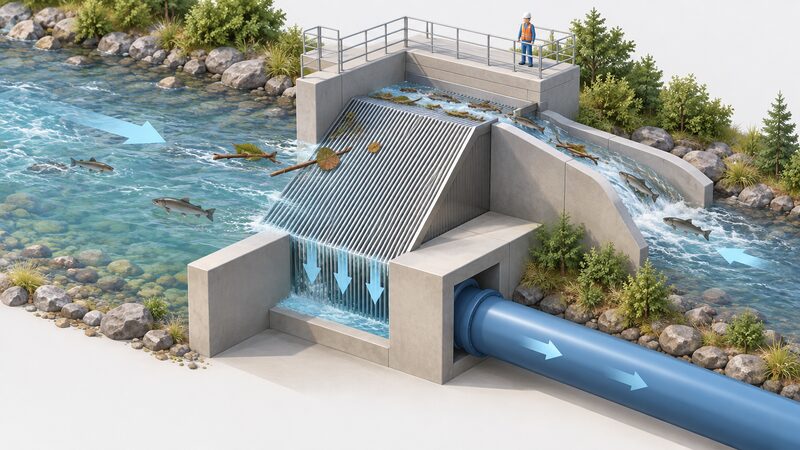
A Coanda screen is one of the most common designs on small run-of-river intakes. It uses an inclined wedge-wire or profile-bar surface; water is drawn through the bars by the Coanda effect while fish and debris are carried over the top and back to the channel. The design has no moving parts, which suits remote sites and reduces maintenance. Screen spacing, the gap between bars, is the critical figure, and it is set by the consenting authority to suit the fish species and life stages present in the watercourse.
The requirements that typically attach to a screened intake include:
- A maximum bar spacing set for the smallest fish that must be protected.
- A maximum approach velocity, so fish are not pinned against the screen.
- A bypass or fish pass route that returns deflected fish to the river downstream of the intake.
- A debris management arrangement, since a blocked screen can raise head loss and reduce generation.
- Inspection and maintenance conditions, often tied to the licence rather than to planning.
The choice of turbine interacts with screening but does not replace it. An Archimedean screw, for example, is often described as comparatively fish-friendly because of its slow rotation and open geometry, but the consenting requirement still applies. The regulator sets the standard; the turbine type does not exempt a scheme from it.
Fish passes and the flow left in the river
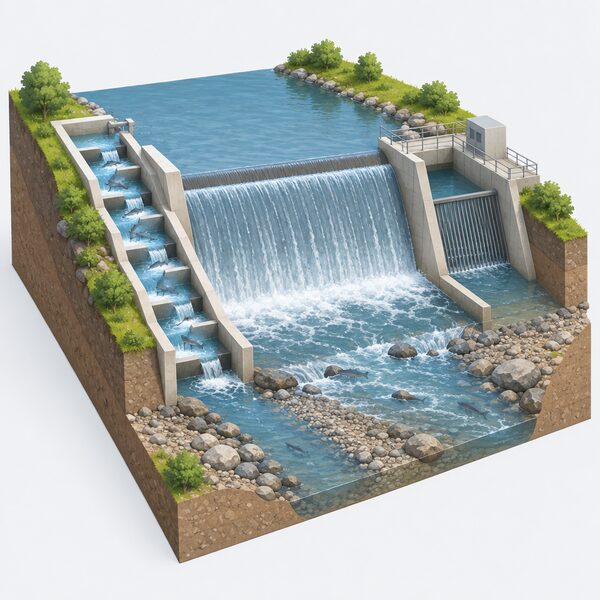
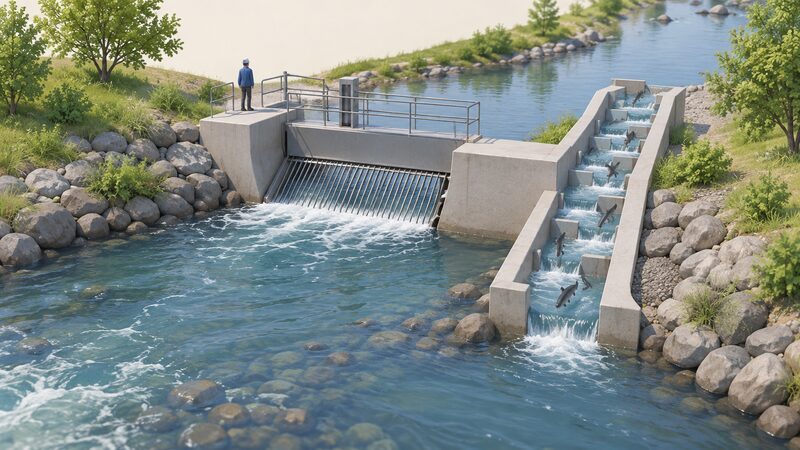
A fish pass is the structure that allows migratory fish to move past the intake and any weir or barrier associated with the scheme. Where a scheme obstructs a migration route, the consent will normally require provision for passage, and the design must suit the species present.
The two conditions work together. The residual flow left in the river maintains a wetted channel and provides the attraction flow that draws fish to the pass entrance. The pass itself provides the route. If the residual flow is set too low, the pass may not function as intended even if it is correctly built.
For a household scheme, the implications are practical rather than abstract:
- The residual flow reduces the water available for generation, and therefore the output.
- The fish pass and its maintenance become part of the scheme's ongoing obligations.
- Monitoring conditions may require records of flow, screen condition or passage.
- Failure to maintain the pass or the screen can breach the licence, not just the planning consent.
The species that must be considered are determined by the regulator for the watercourse. Migratory fish such as salmon and sea trout, and eels, are the groups most often at issue because their life cycles depend on moving both up and down a river. Designated sites add a further layer, since a protected area designation can trigger its own assessment requirements.
When an environmental assessment is required
Whether a full environmental assessment is needed depends on the scale of the abstraction, the sensitivity of the watercourse and the designations that apply to it. There is no single threshold that applies across the UK, because the assessment regimes are devolved.
In Scotland, the entry point is the Strategic Environmental Assessment screening, undertaken under the Environmental Assessment (Scotland) Act 2005 in consultation with SEPA, SNH and HES1. The screening decides whether a fuller assessment is required. The consultee bodies bring different remits: SEPA on water and pollution, SNH on nature conservation, and HES on the historic environment.
Where a scheme is on or near a designated site, or where protected species are present, survey work is commonly required before an application can be determined. That survey may need to run across a full season to capture the relevant life stages, which is one reason hydro projects have long lead times relative to their installed capacity.
The wider regulatory context matters here. The Climate Change Committee has recommended that the need for investment in adapting to climate change should be included within mandates and strategic priorities for all relevant regulated industry regulators, through resilience standards aligned to national-level objectives, naming energy and water regulators and implementing agencies such as the Environment Agency5. That recommendation points to a direction of travel in which environmental regulators carry a broader resilience remit, though it does not itself change the consenting requirements for an individual scheme.
For a household, the practical test is straightforward: the more sensitive the watercourse, the more survey and assessment work the scheme will need, and the longer the consenting process will take. Early engagement with the regulator is the usual approach, because survey requirements and screen specifications are set case by case.
Where the rules differ across the four nations

Environmental assessment and abstraction licensing are devolved, so the requirements attached to a hydro consent differ depending on where the scheme sits. The table below sets out what the available evidence establishes for each nation.
| Nation | Assessment framework | Principal consultee or regulator |
|---|---|---|
| Scotland | Environmental Assessment (Scotland) Act 20051 | SEPA, SNH and HES as statutory consultation authorities1 |
| England | Own consenting regime | Environment Agency named among implementing agencies for resilience standards5 |
| Wales | Own consenting regime | Devolved administration; separate regime |
| Northern Ireland | Own consenting regime | Separate regime |
Scotland is the nation for which the assessment framework is most clearly documented in the available evidence. The Strategic Environmental Assessment screening is undertaken in accordance with the Environmental Assessment (Scotland) Act 2005, in consultation with SEPA, SNH and HES1. SEPA's dual advisory and regulatory role is also documented, with Scottish Government consultation analysis listing SEPA, NatureScot and the Scottish water industry among the public bodies most frequently cited as exercising both functions2.
For England, the Environment Agency is named in the Climate Change Committee's recommendation as one of the implementing agencies through which resilience standards aligned to national-level objectives should be delivered5. That places the Agency within the broader regulatory landscape for water and adaptation, though the specific consenting requirements for a hydro abstraction are set under England's own regime.
Wales and Northern Ireland each operate their own arrangements. A scheme near a border needs the rules of the nation it physically sits in, not the nation of the nearest town. Because the assessment regimes are separate, a survey or screen specification accepted in one nation does not automatically satisfy the requirements of another.
The financial and regulatory context for a hydro scheme
Environmental requirements sit within a wider framework that affects whether a scheme is viable. Two elements are worth setting out because they bear directly on the household's position.
First, the tax treatment of water turbines has changed more than once. Water turbines were reinstated as energy-saving materials in Great Britain from 1 April 20224, and the change permanently brought wind and water turbines back into scope of the relief in Great Britain6. Water turbines are listed as eligible materials in the relevant legislation7, and they qualify for a lower rate of VAT in Great Britain only3. The earlier position was different: the UK was required to exclude wind and water turbines from the list of qualifying energy-saving materials8. A household considering a hydro scheme should therefore check the current VAT position at the time of installation rather than relying on older guidance.
Second, the Feed-in Tariff scheme, which historically supported small-scale hydro, is closed to new applicants. The scheme supported small-scale renewable and low carbon technologies up to a Total Installed Capacity of 5MW in Great Britain9, and its costs are spread across all licensed electricity suppliers in Great Britain through the levelisation process10. The fuel classification flow diagram was published to provide additional clarity on the classification of fuels under the FIT and SEG, allowing greater transparency on processes and decisions and greater consistency across fuels, generators and schemes11. For a new scheme, the relevant route is export under the Smart Export Guarantee rather than the legacy tariff.
The regulatory obligations also carry an administrative dimension. FIT licensees were required to ensure that the identity of the FIT generator was verified when registering an Eligible Installation9, and applicants were required to provide proof of ownership of the installation12. Domestic installation owners were asked to provide proof of address, which could take the form of utility bills, bank statements, council tax bills or equivalent documents9. Non-domestic installation owners had to prove their identity by providing details of their company registration and proof of address12. These requirements illustrate the level of documentation that renewable schemes attract, and hydro consents add environmental conditions on top.
What this means for a household's energy independence
A micro hydro scheme is one of the few domestic generation technologies that can produce power continuously rather than intermittently, because a river flows day and night. That is its central advantage for energy independence: a well-sited run-of-river scheme with sufficient head and flow can supply a meaningful share of a household's electricity across the year, reducing reliance on the grid and on a supplier.
The environmental requirements are the price of that independence, and they are not optional. The residual flow condition reduces the water available to the turbine. The screen and fish pass add capital cost and ongoing maintenance obligations. The survey and assessment work adds time before construction can begin. None of these can be designed around; they are set by the regulator and enforced through the licence.
The dependence that remains is also worth stating plainly. A hydro scheme depends on the watercourse continuing to flow within its consented parameters, which means it is exposed to drought and to changes in catchment management upstream. It depends on the grid for export and for backup, unless it is entirely off-grid with battery storage. It depends on the consenting authority for the licence and on continued compliance with its conditions. And it depends on a turbine manufacturer for spares and support over the scheme's life.
For a household weighing up a scheme, the environmental requirements are best understood as part of the site assessment rather than as a hurdle at the end. The screen specification, the residual flow and the fish pass provision all follow from the watercourse and its species, and they shape what the scheme can produce. A scheme designed around those conditions from the outset is more likely to secure consent and to operate within it.
Sources12 cited
- Permitted Development Rights Impact Assessments, Scottish Government, 2026
- Heat in Buildings: analysis of responses to the call for evidence, Scottish Government, 2022
- Tax on shopping: energy-saving products, GOV.UK, 2026
- VAT Energy Saving Materials and Grant Funded Heating Supplies (VAT Notice), HM Revenue & Customs, 2022
- A lack of leadership is preventing essential investment to prepare the UK for climate change, Climate Change Committee, 2023
- Changes to the VAT treatment of the installation of energy saving materials in Great Britain, GOV.UK, 2022
- The Ecodesign for Energy-Related Products and Energy Information (Amendment) Regulations 2022, legislation.gov.uk, 2022
- Explanatory Memorandum to the Ecodesign Regulations 2022, legislation.gov.uk, 2022
- FIT Guidance for Licensed Electricity Suppliers V17.1, Ofgem, 2024
- Feed-in Tariffs (FIT), Ofgem, 2026
- Feed-in Tariffs and Smart Export Guarantee Fuel Classification Flow Diagram, Ofgem, 2019
- Feed-in Tariffs Guidance for Licensed Electricity Suppliers V15.0, Ofgem, 2021
 Micro Hydro InstallationHow much water do you need, and how far does it have to fall, for a micro hydro system to be worth it?
 Abstraction Licences and PermitsTaking water from a stream to power a turbine needs permission, and where you live decides who grants it.
 Heating Controls Building RulesWhat heating controls must you fit by law when you replace a boiler?
 Building RegulationsReplacing a boiler or heating system usually needs building regulations approval, and the rules differ across England, Scotland, Wales and Northern Ireland.
 Permitted Development by HomeCan you put up solar panels or a heat pump without asking the council?
 Micro Hydro Head and FlowHead is the drop from the top of your water supply to the bottom, and flow is how much water comes down.