
In this guide
A hydrogen fuel cell car is not a way to power a house. There is no vehicle-to-home product for a hydrogen car, no domestic hydrogen supply to refuel one at home, and no UK refuelling network dense enough to make the car a practical household energy store. The fuel cell in a car makes electricity through a chemical reaction, and it does so efficiently, but the electricity goes to the traction motor and nowhere else.
The fuel cell technology that does reach UK homes is micro combined heat and power (micro-CHP), and it is a different proposition entirely. A micro-CHP unit is gas-fired, sits in the same space as a boiler, and generates about 1kW of electricity while it is running1. That electricity is a by-product of heat production, not the point of the machine. Domestic sized models are now available, and the technology has been established in Northern Ireland for some time in large scale installations such as hospitals and leisure centres1.
The distinction matters for household energy independence. A micro-CHP unit reduces the amount of grid electricity a home buys, but it does not remove the gas connection, the boiler service regime or the supplier relationship. A hydrogen car removes none of them and adds a refuelling problem. This page sets out what each technology actually delivers, what the planning and export rules are, and where the limits sit.
What a fuel cell actually does in a domestic setting
A fuel cell generates electricity through chemical reactions rather than combustion2. That is the whole of its appeal: no flame, fewer moving parts than an engine, and a higher conversion efficiency than a Stirling engine, which is the other common micro-CHP prime mover2. In a car, the stack is sized for traction, tens of kilowatts of output delivered to a motor. In a home, the requirement is inverted: heat is the main product and electricity is the residual.
The comparison that matters is not fuel cell versus fuel cell, it is fuel cell versus internal combustion. Internal combustion engines are generally not suitable to use in a home, while fuel cells are more efficient than Stirling engines2. That is why the domestic fuel cell products that exist are heating appliances first. They burn a fuel, usually gas, and harvest electricity from the reaction as a secondary output.
There is one narrow point of contact between gas and vehicles in the tax system. Where gas piped directly to a customer's home is used partially to fuel a car and partially for domestic purposes, the supply should be apportioned accordingly5. That is a VAT apportionment rule for a home gas supply partly used as road fuel. It is not a route to running a house from a car, and it does not describe a hydrogen fuel cell vehicle at all.
A home battery, by contrast, does what a car cannot: it stores any unused energy for use later, for example to power your home during the night6. That is the function a household actually needs if it wants to shift generation to the hours when it is at home. A fuel cell car has no such mode.
Micro-CHP: the fuel cell technology that does reach UK homes
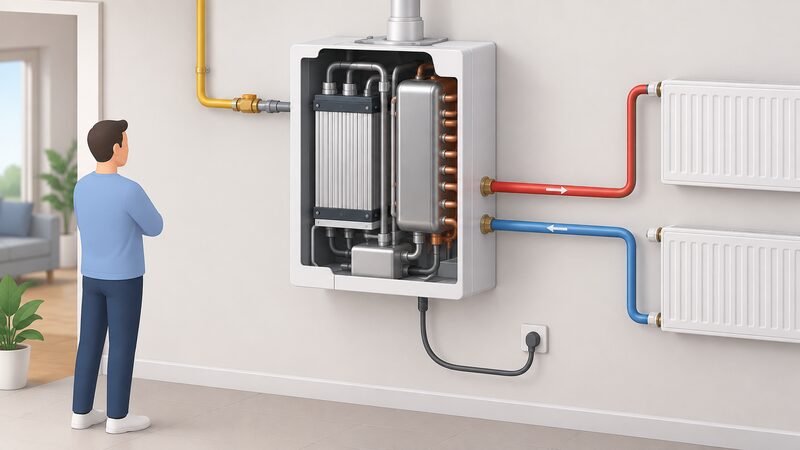
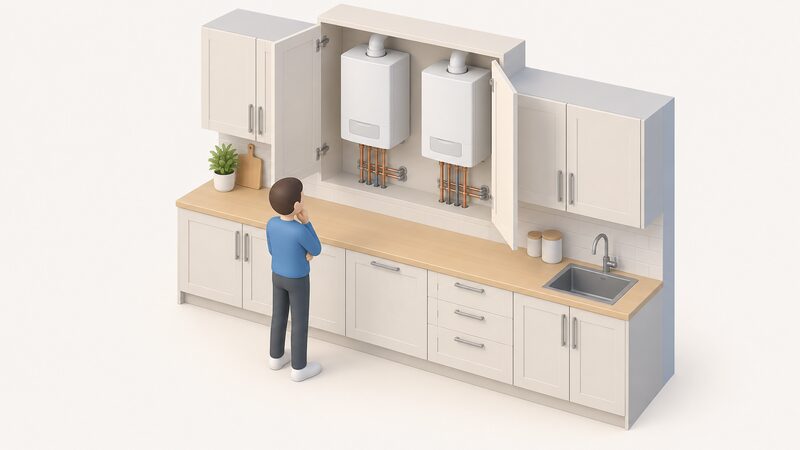
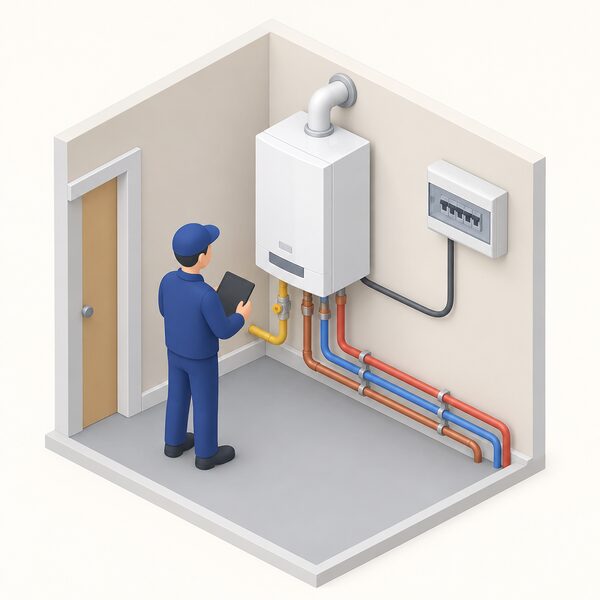
Micro-CHP is the domestic application of fuel cell and engine technology, and it is available in the UK. Domestic sized models are now available, and the technology has a longer history in Northern Ireland in large scale installations such as hospitals and leisure centres1. The domestic versions are compact and come in similar sizes and styles to standard boilers, with options for wall-mounted or floor-standing installation2.
The fuel is the constraint. Micro CHP systems for homes typically use mains gas or liquefied petroleum gas (LPG) as fuel2. A CHP unit is gas-fired1. That means the technology is available to homes on the gas grid, and to off-grid homes that can take LPG, but not to homes with no gas or LPG supply. Off-gas grid households use a range of other fuels to heat their homes including heating oil, liquefied petroleum gas (LPG), solid fuels, mains electricity, and microgeneration7. For the oil and solid fuel households in that list, micro-CHP is not a drop-in replacement.
The carbon case is qualified rather than clean. While it uses fossil fuels, micro CHP is still considered a low-carbon option because it uses fuel more efficiently than separate heating and grid electricity2. That is the honest framing: it is an efficiency play on a fossil fuel, not a renewable. A household wanting to cut gas dependence altogether is looking at a different technology, and the comparison between a fuel cell unit and a heat pump is set out in fuel cell heating vs micro-CHP and micro-CHP vs an air source heat pump.
The wider microgeneration picture is worth holding alongside this. More than 1.4 million homes across the UK already use solar power, and that number continues to grow every year8. Solar is the mass-market domestic generator; micro-CHP is a niche heating appliance that happens to generate. The two are not competitors for the same roof or the same budget.
Output in practice: heat first, with up to 1kW of electricity as a by-product
The headline figure is small and precise. A micro-CHP unit generates about 1kW of electricity while it is running1. That is the number to hold on to, because everything else about the technology follows from it.
One kilowatt is roughly the draw of a fridge, a freezer, a broadband router, a television and a few lights running together. It is not enough to run an electric shower, an oven and a washing machine at the same time. It is enough to cover a household's baseload while the heating is on, which in a gas-heated home is most of the winter. The unit is not a generator that can be switched on to meet a load; it is a heating appliance whose electrical output happens to be available whenever it is producing heat.
The scale of a household's electricity demand puts that in context. Households with mains gas as the primary heating fuel have a mean annual electricity consumption of 15,700 kWh, on January to March 2026 figures4. A 1kW output is only available when there is a call for heat, so the realistic contribution is a fraction of the annual figure, concentrated in the heating season.
| Measure | Figure | Source |
|---|---|---|
| Micro-CHP electrical output while running | about 1kW | 1 |
| Mean annual electricity consumption, mains gas heated homes | 15,700 kWh | 4 |
| Worked example, Wondrwall home energy system battery draw | 1.02kW | 5 |
| Average peak time hourly consumption, homes with electric heating or peak-charged EV | 1.1kWh | 6 |
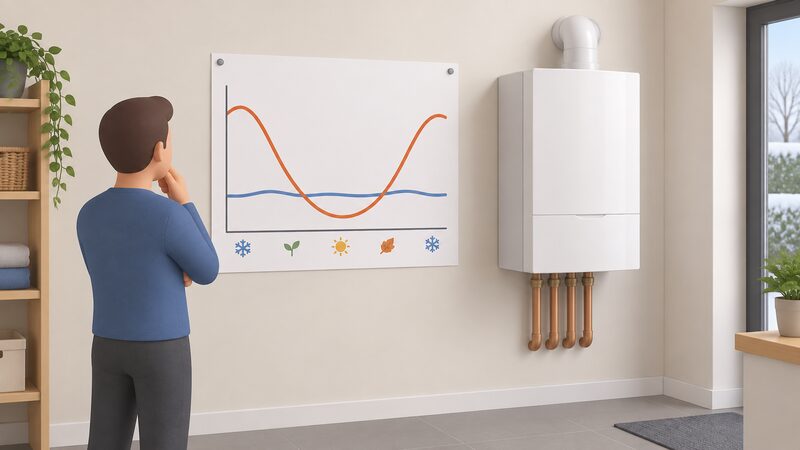
That seasonality is the structural limit. A micro-CHP unit produces most when the home needs heat and least when it does not, which is the opposite of a solar array's summer peak and the opposite of what a household with high summer cooling or EV charging demand would want. It pairs naturally with a home battery, which can store any unused energy for use later, for example to power your home during the night6, but the battery is a separate purchase and a separate control system.
The 6:1 heat-to-electricity ratio and what it means for your bills
The ratio between heat and electricity from a micro-CHP unit is heavily weighted towards heat, which is the arithmetic consequence of a unit sized for a home's heating load producing about 1kW of electricity1. That ratio is the reason micro-CHP is described as a heating technology with an electrical by-product rather than a generator. It matters because households face electricity unit prices four times those of gas2, and the ratio of electricity-to-gas prices is still too high for households who switch to heat pumps to see the full benefits of their greater efficiency9.
What that does to a bill depends entirely on what the household was burning before. Households with electricity as the primary heating fuel could see a mean fuel bill reduction of £530 per year after the Renewables Obligation levy and Energy Company Obligation scheme are removed, on January to March 2026 figures4. That figure is for a switch away from direct electric heating, and it is a mean across a modelled population, not a promise for an individual home.
For a household already on mains gas, the saving is smaller and harder to pin down, because the unit burns gas to make both heat and power. The Climate Change Committee's assessment is that the ratio of electricity-to-gas prices is still too high for households who switch to heat pumps to see the full benefits of their greater efficiency9. The same price ratio shapes the micro-CHP case: the value of the electricity generated depends on the retail electricity price it displaces, and the cost of generating it depends on the gas price.
The wider bill picture is volatile. Since the start of the Iran war, households with gas boilers and petrol cars have seen energy bills rise almost four times more than those with heat pumps and EVs10. That is a comparison of two household archetypes under a price shock, and it illustrates how exposed a gas-burning household is to fuel price movements. Micro-CHP reduces exposure to electricity prices while leaving exposure to gas prices intact.
Fuels: mains gas, LPG, oil and bio-liquids
Micro-CHP runs on mains gas or liquefied petroleum gas (LPG)2. Those are the two fuels the domestic products use, and a CHP unit is gas-fired1. The technology is therefore available to the roughly four in five UK homes on the gas grid, and to off-grid homes that install or already have an LPG supply.
Off-gas grid households use a range of other fuels to heat their homes including heating oil, liquefied petroleum gas (LPG), solid fuels, mains electricity, and microgeneration7. For the oil and solid fuel households in that group, micro-CHP is not an option without a fuel change. The grant rules for the renewable alternative make the boundary explicit: biomass boilers may replace fossil fuel heating systems fuelled by oil, LPG, and coal, but may not replace the heating system in a property with a gas supply, including where the gas supply has been capped or clamped11. That is the mirror image of the micro-CHP position, and it shows how the two technologies divide the housing stock between them.
| Fuel | Micro-CHP available | Notes |
|---|---|---|
| Mains gas | Yes | The standard domestic fuel for micro-CHP units2 |
| LPG | Yes | Off-grid homes with an LPG supply2 |
| Heating oil | No, without a fuel change | Off-gas grid fuel7 |
| Solid fuels | No, without a fuel change | Off-gas grid fuel7 |
| Mains electricity | Not applicable | Direct electric heating is the case the £530 saving is modelled against4 |
The VAT treatment of domestic fuel is broad. The reduced rate for fuel and power covers a wide range of fuels used within homes5. That applies to the gas or LPG a micro-CHP unit burns, and it applies to the electricity a household buys from the grid. It does not create a separate category for micro-CHP.
For households on oil, LPG or electric heating, the official advice is that they may save money on energy bills by switching to a heat pump12. That is the competing pathway for exactly the households micro-CHP cannot reach, and it is worth stating plainly: the homes with the highest fuel costs and the least access to gas are being directed towards heat pumps, not towards gas-fired micro-CHP.
Cost, installation and servicing compared with a standard boiler
Micro-CHP units are compact and come in similar sizes and styles to standard boilers, with options for wall-mounted or floor-standing installation2. That is the practical starting point: the unit occupies the space a boiler occupies, connects to the same heating circuit and the same flue route, and is serviced on a similar schedule. The installation is a heating engineer's job, not a specialist plant installation.
The comparison with a standard condensing boiler is therefore about the unit itself rather than the surrounding system. A micro-CHP unit is a more complex appliance than a condensing boiler, because it contains a generating element as well as a heat exchanger, and that complexity carries through to servicing and to the parts that can fail. The counter-argument is efficiency: micro CHP is considered a low-carbon option because it uses fuel more efficiently than separate heating and grid electricity2. The efficiency gain is real but it is measured against the alternative of a boiler plus grid power, not against a boiler alone.
Installation standards matter for eligibility. For domestic batteries to be eligible for the Warm Homes: Social Housing Fund scheme, the product must be installed by an MCS certified installer, to the relevant MCS installation standard (MCS 3012)13. That is the certification model the sector uses, and micro-CHP has its own MCS certification and performance testing requirements. A household commissioning a unit should expect the installer to work to a published standard and to register the installation.
The running cost comparison is dominated by fuel prices rather than by the appliance. A household with a gas boiler and a petrol car relies on 17MWh of imported energy in 2024, which is 67% (two-thirds) of the total primary energy needed to meet that household's needs for heating, power and fuel14. Micro-CHP reduces the electricity share of that import bill but leaves the gas share, and the gas share is the larger part.
Planning permission, flue rules and listed buildings
Planning permission is not normally needed when installing a micro-combined heat and power system in a house if the work is all internal3. That is the common case: a unit swapped into an existing boiler position, using an existing flue route, needs no application. The rules change when the work reaches the outside of the building.
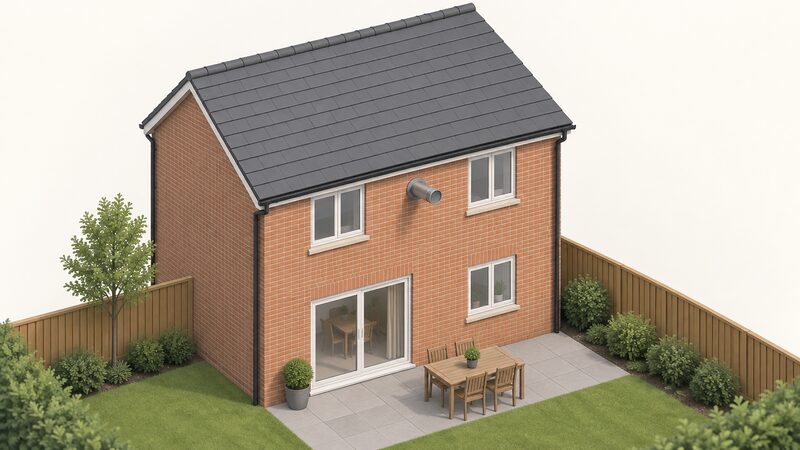
Flues on the rear or side elevation of the building are allowed to a maximum of one metre above the highest part of the roof3. In a conservation area or in a World Heritage site the flue should not be fitted on the principal or side elevation if it would be visible from a highway3. Those two conditions cover most of the contentious cases, and they are the ones a household in a sensitive location should check before ordering equipment.
The permitted development right for the flue itself is set out in legislation. The installation, alteration or replacement of a flue, forming part of a biomass heating system, or a combined heat and power system on a dwellinghouse is permitted development15. That right is not universal: changes of use (Schedule 2, Part 3, Classes G; M; MA; N; P; PA and Q) and New Dwellinghouses (Schedule 2, Part 20) are excluded from the allowances16. A house created through a change of use or a new dwelling does not get the same automatic position.
Listed buildings and designated areas need a separate check. If the building is listed or in a designated area, even if you enjoy permitted development rights, it is advisable to check with your local planning authority before a flue is fitted, and consent is likely to be needed for internal alterations3. Central heating or other flues, solar panels, air con and heat recovery units and pipework may require listed building consent17. For comparison, an air source heat pump needs planning permission if the house or flat is a listed building, or within the garden or grounds of a listed building18.
Selling surplus electricity back to the grid through the SEG
A micro-CHP unit can export. The Smart Export Guarantee is the scheme to sell surplus solar electricity to the grid19, and licensed suppliers offer tariffs under it. Micro-CHP installations are registered on the Microgeneration Certification Scheme database, and statistics on the number of solar photovoltaic, wind and micro combined heat and power installations registered there are published20. That registration is the route by which an installation becomes visible to the scheme and to the statistics.
The practical obstacle is volume. A unit producing about 1kW while running1 will rarely have surplus to export, because the household's own baseload absorbs most of it. Export matters more for a technology with a large peak output and low self-consumption, which is why the SEG is described in terms of surplus solar. A micro-CHP household should expect the self-consumption route to dominate and export payments to be marginal.
The connection rules differ across the UK. In Northern Ireland, from 1 May 2026 applicants can apply for G99/NI Fast Track installations up to 60A per phase, previously 16A per phase, with the export limit remaining at 16A per phase. The parameters of G99/NI Fast Track applications changed on 1 May 2026. The connection process for a generator in Northern Ireland is set out in connecting a generator in Northern Ireland, and the GB equivalent in G98 and G99.
The export and metering arrangements for a micro-CHP unit are the same shape as for any other small generator, and the detail is covered in selling electricity from a wind, hydro or CHP generator. The Feed-in Tariff, which once paid micro-CHP generators, is closed to new applicants, and its history is set out in the Feed-in Tariff for wind, hydro and micro-CHP.
How common micro-CHP is in the UK today
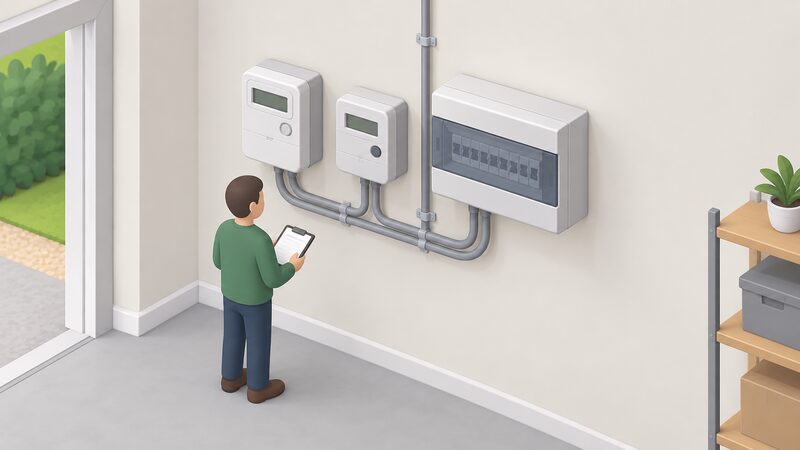
Micro-CHP is a small niche in the UK housing stock, and the available statistics show it indirectly rather than directly. Domestic sized models are now available1, and the technology has been established in Northern Ireland in large scale installations such as hospitals and leisure centres1, but the domestic installed base is not separately reported in the figures available here.
What the housing data does show is the shape of the market it would have to enter. Around one in ten households (11%) who had access to a car used either an electric or hybrid vehicle, in England in 202321. Households living in rural areas (14%) were more likely than households living in urban areas (11%) to have an electric or hybrid vehicle, and households living in flats (11%) were more likely to have access to an EV charge point compared with houses and bungalows (6%)21. Those are the households already engaging with home energy technology, and they are a minority.
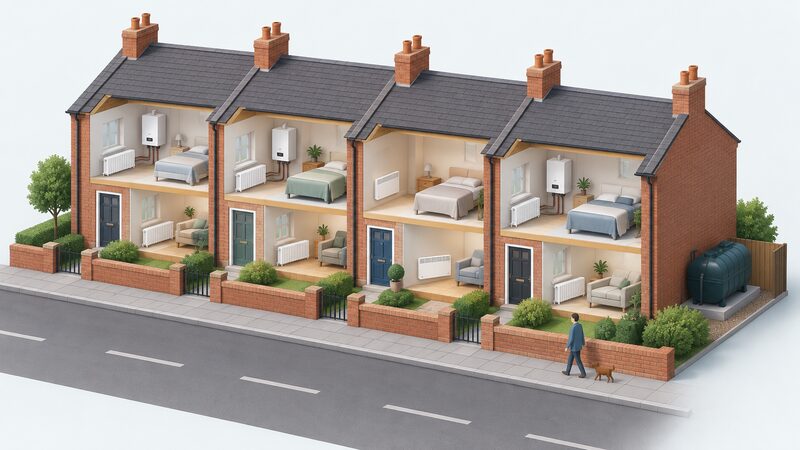
The heating stock is dominated by gas. In Scotland, urban locations use electricity in 8% and oil in 1% of dwellings, while flats have higher levels of electricity (14%) as the main heating fuel than all three house types, and private rented dwellings were more likely to use electricity as their primary fuel type at 21% compared to 8% of owner-occupied homes22. Mean environmental impact ratings by primary heating fuel are 67.4 for gas, 46.6 for oil, 53.4 for electric and 66.9 for other fuel type23. Those figures describe a housing stock where gas is the norm and micro-CHP's fuel is widely available, but where the appliance has not become a mass-market product.
The policy direction is towards electrification rather than gas-fired generation. The Scottish Government's target is to maximise the number of homes with households in fuel poverty achieving a level of energy efficiency equivalent to EPC C by 203024. Around one-third of homes that use electricity or other fuels for heating are in energy efficiency bands A to C (36% and a comparable share for other fuels) in England, on 2025 figures25. Micro-CHP sits outside that electrification narrative, which is the main reason its installed base remains small.
Where the household's independence actually comes from
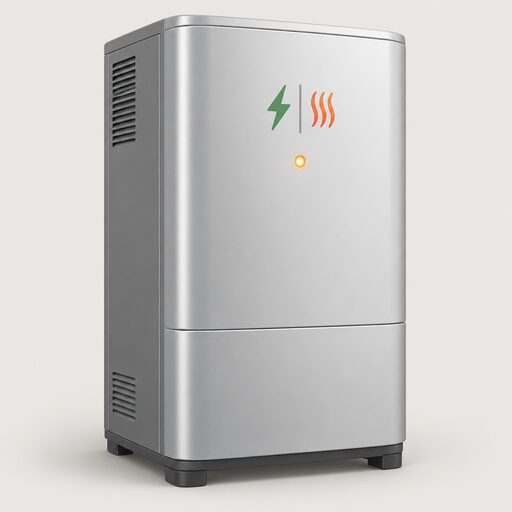
A hydrogen fuel cell car delivers nothing to a household's energy independence. It cannot be plugged into a home, there is no domestic hydrogen supply, and the refuelling network is not a household energy source. The car's fuel cell is a transport component, and the household remains dependent on the grid, a supplier and imported fuel for everything it uses at home.
A micro-CHP unit delivers something, but less than the name suggests. It generates about 1kW of electricity while it is running1, which reduces the electricity a household buys from the grid during the heating season. It does not remove the gas connection, the gas price exposure, the boiler service regime or the supplier relationship. The household's dependence shifts from electricity to gas rather than disappearing.
The comparison with a home battery is instructive. A battery stores any unused energy for use later, for example to power your home during the night6, which decouples generation from use. A micro-CHP unit cannot do that: its output is tied to its heat demand, and its output is small. A household wanting genuine independence from the grid is looking at a combination of on-site generation, storage and a connection agreement, and the options are set out in microgeneration and energy independence and which microgeneration suits your home and site.
The honest summary is that micro-CHP is a heating appliance with an electrical by-product, suited to gas-heated homes with a year-round heat demand, and that a hydrogen fuel cell car is not a household power source at all. The fuel cell technology that reaches UK homes is the boiler-shaped unit, not the vehicle.
Sources25 cited
- Micro combined heat and power, nidirect, 2026-09-17
- Micro-CHP, MCS Certified, 2026-08-17
- Micro combined heat and power: planning permission, Planning Portal, 2026
- Scenario modelling: impact of the reduction of the Renewables Obligation on fuel bills, Scottish Government, 2026
- VAT Fuel and Power (VAT Notice 701/19), HM Revenue and Customs, 2026-09-17
- How do I retrofit my home: solar panels, Oxfordshire County Council, 2026-09-17
- Off-gas grid households, House of Commons Library, 2026-09-17
- Solar panels, Welsh Government, 2026-01-14
- Progress in reducing emissions: 2025 report to Parliament, Climate Change Committee, 2025
- Faster electrification would cut UK household bills, say climate advisers, Climate Change Committee, 2026-06-24
- Boiler Upgrade Scheme guidance, Ofgem, 2023-09-25
- Specialist heat pumps for homeowners, Development Bank of Wales, 2024-11-07
- Warm Homes: Social Housing Fund wave 3 scheme guidance addendum, Department for Energy Security and Net Zero, 2026-06
- Household energy security in 2030, Energy and Climate Intelligence Unit, 2024
- Flue forming part of a biomass heating system or combined heat and power system, legislation.gov.uk, 2026-09-17
- Flue, chimney or soil and vent pipe: permitted development, Planning Portal, 2026-09-17
- Getting consent for works to a listed building, West Northamptonshire Council, 2026-09-17
- Heat pumps, New Forest District Council, 2026-09-17
- Energy improvement options: solar panels, London Borough of Hammersmith and Fulham, 2026-09-17
- Feed-in Tariffs quarterly statistics, Ofgem, 2026-09-17
- English Housing Survey 2023 to 2024: low carbon technologies in English homes, Ministry of Housing, Communities and Local Government, 2023
- Scottish House Condition Survey 2024: key findings, Scottish Government, 2024
- Scottish House Condition Survey 2024: key findings (complete report), Scottish Government, 2024
- Heat in Buildings Strategy: fairer Scotland duty assessment, Scottish Government, 2021-11
- Fuel poverty statistics, House of Commons Library, 2025
 Domestic Fuel CellsA fuel cell boiler makes electricity and heat at the same time, usually from mains gas.
 Hydrogen Safety in the HomeCan hydrogen actually be used to heat UK homes, and is it safe?
 Vehicle-to-Home and LoadCan an electric car really power your house, and which cars can do it?
 Hydrogen Home Heating TrialsHydrogen home heating is still being tested, not sold.
 The Full New Technology GuideWhich new home energy ideas can you actually buy in the UK right now, and which are still stuck in trials?
 Charging and Energy IndependenceCharging an electric car at home can cut your fuel costs, but how much does it really free you from the grid?