
In this guide
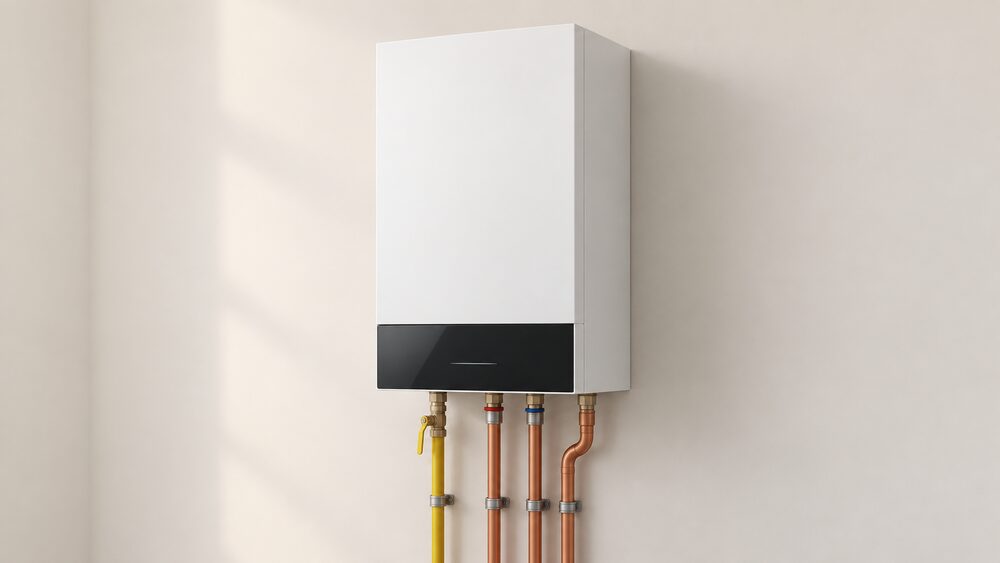
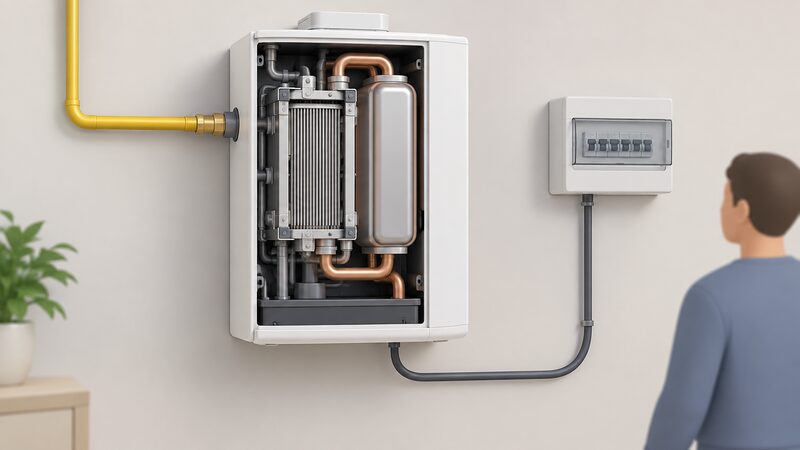
The Viessmann Vitovalor is a domestic fuel cell micro-CHP unit: a heating appliance that generates electricity as a by-product of producing heat. Ofgem's approved innovation measures list describes the product as "a domestic sized micro Combined Heat and Power (mCHP) unit that contains a low temperature fuel cell"1. It is not a boiler with a generator bolted on, and it is not a battery. It is a single appliance that sits where a boiler would sit and produces both heat and a small electrical output.
The electrical output is small. Published test data for the Viessmann generating unit gives 446 W in one set of figures and 230 W in another, and the two have not been reconciled2. Under-frequency test data records active power of 757 W at 50.00 Hz and 760 W at 49.54 Hz2. These are hundreds of watts, not kilowatts. For context, a typical dual fuel household's electricity consumption was modelled at 2,900 kWh a year under previous price cap figures3. A unit running continuously at a few hundred watts contributes to that, but does not cover it.
What the Vitovalor does for independence is therefore specific and limited. It generates while it heats, so some of the electricity a home uses comes from its own appliance rather than from the grid. It does not make the home independent of the gas network, because the fuel cell runs on gas. Ofgem's guidance states that delivery of the measure is "limited to on-gas households"4. A household off the gas grid cannot use it at all.
Electrical output: hundreds of watts, not kilowatts
The headline figure a household wants is how much electricity the unit makes. The published data does not give a single clean answer. The Viessmann generating unit is recorded at 446 W in one set of test results and 230 W in another, with no ruling reconciling them2. Under-frequency testing records 757 W at 50.00 Hz and 760 W at 49.54 Hz2. The spread is wide enough that a household should treat the output as a few hundred watts and check the certification documents for the specific model.
To put that in scale, a kilowatt hour is the standard unit across suppliers for both gas and electricity, and one kWh powers a 100-watt lightbulb for 10 hours7. A unit producing 446 W continuously for an hour produces 0.446 kWh. Over a year of near-continuous operation that is a meaningful contribution to a home's baseload, but it is not a substitute for a grid connection or a battery.
The comparison that matters is with other micro-CHP technologies. MCS, the certification body for small-scale renewables, states that fuel cells are more efficient than Stirling engines, and that internal combustion engines are generally not suitable for use in the home8. That is the technical case for a fuel cell over the older Stirling engine micro-CHP boilers, several of which were withdrawn from the UK market. The electrical output is small either way; the fuel cell simply converts more of the gas into useful energy.
For a household weighing this against other generation, the relevant comparison pages are micro-CHP types and fuel cell heating vs micro-CHP. The wider context for fuel cells as a home technology sits at domestic fuel cells.
Grid connection settings: voltage and frequency trip limits
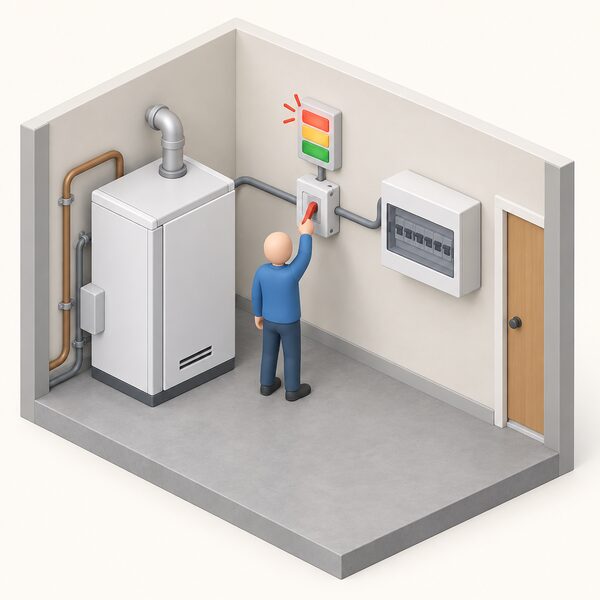
Any appliance that generates electricity in parallel with the mains must disconnect when the supply moves outside permitted limits. The settings are not the manufacturer's choice; they are set by the connection standards the unit is certified against.
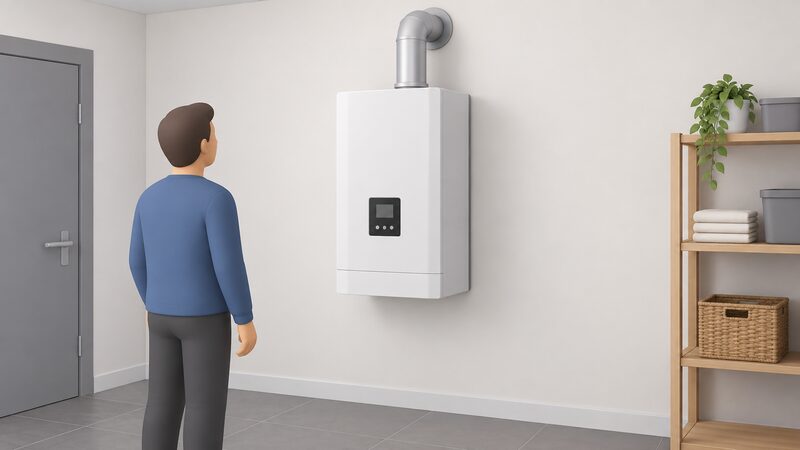
The revised voltage trip settings are 262.2V and 184V9. For comparable certified micro-generators, stage 1 protection settings are 253V with a 0.5 second delay for over-voltage, and 195.5V with a 3.0 second delay for under-voltage2. UK mains electricity operates within limits of 253V and 216V set by the Electricity Safety, Quality and Continuity Regulations10. The trip points therefore sit outside the normal supply envelope, so ordinary voltage variation does not cause the unit to drop out.
Voltages of 253V or more can disrupt equipment by triggering protective devices9. That is the upper end of the statutory band, and it is the point at which over-voltage protection begins to operate on a 0.5 second delay.
| Parameter | Setting | Delay |
|---|---|---|
| Over-voltage stage 1 | 253V | 0.5s2 |
| Under-voltage stage 1 | 195.5V | 3.0s2 |
| Revised trip settings | 262.2V and 184V | Not stated9 |
| Statutory supply limits | 253V and 216V | Not applicable10 |
The wider regulatory frame is BS 7671, the IET Wiring Regulations, which covers installations at voltages up to 1000V AC and 1500V DC11. Household appliances in this class are rated at not more than 250V for single-phase12. A generating unit connected to a domestic supply sits inside all of these limits by design.
The connection process itself is covered at G98 and G99, and the safety requirements for the wiring are set out at electrical safety and wiring.
Loss of mains: 0.5 second disconnection and the 20 second reconnection delay
The single most important behaviour for a household to understand is what happens when the grid fails. The unit stops.
The fast-track connection procedures for small-scale generation state plainly that "the generating units will not operate when there is a loss of mains situation"5. Domestic distributed generation switches itself off until after the mains supply has been restored14. This is not a limitation to be worked around; it is a safety requirement. A generator feeding a dead network would put engineers working on the line at risk.
The disconnection is fast. For comparable certified micro-generators, the loss of mains trip time limit is 0.5 seconds2. Where a solid state switching device fails to disconnect the micro-generator, the voltage on the output side must be reduced to below 50V within 0.5 seconds2.
Reconnection is deliberately slower. The reconnection sequence starts after a minimum delay of 20 seconds once voltage and frequency have returned to within the stage 1 settings2. Certified micro-CHP equipment records a measured reconnection delay of 20.8 seconds against a 20 second setting6. Other certified inverters take longer: the SMA STP 50-40 records measured delays of 27,21 seconds under voltage, 28,73 seconds over voltage, 27,64 seconds under frequency and 27,58 seconds over frequency15, with one unit recorded at 67 seconds across all four conditions16.
For comparison, a smart meter's in-home display may take up to 24 hours to reconnect and begin showing updated information after being off for some time17, and an in-home display moved within the home should reconnect within 24 hours18. Those are consumer display devices, not generators, but they illustrate how much slower consumer equipment reconnection is than the 20 second generator requirement.
Frequency response: constant power across the range and drift testing
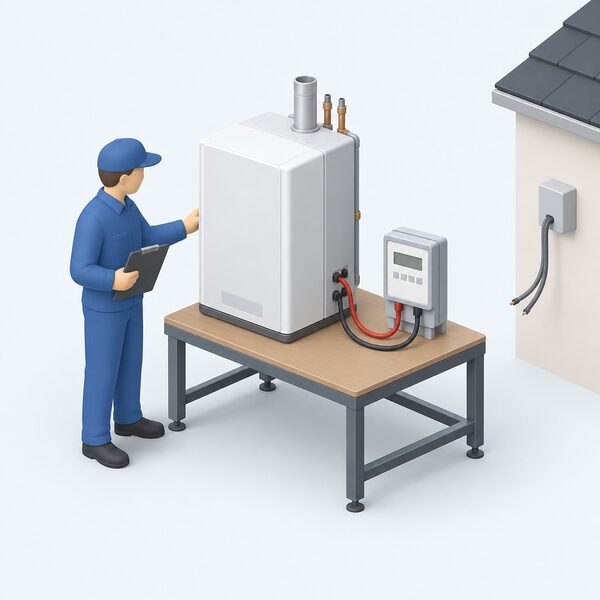
Frequency on the UK network sits close to 50 Hz, and generating equipment must hold its output steady across the permitted band and disconnect when frequency drifts outside it.
The published test data for the Viessmann generating unit records active power of 757 W at 50.00 Hz and 760 W at 49.54 Hz2. The two figures are close, which is the point: output is held near-constant across the frequency range rather than varying with it. The small difference between them is the drift the testing is designed to measure.
Certified micro-CHP equipment is tested for reconnection delay under four separate conditions: under voltage, over voltage, under frequency and over frequency15. The measured delays range from 27,58 seconds for over frequency to 28,73 seconds for over voltage15. A separate certified unit records a measured delay of 67 seconds across over voltage, under voltage, over frequency and under frequency16.
The pattern is consistent: the unit disconnects when frequency or voltage moves outside its permitted band, waits, and reconnects only after the supply has been stable within the stage 1 settings for the minimum delay period. Brief network disturbances therefore do not cause repeated cycling, which matters for the life of the fuel cell stack.
For a household, the practical consequence is that the unit's electrical contribution is only available when the grid is healthy. During a network fault, the home is on grid supply alone or on no supply at all. The frequency response behaviour is what makes the unit safe to connect in parallel, not what makes it a source of resilience.
Power quality: 0.99 power factor, harmonics and DC injection
Power quality requirements determine whether a generating unit can connect at all. A unit that injects distortion or direct current into the network is not permitted.
Certified micro-CHP test data records a power factor of 0.9993 measured at full output, at both 230V and 253V6. Power factor is a measure of how much of the current drawn or exported does useful work; a figure of 1 is unity. At 0.9993 the unit is effectively at unity, which is well inside the 0.99 figure usually quoted for this class of equipment.
On DC injection and capacitor discharge, the requirements for small generating devices are specific. Capacitors larger than 100nF must discharge to a voltage not exceeding 34V within 1 second following disconnection from the mains supply19. The same requirement appears in the withdrawn version of the specification, with capacitors greater than 100 nF discharging to 34V within 1 second following disconnection20. This matters because a capacitor holding a charge after disconnection is a shock risk to anyone working on the circuit.
The general safety standard for household appliances sets the rated voltage limit at not more than 250V for single-phase appliances12. Residual current devices in a consumer unit immediately switch off the electricity if they detect a fault, protecting people from electric shocks and earth faults21. Those devices are part of the installation, not the generating unit, but they are what makes a grid-parallel appliance safe in a domestic setting.
The power quality figures are the least visible part of the specification and the most important for connection approval. A unit that meets them can be connected under the fast-track process; one that does not cannot.
What a fuel cell unit means for household energy independence
The honest answer is that a fuel cell micro-CHP unit gives a household a measure of generation independence and no independence from fuel supply.
What it does: it generates electricity on site while it heats, so a portion of the home's consumption is met by its own appliance rather than drawn from the grid. MCS states that fuel cells are more efficient than Stirling engines8, so the gas used produces more useful heat and power than the older micro-CHP technology. The unit runs on gas and is limited to on-gas households4, which means it is available to the majority of UK homes but not to off-grid properties.
What it does not do: it does not run during a power cut5. It does not remove the household's dependence on the gas network or on a gas supplier. It does not store energy, so generation and consumption must coincide. And its electrical output, at a few hundred watts, is a contribution to baseload rather than a supply capable of running a home.
The wider independence picture is set out at microgeneration and energy independence. For a household comparing technologies, the relevant question is what each one substitutes for. A wood burning stove offers fuel independence, helping avoid sudden tariff changes and standing-charge pressures22. A fuel cell unit does not: it substitutes a more efficient use of gas for a less efficient one, while keeping the gas connection.
The grid itself is not a barrier to independence in the way it is sometimes presented. Energy Systems Catapult's Living Lab work used a baseline group of 230 homes with no low-carbon technologies23, and the finding across that work is that household technologies change the pattern of grid demand rather than removing it. Solar Energy UK's position is that more homegrown energy means greater energy independence24, which is true of generation that reduces imported fuel. A gas-fed fuel cell reduces the amount of grid electricity a home draws, but the gas still comes through a pipe.
For a household weighing a fuel cell unit against alternatives, the comparison pages are micro-CHP vs a condensing gas boiler, micro-CHP vs an air source heat pump and fuel cell heating vs micro-CHP. The question of whether a fuel cell heating system can run on natural gas is covered at fuel cell heating natural gas, and the certification route at micro-CHP performance and certification.
Sources24 cited
- ECO4 Innovation Approved Innovation Measures v1.1, Ofgem, April 2023
- Type test register: HOYMI 02051, Energy Networks Association
- Fuel poverty scenario modelling based on Ofgem energy price caps, Scottish Government, September 2026
- ECO4 Innovation Approved Innovation Measures v1.17, Ofgem, January 2026
- Connecting generation to the electricity networks, Energy Networks Association
- Product type test register: CFCLT001, Energy Networks Association
- How do I read my British Gas energy bill, Uswitch, September 2025
- Micro-CHP, MCS Certified
- Variable voltage, National Grid
- Statutory voltage limits, Energy Networks Association
- Requirements for Electrical Installations, IET Wiring Regulations, BSI
- Household and similar electrical appliances: safety general requirements, BSI
- Connecting generation to the electricity networks (archived), Energy Networks Association
- What is domestic distributed generation, UK Power Networks
- Type test register: SMAST 03599, Energy Networks Association
- Type test register: HUAWE 03566, Energy Networks Association
- Smart Energy GB FAQs, Smart Energy GB
- Fixing problems with your smart meters in-home display, Citizens Advice
- Plug-in solar interim product specification, Department for Energy Security and Net Zero, July 2026
- Plug-in solar interim product specification (withdrawn), Department for Energy Security and Net Zero, June 2026
- Consumer units and fuse boxes, NICEIC, September 2025
- Energy Savers Week: how to cut heating costs with your wood burner, HETAS, 2026
- Grid impacts of heat pumps, EVs and solar revealed, Energy Systems Catapult, August 2025
- Solar Energy Scotland manifesto, Solar Energy UK
 Viessmann boilers and the Vitodens familyViessmann boilers are German made and sold in the UK as combi, open vent and storage models, mostly in the Vitodens range.
 Viessmann Vitodens 100-WHow long does the Viessmann Vitodens 100-W warranty last, and what do you need to do to get the longer cover?
 Viessmann Vitovalor Fuel Cell BoilerThe domestic fuel cell boiler UK buyers still search for, now withdrawn.
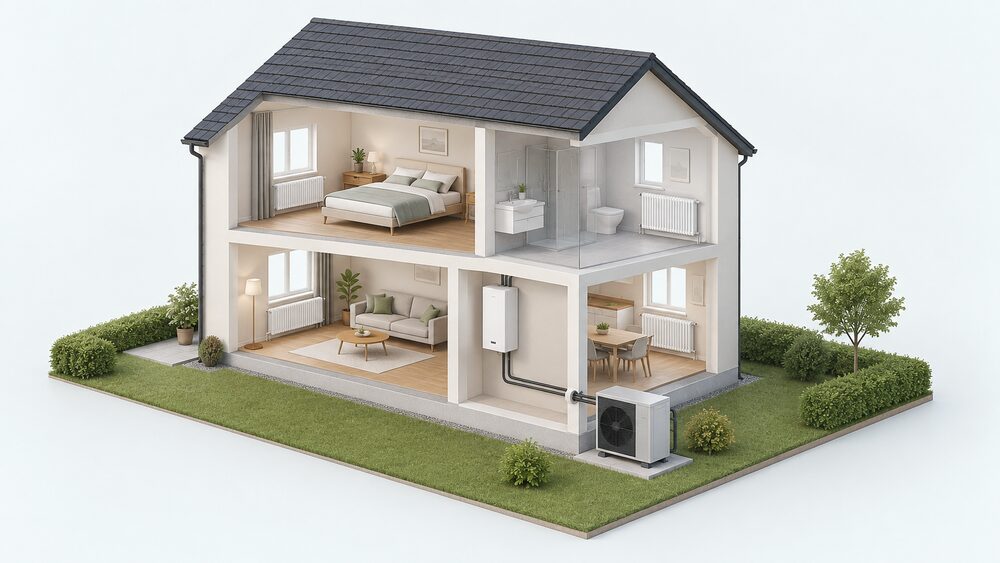 Viessmann Vitocal heat pumpsThinking about a Viessmann Vitocal heat pump for your home?
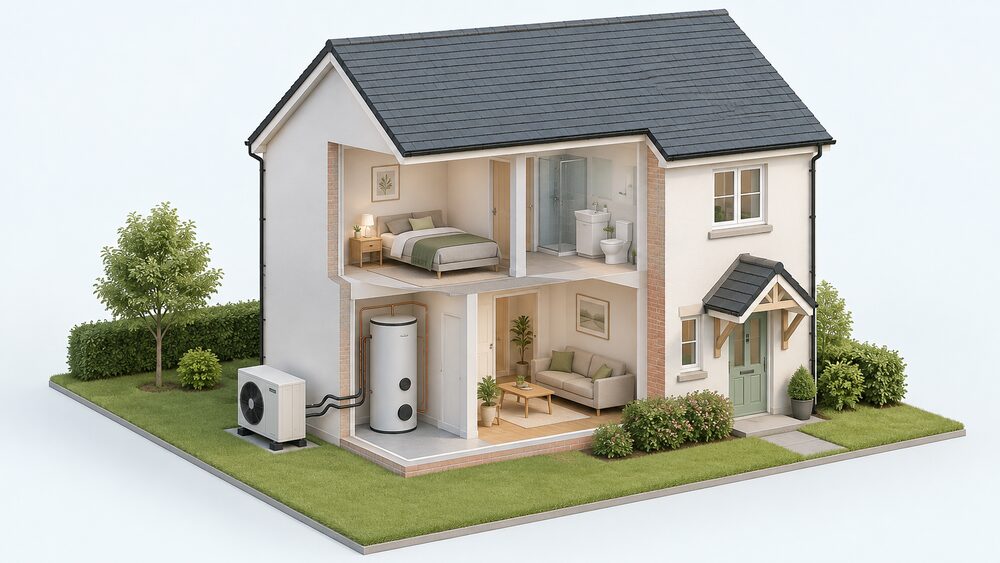 Viessmann Vitocal heat pump rangeThe Viessmann Vitocal range in the UK: current models, flow temperatures, warranty terms, servicing and what the brand's heat pump heritage means for a household.
 Viessmann Heating Controls and the ViCare AppHow Viessmann's ViCare app, Vitoconnect gateway and room controls work in UK homes, what they control, what they depend on, and what they cost to run.
 Viessmann boilers and heat pumps in the UKAre Viessmann boilers any good, and how long do they last?