

In this guide
A wind turbine, a hydro turbine or a micro-CHP unit cannot simply be wired into a house and switched on. The protection settings inside the generator or its inverter have to be set so that the machine disconnects from the network when something goes wrong, and the distribution network operator (DNO) has to know the machine is there. Two engineering standards govern that: G98 for small installations and G99 for everything larger. Both are technical standards for the protection settings required for generators or storage assets to connect to electricity networks, acting as a safety mechanism to protect both the network and the equipment from faults1.
The dividing line is capacity per phase. G98 covers installations up to 16 amps per phase, which is 3.68kW on a single-phase supply and 11.04kW on three-phase2. Anything above 3.68kW per phase needs a G99 application and prior approval from the DNO before it is connected3. Since April 27, 2019, all generating equipment connected to any electricity distribution network, whether managed by a DNO or an independent network operator, has had to comply with G98 or G991.
For a household, the practical difference is the order of events. A G98 installation is connected first and notified to the DNO within 28 days3. A G99 installation is applied for first, studied by network planners, and only energised once full consents are granted4. That single distinction drives the timescales, the paperwork and the cost.
What G98 and G99 are and why they exist
G98 and G99 are not connection products or tariffs. They are the protection settings regulations that a generator or storage asset must comply with to connect to the network, and the settings protect both the network and the asset from potential faults6. G98 is a UK engineering standard written by the Energy Networks Association, and it was previously known as G832.
The purpose is grid stability. G98 ensures small-scale generation installations connect to the grid safely and do not compromise network stability, safety or power quality2. That obligation sits underneath the Electricity, Safety, Quality and Continuity Regulations 20022. In plain terms, the standard exists so that a home generator cannot hold a network live when engineers believe it is dead, and so that a fault on the network does not destroy the generator.
The standards also set what the equipment must be. Technology connected under G98 must be type tested under the requirements of EREC G987. Under the G99 fast track process, any generating units, including electricity storage, must use EREC G99 or G98 type tested inverters8. Type testing is what allows a manufacturer to declare that a unit's protection behaviour is known and repeatable, rather than something assembled on site.
For a household, this is the first layer of dependence worth naming. A grid-connected wind, hydro or CHP system is not independent of the network: it is a supervised appendage to it. The generator exports only while the network is present and within limits, and the DNO holds the records that make that possible. Off-grid operation is a different arrangement entirely, covered in off-grid wind power.
Which standard applies: G98 up to 50kW, G99 above
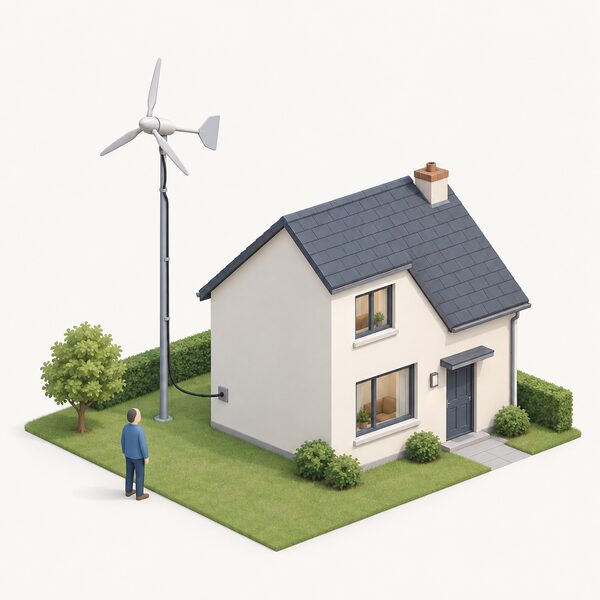
The threshold is expressed in amps per phase, not in kilowatts, and that catches people out. G98 applies to all generation installations up to 16 amps per phase, which is single-phase systems up to 3.68kW and three-phase systems up to 11.04kW2. A generator with a capacity greater than 3.68kW per phase falls under EREC G999.
Above that, the picture splits again at 50kW. Installations above 3.68kW per phase but 50kW or less follow the large generation process for single or multiple electricity supplies8. Installations of 50kW or greater need a G99 A1-1 application in advance of installation so that network planners can conduct a full network study and quote to connect10. Generation and demand-side response projects above 50kW holding connection agreements are listed in DNOs' Embedded Capacity Registers11.
| Capacity | Standard | Approval route |
|---|---|---|
| Up to 16A per phase (3.68kW single-phase, 11.04kW three-phase) | G98 | Connect and notify within 28 days2 |
| Above 3.68kW per phase, up to 50kW | G99 | Apply before installation, Form A1-14 |
| 50kW and above | G99 | Full network study and quote to connect10 |
There is a further simplification for combined systems. Where the total of all generation, fixed storage and the power export capacity of vehicle-to-grid is under 50kW three-phase or 17kW single-phase, a simplified G99 application applies7. Vehicle-to-grid is likely to exceed 16A per phase, so G98 is not applicable and G99 should be used7.
In Northern Ireland the same structure runs under the G98/NI and G99/NI labels, with generation up to 3.68kW single-phase or 11.04kW three-phase handled as G98/NI13. The detail of that regime is set out in connecting a generator in Northern Ireland.
The application process for connections under 50kW
For a single property at or below 3.68kW per phase, the process is deliberately light. G98 is a simple connection procedure for fully type tested installations under 16A per phase, installed on a fit and notify basis14. The form goes in after the equipment is in place, within 28 days3.
The form depends on the site. G98 Form A covers installations of generation or storage at multiple premises, and G98 Form B covers a single premise14. Form B is designed for installations up to 16 amps per phase2. Form A applies to multiple premises each up to 3.68kW single-phase or 11.6kW three-phase, and Form B to a single property up to the same figures12.
There are cases where a small installation must be applied for in advance rather than notified afterwards. An application is required before connection where up to 3.68kW per phase is being installed at more than one property, where there is more than one generator at a single property, or where another property within the same postcode (ignoring the last two digits) has had generation installed within the last 28 days by the same installer1. That last condition is an anti-avoidance rule aimed at clusters of installations.
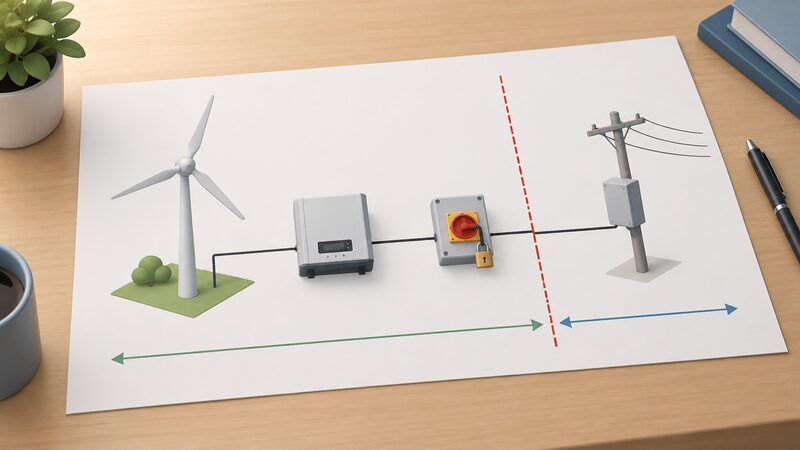
For installations less than 50kW, the applicant completes an A1-1 Form4. Applications above 3.68kW up to 50kW use G99 Form A1.112. The information required includes the proposed total capacity of the installed generation in kW1, and for a micro-generation connection the schematic drawing must show the generator itself, the name and power rating in kW of the inverter, live phases, neutral and earth, lockable isolators, and clear demarcation between the network operator's equipment and the customer's6.
The G99 process for 50kW and above: network studies and quotes
Above 50kW the process becomes an engineering exercise. The applicant completes a G99 A1-1 application in advance of installation so that network planners can conduct a full network study and issue a quote to connect10. The DNO needs to check whether the grid can take the extra electricity load before the system is up and running15.
The study looks upstream as well as at the connection point. A project may be re-classified as a High Voltage study if a Low Voltage connection impacts the network upstream4. In Northern Ireland, generation above the microgeneration limits moves to the G99/NI application process, offered as either G99/NI or G99/NI Fast Track13.
The older G59 process, which G99 replaced for larger connections, gives a sense of what a full study involves: a full technical assessment and site visit to determine the connection arrangement and any possible impact the proposed generation may have on the electricity network17. Any network upgrade work required as a result of the generation installation is chargeable to the applicant and detailed in the connection offer17.
The cost of a connection reflects the work required, based on the export capacity requested, the generator's position on the network and whether reinforcement is needed, with all works and costs specific to site requirements12. That is why no published price exists for a G99 connection: it is quoted per site.
Timescales, consents and when you can energise

The single most important timing rule is that nothing runs before consent. The network operator states it cannot energise a connection until full consents are granted4. G99/NI is not a fit and inform process, and approval must be granted before installation begins18. Systems with an export capacity greater than 3.68kWp need pre-approval through the apply to connect process before connection to the network3.
For G99/NI applications, the three-month licence standard clock starts from the day the application is considered valid, meaning everything needed to process it has been received and the application fee paid19. A connection offer is issued within 90 days from receipt of a renewable connection application, provided all necessary information has been received5. The applicant then has a further 90 days to accept the connection offer5.
Legal consents generally take a minimum of 12 weeks to complete and can be prolonged depending on the grantor4. Where reinforcement is needed, the applicant has 90 days from receiving the quote to confirm proceeding with the reinforcement work16.
The G99 fast track process has its own timetable: the planned commissioning period is between 10 working days and three months from the date the application is submitted to the DNO9. Where commissioning tests and checks are not witnessed, the commissioning confirmation must be submitted no later than 28 days after commissioning9. A G99 Form A1-2 fast track application for battery storage implemented with a generation device must be submitted before installation and reduces the connection time to 10 days or less20.
Planning sits alongside these clocks. For a free-standing wind turbine within the curtilage of a dwelling in Scotland, the prior approval timeframe is 28 days following the date the application was received by the planning authority21. Before installing a turbine, it is worth checking with the local council on the necessary planning permissions22. The planning routes by nation are set out in wind turbine planning permission in Scotland and the equivalent pages for England, Wales and Northern Ireland.
Costs: who pays for network reinforcement and managed connections
Under the current charging methodology, reinforcement costs are paid for by the customer who makes the connection application10. Where the network cannot support the connection, the applicant pays for network reinforcement or chooses a managed connection4. In constrained areas, reinforcement is likely to be required and can be very expensive10.
That position is changing in Northern Ireland. The Department for the Economy, supported by the Utility Regulator, has announced a major change to how new or increased connections to the electricity distribution network are charged10. As reinforcement assets provide system-wide benefits, their costs are to be shared across all users through regulated network charges under the new proposals, and these costs will now be shared across all electricity consumers10. The customer still pays for the cost of the service cable, meter, and any work needed to connect directly to the network; the change only removes the cost of wider reinforcement10.
Where reinforcement is quoted, the customer has options: proceed with the reinforcement work, withdraw the application, or revise design loads to change the reinforcement required16. If the decision is to proceed, confirmation is needed within 90 days of receiving the quote16.
Network costs more broadly are the costs to build, fix and repair pipes and wires to move energy, and they appear on every electricity bill23. A generator owner pays them as a consumer and, where reinforcement is triggered, pays again as an applicant. That is the clearest financial expression of the dependence a grid-connected generator retains.
Type testing, commissioning forms and meter setup
Type testing is the evidence base for the whole regime. Under G98, equipment must be type tested under the requirements of EREC G987. Under the G99 fast track process, generating units including storage must use EREC G99 or G98 type tested inverters8. Units installed before April 27, 2019 may also use EREC G59 or G83 type tested inverters under that process8.
Where equipment is not type tested, the commissioning paperwork grows. For installations less than 50kW, an A3-1 form is needed, and also an A2-1, A2-2 or A2-3 form if the generators are not type tested4. A G99/NI fast track application requires a compliance certificate with test results, and datasheets for all existing and new equipment such as PV panels and inverters24.
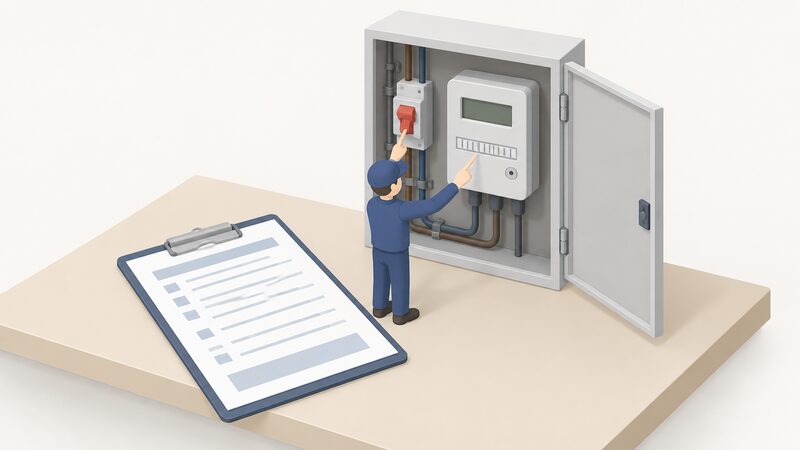
Metering is a separate step from the connection itself. To set up a supply, an electricity supplier is chosen who then installs the meter and applies for a Meter Point Administration Number4. For distributed generation above 50 kilowatts, an Account Manager provides the export MPAN6. A G99/NI fast track application where a meter is installed needs the 11-digit MPRN, found on the bill or meter, and the meter serial number from the meter front panel24.
Whether a scheme is G98 or G99 compliant, the network operator must be notified so that records can be updated8. The G98/NI Stage 1 application collects site location details, a site representative if desired, grid coordinates from a map, installer contact details, details of each proposed micro-generator unit and schematic diagrams for each, before review and submission25. The contact details entered are used for all correspondence and should be the email and phone used to log into the Job Tracker portal25.
How G98 and G99 replaced G83 and G59

G98 replaced G83, and G99 replaced G59. G98 is a UK engineering standard written by the Energy Networks Association, previously G832. Projects can no longer connect under EREC G83 and EREC G597. Since April 27, 2019, all generating equipment connected to any electricity distribution network has had to comply with G98 or G991.
The transition was not instantaneous in every jurisdiction. In Northern Ireland, the old G83 limit was based on the certified continuous steady state operating rating of the inverter, subject to a maximum of 12kW three phase for an inverter-connected generator26. Under the current regime, generation up to 3.68kW single-phase or 11.04kW three-phase is handled as G98/NI13.
The revision that aligned the new standards with the old fast track route was made through the Distribution Connection and Use of System Agreement change process. The stated intent was to bring ERECs G98 and G99 into line with the existing G59 fast track process27. That continuity matters for anyone reading older guidance: the fast track concept survived the change of standard, even though the forms and thresholds did not.
For a household, the practical consequence is that any installer quoting G83 or G59 paperwork for a new connection is working from a withdrawn framework. The current route is G98 for small installations and G99 above 3.68kW per phase, with the forms and thresholds described above. The wider standards picture for small machines is covered in small wind turbine standards, and the certification route for installers in MCS certification for wind and hydro.
Sources27 cited
- Installations up to 3.68kW per phase at a single premises, SSEN
- Micro generation and storage connections, Electricity North West
- Solar panels, Electrical Safety First
- Generation connections up to 50kW, Electricity North West
- What is the connection process for small scale generators, NIE Networks
- Micro generation connections, SSEN
- G98 Single Premises Summary Guide, Energy Networks Association
- G99 Fast Track process, Electricity North West
- Connecting generation to the electricity networks, Energy Networks Association
- Connection charging announcement FAQs, NIE Networks
- UK Solar Roadmap, Department for Energy Security and Net Zero
- Connections FAQs, Electricity North West
- Help to select, NIE Networks
- Micro generation notice, Sell2Wales
- Building regulations renewables guidance, Bedford Borough Council
- Your connections journey, NIE Networks
- Generation connections FAQs, NIE Networks
- G99/NI installations, NIE Networks
- When will I get my connection offer for my G99/NI application, NIE Networks
- Register energy devices in homes or small businesses, GOV.UK
- The Town and Country Planning (Free Standing Wind Turbines) (Scotland) Regulations 2024, legislation.gov.uk
- Small wind turbines, MCS Certified
- Check if you are owed money on your energy bill, Ofgem
- What you need to start your application, NIE Networks
- G98/NI Stage 1 application help, NIE Networks
- After transition period microgeneration G83 limits, NIE Networks
- G98 Single Premises, Energy Networks Association
 G98 and G99 NotificationAdding a home battery usually means telling your network operator first, but sometimes you can just let them know afterwards.
 Small Wind Turbine StandardsA small wind turbine needs the right certificate before it can go up, and that affects whether you need planning permission and whether you can get paid for the electricity you send to the grid.
 Domestic Wind TurbinesCan a wind turbine really power a home, and is your site windy enough?
 Microgeneration and IndependenceWhat can you use when solar cannot cover winter evenings, and does it really make you independent?
 Abstraction Licences and PermitsTaking water from a stream to power a turbine needs permission, and where you live decides who grants it.
 Grid Connection in NIConnecting a generator at home in Northern Ireland means different rules depending on its size.