

In this answer
Short answer
A G98 Stage 2 application is the route a micro-generation connection takes when it cannot be completed under the standard Fit and Inform process. Stage 1 is the standard process for most domestic solar installations under G98/NI, and Stage 2 applies when the proposed connection cannot be completed under Stage 1, for example if the network needs further assessment or reinforcement1. In practice, the trigger is almost always capacity: the G98 regime covers installations up to 16A per phase, which is 3.68kW on single-phase systems and 11.04kW on three-phase systems2.
The threshold matters because it is an aggregate, not a per-device figure. Engineering Recommendation G98 covers projects with a capacity of 16A per phase or less combined capacity per phase where multiple generation or storage units are connected at the same premises3. A household adding a battery alongside existing panels can therefore cross the line without installing anything larger than before.
Where the connection stays inside the limit, the installer notifies the distribution network operator after installation. Where it does not, the connection needs prior approval and takes the G99 route instead4. Stage 2 sits between the two: still a G98 application, but one that requires the network to be assessed before the connection can proceed.
What a G98 Stage 2 application is
EREC G98 is formally titled "Requirements for the connection of Fully Type Tested Micro-generators (up to and including 16 A per phase) in parallel with public Low Voltage Distribution Networks"8. It is a UK engineering standard written by the Energy Networks Association, and it replaced the earlier G83 standard2. Its scope is deliberately narrow: smaller generation capacities of less than 16A per phase8.
The standard exists so that small, type-tested equipment can be connected without individual engineering study. A micro-generator that has passed type testing is treated as predictable, and the network operator accepts it on notification rather than application. That is the Fit and Inform principle, and it covers micro-scale systems up to 16 amps per phase9.
Stage 2 is what happens when that assumption fails. The connection is still within the G98 family, but the network cannot absorb it without further work. Northern Ireland Networks describes the split plainly: Stage 1 applies when a fully type-tested micro-generator can be connected under Fit and Inform without any reinforcement to the network, and Stage 2 applies when the proposed connection cannot be completed under Stage 11.
The distinction is not about the size of the installation alone. A connection inside the 16A limit can still need Stage 2 if the local network is constrained. Conversely, a connection at the limit may pass under Stage 1 if the network has headroom. The application process has been streamlined into two forms, the Stage 1 Commissioning form and the Stage 2 Application form5.
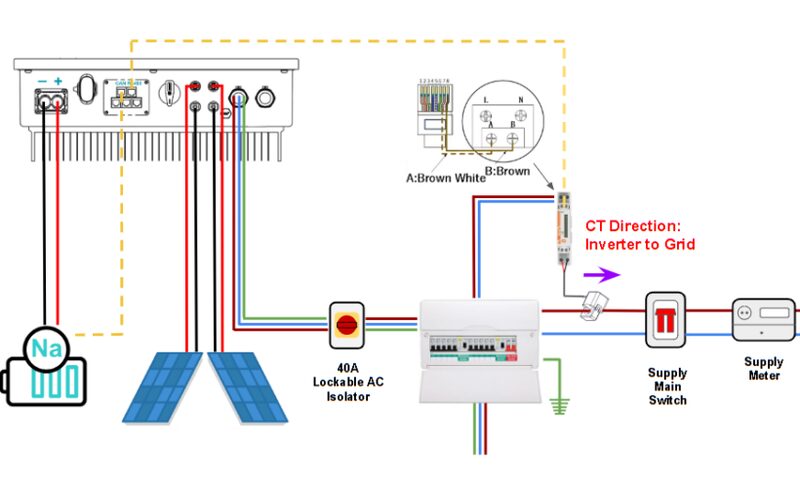
When the 16A per phase limit triggers Stage 2
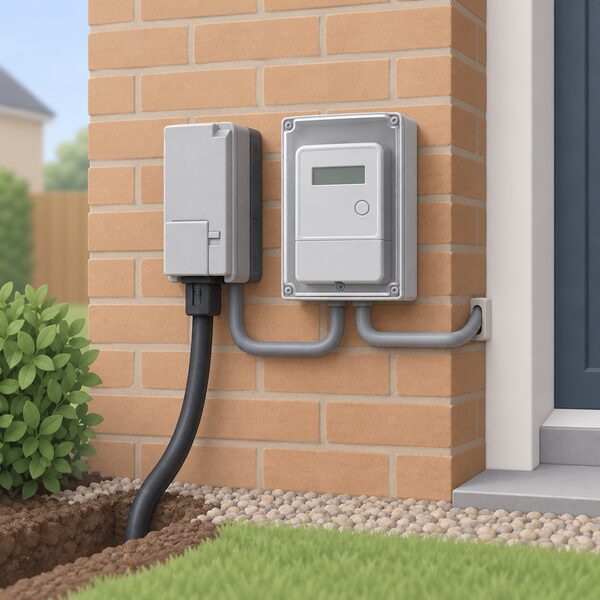
The 16A per phase figure is the boundary of the whole G98 regime. G98 applies to all generation installations up to 16 amps per phase, which is single-phase systems up to 3.68kW and three-phase systems up to 11.04kW2. The same limit appears in the Northern Ireland guidance, which covers micro-scale systems up to 16 amps per phase9.
The limit is expressed in amps because it is a current constraint on the connection point, not an energy constraint. A single-phase system is capped at 3.68kW, which is the figure that corresponds to 16A per phase. Three-phase connections spread the same current across three phases, which is why the capacity ceiling rises to 11.04kW2.
| Connection type | G98 capacity ceiling | Route |
|---|---|---|
| Single-phase | 3.68kW (16A per phase) | G98 install and notify, or Stage 2 if reinforcement is needed |
| Three-phase | 11.04kW (16A per phase) | G98 install and notify, or Stage 2 if reinforcement is needed |
| Above either ceiling | Over 3.68kWp | G99, prior approval required4 |
Two things push a connection from Stage 1 into Stage 2. The first is aggregate capacity: where multiple generation or storage units connect at the same premises, the combined capacity per phase is what is measured against the 16A limit3. The second is network condition. A connection within the limit can still require assessment or reinforcement, and that is the definition of Stage 21.
The storage fast track process is relevant here. Ofgem's modification introduced a fast track process for storage applications of less than 16 Amp per phase, dated 30 November 201810. Storage below the threshold is treated in the same family as generation below the threshold, which is why a battery addition is assessed on the same basis as a panel addition.
Adding to an existing installation: when the aggregate crosses the limit
The aggregate rule is the part most households miss. G98 covers 16A per phase or less combined capacity per phase where multiple generation or storage units are connected at the same premises3. Adding a second device does not reset the count; it adds to it.
A battery storage system needs a DNO application, and the process is the same as for solar panels, with the installer able to complete it7. Battery storage can be added to existing solar panels to maximise the benefits of the system11. Neither of those facts changes the capacity arithmetic: the new device's contribution is added to what is already connected.
Northern Ireland Networks describes Stage 2 as covering multiple installations at one site5. That is the clearest statement of the aggregate principle in the guidance: one site, several devices, one combined figure measured against the limit.
The practical consequence is that a household planning a battery should establish the existing inverter rating before ordering. A system that was comfortably inside the limit on panels alone may not be once storage is added. The application is the installer's task, but the capacity figure is the household's to know.
Stage 2 versus G99: which route your installation takes
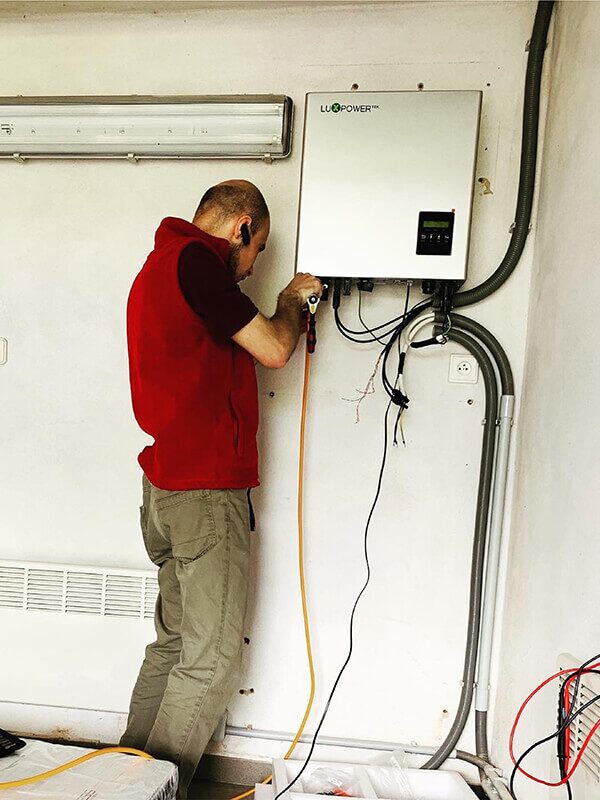
The dividing line between G98 and G99 is capacity. Anything larger than the G98 ceiling falls into a G99 application2. Official guidance puts the same boundary at 3.68kWp: apply to connect is for larger installations exceeding 3.68kWp and requires a G99 application7. Installations over 3.68kWp require prior approval from the DNO and fall outside the G98 install and notify scope4.
The two routes differ in sequence as well as in threshold. G99 works on an apply then install basis, so approval is needed before installation12. G98 works the other way round: the installer fits and commissions the generator, then registers the connection online1. That sequencing is the practical difference a household feels, because a G99 application can hold up an installation while a G98 notification follows it.
| G98 | G99 | |
|---|---|---|
| Capacity | Up to 16A per phase (3.68kW single-phase, 11.04kW three-phase)2 | Above the G98 ceiling2 |
| Sequence | Install and notify1 | Apply then install12 |
| Approval | Notification after commissioning, or Stage 2 where reinforcement is needed1 | Prior approval required4 |
| Inverter requirement | Fully type-tested micro-generator8 | EREC G99 or G98 type tested inverters13 |
The G99 Fast Track process has its own equipment rule. Any generating units, including electricity storage, connected through that process must use EREC G99 or G98 type tested inverters13. Units installed before April 27, 2019 can also use EREC G59 or G83 type tested inverters13. That grandfathering matters for older installations being extended.
For non-domestic installations, the Energy Networks Association directs applicants to the G98, G99 and G100 forms for non-domestic installations14. Domestic households at a single premises use the G98 Form B, which is designed for installations up to 16 amps per phase2. G98 Form A covers installations of generation or storage at multiple premises4.
What the application must include and who submits it
The installer submits the application. For Stage 2, the household arranges for the installer to submit it using the G98/NI Stage 2 Application form6. Under Stage 1, the installer fits and commissions the generator, then registers the connection online1. The household's role is to provide access and information, not to file the paperwork.
The core content of a G98 application is the generation capacity: the proposed total capacity of the installed generation in kW15. That single figure determines which route the connection takes, so it needs to reflect every unit at the site, not just the newest one.
Supporting documents include approved inverter type test certificates and a G100 declaration13. The G100 declaration is relevant where export is limited, and the G99 route requires the G99 application form or G100 if export is limited16. The application also needs site location details, installer contact details, details of each proposed micro-generator unit and schematic diagrams for each unit17.
"We will need the schematic diagrams for each of your micro generators. Your installer can provide you with these."
The online form enforces completeness. Incomplete fields are highlighted in red and the submit button only appears once all required fields marked with an asterisk have been filled in17. That removes the common failure mode of a partially completed application sitting unsubmitted.

What happens after you apply: approval, commissioning and witness tests
Where Stage 2 requires reinforcement, the process has a defined sequence. Confirming the quote starts the pre-construction phase, covering survey, legal permissions and wayleaves, and then the construction phase6. A 20% deposit is needed to proceed with the quoted reinforcement work5.
The household has three options once a reinforcement quotation is issued: proceed with the reinforcement work, withdraw the application, or revise design loads to change the reinforcement required6. The same three options are set out in the support guidance: confirm the reinforcement work, change the design to reduce the reinforcement needed, or withdraw the application and remove the generation from the design18.
Once reinforcement work is complete, the installer has 30 days to submit a G98/NI Stage 1 Commissioning form with the details of the commissioned site6. For standard G98 notifications, the application form must be completed within 28 days of the solar panels being in place7.
The Fit and Inform process sets its own deadline: the installer submits the Stage 1 form and all relevant documentation within 30 days for approval19. Where the connection is part of a scheme with accreditation, the validity period matters too: once preliminary accreditation is granted, the installation must commission and an application for full accreditation be made within a certain time20.
For a household, the sequence is: installer applies, network assesses, reinforcement is quoted if needed, deposit is paid, work is done, commissioning form is submitted, and the connection is registered. The independence this delivers is partial. The household generates and stores its own electricity, but the connection to the distribution network remains the network operator's to approve, and the export capacity remains capped by the standard the connection was made under.
Sources20 cited
- What is the difference between G98/NI Stage 1 and G98/NI Stage 2, Northern Ireland Networks, 2026-09-19
- Micro-generation and storage connections, Electricity North West, 2026-09-17
- G98 Single Premises Summary Guide, Energy Networks Association, 2026-09-17
- Barcud Solar Panel Installation Scheme Specification, Sell2Wales, 2026-06-15
- Micro-scale generation connections, Northern Ireland Networks, 2026-09-20
- Your connections journey, Northern Ireland Networks, 2026-09-19
- Installations up to 3.68kW per phase at a single premises, SSEN, 2026-09-17
- G98 Single Premises, Energy Networks Association, 2026-09-17
- What is G98/NI, Northern Ireland Networks, 2026-09-19
- G99 Fast Track process, Electricity North West, 2026-09-19
- Key terms explained for Feed-in Tariffs, Ofgem, 2026-09-17
- GivEnergy feed, GivEnergy, 2026-02-16
- Connect Direct, Energy Networks Association, 2026-09-17
- Revision of Engineering Recommendations EREC G98 and G99 storage fast track process, Ofgem, 2018-11-30
- Connecting generation to the electricity networks, Energy Networks Association, 2026-09-17
- DNO: what you need to know, Nu-Heat, 2025-02-24
- Building regulations renewables guidance, Bedford Borough Council, 2026-09-17
- What happens after an application, Northern Ireland Networks, 2026-09-19
- What is the Fit and Inform process, Northern Ireland Networks, 2026-09-19
- Switch Together Birmingham, Birmingham City Council, 2026-01-27
 G98 and G99 NotificationAdding a home battery usually means telling your network operator first, but sometimes you can just let them know afterwards.
 G98 and G99 Grid ConnectionDoes your solar system need telling the network or asking it first?
 Export Limitation and G100Your solar panels can be set to stop sending power to the grid once they reach a certain level.
 G98 and G99 Grid ConnectionConnecting a wind turbine, hydro turbine or micro-CHP unit at home raises the question of whether it needs G98 or G99.
 Grid Connection in NIConnecting a generator at home in Northern Ireland means different rules depending on its size.
 Sizing a Self-Sufficient HomeHow many solar panels and how much battery storage does a home need to stop relying on the grid?