

In this answer
Short answer
An electricity supply upgrade is the work a distribution network operator carries out to raise the capacity of the cable and fuse feeding a property. In most UK homes the trigger is a new load: an electric vehicle charger, a heat pump, solar panels, energy storage, a power shower, or a hot tub. UK Power Networks lists exactly these as the typical reasons a household needs more power1.
The upgrade itself is usually a fuse change. UK Power Networks can upgrade a main fuse from 30 or 60 amps up to either 80 amps or 100 amps2. Where the property needs more than that, the route is an amp increase or a move from single phase to three phase, which the network says gives up to 70kVA of power1. The application is normally made by the installer, not the householder, and it begins with a surveyor visit that produces a price.
What the upgrade buys a household is headroom: the ability to run larger loads at once without the main fuse limiting the property. What it does not buy is independence from the network. The cable, the fuse, the meter and the connection point all remain the network operator's and the supplier's, and the household still depends on the grid for every unit of electricity it uses.
What a supply upgrade means and who it applies to
A supply upgrade is distinct from a new connection. It applies to a property that already has electricity and needs more of it. UK Power Networks frames the fuse upgrade around a recommendation from an electrician or installer, or a planned EV charger, heat pump or solar panel installation1. The same page lists extending a property that needs more power for more appliances, installing a power shower, and installing a Jacuzzi or hot tub1.
There is a second, separate category of work that is often confused with a capacity upgrade: moving the supply. UK Power Networks offers a domestic supply move for customers carrying out a renovation or extension that requires the supply point to be in a different location, demolishing or significantly altering part of a building where the supply enters, or repositioning the meter and supply as part of a larger building project6. That is a relocation of the connection, not an increase in its capacity, though the two can be done together.
In Northern Ireland the process sits with NIE Networks, which assesses whether an upgrade to the connection is required if the current supply cannot support the additional load from new equipment7. The connection charging arrangements there apply to customers getting a new connection or increasing the electricity supply at an existing property8.
For a household, the practical meaning is this: the upgrade raises the ceiling on what can be drawn at once, which is what makes electrified heating and transport possible on the existing service. It does not change who owns the network or who supplies the power. The household remains connected to a distribution network, buys electricity from a supplier, and depends on both. What it gains is the ability to electrify its own loads without tripping the main fuse, which is a real but partial step toward running more of the home from its own equipment.
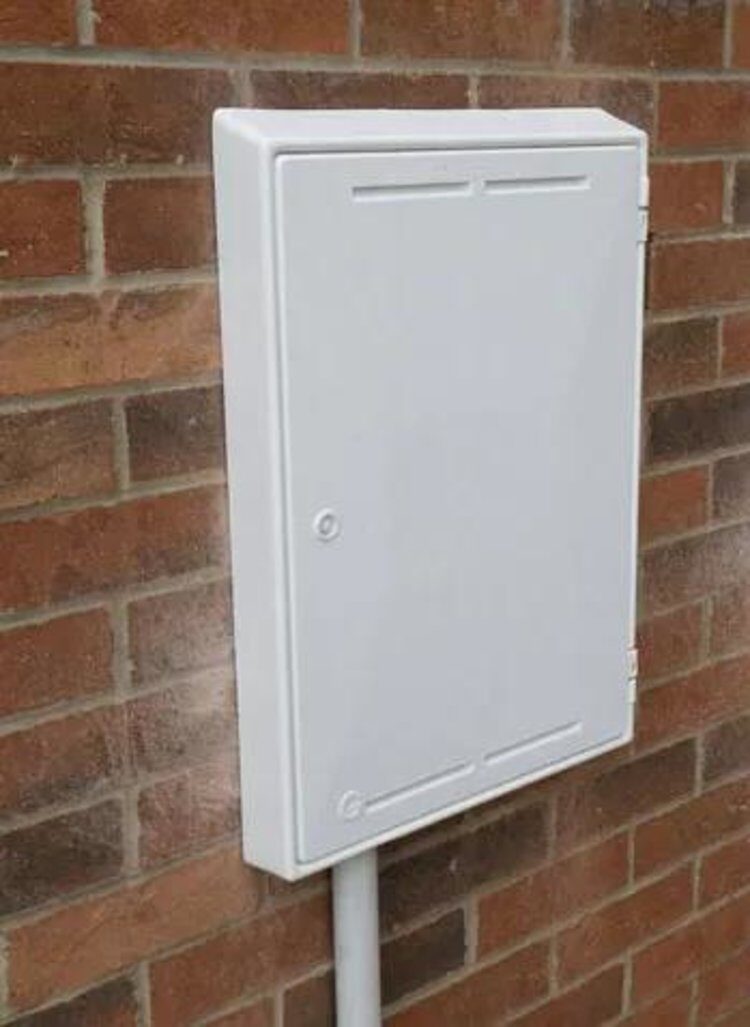
Fuse upgrade options: 80 or 100 amps from a 30 or 60 amp supply
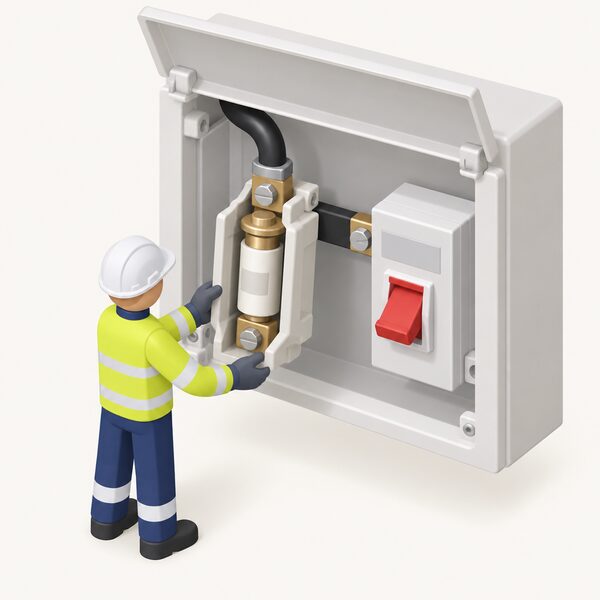
The main fuse is the network operator's, not the householder's, and it is the component that sets the practical limit on the property. UK Power Networks states it can upgrade a main fuse from a 30 or 60 amp fuse up to either an 80 amp or a 100 amp fuse2. Its contact page repeats the same two options: an upgrade to 80 or 100 amps, with a visit requested9.
The choice between 80 and 100 amps is not free. It depends on the existing service cable, the earthing arrangement and the load the property needs to carry. A household cannot simply request the larger figure; the network decides what the cable can support.
In Northern Ireland the threshold is expressed differently. NIE Networks says that if the main fuse is below 80 amps, such as a 60A fuse in older properties, the fuse may need upgraded to 80A to support an EV charger, and the installer checks this10. That makes 80 amps the working target for a charger in older Northern Ireland properties.
Above a certain size, a fuse change is no longer enough. Electricity North West states that if a supply over 20kW is required, an amp increase or a move from single phase to three phase may be needed11. NIE Networks puts the single phase ceiling at 17kW maximum, above which a three phase supply is required12. The two figures are close but not identical, and they come from different network operators, so the applicable limit depends on which network serves the property.
Looped supplies complicate all of this. A looped service is one cable shared between neighbouring properties. NIE Networks notes that installing a home EV charger typically requires a fuse upgrade to 80 to 100 amps, which often cannot be done on a looped supply without overloading the shared cable13. Where a property is looped, the upgrade may require the loop to be split first, which is separate work.
| Upgrade | From | To | Source |
|---|---|---|---|
| Main fuse | 30 or 60 amps | 80 or 100 amps | UK Power Networks2 |
| Main fuse (NI, EV charger) | below 80 amps | 80 amps | NIE Networks10 |
| Phase | single phase | three phase, up to 70kVA | UK Power Networks1 |
| Single phase ceiling | 17kW maximum | NIE Networks12 |
How to apply: installer contact, survey visit and pricing
For low carbon technology, the application starts with the installer. UK Power Networks states that the installer should contact it on the householder's behalf14. The same instruction appears in its cost and time guidance for the same category of work14. This matters because the installer knows the load the new equipment will draw and can state it accurately on the application.
For other work, such as a supply move, the householder books directly. UK Power Networks describes the next step as booking an appointment with a surveyor so they can visit the property and give a price15. The same surveyor appointment model applies to temporary connections16 and to permanent disconnection, where an application form is downloaded and completed first17.
The survey visit is the point at which the price is set. UK Power Networks describes a free site visit in its power cable and power line service18, and the surveyor appointment is the mechanism by which a price is produced for a move or a temporary connection15. The visit being free does not make the work free: the connection work is quoted, and the quote governs.
In Northern Ireland the sequence is more formal. NIE Networks outlines the work involved, including any network reinforcement, and provides a formal quotation, and no work proceeds until the quote is accepted7. That acceptance step is explicit: nothing starts until the householder agrees the price.
Where the network cannot support the connection without reinforcement, the applicant pays for that reinforcement or chooses a managed connection19. That is a material cost consideration and it is decided at the quotation stage, not after work begins.
Connection capacity: the default 15kVA and when to state your own need

When a new connection application does not state a power requirement, UK Power Networks assumes 15kVA. Its guidance is blunt about the risk: if you do not tell it how much you need, it will assume 15kVA, and it stresses that getting this right matters3. A stated need that is too low produces a connection that cannot carry the intended load; a stated need that is too high may cost more than necessary.
This is why the installer's load calculation matters. The application should state the actual demand of the property, including the new equipment, rather than accept the default. The 15kVA assumption is a fallback, not a recommendation.
The capacity figures across the networks form a ladder. NIE Networks puts the single phase maximum at 17kW, above which three phase is required12. Electricity North West puts the threshold for an amp increase or a phase change at over 20kW11. UK Power Networks states that a single phase to three phase upgrade gives up to 70kVA of power1. These are different operators describing different networks, and the applicable figure depends on who serves the property.
For generation rather than import, the rules differ again. Electricity North West's guidance for generation connections states that the applicant pays for network reinforcement or chooses a managed connection if the network cannot support the connection19. NIE Networks offers a budget estimate tool for new domestic or commercial connections up to 69kVA, such as up to four houses or a small shop21.
The practical point for a household is that capacity is stated, not assumed. A heat pump, an EV charger and a battery together draw a figure that should be calculated and written on the application. Leaving it blank defaults the connection to 15kVA3, which may not be enough for the equipment being installed.
What happens on the day: digging, ducting, meter box and reconnection
The physical work divides into digging and electrical work, and most jobs include more than one visit. Electricity North West states that most jobs usually include more than one visit by its teams, with the digging followed by the electrical work22. That sequencing is worth knowing before work starts, because the property is not finished in a single day.
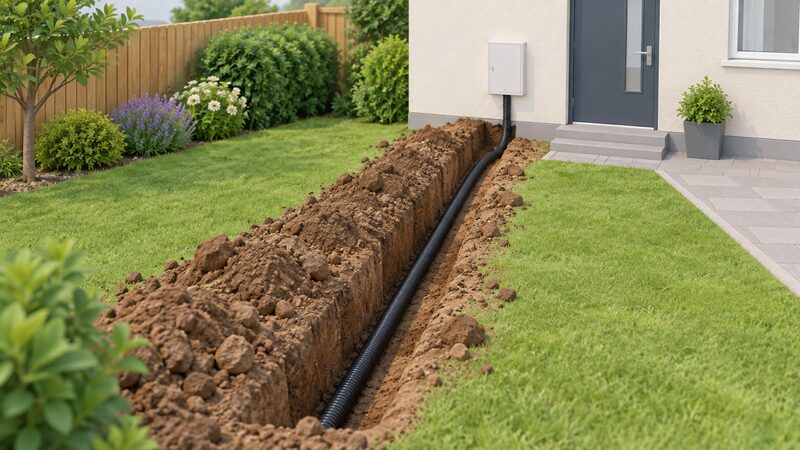
The householder has a choice on the digging. UK Power Networks states it can take care of the digging, or the householder can arrange it on their own land, and where the householder digs, the network provides the black tubing, known as ducting, to place inside the trench5. The same arrangement appears in the supply move guidance15 and the new connection guidance23.
The meter box position is fixed. For a new connection, UK Power Networks states that electricity meter boxes need to be fitted on the outside of an external wall23. The supply move guidance repeats it: a new electricity meter box and black tubing need to be installed on the outside wall of the property15. The householder does not choose an internal position.
Reinstatement depends on who dug. If UK Power Networks handled the digging, it returns within 48 hours to fill the trench back to its original condition5. If the householder did the digging, filling the hole is the householder's job. The same 48 hour figure appears in the supply move guidance15 and the temporary connection guidance16.
Some of the work is not the network's to do. Electricity North West states that preparation may include digging on the householder's land, hiring a builder, and employing an electrician to move the fuses to the new meter position, which the network cannot do22. That division of labour is a cost the householder carries separately from the connection quote.
After the upgrade: your supplier's meter visit and MPAN
The network's work ends at the connection point; the meter is the supplier's. For a new connection, the householder chooses an electricity supplier who then installs the meter and applies for a Meter Point Administration Number19. The MPAN is a unique identifier for the electricity supply, a code that identifies and manages the electricity going into the home24.
Where UK Power Networks is paid to install a new connection, it automatically provides an MPAN25. That is the straightforward case. For an additional MPAN where no works to the incoming supply cable are needed, such as a second meter for a THTC system or a microgeneration export meter, the request goes through the electricity supplier instead25.
There is a verification step before an import MPAN is requested: a qualified electrician must verify that the existing supply can handle the additional electrical load25. That check sits alongside the network's own assessment and is part of the same capacity question.
If the supplier is unknown, UK Power Networks offers a tool that emails back who the supplier is and the MPAN25. That is useful after a move or where the meter point details have been lost.
The independence picture after the upgrade is unchanged in kind. The household now has a higher capacity connection, a meter installed by a supplier, and an MPAN registered to the property. It still buys every unit from a supplier, still depends on the distribution network for the cable and fuse, and still depends on the wider grid for generation. The upgrade widens what the home can do with the connection; it does not remove the connection.
Where the process differs across the UK

The application route depends on which distribution network serves the property, and the network is found by postcode26. Great Britain has several distribution network operators, each with its own application pages and thresholds, while Northern Ireland has NIE Networks.
The fuse options are broadly consistent. UK Power Networks offers 80 or 100 amps from a 30 or 60 amp supply2. NIE Networks works to an 80 amp target for EV chargers in properties with a fuse below 80 amps10. Electricity North West frames the threshold in kilowatts, with an amp increase or phase change above 20kW11.
The capacity ceilings differ. NIE Networks puts the single phase maximum at 17kW12. Electricity North West puts the phase change threshold at over 20kW11. UK Power Networks states that a single phase to three phase upgrade gives up to 70kVA1. These are not the same measurement expressed differently; they are different operators describing their own networks, and the applicable figure follows the property's network.
The quotation process is more formal in Northern Ireland, where NIE Networks provides a formal quotation and no work proceeds until it is accepted7. In Great Britain the surveyor visit produces a price15, and reinforcement costs fall to the applicant where the network cannot support the connection19.
Contact arrangements also differ. Electricity North West asks customers to call between 08:00 and 18:00, Monday to Friday, to arrange an appointment27. UK Power Networks publishes differing hours across its pages, with lines given as Monday to Friday 8.30am to 5.00pm on some pages and 9:00am to 5:00pm on others, and one page describing lines as free to call and open 24 hours9.
Sources27 cited
- Adding more power: what do you need to upgrade, UK Power Networks, 2026-09-17
- Fuse upgrade, UK Power Networks, 2026-09-17
- What are watts, kilowatts and kilovolt amps, UK Power Networks, 2026-09-17
- Adding more power, UK Power Networks, 2026-09-17
- Adding more power: what's involved, UK Power Networks, 2026-09-17
- Move: what do you need to move, UK Power Networks, 2026-09-17
- If your electricity supply can't cope with the new equipment, NIE Networks, 2026-09-19
- Does this apply to all customers, NIE Networks, 2026-09-19
- Help and contact, UK Power Networks, 2026-09-17
- EVs and heat pumps, NIE Networks, 2026-09-19
- Upgrade or reduce your supply, Electricity North West, 2026-09-19
- Connections FAQs, NIE Networks, 2026-09-19
- Looped services, NIE Networks, 2026-09-19
- Adding more power: cost and time, UK Power Networks, 2026-09-17
- Move: what's involved, UK Power Networks, 2026-09-17
- Temporary electricity connection: what's involved, UK Power Networks, 2026-09-17
- Permanently disconnect FAQs, UK Power Networks, 2026-09-17
- Replace power cable or power line, UK Power Networks, 2026-09-17
- Generation and storage up to 50kW, Electricity North West, 2026-09-19
- Boiler Upgrade Scheme, GOV.UK, 2026-09-18
- Budget estimate, NIE Networks, 2026-09-19
- Service alteration: what's involved, Electricity North West, 2026-09-20
- New electricity connection: what's involved, UK Power Networks, 2026-09-17
- What is an MPAN, SSEN, 2026-09-17
- MPAN only, UK Power Networks, 2026-09-17
- Find my network operator, Energy Networks Association, 2026-09-17
- Cutout, Electricity North West, 2026-09-19
 Check Supply Capacity FirstAdding a heat pump, car charger or home battery can push your electricity supply past what it can safely handle.
 Electricity Supply and WiringWill your fuse box cope with a heat pump, and will the mains supply need upgrading?
 New Electricity ConnectionWho do you contact for a new or upgraded electricity connection, and what will it cost?
 Energy IndependenceA heat pump runs your heating on electricity instead of gas or oil, so how much does that really cut what you pay and how exposed you are when fuel prices jump?
 Rising Electricity DemandElectric cars, heat pumps and data centres all need more electricity, so how much more will the UK actually use, and will the grid cope?
 Prepayment MetersHow do you top up a prepayment meter for gas or electricity, and what happens when the credit runs out?