
In this answer
Short answer
The Sero home energy upgrade programme is a whole-home retrofit arrangement in which a landlord installs solar panels, a battery, a hub and meters, buys electricity from an approved supplier, combines it with the power generated on the roof, and sells the result back to the resident on a two-rate tariff that costs more during the day and less overnight1. The resident pays Sero for electricity and receives one monthly bill covering everything used, whether it came from the panels or the grid1.
The programme is designed to run for at least 25 years, and the installation itself takes 2 to 3 days1. Joining involves switching electricity supplier to the lower cost electricity supplied by the landlord, so the household's supply relationship changes at the same time as the hardware arrives1.
That combination is what makes the arrangement distinctive, and also what limits it. The household gains on-site generation and storage without buying either, but the electricity still arrives through a supplier chosen by someone else, and the tariff is set within the programme rather than by the open market. This page sets out what is installed, how the tariff works, who owns what, how the process runs, and what leaving involves.
What the Sero home energy upgrade programme is
The programme is a managed retrofit: the landlord owns and operates the generating and storage equipment, and the resident buys the electricity that comes out of it. Sero's resident guidance describes the landlord buying electricity from an approved supplier and combining it with power generated on-site from solar panels1. The household therefore sits behind a single supply relationship rather than owning a generation asset outright.
That places it in a different category from the grant-funded retrofit schemes operating across the UK. The Boiler Upgrade Scheme provides grants to encourage property owners to replace fossil fuel heating with low carbon systems in England and Wales2. The Warm Homes Local Grant helps homeowners and private renters make upgrades such as wall and loft insulation, solar panels, heat pumps and ventilation systems3. Home Energy Scotland's grant and loan scheme helps eligible homeowners pay for energy efficiency improvements and clean heating systems4. In each of those, the household ends up owning the measure. In the Sero arrangement, the equipment stays with the landlord and the household buys the output.
For a household's energy independence, the distinction matters. On-site generation reduces the volume of electricity that has to be bought in from the wider grid, and a battery shifts some of that generation to the hours when it is needed. What does not change is the dependence on a supplier, because the resident still buys every unit through the programme. The household's exposure to wholesale prices is mediated rather than removed. Readers weighing that trade-off against outright ownership may find the comparison in joining a community energy scheme versus installing your own solar useful, and the wider measures in self-consumption.
What gets installed: solar panels, battery, hub and meters
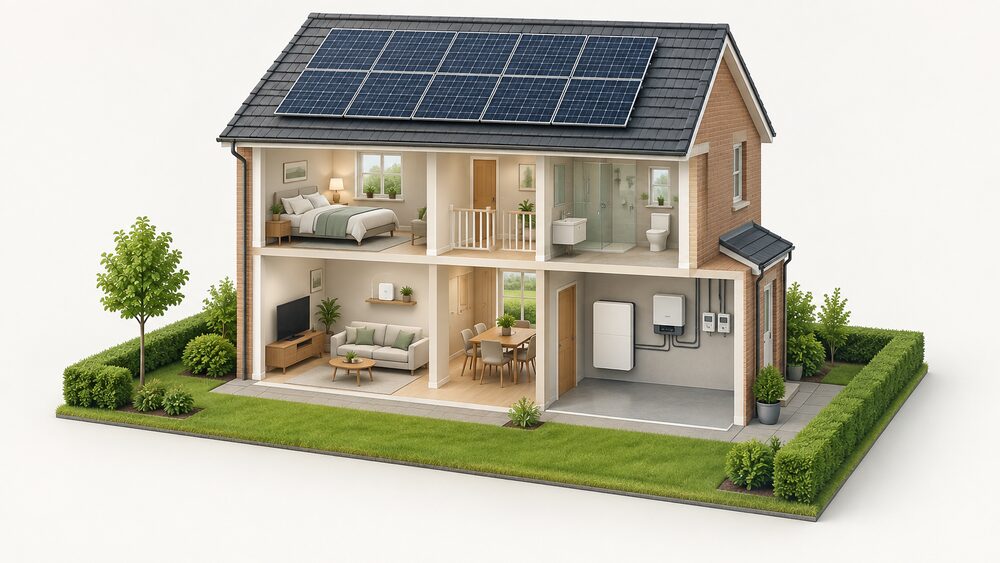
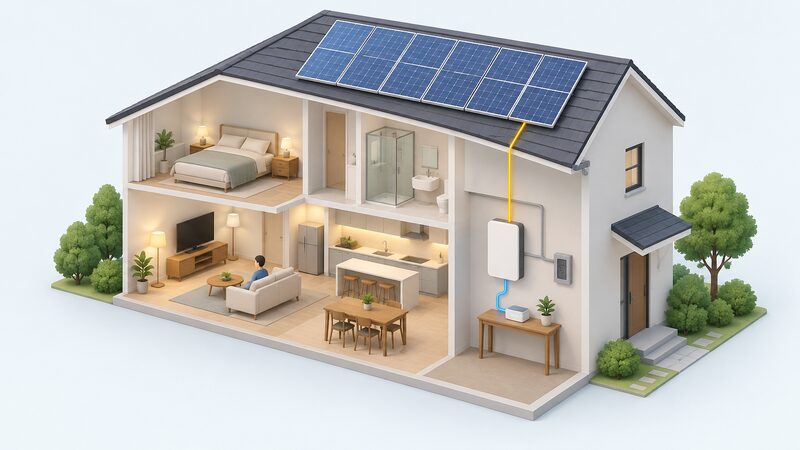
The hardware package is solar panels, a battery, a hub and meters, installed by an approved installer over 2 to 3 days1. The solar panels generate on-site; the battery stores surplus for later use; the hub and meters provide the monitoring and billing data that the programme runs on.
Battery storage is the part that changes the household's daily pattern most. Independent guidance describes how a home battery can be charged with cheap electricity from a supplier, typically on certain tariffs at night or in the middle of the day2. Sero's own guidance makes the same point for its battery: it can buy energy from the grid when it is cheap, so savings continue when the sun is not shining1. That means the battery is doing two jobs, absorbing surplus solar generation and arbitraging the tariff.
Installation of this kind of equipment can trigger an electricity supply upgrade. UK Power Networks lists installing solar panels, energy storage or heat pumps among the low carbon technologies that may require more power, alongside power showers and hot tubs5. Where an installer can complete the work without upgrading the supply, there are no costs to pay for that upgrade6. Households should expect the question to be raised at survey stage rather than assume it will not apply.
The two-rate tariff: cheaper overnight, dearer by day
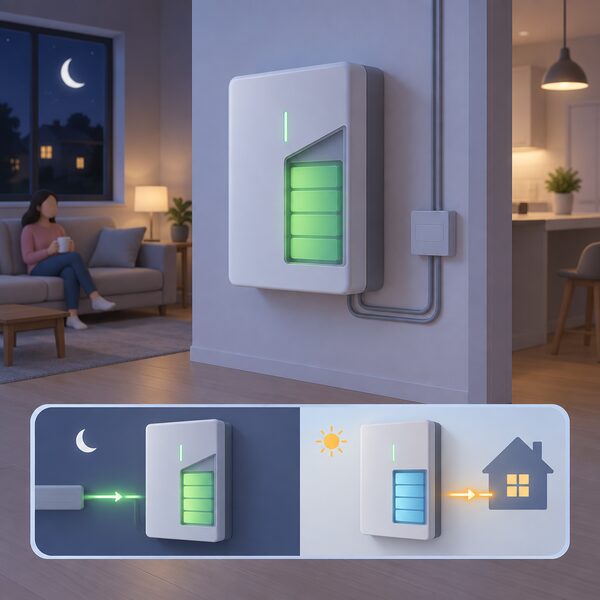
Sero residents are on a two-rate electricity tariff, where the price paid depends on when energy is used, costing more during the day and less overnight1. That structure is the same shape as the time-of-use tariffs sold in the wider market. Ofgem's consumer guidance describes time-of-use tariffs as having prices that vary throughout the day, usually with a cheaper overnight charging window3. Energy Saving Trust guidance describes rates that are cheaper when demand is low, usually overnight, and more expensive when demand is high, in the early evening4.
The mechanism behind the cheaper window is the shape of national demand. Smart Energy GB describes electric vehicle tariffs as typically two-rate, with cheaper energy at night8. Which? describes the same structure, with cheaper overnight electricity on a two-rate tariff, and notes that the cheap power can also be used for other appliances4. For a household with a battery, that is the point: the battery can absorb cheap overnight units and discharge them during the expensive daytime hours, whether or not the sun is out.
What the household should expect in practice is a bill that varies with when electricity is used, not just how much. Sero states that the electricity tariff and payment schedules are reviewed on a regular basis based on electrical use1. So the rates are not fixed for the life of the programme, and the household's own consumption pattern feeds back into what it pays.
The independence question here is real but partial. A battery that charges on cheap overnight electricity reduces the cost of the units a household imports, and it reduces the volume imported during peak hours. It does not reduce the total dependence on a supplier, because every unit still comes through one. The tariff is a price mechanism, not a supply of its own. Households interested in how much of their own generation they actually consume may want the detail in self-sufficiency ratio and other measures of energy independence.
Who owns the kit and who sets the tariff
The landlord owns the equipment and buys the electricity that feeds it. Sero's guidance states that the landlord buys electricity from an approved supplier and combines it with power generated on-site from solar panels1. The resident's obligation is to pay Sero for electricity, with one monthly bill covering all electricity used, showing usage and savings1.
This is a different ownership model from the export schemes that apply to household-owned generation. Under the Smart Export Guarantee, it is the electricity suppliers who determine the tariff they are willing to pay to small-scale generators, and SEG licensees set the rate, contract length and other terms9. The government does not make feed-in tariff or SEG payments; suppliers signed up to either scheme administer it and make the payments11. Under the feed-in tariff, the policy and tariff rates are set by the Department for Energy Security and Net Zero12, and a generator of a ROO-FIT installation must inform Ofgem, as well as the FIT licensee, of any change to the installation or its ownership by updating the Renewable Electricity Register13.
None of that applies directly to a Sero resident, because the resident is not the generator. The relevant point is that in every one of these arrangements, the tariff is set by a party other than the household: a supplier under the SEG, a government department under the feed-in tariff, and the programme under the Sero model. The household's control is over when it uses electricity, not over what it is paid or charged per unit.
"your landlord buys electricity from an approved supplier and combines it with power generated on-site from solar panels."
The upgrade process, from first look to install
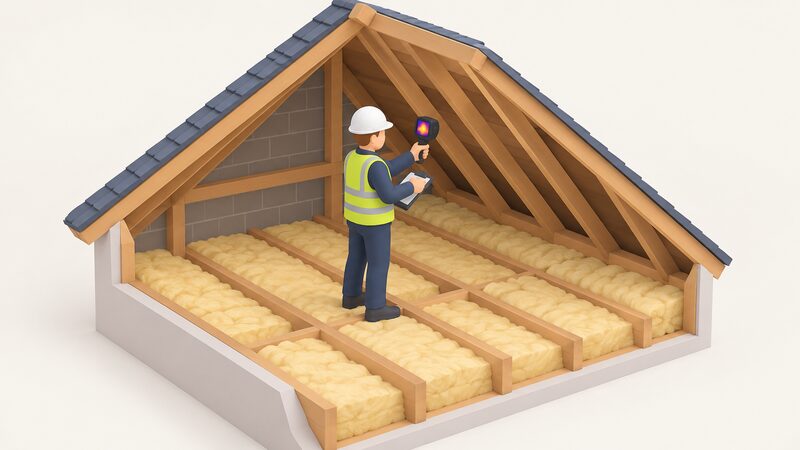
Sero sets out the process in steps, with a stated time for each. The first look is a home survey, described as a retrofit assessment carried out by a qualified assessor, taking 2 to 3 hours1. A later step, About Your Home, involves an assessor visiting to carry out an installation survey, also taking 2 to 3 hours1. The install itself, by an approved installer, takes 2 to 3 days1.
That sequence mirrors retrofit programmes elsewhere. Cosy Homes Oxfordshire begins with a visit from a retrofit coordinator or energy assessor who assesses the home to identify appropriate measures14. Warm Homes Local Grant guidance puts retrofit assessments at 1 to 3 hours on site6, which brackets the Sero figure closely. Home Energy West Yorkshire offers an installation service including a personalised advice summary with recommended improvements15, and TrustMark describes a smart energy service providing personalised end-to-end home energy upgrade guidance to cut energy costs and carbon9.
The wider direction of travel is towards more products and services, from plug-in solar to optimisation software, reshaping how consumers use energy10. A household entering a managed programme should expect the assessment stage to be the point at which the measures are settled, and the install stage to be short relative to the life of the arrangement.
- First look: retrofit assessment in the home, 2 to 3 hours1
- About your home: installation survey by an approved assessor, 2 to 3 hours1
- Install: fitting by an approved installer, 2 to 3 days1
- Ongoing: one monthly bill, tariff reviewed regularly against electrical use1
Leaving the programme: exit terms and what you lose
Sero's guidance states that leaving means losing access to the benefits and customer support the energy programme provides, and that depending on the landlord's terms there may be an exit fee1. That is the whole of the published position: the fee is conditional and its amount is not stated in the resident material.
For context on how exit fees work in the wider market, Ofgem's guidance is that a household may have to pay a previous supplier an exit fee if it was on a fixed rate tariff and left before it ended16. StepChange states that a provider cannot charge exit fees if the switch happens within 49 days of the current deal ending17. A worked example from a bill guide shows exit fees of £50 per fuel, electricity and gas, giving £100 total for switching before the final 49 days of the contract18. Those figures belong to a different supplier's tariff and are not Sero's terms; they illustrate the shape of the charge, not its size here.
What a household loses on exit is more than the equipment. Because the resident is not the owner, leaving removes access to the generation, the battery and the tariff structure at the same time. The household would return to buying all its electricity from a supplier of its own choosing, at whatever terms are then available.
Prepayment, faults and supplier failure
Sero states that residents paying for electricity by pre-payment meter will find usage and cost information on the meter display1. Ofgem describes a prepayment meter as a way to pay for electricity or gas in advance rather than after use19. Where a supplier installs a prepayment meter without household permission, it must give £30 credit once the meter is installed or remotely switched to prepayment mode20.
On faults, Sero's position is that no action is needed to operate the technology, and that customer support comes with the programme1. Where an electricity supplier fails, Ofgem's guidance is that the household does not need to do anything: it is moved automatically to a new supplier and supply is not interrupted16. That protection applies to the supply relationship, not to equipment owned by a landlord, so a resident's route for a faulty battery or inverter runs through the programme's support rather than through the supplier.
The dependence that remains is worth stating plainly. The household does not own the panels or the battery, does not choose the supplier, does not set the tariff, and cannot take the equipment with it on leaving. What it gains is on-site generation and storage without capital cost, a cheaper overnight window for the battery to exploit, and a single monthly bill. What it does not gain is control of the supply chain behind that bill. Households weighing that against full ownership may find what energy independence costs a UK household and local control versus the manufacturer's cloud set out the alternatives.
Sources20 cited
- I'm a resident, Sero, 2025-12-08
- Battery storage, Home Energy Scotland, 2026-09-20
- EV tariffs and home charging, Energy Ombudsman, 2026-09-11
- Time of use tariffs explained, Which?, 2026-04-23
- Adding more power: what's involved, UK Power Networks, 2026-09-17
- Warm Homes Local Grant, Surrey County Council, 2026-09-17
- Barcud Solar Panel Installation Scheme Specification, Sell2Wales, 2026-06-15
- Energy flexibility, Smart Energy GB, 2026-08-17
- Homeowner, TrustMark, 2026-09-20
- Supporting the shift, Citizens Advice, 2026-07-29
- Can I switch energy supplier if I have solar panels?, Uswitch, 2026-06-04
- Feed-in Tariffs, Ofgem, 2026-09-17
- Feed-in Tariffs: generators, Ofgem, 2026-09-17
- Cosy Homes Oxfordshire, Low Carbon Hub, 2025-12-19
- Home Energy West Yorkshire, Energy Saving Trust, 2025-12-09
- Switch your home energy supplier, Ofgem, 2026
- Understanding energy bills, StepChange, 2026-09-20
- How do I read my OVO Energy bill?, Uswitch, 2025-09-10
- Get help with your prepayment meter, Ofgem, 2026
- Check energy suppliers can install prepayment meters without household permission, Ofgem, 2026
 Free Solar Panels vs Rent-a-RoofOffers of free panels usually mean a company owns the system and keeps the generation income or charges a monthly fee.
 Solar Export PaymentsIf you have solar panels, how do you actually get paid for the electricity you send back to the grid?
 The Full Solar Panels GuideHow much do solar panels cost, and what could they save you each year?
 Installation Cost TrendsTracks the published median and average installed costs of domestic solar, heat pumps and batteries and how they have moved.
 Deposits and Staged PaymentsHow much deposit should you pay for solar panels or a heat pump, and what happens to your money if the installer goes bust?
 Energy Bills and IndependenceSolar panels can cut the part of your bill that goes up with every unit you use, but you still pay a daily standing charge just for being connected to the grid.