
In this answer
Short answer
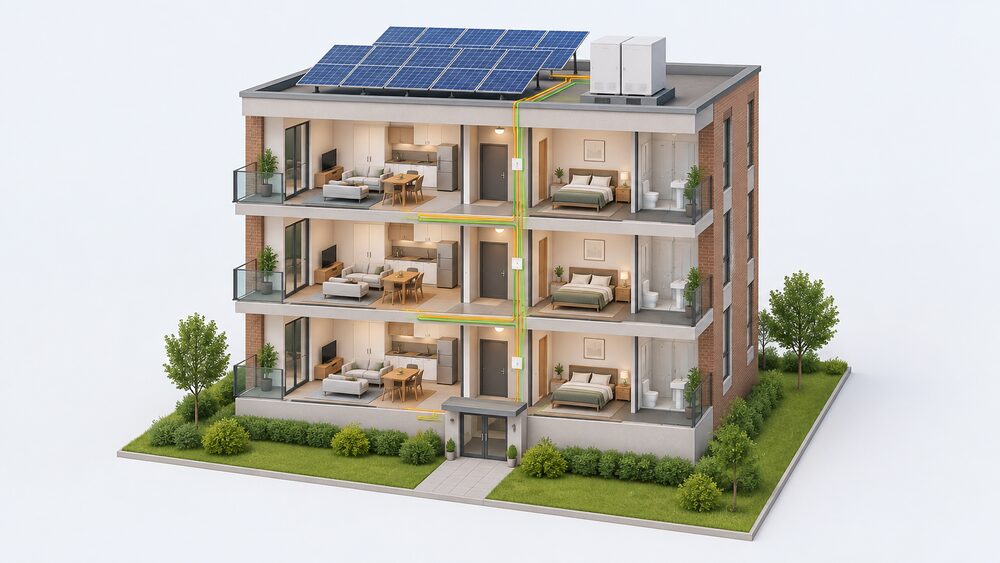
The Urban Energy Club is a battery-sharing arrangement in which residents of a block hold virtual shares in a rooftop battery rather than owning the hardware themselves. The model sits inside community energy, which Community Energy England defines as allowing people and communities to take democratic control over their energy future by understanding, generating, using, owning and saving energy in their communities1. The battery stores energy converted from electricity supplied to the building or generated by a microgeneration system, so a flat with no panels of its own can still draw on a shared array2.
The scheme is associated with two Dyness products, the PowerDepot H5B and the PowerBox G2. A suburban house in the south of England chose the PowerDepot H5B as its energy storage system in March 2025, and Dyness deployed a 10.24 kWh PowerBox G2 for a suburban customer in the Netherlands in May 20253. The Powercube X2 uses battery module H480743.
What the club does for a household is shift part of the electricity supply from a national network to a shared local asset. What it does not do is remove dependence on the grid, a licensed supplier or the manufacturer's own systems. The sections below set out how the model works, what the batteries are, and where the limits fall.
What the Urban Energy Club is
The Urban Energy Club is best understood as a local energy supply arrangement built around a shared battery. Energy Saving Trust describes how an Energy Local Club overcomes the obligation to become a licensed supplier, which is the regulatory trick that lets a group of households trade power among themselves without each becoming a supplier in their own right6. The Urban Energy Club applies the same logic to storage: the club holds the battery, and members hold shares in it.
Community energy enterprises use social enterprise, cooperative and charitable business models, backed by community shares and crowdfunding from local people, retail, public sector and social impact investors1. That is the ownership structure a battery club typically adopts. The organisers are usually local community groups, local authorities, housing associations, intermediary or advisory organisations and local businesses7. Electricity North West states that it helps community energy groups set up their own local energy projects, which is the kind of distribution network operator support a new club would seek7.
Community energy more broadly provides clean, efficient and affordable ways to power schools, hospitals, local government buildings, high streets and so on7. A rooftop battery in a residential block is a smaller version of the same idea. Community energy organisations have a strong understanding of their local community, its characteristics and needs, which is why block-level schemes are often run by people who live in the block8.
The distinction that matters for a household is between a club and a tariff. Collective energy switching is a type of energy switching where customers switch to new energy deals as a group rather than as individual households9. That is a buying club. A battery club is different: it holds an asset and allocates its output. The Energy Ombudsman, which is part of the Trust Alliance Group, handles disputes in the supply market, and a club that is not itself a licensed supplier sits outside that route for some complaints10.
Virtual shares in a rooftop battery: how the model works
A virtual share is a notional allocation of a physical battery's capacity or output. The physical unit is defined in legislation: an electrical storage battery is within the relevant sub-paragraph if it is intended for use solely for storing energy converted from electricity supplied to the residential accommodation or building in question, or generated by a microgeneration system2. That definition matters because it ties the battery to the building it serves, which is exactly what a rooftop block battery does.
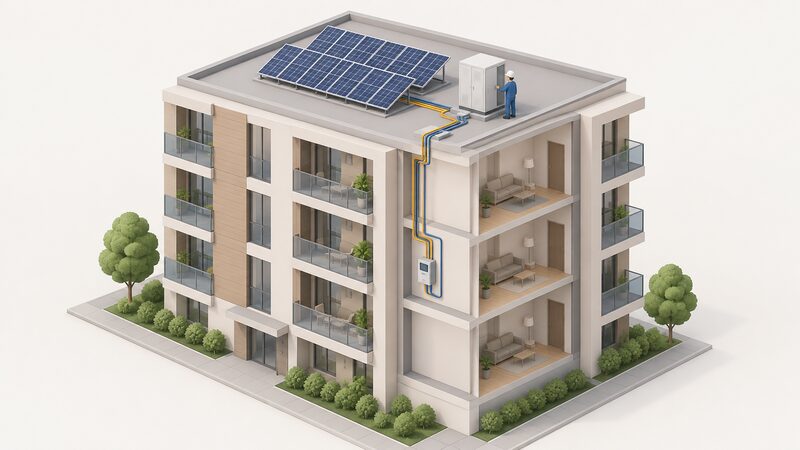
Behind-the-meter energy systems are localised energy solutions installed at a specific site, typically featuring on-site generation like rooftop solar PV, often paired with battery storage11. A block battery behind the meter avoids the costs and losses of exporting to the grid and buying back. With a rooftop solar system and a home battery, as much power produced onsite is used as possible12. The same principle scales to a block: the more of the shared array's output the battery absorbs, the less the block imports.
Storage itself is a conversion process. Electrical storage batteries store energy in the form of chemical energy which is then converted back to electrical energy when the battery is discharged13. A virtual share therefore represents a claim on a quantity of energy over time, not a physical portion of the cells.
The allocation question is the hard one. Nothing in national statistics fixes how a club must divide output between flats; that is a matter for its constitution and metering. What the data show is the underlying pattern of electric heating. In 2024, 10% of social sector dwellings and 8% of owner occupied dwellings used electricity as their primary heating fuel4. In a block where a larger share of residents heat with electricity, the battery's winter output is under more pressure, and the club's rules on priority matter more.
"An electrical storage battery is within this sub-paragraph if it is intended for use solely for storing energy converted from electricity supplied to the residential accommodation or building in question, or generated by a microgeneration system."
What it means for a household's energy independence
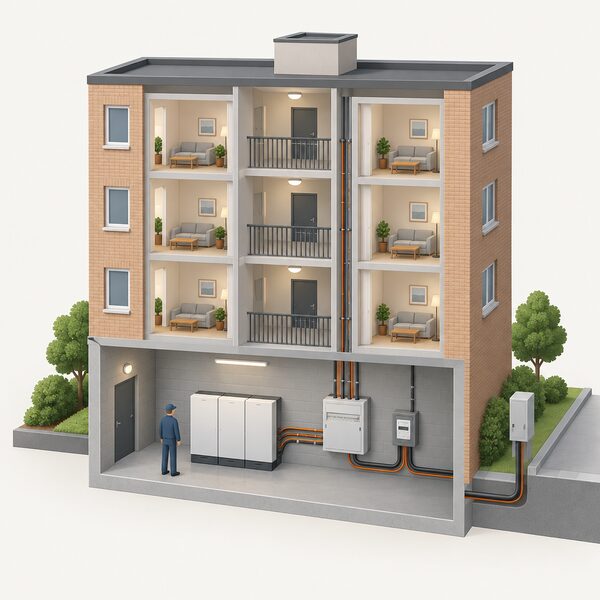
A virtual share moves a household part of the way toward independence and no further. The gain is real: the block generates and stores some of its own power, and the share gives a flat a claim on it without the capital cost of a private battery. The dependence that remains is substantial. The block still needs a grid connection for the hours the battery cannot cover, still buys from a licensed supplier for whatever the shared asset does not meet, and still relies on the battery manufacturer for hardware, firmware and any cloud service attached to it.
The funding landscape around block-level retrofit is where most of the practical support sits. The Energy Company Obligation supports energy efficiency measures in the home of those considered to be in fuel poverty14. ECO 4 allows local authorities to identify the most vulnerable households who could benefit from energy efficiency improvements15, and it is a Government scheme aimed at improving the least efficient homes in Great Britain through funding energy-saving measures15. Local authorities can set their own criteria for eligibility for funding for domestic energy efficiency measures16.
Applications for ECO Flex must come from the relevant council scheme, rather than the householder17. That is the route by which a block's fabric, and sometimes its services, get improved. In Scotland, the council works with Registered Social Landlords to assist owners in mixed tenure blocks where the Housing Association are planning to deliver energy efficiency measures to blocks of flatted properties18. That mixed tenure support is the closest thing in the evidence to a template for how owners and renters in one block join a shared scheme.
For a household, the honest summary is that a virtual share lowers the volume of imported electricity and the exposure to wholesale price spikes, but it does not remove the standing charge, the supplier relationship or the maintenance liability that sits with whoever owns the battery.
The batteries behind the scheme: PowerDepot H5B and PowerBox G2
The hardware associated with the scheme is Dyness equipment. The PowerDepot H5B was chosen by a suburban house in the south of England as its energy storage system in March 20253. The PowerBox G2 is a 10.24 kWh residential energy storage system, deployed by Dyness for a suburban customer in the Netherlands in May 20253. The Powercube X2 uses battery module H480743.
| Product | Figure | Detail | Date |
|---|---|---|---|
| PowerDepot H5B | chosen as home storage system | Suburban house, south of England | March 20253 |
| PowerBox G2 | 10.24 kWh | Residential storage, Netherlands | May 20253 |
| Powercube X2 | battery module H48074 | Maker datasheet | 20263 |
A home battery captures surplus solar energy for later use including overnight EV charging, whereas without it unused solar electricity is wasted or exported to the grid often at a relatively low rate19. That is the value a block battery creates for residents who cannot each install their own unit.
The manufacturer relationship is itself a form of dependence. A club that buys one maker's hardware depends on that maker for spares, firmware and any monitoring platform. Where a scheme relies on a cloud service to allocate shares or report usage, the household's visibility of its own share depends on that service continuing.
Community energy in cities: from Brixton Energy onwards
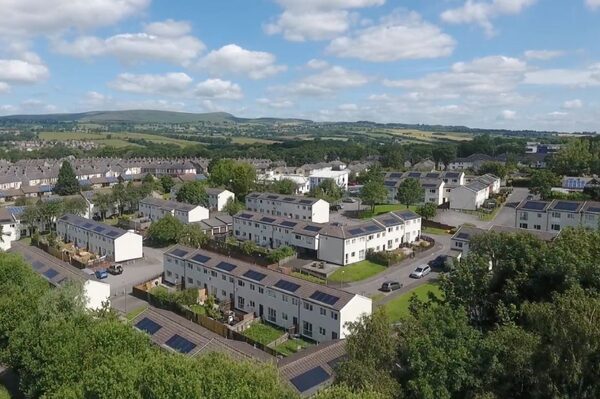
Urban community energy has a clear starting point. In January 2012, Brixton Energy Solar Co-operative installed a solar panel system on a local housing estate, becoming the first urban community energy project in the UK6. That project established the template the Urban Energy Club follows: a co-operative, a shared generation asset on a housing estate, and local people holding the shares.
The wider urban picture is mixed. Bristol's City Leap Energy Partnership brings together Bristol City Council, Ameresco, Vattenfall Heat UK and local partners21. South East London Community Energy delivers energy advice and energy efficient improvements to help local people reduce their energy bills and address fuel poverty8. Action on Energy provides communities with advice and support for improving home energy efficiency22.
Planning rules make rooftop generation easier than many residents assume. The installation of solar panels and equipment on residential buildings may be permitted development with no need to apply to the London Borough of Bromley for planning permission5. Installing solar panels and equipment on residential buildings and land may be permitted development with no need to apply to the council for planning permission23. In many cases, even in conservation areas, homes can have solar panels without requiring planning permission from the Council under permitted development24. Homes can often have solar panels without requiring planning permission, covered by permitted development so long as certain conditions apply25.
For a block, that means the rooftop array behind a battery club is often deliverable without a full planning application, though listed buildings and some conservation areas will differ. The Centre for Sustainable Energy, an independent charity supporting people and organisations across the UK, is one of the advice bodies a group can approach26.
How residents take part, and who can hold a share
Participation runs through the block rather than the individual household. In mixed tenure flatted blocks, the council works with Registered Social Landlords to assist owners where the Housing Association are planning to deliver energy efficiency measures18. Applications for ECO Flex must come from the relevant council scheme, rather than the householder17.
Tenure does not have to be ownership. The electric vehicle chargepoint grant for renters and flat owners is open to people who own and live in a flat, or rent and live in any residential property including properties under the shared ownership scheme, provided they own an eligible vehicle and have private off-street parking27. The property must be in the UK28. That grant concerns chargepoints rather than batteries, but it shows the policy direction: renters and shared owners are treated as able to hold energy assets at their home.
Where the model falls short
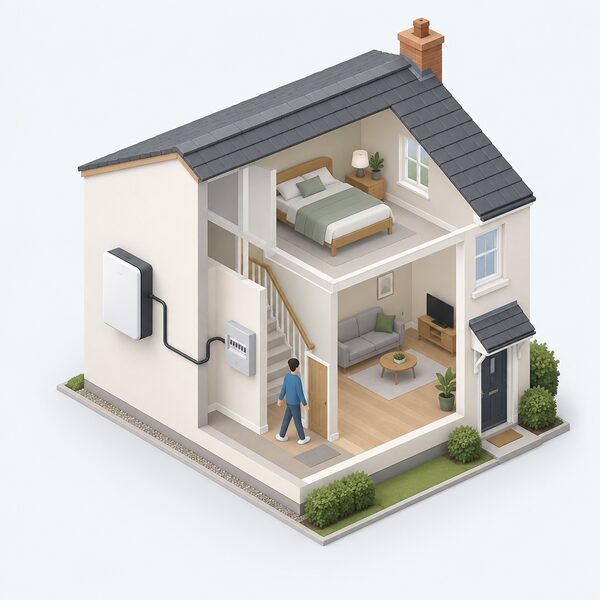
Three limits are worth stating plainly. First, a virtual share is not a supply licence: the club structure exists precisely because members do not each become licensed suppliers, and the Energy Local model is the established way round that obligation6. Second, the battery is defined by its connection to one building, so a share cannot easily be moved to another address2. Third, the allocation of output between flats is a governance question the club must answer itself, and the evidence offers no standard formula.
On the regulatory side, England has approved the 2026 version of the National Calculation Methodology for buildings other than dwellings30, and the UK Government has proposed replacing the SAP with a new methodology, the home energy model31. Both affect how a block's energy performance is expressed, not how a club divides its output, but they shape the paperwork a scheme will meet.
For a household weighing a share, the questions to put to the club are the ones the evidence cannot answer for it: who owns the battery, who maintains it, what happens if the manufacturer withdraws support, and what the rules say when the battery is empty and the block is importing.
Sources31 cited
- What is community energy?, Community Energy England, 2026-09-20
- Energy Act 1994, Schedule 7A, Part 2, Chapter 2, legislation.gov.uk, 2026-09-17
- US5000 datasheet, Midsummer Energy, 2026-09-17
- Scottish House Condition Survey 2024: key findings, Scottish Government, 2024
- Solar photovoltaic (PV) panels, London Borough of Bromley, 2026-09-17
- Community energy delivers affordable power, Energy Saving Trust, 2025-09-22
- What is community and local energy?, Electricity North West, 2026-09-19
- Delivering warm homes through community power, Energy Saving Trust, 2025-10-09
- Collective energy switch, Confused.com, 2026-01-14
- Energy Ombudsman FAQs, Energy Ombudsman, 2026-09-19
- Behind-the-meter energy systems guidance, Welsh Government, 2026-06-29
- Batteries in the home, Solar Energy UK, 2026-09-17
- VAT energy saving materials and grant funded heating supplies, HMRC, 2026-09-17
- Energy Company Obligation (ECO), Ofgem, 2026-09-17
- ECO 4 ECO Flexible Eligibility, Breckland Council, 2026-09-17
- Energy Efficiency Advice, Torridge District Council, 2026-09-17
- Energy Company Obligation (ECO) scheme, Leeds City Council, 2026-09-20
- Area Based Schemes, Glasgow City Council, 2026-06-08
- Can solar panels charge electric cars?, The CPA, 2026-04-15
- Is your e-bike battery safe?, Electrical Safety First, 2026-09-17
- Our climate action on buildings, Bristol City Council, 2026
- Energy incentives and schemes, South Cambridgeshire District Council, 2026-09-17
- Guidance on retrofitting homes: solar panels, London Borough of Lambeth, 2026-09-17
- Solar panels and permitted development, London Borough of Richmond upon Thames, 2026-07-06
- Solar panels and planning permission, Cornwall Council, 2026-09-17
- Contact Cosier Homes for energy advice, Centre for Sustainable Energy, 2026-02-12
- Electric vehicle chargepoint grant for household eligibility, GOV.UK, 2026-09-18
- Electric vehicle chargepoint and infrastructure grants, Department for Infrastructure Northern Ireland, 2026-09-17
- ECO4 delivery guidance v3.2, Ofgem, 2025-12-08
- Notice of approval of the methodologies of calculation of the energy performance of new buildings, GOV.UK, 2026-03-24
- Research briefing CBP-8830, House of Commons Library, 2026-09-17
 Peer-to-Peer Energy TradingSharing power with your neighbours sounds simple, so why does it need a supplier in the middle?
 Microgrids and Local EnergyA microgrid shares electricity between neighbours, using local solar and batteries instead of relying only on the national grid.
 Community Energy Share OffersHow community energy share offers work in community benefit societies and co-operatives, what returns and risks are stated, how withdrawal works, and how owning shares differs from owning generation on your own roof.
 Free Solar Panels vs Rent-a-RoofOffers of free panels usually mean a company owns the system and keeps the generation income or charges a monthly fee.
 AC-Coupled vs DC-CoupledCan you add a battery to your existing solar panels without swapping the inverter, and does one kind waste more of your solar power than the other?
 Charging With a Home BatteryHow a home battery and an EV charger share one supply, whether a battery can usefully charge a car, and how combined systems are controlled so the battery is not discharged into the vehicle at a loss.