In this guide
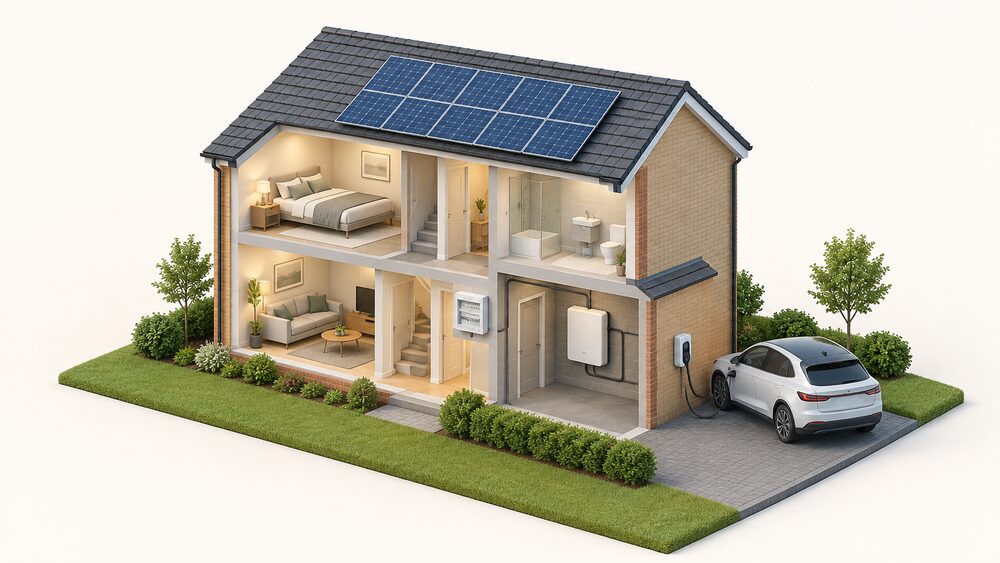
A home battery and an EV charger can share one supply, and the pairing is the most common way a household with solar tries to keep car charging off the grid. The battery does not charge the car directly in most setups. It stores surplus solar or cheap-rate electricity, and the charger draws from the house supply as normal, with the battery covering the load behind the meter. Energy Saving Trust states that a home battery stores excess solar electricity or charges when the tariff is cheap, then releases that energy at night or when prices are high1.
The practical gain is real but bounded. The Centre for Sustainable Energy reports that domestic battery systems can store as much electricity as a household typically uses in a day, enabling a PV system to provide up to 70% of a household's annual electricity demand2. A car is a much larger load than a day of household demand, so a battery rarely covers a full charge on its own. The Centre for Alternative Technology describes the realistic pattern as a hybrid approach, where solar covers as much of the charging as it can and the grid fills the gaps3.
What the pairing does for independence is shift when electricity is bought, not whether it is bought. The battery, the charger and the car all remain dependent on the grid connection, on a supplier for top-up units, and on the manufacturer's app and firmware for control. The sections below set out how the two systems interact, what load management adds, what the hardware requires, and where the arrangement falls short.
Why pair an EV charger with a home battery
The case rests on what happens to solar electricity that is not used the moment it is generated. Without storage, surplus generation is exported, often at a relatively low rate. The Centre for Alternative Technology states that with a home battery, surplus energy is captured and held for when it is actually needed, including overnight EV charging3. That is the whole mechanism: the battery moves daytime generation into the evening and night window when a car is usually plugged in.
The second driver is tariff arbitrage. Energy Saving Trust notes that a battery can be charged when the tariff is cheap and discharged when prices are high1. For a household on a time-of-use tariff, that means the battery can absorb cheap overnight units and release them during the day, while the car charges in the same cheap window. Us witch makes the dependency explicit: a home EV charger is needed for an EV tariff to be useful, because there is no point having the tariff if the car cannot be charged at home9.
A third consideration is the connection itself. Energy Networks Association guidance recommends a dedicated EV charge point over a standard 13A household socket to achieve faster charging speeds10. Adding a battery does not change that recommendation, but it does change the load profile the charger sees, because the battery can supply part of the demand rather than the whole draw coming from the grid at once.
The independence gain is therefore partial and conditional. A household with solar, a battery and an EV charger can cover a meaningful share of car charging from its own generation, and can time the rest to cheap periods. It still relies on the grid for whatever the battery cannot supply, on a supplier for those units, and on the charger and battery makers for the software that coordinates the two.
How the two systems work together: charging the car from stored solar
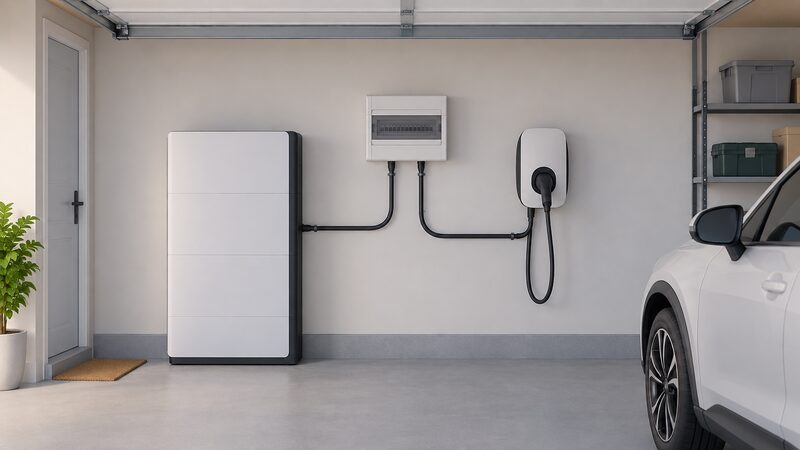
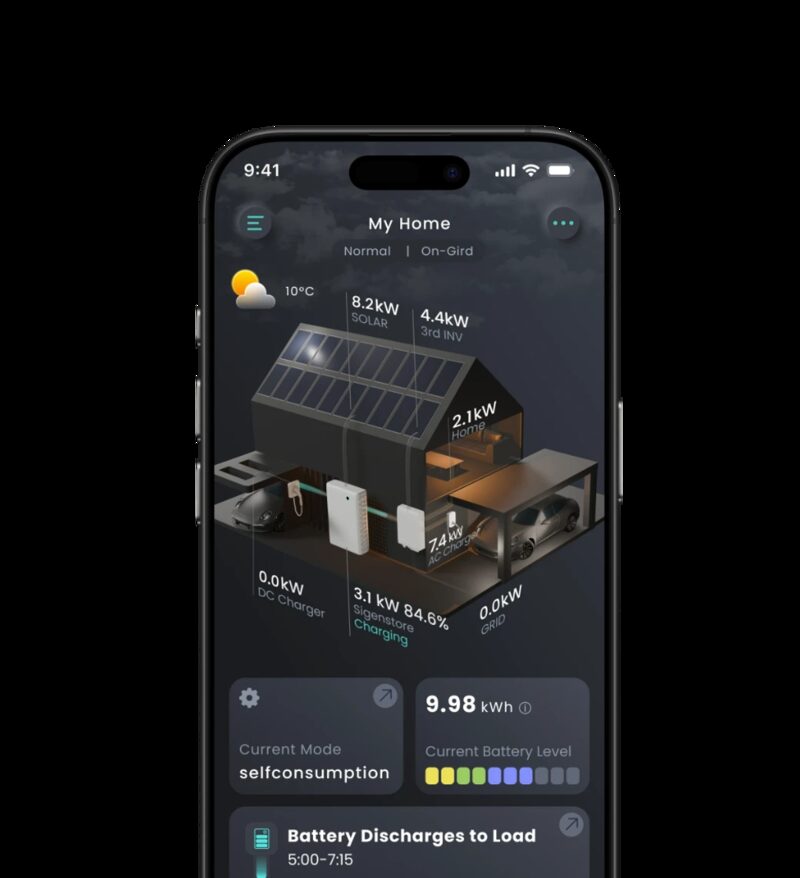
The two devices are separate products that meet at the consumer unit. The battery sits behind the meter, storing and releasing electricity. The charger draws from the same supply. Coordination happens either through the charger's own energy management or through a home energy management system that sees both.
The Centre for Sustainable Energy sets out the three destinations for solar generation: it can be used throughout the home, exported to the grid, or stored in a battery for use at another time11. NICEIC gives the same three options and adds the timing motive, noting that stored energy can be used during peak hours when the electricity supply is expensive12. For a car, that timing is the point. A vehicle parked from early evening to morning is available precisely when a battery has stored energy to release and when peak rates apply.
The realistic pattern is not full self-sufficiency. The Centre for Alternative Technology describes the practical reality as a hybrid approach in which solar covers as much of the charging as it can and the grid fills the gaps3. A battery sized for household demand will not usually cover a full car charge, so the grid supplies the balance. What the battery changes is the proportion drawn at expensive times.
"With a home battery, that surplus energy is captured and held for when you actually need it, including overnight EV charging."
Dynamic load management: charging at full speed without tripping the fuse
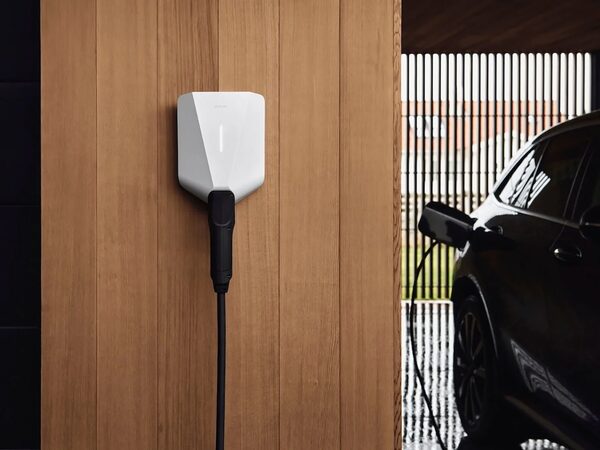
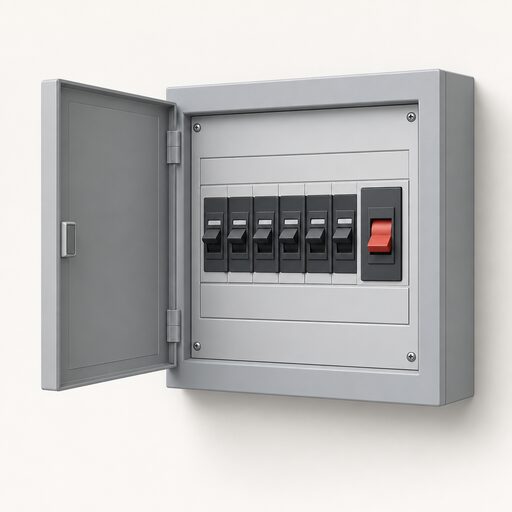
A charger running at full rate adds a large load to whatever the house is already drawing. Dynamic load management is the control that keeps the total below the main fuse rating by reducing charging current when household consumption rises. Homey describes the function plainly: the EV charger dynamically adjusts the charging current based on real-time household consumption13.
This matters more, not less, when a battery is present. A battery charging at the same time as a car, an oven and a heat pump can push a supply close to its limit. Load management lets the charger hold its rate while the battery and other loads vary, rather than forcing the household to choose between charging the car and running the house.
There is a network-level reason too. The Energy Systems Catapult reports that when neighbouring homes all export solar energy simultaneously, local network voltage rises, and some EV chargers respond by shutting down14. That is a failure mode of uncontrolled operation on a shared low-voltage network, and it is one reason coordination between generation, storage and charging is treated as a system problem rather than a product feature.
What dynamic load management needs: a power meter and compatible hardware
The control loop needs a measurement. Something has to tell the charger how much the rest of the house is drawing, and that is normally a current transformer or a meter at the supply point.
Wallbox states that adding a Wallbox power meter to the installation enables dynamic load management, solar charging and more from the device16. Homey describes a comparable arrangement, where a dongle with a P1 port splitter lets the EV charger share a connection with the utility meter, providing live household consumption data so the charger adjusts its speed through dynamic load balancing while preventing overloads on the main fuse13.
The requirement is therefore two-part: compatible hardware at the charger, and a metering point that can report whole-house consumption. A charger that only measures its own output cannot perform the function. Where a battery is also installed, the inverter or energy management system may already provide the measurement, but the charger must be able to read it.
AC or DC: why the car does the converting
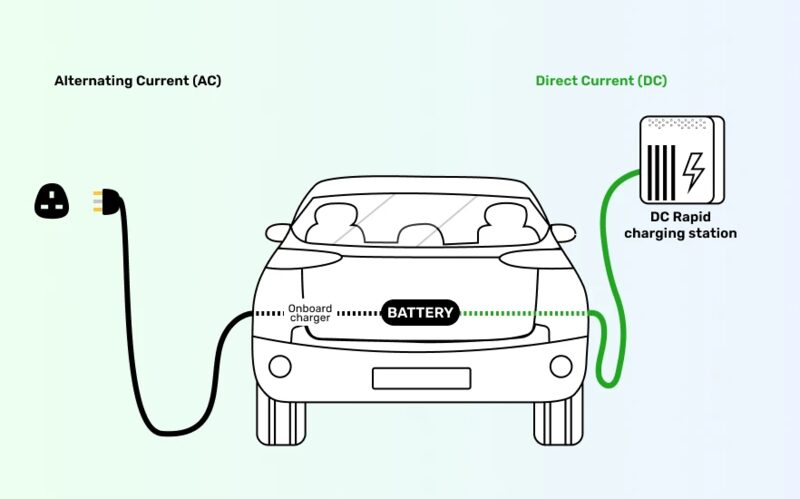
A home charge point supplies alternating current. The conversion to direct current happens in the vehicle. Flexi-Orb states that the vehicle's onboard charger converts Alternating Current (AC) to Direct Current (DC)18. Homey describes the same division of labour from the charger side, noting the charger is responsible for converting AC electricity from the home into DC electricity which the car's battery needs13.
That has a direct consequence for a battery and charger pairing. A home battery stores and releases DC internally but presents AC at the meter through its inverter, so the car's onboard charger does the final conversion. Each conversion step loses some energy, which is one reason a battery discharging into a car is not a lossless transfer.
Bidirectional charging changes the picture, but not yet for most households. Energy Saving Trust states that bidirectional charging lets an EV either draw or supply power to your home or the grid, and that this is currently being trialled in some places but is not widely available1. The Centre for Sustainable Energy notes that using a car to power a home requires the EV and the EV charger to be bidirectional charging compatible19. Until that is common, the flow is one way: house to car.
Cost position: home charging versus public charging
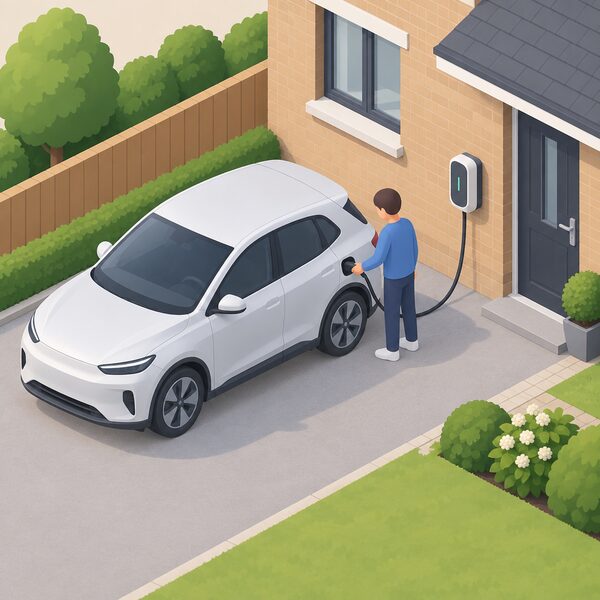
Charging at home is cheaper than public charging, and the gap is structural rather than promotional. Flexi-Orb states that electric vehicle charging at home is likely to be cheaper than at a public EV station18. Part of the reason is tax: Zapmap notes that public rapid charging tends to be the most expensive option due to higher energy tariffs and a 20% VAT rate, compared to the 5% VAT applied to domestic electricity20. Carwow gives the same split, stating that VAT on home electricity is just 5%, compared with 20% at public chargers7.
The Centre for Alternative Technology puts the comparison more broadly, stating that charging from your own electricity is significantly cheaper than using grid power and is far cheaper than petrol or diesel over the same distance3. ChargeUK published a comparison showing a home off-peak cost of £158 over 7,100 miles21.
A battery changes the home figure by shifting units into cheaper windows, but it does not change the VAT position or the standing costs. The battery itself is a capital cost. The Centre for Sustainable Energy states that domestic battery systems may save on imported electricity costs but are currently very expensive, and do not make financial sense for every household2.
| Cost element | Position | Source |
|---|---|---|
| Home charging vs public | Home likely cheaper | 18 |
| VAT on domestic electricity | 5% | 7 |
| VAT at public chargers | 20% | 7 |
| Home off-peak cost over 7,100 miles | £158 | 21 |
| Home charger supply and fit | £500 to £1,200 | 6 |
| 7kW charger supply and fit | Around £900 | 6 |
Battery lifespan and warranties: the car battery's 10 to 20 years
Two batteries are in play, and they have different lives and different warranties. Energy Saving Trust states that the typical lifespan of a battery is about 10 to 12 years1. Home Energy Scotland gives a range of 10 to 15 years for batteries generally4. These are the storage units, not the vehicle.
For the car, SMMT states that manufacturers provide warranties on EV batteries lasting at least eight years or 100,000 miles5. Energy Saving Trust reports that EV batteries are expected to last 10 to 20 years22. Us witch states that most electric car batteries are guaranteed by manufacturers to last for eight years or around 100,000 miles8. Us witch also reports that most manufacturers offer battery warranties of seven or eight years23.
The spread between seven and eight years, and between 10 and 20 years of expected life, reflects different manufacturers and different measurement bases rather than a disagreement about the technology. A warranty term is a contractual floor; an expected life is a projection. Both are worth reading separately.
Grants and tax dates that affect the running costs
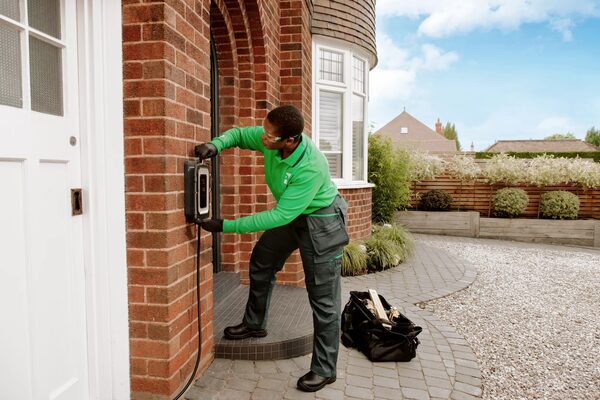
The grant landscape changed on 1 April 2026. GOV.UK states that five grant schemes have been extended until 31 March 2027, with new grant rates, and that three schemes closed for applications on 31 March 202625. Carwow reports that applications open on 1 April and will be available for one year7.
For households, the relevant scheme is the Electric Vehicle Chargepoint Grant for Households with On-Street Parking. GOV.UK states that OZEV will pay the grant to the chargepoint installer, that the grant cannot be backdated, and that it is only for people who have vehicles on the list of OZEV-approved electric vehicles17. Zapmap notes that the government provides financial support for electric vehicle buyers living in flats and rented properties through the EV Chargepoint Grant, which covers a proportion of the total costs of installing an EV home charger26. The grant for residential landlords closes on 31 March 2027 at 11:59pm27.
On tax, Vehicle Excise Duty applies to battery electric vehicles from April 2025, at the lowest rate28. From April 2028 a new tax applies to EVs at 3p per mile driven12. NAPIT reports EV drivers charged 3p per mile from April 202829. Carbon Brief refers to a new 3p per mile EV tax due to start from April 202830.
| Date | Change | Source |
|---|---|---|
| April 2025 | VED applies to battery electric vehicles, at the lowest rate | 28 |
| 31 March 2026 | Three OZEV schemes closed for applications | 25 |
| 1 April 2026 | New grant rates; applications open for one year | 7 |
| 31 March 2027 | Five OZEV schemes extended to this date | 25 |
| April 2028 | eVED at 3p per mile driven | 12 |
Where the setup falls short: availability and added cost
The limits are cost, capacity and control, and none of them disappears with better hardware.
Cost is the first. A home EV charger typically costs between £500 and £1,200 to buy and install, and 7kW chargers cost around £9006. A domestic battery is a separate capital cost, and the Centre for Sustainable Energy states that battery systems are currently very expensive and do not make financial sense for every household2. Adding both is a larger outlay than either alone.
Capacity is the second. A battery sized for household demand will not usually cover a full car charge, so the grid supplies the balance. The Centre for Alternative Technology's hybrid description is the honest expectation: solar covers as much as it can, the grid fills the gaps3.
Control is the third. The charger depends on a metering point and compatible hardware to perform load management16. It depends on Wi-Fi for software updates and energy reporting, and Us witch notes the installer connects the charger to the home Wi-Fi network so it can access software updates and report energy usage31. A battery adds its own app and firmware dependency on top.
Sources31 cited
- Battery storage, Energy Saving Trust
- Making the most of your solar PV panels, Centre for Sustainable Energy, 2026-08
- Can solar panels charge electric cars?, The Centre for Alternative Technology, 2026-04-15
- Battery storage, Home Energy Scotland
- EVs: the facts, SMMT, 2025-09-22
- Electric car charging at home, Which?, 2026-02-25
- Electric car charger grants rise to £500, Carwow, 2026-02-25
- Electric cars and energy bills, Uswitch, 2026-04-27
- EV energy tariffs, Uswitch, 2025-09-17
- Connecting to the networks: LCT strategy, Energy Networks Association, 2026-09-17
- Electric car charging guide, Carwow, 2025-07-16
- Should I buy an electric car?, Which?, 2026-04-16
- What are EV chargers and how to optimize their energy usage in a smart home?, Homey, 2026-09-20
- Making home energy management work for consumers, Energy Systems Catapult, 2026-02-12
- EVs and heat pumps, NIE Networks, 2026-09-19
- Wallbox App, Wallbox, 2026-09-17
- Electric Vehicle Chargepoint Grant for Households with On-Street Parking, GOV.UK, 2026-09-17
- Electric vehicle charge points, Flexi-Orb, 2025-04-22
- Battery storage, Centre for Sustainable Energy, 2025-10
- Tesla Model 3 charging, Zapmap, 2026
- Reduced public charging prices could boost EV sales, ChargeUK, 2026-07-31
- Electric vehicles: debunking myths, Energy Saving Trust, 2025-09-22
- Electric car myths busted, Uswitch, 2024-11-26
- Electric vehicle charging, SMMT, 2025-06-25
- Changes to electric vehicle chargepoint grant schemes from 1 April 2026, GOV.UK, 2026-07-07
- Driving electric car top tips, Zapmap, 2024-12-06
- Electric vehicle chargepoint and infrastructure grants for landlords, GOV.UK, 2026-09-18
- Incentive for electric vehicles, SMMT, 2025-04
- Government urged to rethink pay-per-mile scheme for electric vehicles, NAPIT, 2026-02-24
- CCC: faster electrification of UK will put money back into people's pockets, Carbon Brief, 2026-06-24
- EV charger home installation process, Uswitch, 2022-02-03
 Load Management for ChargersWill a home charger trip the main fuse when the oven, shower and car all draw power at once?
 Charging and Energy IndependenceCharging an electric car at home can cut your fuel costs, but how much does it really free you from the grid?
 Charger Apps and ConnectivityHow a home charge point connects: Wi-Fi, Ethernet, 4G and Bluetooth, what the app controls, what happens when the network drops, and how much of the charger depends on the maker's cloud.
 Charging Without a DrivewayParking on the street makes charging an electric car at home tricky.
 Home EV Charger ManufacturersWhich home EV charger brands are worth considering, and how do you choose between them?
 Types of Home EV ChargerWhich home charger suits your car and your driveway?