
In this guide
The residential landlord chargepoint grant pays 75% of the cost of buying and installing a chargepoint socket at a rented home, up to a maximum of £500 per socket1. It is one of five chargepoint grant schemes that run until 31 March 2027 with the current grant rates2. A landlord can claim for up to 200 sockets per year, across several properties or for one property1.
The scheme is open to private landlords, registered providers of social housing, and property management companies working on behalf of a landlord3. Applicants must be registered at Companies House or VAT registered, and the property must be in England, Wales, Scotland or Northern Ireland4. Properties in the Channel Islands or the Isle of Man are not eligible4.
The grant is not a payment to the landlord. OZEV confirms eligibility to the applicant and the installer, and the work must not start before that confirmation arrives4. The chargepoint must be installed by an OZEV-authorised installer using an eligible residential chargepoint4.
What the grant covers: 75% off up to £500 per socket
The grant is a contribution towards the purchase and installation of electric vehicle chargepoints at residential properties, not a fixed payment6. The rate is 75% of the cost of buying and installing chargepoints, capped at £500 per socket4. A socket costing £700 would attract £500, the maximum, leaving the landlord to meet the balance.
The £500 ceiling is recent. On 1 April 2026 the maximum grant rate that residents and landlords can apply for increased from £350 to £500 per socket2. Older published figures still in circulation, including £350 per socket for residential landowners and up to £350 off the cost of installing a charger, reflect the position before that change6. Where a page has not been updated, the £350 figure is the one it carries; the current rate is £5002.
The grant is not the same as the commercial landlord chargepoint grant, which covers 75% of the cost of the work up to a maximum of £350 per chargepoint socket and closed to customer applications on 31 March 20262. A landlord with both domestic and commercial premises is dealing with two different schemes, one of which is now shut to new applicants.
What the money does for a household's independence is indirect. The chargepoint itself is fixed to the property, so the tenant charges at home rather than at a public network, on a domestic tariff rather than a retail one. The landlord's exposure does not end with the capital cost: the electricity is metered and billed through the tenancy, and the chargepoint's smart functions depend on the maker's app and cloud service, which is a continuing dependence the grant does nothing to remove. See EV charging and household energy independence for how that balance works across a home.
Where the properties must be: UK only, not the Channel Islands or Isle of Man
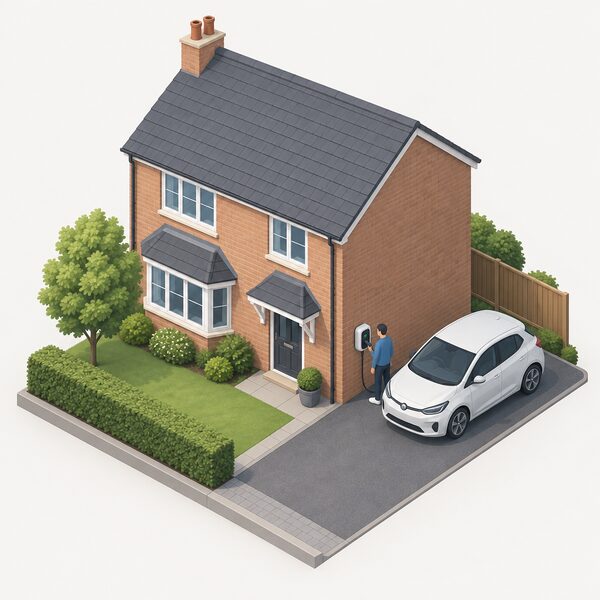
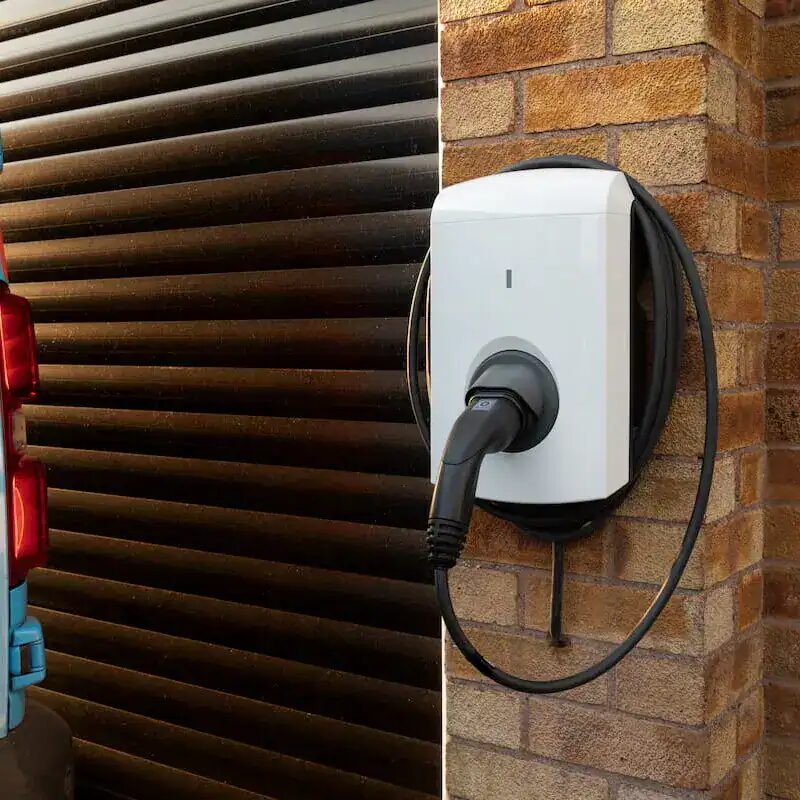
The property must be located in England, Wales, Scotland or Northern Ireland4. The same four-nation extent applies to the renters and flat owners grant and to the on-street parking grant, so the territorial rule is consistent across the domestic schemes8. If a property is in the Channel Islands or the Isle of Man, it is not eligible4.
There is no separate devolved version of this grant. Unlike domestic energy efficiency schemes, which are delivered differently in each nation, the landlord chargepoint grant is a single UK-wide scheme administered by OZEV, and the eligibility conditions do not vary between the four nations4. A landlord with properties in Glasgow, Cardiff and Belfast applies through the same process as one with properties in Manchester.
The one place where the nations diverge is building regulations, and that divergence matters because it feeds an exclusion. Buildings under construction or being renovated where the Part S Regulations applies on or after 15 June 2022 are excluded in England, and devolved countries with similar regulations are excluded too, for example the Building (Scotland) Regulations from 5 June 20234. Scotland has consulted on proposed changes to energy standards and associated topics in its building regulations, which is the mechanism by which an equivalent requirement would arise north of the border10.
For a landlord, the practical effect is that the grant is available across the UK but the building standards that can disqualify a property are set nationally. A new build or a major renovation in England falls outside the grant; an older property being refurbished without triggering Part S does not.
What is excluded: homes under construction, renovations and pre-installed chargepoints
The exclusions fall into three groups: the state of the property, the state of the installation, and the applicant's history.
On the property, a landlord cannot apply if they live in the property, if the property is not a residential property, or if it is used only for holiday accommodation4. The renters and flat owners scheme states the same principle from the other side: an application cannot be made for a property that is unoccupied or still being built, and only an existing residential property qualifies8. A landlord cannot claim for a house that is not yet habitable.
On the installation, a chargepoint already installed before OZEV confirms eligibility is excluded, and the grant cannot be backdated4. The same rule appears in the on-street parking scheme, where an applicant must not have already installed the chargepoint9. The sequence is fixed: quote, application, OZEV confirmation, installation.
On the applicant's history, a landlord cannot apply if there is no company registration number or VAT registration number, or if the installation is being made because of a mandatory requirement4. The renters and flat owners scheme adds a further bar for anyone who has already claimed that grant or its predecessors, the Electric Vehicle Homecharge Scheme or the Domestic Recharge Scheme11. The landlord scheme's own exclusion list is framed around the applicant and the property rather than a prior claim, but the predecessor schemes are closed, so a landlord who claimed under the Electric Vehicle Homecharge Scheme is dealing with a different set of rules from the current one.
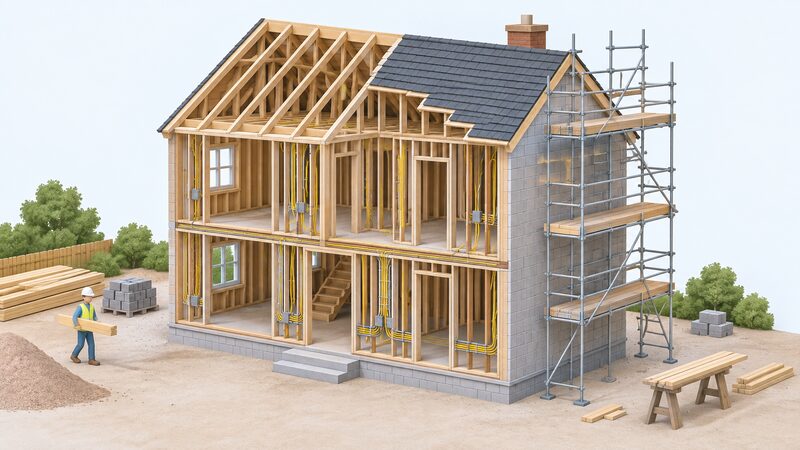
The mandatory requirement exclusion is the one most likely to catch a landlord by surprise. It covers buildings under construction or being renovated where the Part S Regulations applies on or after 15 June 2022 in England, devolved countries with similar regulations such as the Building (Scotland) Regulations from 5 June 2023, and planning application conditions that mandate chargepoint installation4. Where a planning authority has already required a chargepoint, the grant is not available for that chargepoint.
The 200-socket annual limit and how it works across multiple properties
A landlord can receive grants for up to 200 sockets per year4. The limit is expressed per applicant rather than per property, and the guidance states that grants can be across several properties or for one property1. A landlord with a portfolio of twenty houses can spread the 200 sockets across the portfolio in a single year, or concentrate them on one block.
The limit is higher than the equivalent for commercial landlords, who are eligible for grants for up to 100 sockets per year2. It is also higher than the application limits under the residential landowners scheme run with Energy Saving Trust, which allows 200 applications per year per applicant for non-resident building owners including landlords and social housing providers, and 30 applications per year per applicant for owners of apartment blocks6. The two schemes are separate: the OZEV landlord grant is the one with the £500 per socket rate, and the residential landowners scheme is limited to £350 per socket6.
The common control rules sit behind the annual limit. Common control is defined by the Subsidy Control Act 2022 Section 84. That definition determines whether two companies count as one applicant for the purposes of the 200-socket ceiling, which matters to a landlord operating through several limited companies. Where companies are under common control, the limit is not multiplied by the number of companies.
For a landlord, the limit is generous relative to typical portfolio sizes. The scheme's own usage figures suggest it has not been stretched: 1,912 socket installations had been funded as of 1 July 2026, of which 410 were in the last 12 months, with a total of £673,983 paid for socket installations5. By comparison, the renters and flat owners grant had funded 26,504 sockets, of which 9,301 were in the last 12 months, at a total of £9.2 million5. The landlord scheme is the smaller of the two by an order of magnitude.
| Scheme | Sockets funded | In last 12 months | Grant value |
|---|---|---|---|
| Residential landlords | 1,912 | 410 | £673,983 |
| Renters and flat owners | 26,504 | 9,301 | £9.2 million |
| Commercial landlords | 467 | 89 | £170,200 |
| Residential landlords, infrastructure | 3,652 | 1,091 | Not stated separately |
All figures as of 1 July 20265.
Using an OZEV-authorised installer and an eligible chargepoint
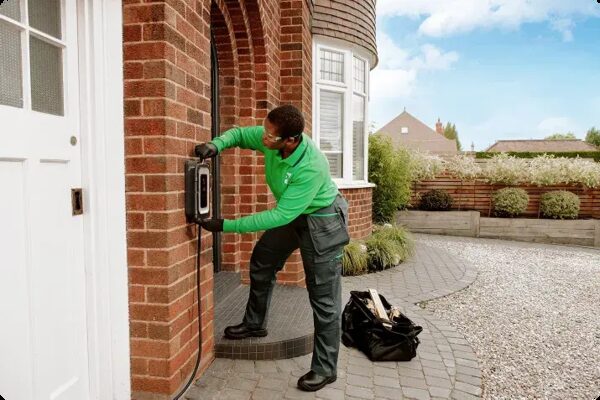
The grant is conditional on who does the work and what they fit. A landlord must use an OZEV-authorised installer and an eligible residential chargepoint4. The same requirement applies to the renters and flat owners grant and to the on-street parking grant, which requires an OZEV approved installer11.
The installation standards are set out separately. Chargepoints must be installed on a residential property, and installations must be carried out to BS EN 61851, the IET wiring regulations BS 7671, the IET Code of Practice for Electric Vehicle Charging Equipment Installations, and the Electricity Safety, Quality and Continuity Regulations installation requirements12. These are the same standards that apply to any domestic chargepoint installation, so a landlord is not facing a special regime, but the grant claim depends on them being met.
Claims are submitted through the claims management portal12. OZEV confirms eligibility to the applicant and the installer, and the installer is the party who receives the grant payment under the equivalent household scheme4. That structure means the landlord is not usually handling the grant money: the installer discounts or reclaims it, and the landlord pays the balance of the quoted price.
For a household's independence, the installer requirement is a constraint rather than a benefit. It narrows the field of contractors to those on OZEV's authorised list, which limits a landlord's ability to use a preferred local electrician who is not registered. The chargepoint eligibility list does the same for hardware. Both are conditions of the subsidy, not statements about quality, and a landlord weighing up a chargepoint should treat the authorised installer list as the starting point for quotes rather than as a recommendation. The installation process and the electrical requirements are covered in more detail elsewhere on this site.
How to apply: quote, account and application steps
The application route is set out in the scheme rules and runs in a fixed order4:
- Contact an OZEV-authorised installer to get a quote for the work.
- Select the "Start new application" button on the scheme page.
- Create an account on the application platform.
- Apply using the form provided, submitting details of the property and the vehicle to OZEV.
- Wait for OZEV to confirm eligibility to the applicant and the installer.
- Have the chargepoint installed only after that confirmation.
The platform changed on 1 April 2026, when the flats and renters grant and the residential landlord chargepoint grant moved to a new platform for customer applications2. A landlord who applied before that date used a different system, and any saved login or bookmark will not carry over.
The vehicle element is worth noting. The renters and flat owners grant requires the applicant to own or use an eligible vehicle, and the vehicle must be on OZEV's list of approved vehicles8. The landlord scheme's exclusion list is framed around the property and the applicant rather than the vehicle, but the application form asks for vehicle details4. A landlord fitting a chargepoint for a tenant's use is not the vehicle's keeper, which is one reason the landlord scheme exists separately from the tenant's own entitlement.
How the scheme has been used so far: 1,912 sockets and £673,983 paid
Official statistics to 1 July 2026 record 1,912 socket installations under the residential landlord grant, of which 410 were in the last 12 months, and a total of £673,983 paid for socket installations5. The separate electric vehicle infrastructure grant for residential landlords, which funds supporting infrastructure rather than sockets, had funded 3,652 sockets, of which 1,091 were in the last 12 months5.
The comparison across schemes is stark. The renters and flat owners grant had funded 26,504 sockets at a total of £9.2 million5. The commercial landlord grant had funded 467 sockets, of which 89 were in the last 12 months, at £170,200 for socket installations and supporting infrastructure5. The workplace charging grant schemes had funded 85,547 installations since 2016, at £26.9 million for socket installations and supporting infrastructure5. Public charging grant schemes had funded a provisional 24,945 EV charger installations since 20175.
The landlord scheme's small numbers have a history. Earlier official statistics recorded that 27 councils that had already completed installations under the On-Street Residential Chargepoint Scheme had further funding awarded to install a further 4,522 charging devices with a grant value of £11.8 million14. The On-Street Residential Chargepoint Scheme itself had received £64.9 million in grant value since its launch in 2017, with 6,567 charging sockets completed in the last 12 months5. The public charging effort has consistently dwarfed the landlord grant.
The scheme's slow uptake is not explained by the grant rate, which is the most generous per socket of the domestic schemes. It is more likely to reflect the structure of the private rented sector: a landlord has no direct use of the chargepoint, the tenant may change, and the capital cost falls on the owner while the benefit accrues to the occupier. The grant reduces that asymmetry but does not remove it. A landlord weighing the decision is weighing a property improvement against a tenancy that may end, and the 200-socket limit is not the binding constraint.
Related OZEV grants for tenants, flat owners and other schemes
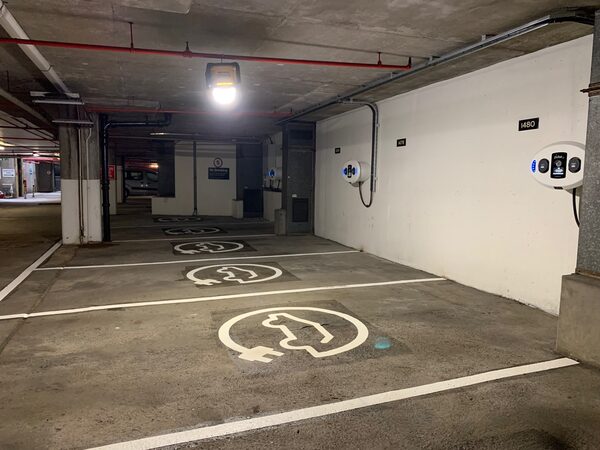
The landlord grant sits inside a family of OZEV schemes, and the boundaries between them matter because a household or a landlord may be eligible for one and not another.
The Electric Vehicle Chargepoint Grant for renters and flat owners pays 75% off the cost to buy and install a socket, up to a maximum of £50011. It is for people who own and live in a flat, or rent and live in any residential property including shared ownership, who own or use an eligible vehicle and have private off-street parking8. It opened on 1 April 2022 and closes on 31 March 2027 at 11:59pm11. OZEV aims to provide four weeks' notice if the grant ends or the grant amount changes, with claims made before any public announcement honoured subject to the grant criteria11.
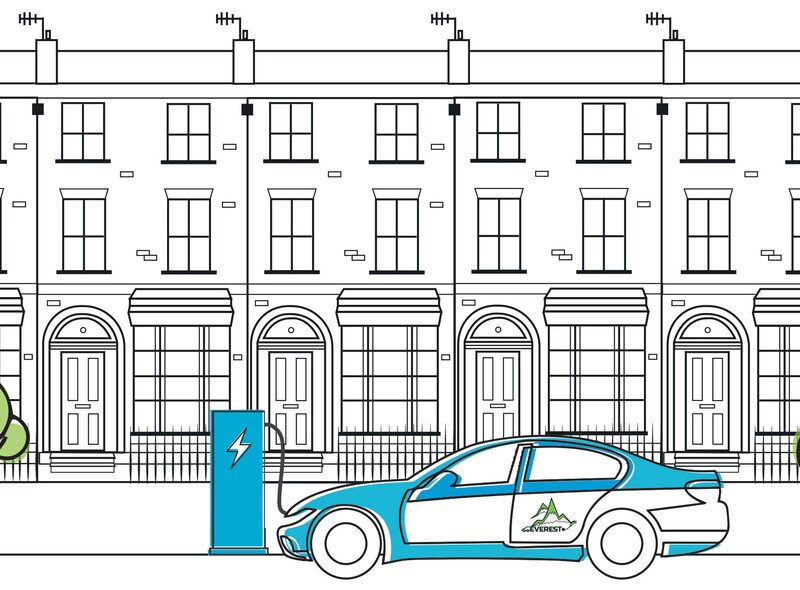
The Electric Vehicle Chargepoint Grant for households with on-street parking pays the same 75% up to £500, for domestic properties where the applicant owns or rents and is a resident, has no private and exclusive access to off-street parking, and has permission from the local highways authority9. It cannot be backdated, and OZEV pays the grant to the chargepoint installer9.
The residential landowners scheme, delivered with Energy Saving Trust, allows non-resident building owners including landlords and social housing providers to apply for a grant covering 75% of the costs towards purchase and installation of a chargepoint, limited to £350 per socket, with a limit of 200 applications per year per applicant and 30 per year for owners of apartment blocks6. OZEV introduced the grants and Energy Saving Trust delivered webinars on them6.
The commercial landlord chargepoint grant closed to customer applications on 31 March 20262. The Workplace Charging Scheme had funded 85,547 installations since 20165. The On-Street Residential Chargepoint Scheme had received £64.9 million since its launch in 20175. Five chargepoint grant schemes are available until 31 March 2027 with new grant rates2.
For a landlord, the interaction with the tenant's entitlement is the point to hold on to. A tenant who rents a property with private off-street parking may be able to claim the renters and flat owners grant in their own right, and independent guidance states that a renter will need to ask the landlord's permission13. A landlord who fits a chargepoint under the landlord grant removes the tenant's need to apply, but also removes the tenant's claim. The two routes are alternatives, not additions, and the landlord grant is the one that leaves the asset with the property.
"However, it will depend on what your landlord says, as you will need to ask their permission."
Sources15 cited
- Electric vehicle chargepoint grant for landlords, GOV.UK, 2026-09-17
- Changes to electric vehicle chargepoint grant schemes from 1 April 2026, GOV.UK, 2026-04-01
- Electric vehicle chargepoint grants, GOV.UK, 2025-04-08
- Electric vehicle chargepoint grant for residential landlords, Find Government Grants, 2026-09-18
- Grant schemes for electric vehicle charging infrastructure statistics, 1 July 2026, GOV.UK, 2026-07-01
- Residential landowners electric vehicle chargepoint scheme, Energy Saving Trust, 2025-09-22
- Grants and incentives, Electricity North West, 2023-04-25
- Electric vehicle chargepoint grant: eligibility, GOV.UK, 2026-09-17
- Electric Vehicle Chargepoint Grant for Households with On-Street Parking, Find Government Grants, 2026-09-17
- Scottish building regulations: proposed changes to energy standards, Scottish Government, 2021-07-23
- Electric Vehicle Chargepoint Grant for Renters and Flat Owners, Find Government Grants, 2026-09-18
- Electric vehicle chargepoint and infrastructure specifications, GOV.UK, 2023-10-10
- Electric vehicle charger installation and maintenance, NICEIC, 2025-08
- Electric vehicle charging device grant scheme statistics, April 2022, GOV.UK, 2022-05-26
- Electric vehicle charging, SMMT, 2025-06-25
 Home Charger InstallationWho can fit a home EV charger, and does it need building regulations approval?
 Charging by Home TypeHow the practical and legal position for home EV charging changes by property type: flats and leasehold consent, terraced homes without frontage, shared car parks and metering, rural properties with long cable runs, and listed or conservation area homes.
 Rented Homes and Landlord MetersWho is responsible for the energy in your rented home?
 The Full EV Charging GuideCharging an electric car at home usually means a wallbox, but do you need one, and what will it cost to fit and run?
 Charging and Energy IndependenceCharging an electric car at home can cut your fuel costs, but how much does it really free you from the grid?
 Electrical RequirementsWill your home need a bigger electricity supply before a charge point can go in?