
In this guide
The Electric Vehicle Homecharge Scheme is closed to new applications. It provided funding from 2014 to 2022, and the statistics published for it are final1. Across its life it funded 340,222 domestic charging device installations in the United Kingdom, with a total grant value of £140.8 million1. At April 2021 the grant covered up to £350 per chargepoint, or up to 75% of the installation cost, whichever was lower, and the rate had fallen over time from £950 in 20152.
For a householder searching for the scheme today, the practical answer is that no application can be made. The scheme was replaced on 1 April 2022 by the Electric Vehicle Chargepoint Grant, which is aimed at renters and flat owners rather than owner-occupiers of houses with driveways3. Anyone who already claimed under EVHS, or under its predecessor the Domestic Recharge Scheme, is excluded from the current grant schemes for the same residence4.
What follows sets out who was eligible, how claims were handled, what the scheme achieved, why it closed, and what grant funding remains for a home charge point in 2026, including the separate Scottish scheme that still pays up to £400.
The Electric Vehicle Homecharge Scheme is closed: what that means for homeowners
The closure is absolute rather than a pause. The scheme is closed to new applications and the published figures are the final statistics1. There is no waiting list, no reopening date and no route to a retrospective claim. A householder who installed a chargepoint privately, without going through an authorised installer at the time, has no mechanism to recover part of that cost now.
The scheme's own history explains the shape of the current landscape. It was launched in 2015, replacing a device grant scheme that had been in place since 20132. That earlier scheme, the Domestic Recharge Scheme, funded 40,333 domestic charging device installations between 2013 and 2014 and was itself closed to new applications, replaced by EVHS1. The pattern is a rolling succession of grant schemes, each narrower in scope than the last, rather than a single permanent subsidy.
For homeowners, the consequence is that the cost of a home charge point now falls on the household unless a specific current scheme applies. The current schemes are targeted: renters, flat owners, households without off-street parking, landlords and businesses. A homeowner with a driveway and an electric vehicle is, in most cases, outside all of them.
The wider context is that home charging grant schemes as a group have funded 412,682 installations since 2013, of which 10,833 fell in the twelve months to 1 July 20261. The EVHS share of that total is the largest single block, which is why the scheme's name persists in searches long after its closure.
Who was eligible under the scheme
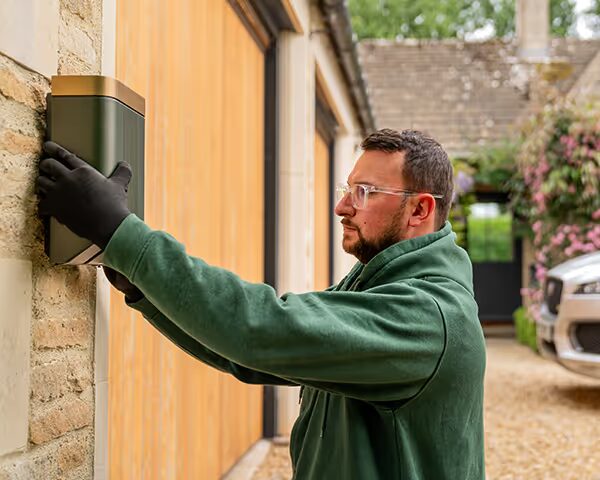
EVHS was built around owner-occupiers. It provided part funding for up to 75% of the installation cost of home chargepoints, and it applied across the United Kingdom2. The scheme's territorial extent was UK-wide, and its statistics were published on that basis8.
Eligibility rested on three things: a residential property where the applicant lived, an eligible electric vehicle, and an installation carried out by an authorised contractor. The vehicle requirement mattered because the grant was tied to plug-in vehicle ownership rather than to the property alone. The current residential chargepoint grants retain a version of that logic: vehicles that may no longer be eligible for a plug-in vehicle grant remain eligible for the residential chargepoint grant, including where there is no longer a grant offered for the vehicle type, where they exceed the category price cap, or where they are no longer on sale in the UK9.
The scheme also sat alongside a workplace counterpart. The Workplace Charging Scheme offered a grant of up to £350 per charge point, up to a maximum of 40 charge points at each location, and the same authorisation covered claims under either scheme10. That pairing, domestic and workplace, was the core of the Office for Low Emission Vehicles' charging support in the mid-2010s.
How the grant claim process worked
The householder did not claim the money. OZEV authorised installation contractors could claim the EVHS grant, and that authorisation also allowed them to claim under the Workplace Charging Scheme10. The grant was therefore routed through the installer, who handled the paperwork and received the payment.
Claims were submitted through a claims management portal10. The published statistics were broken down by local authority, which is why the scheme's record can be read area by area rather than only as a national total13. The figures were released as experimental statistics, a designation that signals a developing data series rather than a settled one13.
The structure carried into the replacement schemes. Under the Electric Vehicle Chargepoint Grant for Households with On-Street Parking, OZEV will pay the grant to the chargepoint installer once a claim is approved5. The same principle applies to the Scottish domestic charge point grant, though with a different mechanism: Energy Saving Trust reimburses the householder after the installation has been completed and commissioned, paying into a nominated bank account14.
The published EVHS statistics do not give a processing time for claims. For the current Scottish scheme, Energy Saving Trust states that a decision is issued within 8 working days of application and payment is made within 15 working days of a claim14. Those figures belong to the Scottish scheme, not to EVHS, and should not be read back onto it.
The scheme's record: 340,000 chargepoints and £140.8 million
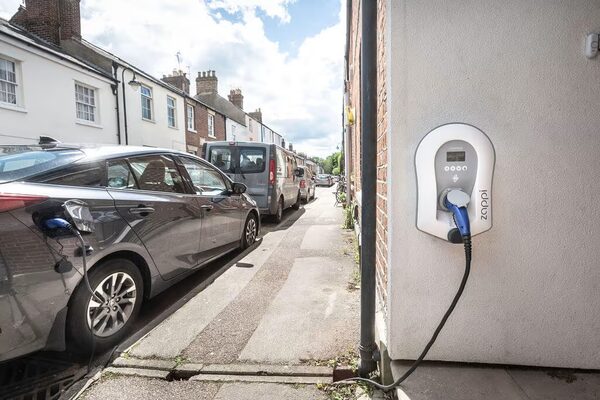
The final figures are the clearest measure of what the scheme did. A total of 340,222 domestic charging device installations received funding in the United Kingdom under the EVHS, with a total grant value of £140.8 million1. The grant rate changed repeatedly across the scheme's life, from up to £350 per chargepoint as at April 20212, so the total reflects a shifting per-unit rate rather than a single figure applied throughout.
The scheme's scale is best read against its own trajectory. As of 1 October 2021, the EVHS had funded a total of 189,815 domestic chargepoint installations, with a total grant value of £88,107,32315. The final figures, published later, show how much of the scheme's activity fell in its last months before closure on 1 April 2022.
| Measure | Figure | Date |
|---|---|---|
| EVHS installations funded | 340,222 | Final statistics1 |
| EVHS total grant value | £140.8 million | Final statistics1 |
| EVHS installations to 1 October 2021 | 189,815 | October 202115 |
| EVHS grant value to 1 October 2021 | £88,107,323 | October 202115 |
| Domestic Recharge Scheme installations | 40,333 | 2013 to 20141 |
| All home charging grant schemes since 2013 | 412,682 | To 1 July 20261 |
The predecessor scheme's contribution is smaller but not negligible: the Domestic Recharge Scheme funded 40,333 domestic charging device installations between 2013 and 2014, in the United Kingdom1. Together, the two schemes account for the bulk of the 412,682 installations funded by home charging grant schemes since 20131.
The scheme's reach should also be read against the size of the potential market. In England in 2023, around 930,000 dwellings had access to a charge point for exclusive use, 135,000 dwellings had a charge point for communal use, and 714,000 had access via an on-street point within 100 metres of the home16. The EVHS total of 340,222 installations is a substantial share of the exclusive-use figure, but it left a large remainder of households without a funded charge point.
Why the scheme closed and what replaced it
The scheme was replaced on 1 April 2022 by the Electric Vehicle Chargepoint Grant3. The replacement was not a like-for-like swap. EVHS had been open to owner-occupiers with off-street parking; the new grant was aimed at renters and flat owners, a group the earlier scheme had largely missed.
The closure sits within a broader pattern of grant schemes ending. The Renewable Heat Incentive was closing in 202217. The Energy Price Guarantee is now closed18. In Northern Ireland, the Better Energy Homes Cashback and Better Energy Homes Plus schemes are both recorded as closed19. Grant funding for low-carbon home technologies has generally been time-limited rather than permanent, and EVHS followed that pattern.
The current grant landscape is a set of five chargepoint grant schemes, available until 31 March 2027 with new grant rates6. The extension was announced with the schemes extended until 31 March 2027 and new grant rates applied7. The five schemes cover different groups: renters and flat owners, households with on-street parking, residential landlords, and workplace and infrastructure grants.
The exclusion rules tie the old scheme to the new ones. A householder cannot apply for the Electric Vehicle Chargepoint Grant for Renters and Flat Owners if they have already claimed for the grant or its predecessors, the Electric Vehicle Homecharge Scheme or the Domestic Recharge Scheme4. The same exclusion applies to the on-street parking grant, which bars anyone who has already claimed a grant for their residence under the renters or flat owners grant, EVHS or the Domestic Recharge Scheme5. A previous EVHS claim therefore follows the residence, not the person.
Grants still available: the EVCG and Scotland's domestic charge point grant
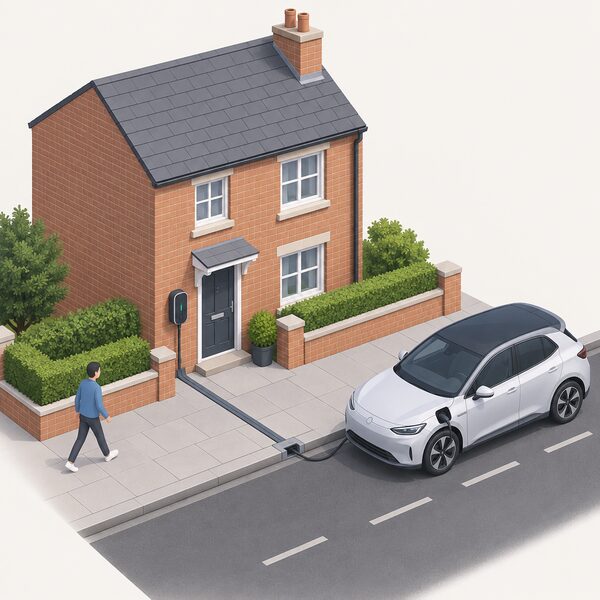
Two routes remain open to householders, and both are narrower than EVHS was.
The first is the Electric Vehicle Chargepoint Grant for Households with On-Street Parking. It requires the applicant to own or rent a residential property in which they live, to install a cross-pavement charging solution alongside the chargepoint, to have no private and exclusive access to off-street parking, to have adequate on-street parking, to have permission from the local highways authority, and to own or be responsible for an eligible vehicle5. The vehicle must be on the list of OZEV-approved electric vehicles, and the chargepoint must be an eligible model installed by an OZEV-approved installer5. Funding is confirmed until 31 March 20275.
The second is the Scottish domestic charge point grant, which is the only remaining scheme that pays a householder directly for a home charge point. It is funded by Transport Scotland and managed by Energy Saving Trust, provides up to £400, and is available to residents in Scotland14. Eligibility requires living in a rural or remote area of Scotland, including islands, having or being able to show a forthcoming electric vehicle, and an annual household income of £50,000 or less14. Eligible postcode categories are URC 5, 6, 7 and 8 under the Scottish Government Urban Rural Classification14.
| Feature | EVHS (closed) | EVCG on-street parking | Scottish domestic charge point grant |
|---|---|---|---|
| Status | Closed to new applications1 | Open, funding to 31 March 20275 | Open while funding lasts14 |
| Amount | Up to £350 or 75% of cost2 | Set by current grant rates6 | Up to £40014 |
| Who receives payment | Installer, via OZEV authorisation10 | Installer, paid by OZEV5 | Householder, reimbursed after commissioning14 |
| Territory | United Kingdom8 | Great Britain scheme rules5 | Scotland only14 |
| Key condition | Owner-occupier with eligible vehicle | No private off-street parking; cross-pavement solution | Rural or remote postcode; income £50,000 or less14 |
The Scottish scheme carries conditions that matter. The charge point must be installed at the main home address, and holiday homes, second homes and commercial properties are excluded14. Installation work must not begin or be completed before the grant offer letter is sent, and installing before receiving the offer letter makes the applicant ineligible14. Grants are offered on a first come, first served basis and only while there is enough funding, and the grant may close without notice at any time within the 2026/27 financial year14. Applying while the grant is open carries no guarantee of an offer14.
For landlords, a separate grant remains open. The Electric vehicle chargepoint grant for residential landlords is open to landlords with property to let, right to manage companies, residents' management companies, freehold owners of multi-unit property, public sector organisations, charities managing residential property, registered social housing providers, property management companies representing a landlord, and property factors in Scotland20. It excludes anyone who lives in the property, non-residential property, properties where a chargepoint was already installed before OZEV confirmed eligibility, holiday accommodation, applicants without a company or VAT registration number, and installations made because of a mandatory requirement20.
What the EVHS era means for home energy independence
The scheme's significance for a household's energy independence is structural rather than financial. A home charge point is what allows an electric vehicle to be charged from a domestic supply rather than a public network. That shifts the energy source from a commercial charging operator to the household's own electricity supply, and, where solar or a home battery is present, potentially to self-generated power. The EVHS funded 340,222 such installations, which is the largest single contribution any UK grant scheme has made to domestic charging1.
What the scheme did not do is remove dependence. A home charge point still draws from the grid through a licensed supplier, and the household remains exposed to electricity prices, standing charges and tariff structures. The grant reduced the capital cost of the connection point; it did nothing about the running cost. The scheme also tied households to authorised installers and eligible models, which meant the equipment installed was approved but not necessarily the household's first choice.
The closure also removed a route that had been available to owner-occupiers. The current schemes are aimed at renters, flat owners, households without off-street parking and landlords. A homeowner with a driveway who did not install a charge point during the EVHS years now faces the full cost, and cannot claim under the successor schemes for that residence if an EVHS claim was ever made there4.
The dependence on a manufacturer or an app is a separate layer. Smart charge points are subject to the Electric Vehicles (Smart Charge Points) Regulations 2021, and the Office for Low Emission Vehicles recommended that combined electric vehicle and home energy smart tariffs be mandated, and called for a common digital language or protocol to be in place by 202121. Those recommendations point to a future in which the charge point's behaviour is set by tariff signals and software rather than by the household alone.
"The Office for Low Emissions Vehicles has recommended that this be mandated."
The EVHS era established the domestic charge point as standard equipment for a household with an electric vehicle. It did not establish energy independence. The charge point connects the car to the grid, and the grid, the supplier and the tariff remain the household's continuing dependencies.
Sources21 cited
- Grant schemes for electric vehicle charging infrastructure statistics, 1 July 2026, GOV.UK, 2026
- Electric Vehicle Charging Market Study: Final Report, GOV.UK, 2021
- Electric vehicle charging device grant scheme statistics: July 2022, GOV.UK, 2022
- Electric vehicle chargepoint grant for renters and flat owners, Find government grants, 2026
- Electric Vehicle Chargepoint Grant for households with on-street parking, Find government grants, 2026
- Electric vehicle chargepoint grants, GOV.UK, 2026
- Changes to electric vehicle chargepoint grant schemes from 1 April 2026, GOV.UK, 2026
- Electric vehicle charging infrastructure statistics: data tables, GOV.UK, 2022
- Residential chargepoints: eligible vehicles, GOV.UK, 2022
- Register energy devices in homes or small businesses: guidance for device owners and installation contractors, GOV.UK, 2021
- Heat Pump Sector Deal Expert Advisory Group: final report, Scottish Government, 2021
- Home and business grants, schemes and advice, East Herts Council, 2026
- Electric vehicle charging device grant scheme statistics: July 2023, GOV.UK, 2023
- Domestic charge point funding, Energy Saving Trust, 2026
- SMMT EV Infrastructure Position Paper, SMMT, 2024
- English Housing Survey 2023 to 2024: low carbon technologies in English homes, GOV.UK, 2024
- The Heat in Buildings Programme, Scottish Government, 2026
- Energy Price Guarantee scheme documents, GOV.UK, 2025
- NISEP List of Schemes 2024-25, Utility Regulator Northern Ireland, 2024
- Electric vehicle chargepoint and infrastructure grants for landlords, Find government grants, 2026
- Electric vehicle charging strategy consultation document, Welsh Government, 2020
 Home EV Charger CostA home charge point usually costs between seven hundred and fifteen hundred pounds fitted, with most people paying around a thousand.
 Cost to Charge an EV at HomeHow home charging cost is worked out from battery size, efficiency, the unit rate paid and the tariff behind it, with full-charge costs of about £8 to £17, cost per mile, annual running costs and what changes for EV owners from April 2028.
 Home Charger InstallationWho can fit a home EV charger, and does it need building regulations approval?
 The Full EV Charging GuideCharging an electric car at home usually means a wallbox, but do you need one, and what will it cost to fit and run?
 New Build Charger RequirementsExplains the requirement for charge points and cable routes in new and materially altered homes, set by Part S in England and equivalent rules elsewhere in the UK.
 Charging by Home TypeHow the practical and legal position for home EV charging changes by property type: flats and leasehold consent, terraced homes without frontage, shared car parks and metering, rural properties with long cable runs, and listed or conservation area homes.