In this guide
A home charge point in the UK is held to two separate bodies of rules: the electrical and product standards it must be built to, and the installation standards it must be fitted to. The product side is anchored by IEC 61851-1, the international standard for conductive charging systems, and by the Electric Vehicles (Smart Charge Points) Regulations 2021, which require domestic chargers to be smart and to refuse user inputs that would create a safety risk1. The installation side is anchored by BS 7671, the eighteenth edition of the Wiring Regulations, and by the IET Code of Practice for Electric Vehicle Charging Equipment Installation2.
The BSI Kitemark is the voluntary mark that shows a specific model has been tested against those criteria. BSI states that its Kitemark certification for EV chargers is aligned to the IEC 61851-1 standard, and that the electrical safety element can be assessed on its own or combined with digital security criteria covering the UK Smart Charge Regulation and ETSI EN 303 6453. Testing covers insulation, high voltage and shock protection, plus temperature, humidity and dust and water exposure4.
Enforcement sits with the Office for Product Safety and Standards, which acts on behalf of the Secretary of State for the Smart Charge Points Regulations and is the enforcement authority for consumer connectable product security legislation5. Where a product fails, the result is a published safety report: two ROMADA New Energy chargers were reported in September 2026 as presenting a serious risk of electric shock7.
What the law requires of an EV charge point
The legal position has three layers, and they apply to different parties. The first is the product itself. A charge point installed under the grant schemes must be a minimum of a Mode 3 specialised system for electric vehicle charging running from a dedicated circuit, or equivalent, as defined in BS EN IEC 61851-1, and must meet the requirements of BS 7671 and the IET Code of Practice2. The same guidance lists BS EN 61851, the IET wiring regulations BS 7671, the IET Code of Practice for Electric Vehicle Charging Equipment Installations, and the Electricity Safety, Quality and Continuity Regulations as the installation requirements2.
The second layer is smart functionality. The Electric Vehicles (Smart Charge Points) Regulations 2021 require that domestic EV chargers must be smart, capable of responding to signals to shift charging to off-peak periods9. Regulation 8 adds a safety override: a relevant charge point must not follow certain user inputs where this would create a safety risk1. That matters because a charger that can be told to draw power at a set time is also a charger that can be told to do something unsafe, and the regulation closes that route.
The third layer is building regulations. Building regulations approval is always required when installing an EV home charger, and a competent and reputable installer should be used, with specific processes for notifying the local building control authority10. The Building Regulations 2010 contain a provision headed "Minimum standards of an electric vehicle charge point" at regulation 44J11. In Scotland, the policy for new buildings requires all dwellings with a parking space to have at least one EV charge point socket with a minimum 7kW output power rating12.
| Layer | Instrument | What it governs |
|---|---|---|
| Product | BS EN IEC 61851-1, Mode 3 | The charging system and its communication with the vehicle2 |
| Smart function | Electric Vehicles (Smart Charge Points) Regulations 2021 | Smart capability and the regulation 8 safety override1 |
| Installation | BS 7671 and the IET Code of Practice | The fixed circuit and its protective devices2 |
| Building work | Building Regulations 2010, regulation 44J | Minimum standards and building control notification11 |
For a household, the practical effect is that a charge point is not a plug-in appliance. It is a fixed electrical installation with a product standard, a smart-function standard and a building control notification attached to it. The independence it delivers is real, in that the energy comes through your own supply rather than a public network, but the compliance chain runs through an installer, a manufacturer and a regulator, and none of those can be bypassed by the householder.
The standards behind the safety mark: IEC 61851-1 and the BSI Kitemark
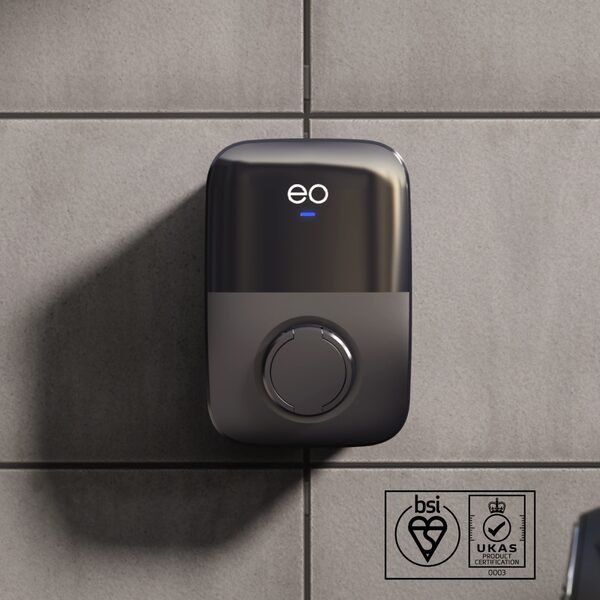
IEC 61851-1 is the standard that defines how a conductive charging system communicates with the vehicle and how it manages the connection. BSI describes its Kitemark certification for EV chargers as aligned to that standard, and lists the mark under the heading "Kitemark for EV Chargers (IEC 61851-1)"4. The same alignment is stated across BSI's product pages for the certification3.
The Kitemark itself is a certification programme rather than a single test. To carry it, a product must pass all the tests required by the BSI certification programme, and manufacturers must pass regular site audits4. That audit element is what separates the mark from a one-off type test: it means the certification follows the factory, not just the sample submitted.
BSI also states that over 80% of UK consumers have increased confidence in products displaying the BSI Kitemark3. That figure is a measure of recognition rather than of performance, but it explains why manufacturers seek the mark and why it appears on packaging.
The certification is described as testing and certification for charge points both for home and commercial use, and as addressing legislative, market access, specifier and compliance requirements3. BSI frames the purpose as helping manufacturers demonstrate due diligence, differentiate the product and showcase quality, and as helping them improve or speed up new product development and produce safe electric vehicle charging units3.
"Kitemark for EV Chargers (IEC 61851-1)"
The mark is voluntary. Nothing in the regulations requires a home charge point to carry it, and a charger without it is not automatically unsafe. What the mark does is move the assessment from the buyer to a third party, which is the only practical way for a householder to judge a product that cannot be opened, tested or inspected at the point of sale.
Electrical safety testing: insulation, shock protection and environmental tests
The electrical safety element of the Kitemark tests a charger against various electrical safety criteria, and BSI names three areas in particular: insulation, high voltage testing and shock protection4. Insulation testing checks that the wires and parts carrying electricity are properly insulated so there is no risk of electric shock. High voltage testing stresses the unit beyond its normal operating conditions. Shock protection testing covers the design of the enclosure and the connections.
Environmental testing sits alongside the electrical tests. BSI describes temperature testing in both very hot and very cold conditions, humidity testing, and dust and water exposure testing4. These are the tests that produce an IP rating, and they matter in a UK context because a wallbox on an external wall faces driving rain, frost and summer heat.
IP ratings are quoted differently by different parts of the market. Most commercial EV chargers are rated IP54 or IP65 as standard9. IP54 and IP65 are not the same: the second digit describes water ingress, and a higher number means greater protection. A domestic unit mounted under a carport and a unit on an exposed coastal wall are not facing the same conditions, which is why the rating is worth checking against the mounting position rather than treating as a single pass mark.
The Kitemark programme also checks that the charger works correctly with all types of charging methods, from basic to fast charging4. That is a compatibility test rather than a safety test, but it bears on safety indirectly: a charger that miscommunicates with a vehicle can fail to start a session cleanly.
For a household, the electrical tests are the ones that cannot be replicated after purchase. A charger that has passed insulation, high voltage and shock protection testing has been assessed against failure modes that only appear under fault conditions, and those are exactly the conditions a household cannot create deliberately to check.
Digital security: the UK Smart Charge Regulation and ETSI EN 303 645
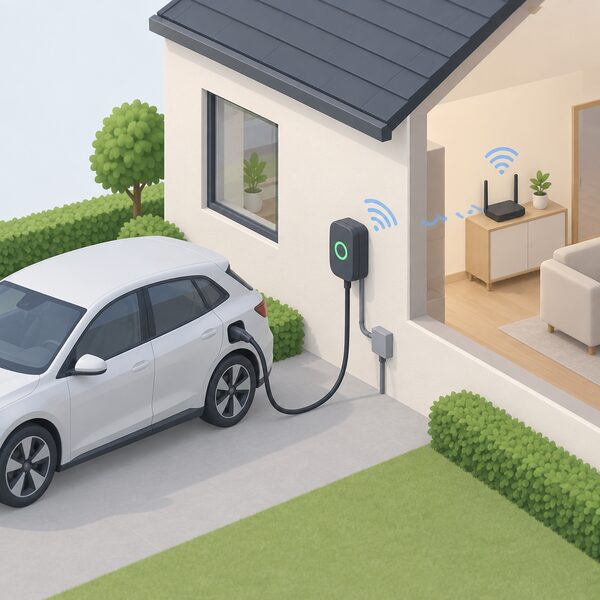
A smart charger is a networked device with a mains connection, which makes its software a safety-relevant surface as well as a data one. The Smart Charge Points Regulations require that those selling a charge point must ensure it meets the security requirements set out in Schedule 1 to the Regulations, which are mostly based on the existing cyber security standard ETSI EN 303 6455.
The compliance route is not fixed to a single standard. The government has confirmed that conformity with cyber security standard EN 18031-3:2024 will be accepted as an equivalent route to compliance alongside ETSI EN 303 645 cyber security requirements13. That gives manufacturers two accepted paths rather than one, and it means a charger can be compliant without citing ETSI EN 303 645 by name.
BSI's digital security certification for EV chargers is built on the same requirements. BSI states that its Kitemark Certification for Digital Security of EV Chargers ensures compliance with regulations such as UK Smart Charge Regulation and ETSI EN 303 6453. The combined mark is described as covering the UK Smart Charge Regulations, ETSI EN 303 645 and IEC 61851-1 together4.
The wider policy context is the Smart Secure Electricity Systems programme, whose first phase covers energy smart appliances. The Electric vehicle smart charging action plan set out the consumer-facing aim as increasing consumer confidence in smart charging and providing appropriate protections for a positive experience14. That framing matters: the security requirements are not only about grid resilience, they are also about whether a household can trust a device that can be instructed remotely.
The flexibility side of smart charging has already reached domestic households. In September 2023, domestic households offered real-time flexibility to the Electricity System Operator's balancing activities through EV charging for the first time15. A charger that participates in that kind of service is doing something useful with its connection, but it is also a charger whose behaviour is set partly from outside the home. The security requirements in Schedule 1 are what stand between that arrangement and an unmanaged remote control path.
Electrical safety and digital security: one assessment or two
The two elements of the Kitemark are separate criteria that can be taken together or apart. BSI states that the electrical safety element of the Kitemark certification for EV chargers can be assessed independently or combined with the digital security assessment criteria3. The digital security element is described as ensuring compliance with regulations such as UK Smart Charge Regulation and ETSI EN 303 6453.
| Assessment | Aligned to | Can be held alone |
|---|---|---|
| Electrical safety | IEC 61851-1 | Yes3 |
| Digital security | UK Smart Charge Regulation and ETSI EN 303 645 | Yes3 |
| Combined mark | All three, described as the Kitemark for Smart EV Chargers | Covers both elements4 |
That structure has a practical consequence for a buyer. A charger can hold the electrical safety element without the digital security element, or the reverse. The two are not a single pass mark, and a claim that a product is "Kitemark certified" does not by itself say which element was assessed. The combined mark is the one that covers both, and BSI describes it as the Kitemark for Smart EV Chargers, covering the UK Smart Charge Regulations, ETSI EN 303 645 and IEC 61851-14.
The distinction is not academic. Electrical safety failures show up as shock and fire risk, and the ROMADA reports are an example: the charger presented a serious risk of electric shock because it had poor quality internal connections7. Digital security failures show up differently, as unauthorised control, data exposure or a device that can be manipulated. Both matter to a household, but they fail in different ways and are tested by different methods.
BSI also offers digital security lab testing and certification as a standalone service for EV chargers, which it describes as helping manufacturers assure customers and internal stakeholders3. That is a testing service rather than the full Kitemark, and it is another reason why the wording on a product page or a certificate is worth reading closely rather than treating "certified" as a single condition.
Who enforces charge point standards: the Office for Product Safety and Standards

The Office for Product Safety and Standards is part of BEIS and acts on behalf of the Secretary of State as the enforcement authority responsible for ensuring compliance with the Smart Charge Points Regulations5. Regulation 15 of those Regulations provides for the Secretary of State to enforce them1. OPSS is also the enforcement authority responsible for ensuring compliance with UK consumer connectable product security legislation on behalf of the Department for Science, Innovation and Technology6.
Its remit extends beyond charge points. OPSS is responsible for enforcing ecodesign regulations16, and it sets and enforces compliance with product and installation standards for chargepoints, though installation and other operational aspects are not currently regulated17. That last point is worth stating plainly: the product and the installation standard are enforced, but the act of installation itself is not currently a regulated activity in the same way.
Contact details are published:
- Email: evscp@beis.gov.uk
- Telephone: 0121 345 1201
- Post: Office for Product Safety and Standards, PO Box 17200, Birmingham B2 2YT5
For a household, the enforcement route matters because it is the only route that does not depend on the seller. A charger that does not meet the regulations can be reported to OPSS or to a local authority trading standards service, and the outcome is published. The independence a home charger provides is electrical, not regulatory: the household still depends on a national enforcement body to keep unsafe products off the market, and on the manufacturer to keep the unit compliant after it is installed.
Electrical Safety First: the charity's role and what its research shows
Electrical Safety First is a UK charity that campaigns on electrical safety in the home and publishes recall information. Its published research puts the scale of the problem in context: every year, half of accidental domestic fires in the UK are caused by electricity, and that figure is not changing18. It also reports over five fires a day in England caused by white goods such as tumble dryers, washing machines and dishwashers18.
The charity names the causes as misuse of appliances, poor regulation of electrical safety checks, particularly in the private rented sector, and faulty appliances18. On that basis it campaigns for mandatory five-yearly electrical checks in rented homes18. That campaign is about domestic electrical safety generally rather than charge points specifically, but the same logic applies to a fixed high-power installation.
Its most directly relevant work on charging devices concerns e-bike and e-scooter chargers rather than car charge points. The charity looked at mains plug in charging devices advertised for use with e-bikes, e-scooters or other e-battery operated transport devices, and did not look at batteries19. It found nearly 60 listings across Amazon Marketplace, eBay, Wish.com and AliExpress, all of which failed to meet the necessary standard for UK plugs, with many appearing to have no fuse, and all visibly small in size, leaving the user exposed to electric shock if their fingers were to come into contact with the live plug pins19.
"The charging devices, advertised as accessories for e-bikes to power up lithium-ion batteries, all failed to meet the necessary standard for UK plugs"
The charity does not install charge points and does not operate a register of installers. Its value to a household is as an independent source on electrical risk and as a publisher of recall information, not as a certification body or a trade association.
Recalls and what to do if your charger is affected
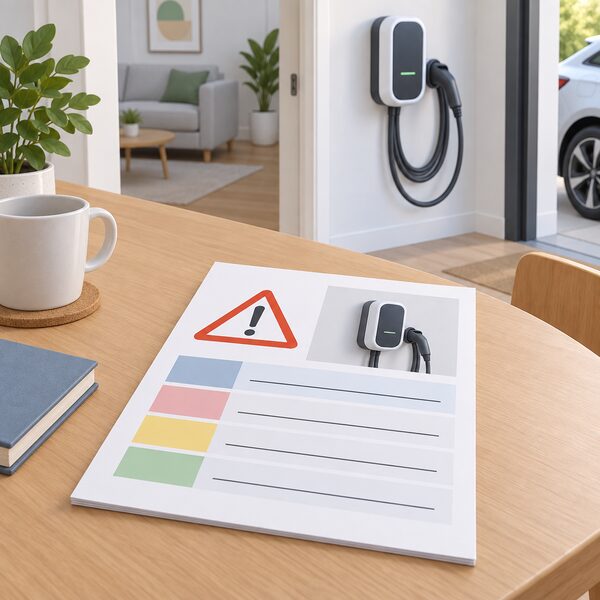
Recalls are published as product safety reports on GOV.UK, and they follow a consistent format. Each report names the product, the hazard, the risk level, the regulations the product fails, and the body that notified it. The notifying body can be a local authority trading standards service or OPSS itself, which is why a report can originate with a council.
| Product | Hazard | Regulations failed | Notified by |
|---|---|---|---|
| ROMADA New Energy EV Charger and Cable | Serious risk of electric shock, poor quality internal connections | Electrical Equipment (Safety) Regulations 2016; Plugs & Sockets etc (Safety) Regulations 1994 | Local Authority Trading Standards7 |
| ROMADA New Energy Charging Pile (EV Charger) | Serious risk of electric shock | Not stated in the report | Not stated in the report8 |
| Easee One EV Charger Backplate | Backplate hazard | Not stated in the report | Office for Product Safety and Standards20 |
The Easee report concerns a backplate rather than the charger itself, which is a reminder that the accessory and mounting hardware are part of the installation and can carry their own risk.
The practical steps are the same in each case. Identify the exact model and, where relevant, the backplate or accessory. Read the published report for the hazard and the risk level. Follow the remedy the report describes. Where the report was notified by a local authority, that authority is the point of contact; where it was notified by OPSS, the OPSS contact details apply5.
For a household, a recall is the clearest example of the dependence that remains after installation. The charger is on your wall and on your supply, but the information that it is unsafe comes from a regulator, and the remedy comes from a manufacturer or a seller. Neither is under the household's control.
Installation: why a registered electrician matters
Installation is where the product standards meet the building. Building regulations approval is always required when installing an EV home charger, and a competent and reputable installer should be used, with specific processes for notifying the local building control authority10. The certificate issued for the work serves the purpose of proving the work complies with building regulations21.
Competence is defined by the standards rather than by a job title. To install EV chargers, an installer needs competence in the IET Code of Practice for Electric Vehicle Charging9. The guidance for the grant schemes recommends using a reputable company and ensuring the installer has the relevant qualifications21. Costs are obtained by contacting an installer approved by the Office for Zero Emission Vehicles22.
The electrical design detail matters as much as the paperwork. Where an EV charger has built-in DC fault current detection to 6mA, a Type A RCD at 30mA is sufficient9. That is a specific condition, and it depends on the charger rather than on the installer's preference, which is why the protection type and the charger model have to be considered together.
Planning is a separate question from building control. Installing a home charger is classified as development, so it is up to the householder to ensure the correct permissions are in place23. Permission is usually required for on-street parking, conservation areas, listed buildings, areas where the installation is restricted through article 4 directives, and more than one upstand per parking space23.
The independence a home charger provides is therefore conditional on the installation being done properly. A charger fitted to a circuit that does not meet BS 7671, or without the correct protective device for its fault detection design, is a high-power load on a domestic supply with a defect behind it. The household owns the risk from that point on.
Buying a charger: what to check before you purchase
The checks that can be made before purchase are limited but specific.
- The standard the product claims. A charger built to a Mode 3 specialised system as defined in BS EN IEC 61851-1, meeting BS 7671 and the IET Code of Practice, is the baseline the grant guidance describes2.
- The certification. Whether the model holds the electrical safety element of the Kitemark, the digital security element, or both, since the two are assessed separately3.
- The IP rating against the mounting position. Most commercial EV chargers are rated IP54 or IP65 as standard, and the two are not equivalent9.
- The fault detection design. A charger with built-in DC fault current detection to 6mA allows a Type A RCD at 30mA to be sufficient, which changes the protective device specified for the circuit9.
- The smart charging requirement. Domestic EV chargers must be smart under the Electric Vehicles (Smart Charge Points) Regulations 2021, capable of responding to signals to shift charging to off-peak periods9.
- The recall record. Checking the model against published product safety reports before buying is a step that costs nothing and catches the cases where a product has already been found to present a serious risk of electric shock7.
Prices for charge points are installer-quoted, and the published guidance directs households to contact an OZEV-approved installer to find out how much installation costs22. The grant schemes that supported domestic installations are confirmed to run until 31 March 2027, which is expected to be the final year of the current grant structure.
What none of these checks can establish is how the charger will behave in five years, whether the manufacturer will still support the firmware, or whether the app that controls it will still work. The electrical independence is real: the energy comes through your own supply. The dependence that remains is on a manufacturer's company, its software and its willingness to keep a networked device patched.
Sources23 cited
- The Electric Vehicles (Smart Charge Points) Regulations 2021, legislation.gov.uk, 2021
- Electric vehicle chargepoint and infrastructure specifications, GOV.UK, 2023
- BSI Kitemark certification for EV chargers, BSI, 2026
- What makes BSI Kitemark certified EV chargers a smarter choice, BSI, 2026
- Guide to the EV smart charge point regulations 2021, GOV.UK, 2026
- Regulations: consumer connectable product security, GOV.UK, 2024
- Product safety report: ROMADA New Energy EV Charger and Cable, GOV.UK, 2026
- Product safety report: ROMADA New Energy Charging Pile (EV Charger), GOV.UK, 2026
- Section 722 EV charging: complete guide, Elec-Mate, 2026
- Electric vehicle charging: house elements, Planning Portal, 2026
- The Building Regulations 2010, legislation.gov.uk
- Electric vehicle charge points for new buildings: policy proposals, Transport Scotland
- Smart Secure Electricity Systems programme: first phase interim response, GOV.UK, 2026
- Electric vehicle smart charging action plan, GOV.UK, 2023
- Domestic electric vehicle charging helps ESO balance energy system for first time, NESO, 2023
- Extended CE marking recognition for ecodesign regulations, GOV.UK, 2026
- Electric vehicle charging market study: final report, GOV.UK, 2021
- 10 ways to avoid electrical fires in your home, Electrical Safety First, 2026
- Dangerous e-bike charging devices for sale online, Electrical Safety First, 2026
- Product safety report: Easee One EV Charger Backplate, GOV.UK, 2026
- Building regulations for electric vehicle charging, Planning Portal, 2026
- Electric vehicle chargepoint installers, GOV.UK, 2026
- Planning permission for electric vehicle charging, Planning Portal, 2026
 Charger Cybersecurity and DataWho can control your home charger, and how do you keep it secure?
 What Is a Smart Charger?A smart EV charger is an internet-connected home charge point that schedules charging around tariff prices, grid demand and household load.
 EV Charge Point Faults and FixesDescribes the common failure patterns on domestic charge points: tripped protective devices, lost connectivity, stuck cables and locks, error indications and charging that stops early.
 Electrical RequirementsWill your home need a bigger electricity supply before a charge point can go in?
 EV Charger WarrantiesCovers typical warranty lengths on UK home charge points, what parts and labour are included, registration conditions and extended warranty options.
 Charging With a Home BatteryHow a home battery and an EV charger share one supply, whether a battery can usefully charge a car, and how combined systems are controlled so the battery is not discharged into the vehicle at a loss.