
In this guide
The Electric Vehicles (Smart Charge Points) Regulations 2021 are the reason a home charge point bought in Britain today arrives with a schedule already set inside it. The regulations were made on 15 December 2021 and came into force on 30 June 2022, and they require all charge points sold in Great Britain for private domestic or workplace use to have smart functionality1. They apply to most charge points sold after 30 June 2022, although not to certain public charge points or to rapid charge points of at least 50 kilowatts1.
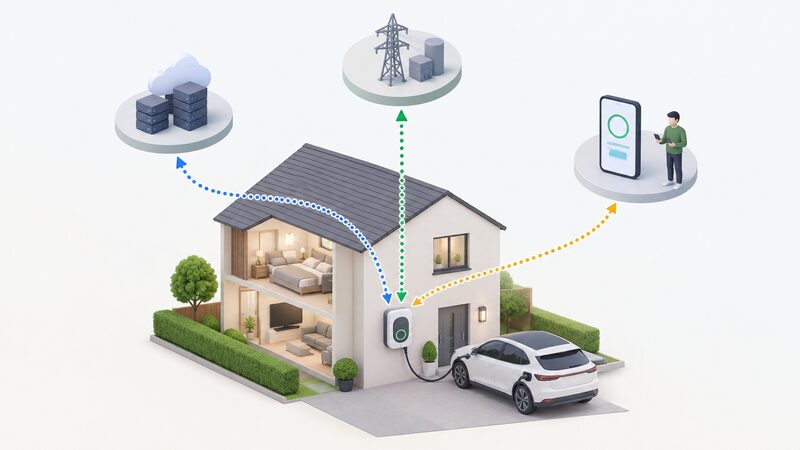
The rules are not a suggestion. Smart charging capability is a legal requirement, not optional, and it falls on the sale rather than on the household3. A compliant unit must be able to communicate over an electronic communications network, must carry pre-set default charging hours outside peak hours, must apply a randomised delay when charging starts, must measure its own electricity use, and must meet a set of security provisions1.
The Office for Product Safety and Standards is responsible for ensuring compliance, and the Secretary of State is the enforcement authority, with compliance notices and civil penalties available2. The regulations extend to England and Wales and Scotland, and cover charge points sold in Great Britain1.
What the regulations require of a charge point
The core obligation sits in regulation 5, which requires relevant charge points to have smart functionality, including the capability of communicating via an electronic communications network1. The regulations apply to charge points intended to be used for charging cars, vans or both, other than non-smart cables, public charge points and rapid charge points1. A rapid charge point is defined as one allowing a transfer of electricity with a power of not less than 50 kilowatts1.
Smart functionality is defined by what the unit can do rather than by a badge. It includes the ability to send and receive information, the ability to respond to signals to increase the rate or time at which electricity flows through the charge point, demand side response services and a user interface6. The regulations also require that a charge point must not be configured so that it will cease to have smart functionality if the owner changes their electricity supplier, which is the interoperability provision aimed at preventing lock-in1.
Two further requirements shape daily use. Regulation 7 requires that a relevant charge point must remain capable of charging a vehicle even if it is not connected to an electronic communications network, so a lost broadband connection does not stop the car charging1. Regulation 9 requires that a relevant charge point measures or calculates certain information about its electricity usage, viewable by the owner, and provides usage rate information via an electronic communications network1.
"Regulation 5 requires relevant charge points to have smart functionality. This includes a requirement that the charge point is capable of communicating via an electronic communications network."
The measuring system is specified in some detail. A charge point must measure or calculate every one second the electrical power it has imported or exported, in watts or kilowatts, and any figure must be accurate to within 10% of the actual figure, with inaccuracies not systematic1. The owner must be able to view import and export information for any occasion, any month, or the entirety of the preceding 12 months1.
Default charging hours and the randomised delay

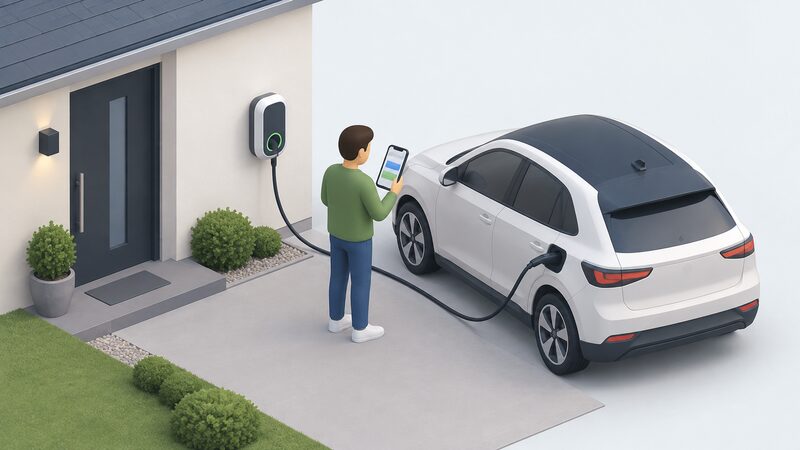
The two provisions a household notices most are the default schedule and the delay at the start of a charge. Regulation 10 requires that a relevant charge point incorporates default charging hours and that in most circumstances it will only charge a vehicle during those hours1. The pre-set default charging hours must be outside peak hours, and the owner is able to accept, remove or change them1.
Peak hours are defined in the regulations as 8am to 11am on weekdays and 4pm to 10pm on weekdays1. Those are the windows a compliant unit avoids by default, which is why a new charge point often appears to refuse to charge the moment it is plugged in during the working day.
Regulation 11 requires that, in most circumstances, a relevant charge point operates with a random delay of up to 10 minutes when charging first starts, and that it is capable of operating with a random delay of up to 30 minutes1. In the regulation's own terms, the unit must be capable of operating at each relevant time with a delay of up to 1800 seconds, adjustable remotely, and in most circumstances operates with a delay of up to 600 seconds1. The owner can cancel the delay1.
| Provision | Requirement | Owner control |
|---|---|---|
| Default charging hours | Pre-set hours outside peak hours; unit charges only in those hours in most circumstances1 | Accept, remove or change1 |
| Peak hours definition | 8am to 11am and 4pm to 10pm on weekdays1 | Not adjustable |
| Randomised delay, normal operation | Up to 600 seconds1 | Cancellable by the owner1 |
| Randomised delay, capability | Up to 1800 seconds, adjustable remotely1 | Cancellable by the owner1 |
| Offline charging | Must remain capable of charging without a communications network1 | Not applicable |
The purpose is load spreading rather than restriction. The regulations were introduced to ensure all UK charge points have smart functionality as standard, and the stated aim is to maximise the use of smart charging technologies to benefit both consumers and the electricity system7. A maker's account of the same rules describes them as aiming to solve the problem of everyone charging at the same time and prevent power cuts9.
Security, compliance and enforcement
The security provisions sit in Schedule 1 and did not apply from day one. Regulation 4(2) provides that relevant charge points sold before 30 December 2022 are not required to comply with the Schedule 1 security requirements1. The general requirements came into force on 30 June 2022, except for the security requirements set out in Schedule 14. A maker's compliance notice confirms the same split, working toward full compliance with the additional security regulations which come into effect on 30 December 202210.
The security requirements themselves are specific. A relevant charge point must incorporate software which is able to be securely updated, using adequate cryptographic measures with verification of authenticity and integrity1. Communications sent from it must be encrypted1. The password must be unique to that charge point and not derived from, or based on, publicly available information, and cannot be reset to a shared default password1. A charge point must incorporate a tamper-protection boundary to protect its internal components, with owner notification of breach attempts, and must incorporate a security log recording events by reference to Coordinated Universal Time1. A maker's summary describes the security requirements as consistent with the existing cybersecurity standard ETSI EN 303 6456.
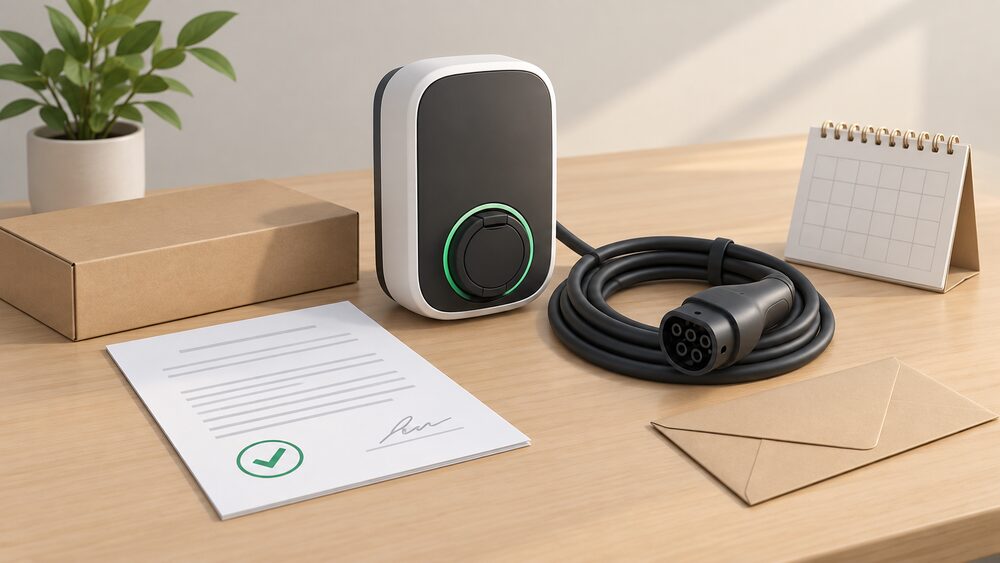
Compliance is declared through paperwork rather than a certificate on the wall. Regulation 13 requires that a relevant charge point is sold with a statement of compliance confirming that it meets the requirements, and that a technical file must be available to the buyer on request1. The statement must identify the model or type, state compliance, give the seller's name and address, and be signed and dated1. Regulation 14 requires a seller to keep a register of the relevant charge points they have sold within the past ten years1.
Enforcement is by the Secretary of State, who is the enforcement authority under regulation 151. Sanctions consist of compliance notices requiring the person who has breached the regulations to take certain steps, and civil penalties, which are also available for obstruction of the enforcement authority1. A civil penalty of £10,000 applies for each relevant charge point in respect of which there has been a breach of regulation 4, and £250,000 for a breach of paragraph 8 of Schedule 21. A person receiving a notice of intent has the right to make representations and objections within 28 days beginning with the day the notice was received, and any appeal must be made to the First-tier Tribunal1. Civil penalties are payable into the Consolidated Fund1.
Where the regulations came from
The powers behind the regulations are in the Automated and Electric Vehicles Act 2018. The regulations are made using powers in that Act, and specifically in exercise of the powers conferred by sections 15, 16, 17 and 181. The Act itself was passed to help reach the UK's commitment for most cars and vans to be zero-emissions vehicles by 2050, and it gave the Department for Transport powers to improve the consumer experience, ensure provision at key strategic locations and require that all connections are smart, with secondary legislation required to use them11.
The Act's regulatory scope was drawn widely. It potentially imposes requirements in connection with payment methods, equipment performance, maintenance and availability, equipment components, co-operation between operators, making important information available to users, ensuring that information is based on live data, and meeting smart charging standards12. As of the independent commentary's date, no secondary legislation had been passed to further define or enforce any of those requirements beyond what the 2021 regulations cover12. The Act has been described as a yet-to-be-enforced power for the government to improve the EV charging infrastructure nationwide, including requiring key locations like motorway service stops to have smart charging points13.
The 2021 regulations were not universally welcomed. A BEAMA response to a related consultation records that these regulations have already proven highly controversial when implemented solely for EVs in 2021/202214. Ofgem's consumer survey work in the same period notes that the UK Government had laid legislation which will mandate that all privately owned slow chargepoints in future will need to be smart15.
The regulations also carry a review obligation. Regulation 17 provides for the Secretary of State to undertake a review of the regulatory provisions contained in the regulations, with the first report published before the end of the period of five years beginning with the date on which the regulations came into force, and then at intervals not exceeding five years1.
Do the regulations apply across the UK?
The territorial extent is stated plainly in the legislation: these regulations extend to England and Wales and Scotland1. The official guidance is equally direct, stating that the regulations cover charge points sold in Great Britain only4. The regulations apply to the sale of private charge points sold in Great Britain after 30 June 20224.
That leaves Northern Ireland outside the extent of the instrument. The position is not stated identically in every document. Welsh government infrastructure standards documentation describes the 2021 regulations as having been introduced to ensure all UK charge points have smart functionality as standard, and a maker's guidance describes the mandate as covering new domestic and workplace EV charge points sold and installed in the UK7. The legislation's own extent, and the official guidance on scope, are the firmer statements: Great Britain, meaning England, Wales and Scotland.
| Nation | Position under the 2021 regulations |
|---|---|
| England | In scope; regulations extend to England and Wales and Scotland1 |
| Wales | In scope; Welsh infrastructure standards describe the regulations as ensuring smart functionality as standard1 |
| Scotland | In scope; regulations extend to England and Wales and Scotland1 |
| Northern Ireland | Outside the stated territorial extent of the instrument1 |
There is a related instrument worth noting for completeness. The Product Security and Telecommunications Infrastructure regime, made in 2023, excepts products from its own scope if they are charge points to which the 2021 regulations apply, so the two regimes do not double up on the same devices17.
What the regulations mean for energy independence
The regulations do something specific for a household's energy position, and it is worth being exact about what. They guarantee that a new charge point can be told when to draw power, and that it will keep that ability if the household changes supplier1. That is the interoperability provision, and its stated purpose is to ensure consumers are protected from lock-in4. A household that switches tariff, or moves to a supplier with a different off-peak window, does not lose the scheduling capability it paid for.
The measuring requirement supports the same end. A charge point must monitor consumption data and provide a method for owners to view the information from the preceding 12 months4. A household can see what the car actually drew, and when, rather than estimating it from a bill.
The limits are equally clear. The regulations do not make a household independent of the grid, and they do not make it independent of a supplier. A charge point must remain capable of charging without a communications network, which protects against a broadband outage, but the unit still draws from the mains and still depends on a live supply1. The default charging hours are a nudge built into the hardware, not a guarantee of a cheaper rate: the regulations set the hours, and the tariff is a separate matter. The randomised delay is designed around network load, not around the household's convenience, and it applies whether or not the household is on a time-of-use tariff.
There is also a dependency on the maker. Smart functionality, remote adjustment of the delay, demand side response and the user interface all rely on the manufacturer's software and, in most cases, its app and cloud service. The regulations require that the unit keeps working offline, and that software can be securely updated, but they do not require a maker to keep a cloud service running indefinitely1. A household's smart charging capability is therefore only as durable as the company behind it.
For households thinking about the wider picture, the regulations sit alongside the tariff and flexibility arrangements that determine what smart charging is actually worth. EV energy tariffs and how they change home charging covers the rate side, and smart charging, flexibility services and reward schemes covers what demand side response pays. The EV charging at home guide sets the regulations in the context of the whole installation.
What a household should expect in practice
The obligations fall on the seller, not the buyer. Compliance is the responsibility of the business selling the device, and a household should not need to check for compliance itself18. The rules do not apply retrospectively to chargers sold before 30 June 2022, and there is no requirement to upgrade an existing charger that is not smart18. The regulations cover sales whether online, in-store, direct from an installer or with a vehicle purchase18.
In use, a compliant charge point will typically arrive with a schedule already set. A maker's account of the regime describes new charge points featuring pre-set default charging hours outside peak times, which are weekdays between 8am and 11am and 4pm and 10pm, with charging start times randomly delayed by up to 10 minutes to ensure a balanced energy distribution across the network10. The same account notes that smart functionality in home and workplace chargers will continue to work even if the household switches energy providers18.
The regulations also apply to Mode 3 electric vehicle supply equipment, which is the standard mode for a dedicated home charge point19. They do not apply to the charging cable itself where it is a non-smart cable, nor to public charge points, nor to rapid units at 50 kilowatts and above1.
For a household weighing up a purchase, the practical questions are the ones the regulations do not answer: what the unit costs, what the installation requires, and what the maker's warranty and software support look like. How much a home EV charge point costs, fitted covers pricing, electrical requirements for a home EV charge point covers the supply side, and EV charge point warranties and aftercare covers what happens after the sale. The cybersecurity and data page covers the Schedule 1 provisions in more depth.
Sources19 cited
- The Electric Vehicles (Smart Charge Points) Regulations 2021, legislation.gov.uk, 2021-12-15
- Approved Document S: infrastructure for charging electric vehicles, frequently asked questions, GOV.UK, 2023-04-17
- Section 722 EV charging: complete guide, elec-mate, 2026-07-02
- Guide to the Electric Vehicles (Smart Charge Points) Regulations 2021, Department for Transport, 2026-09-18
- EV charger regulations in England: what's changed, NICEIC, 2026-08-19
- What is smart charging, Andersen, 2023-11-27
- Electric vehicle infrastructure national standards, Welsh Government, 2023-06
- A quick guide to the Electric Vehicle Smart Charge Point Regulations 2022, Indra, 2022-06-30
- Smart charge point regulations explained, myenergi, 2026-09-17
- Smart chargepoint compliance, Simpson & Partners, 2022-07-06
- Electric vehicle charging market study: final report, Competition and Markets Authority, 2021-07-23
- Electric vehicle infrastructure barriers, Cenex, 2021-01-22
- EV charging and the UK energy crisis, ev.energy, 2021-09-30
- BEAMA response to Energy Smart Appliances Regulations consultation, BEAMA, 2021
- Consumer survey EVs summary, Ofgem, 2021-10-25
- What size cable for an electric car charger UK, Fuse Energy, 2026-05-15
- The Product Security and Telecommunications Infrastructure (Security Requirements for Relevant Connectable Products) Regulations 2023, legislation.gov.uk, 2023-09-14
- What does EV charger regulation mean for drivers, ev.energy, 2022-06-24
- RCDs for electric vehicle supply equipment, IET Wiring Matters, 2024-05
 What Is a Smart Charger?A smart EV charger is an internet-connected home charge point that schedules charging around tariff prices, grid demand and household load.
 Planning Permission for ChargersDo you need planning permission for a home EV charger, and does it change if you live in a listed building, a conservation area or a flat?
 New Build Charger RequirementsExplains the requirement for charge points and cable routes in new and materially altered homes, set by Part S in England and equivalent rules elsewhere in the UK.
 Electric Vehicle TariffsCharging an electric car at home can cost far less overnight, but only on special electricity plans.
 Supplier-Controlled ChargingSmart charging tariffs let your energy supplier decide when your car charges, usually overnight when electricity is cheaper.
 Home Charger InstallationWho can fit a home EV charger, and does it need building regulations approval?